Presentation – Being A Contrarian

I’m sharing a presentation which I spoke to this week.

The topic is contrarianism where I show long-term charts (on a weekly basis) and quantified extreme moments using three measures, being:

– the 200 week moving average

– the Relative Strength Indicator (signalling Overbought and Oversold readings) and 

– Bollinger Bands showing when prices traded to 2.5 standard deviations (either above or below its rolling weekly mean)

I attempted to highlight the case for lower interest rates and inflation (as they are themselves trading at ‘extreme’ levels) by showing a host of correlations and I believe moderation is aided with further mean reversions amongst various prices, while many other commodities have already done so. As reported inflation figures lag, lower readings are expected to appear in the coming 4-10 months.

There is also a series of charts showing recent buying ‘windows’ and where I’m waiting for some others to enter my buying territory.

Towards the end of the presentation I touch on how a scramble to secure supply led to price spikes and parabolic price moves in commodities such as Lumber and Steel, where such parabolas were (and often) followed by sharp declines.

I think there is much finished product still held as inventory, thus tying up working capital and should lead to discounting wars. This will be deflationary and assist in abating inflation and interest rates.

To be clear, I’m calling for interest rates and inflation to abate, not collapse.

September 2, 2022

by Rob Zdravevski

rob@karriasset.com.au

Steel Correlations

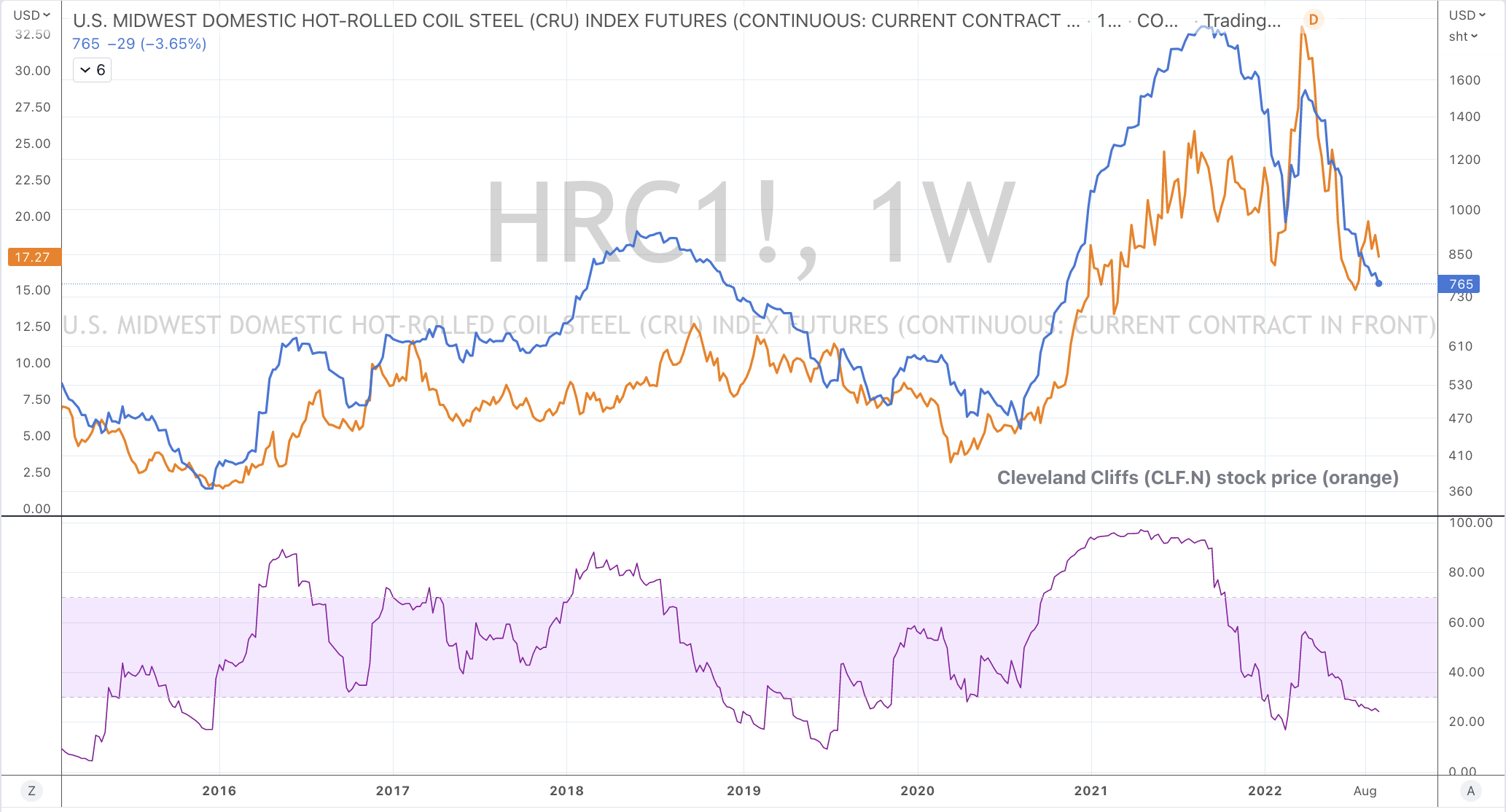
Lows in U.S. Hot Rolled Coiled Steel prices are correlating with the stock prices of selected steel companies.

Cleveland Cliffs (CLF.N) is the featured comparison in the chart below.

September 1, 2022

by Rob Zdravevski

rob@karriasset.com.au

Bubbles: Natural Gas, LNG, Coal and Lithium

Anecdotally, the most euphoric noise that I hear globally surrounds three markets, being LNG, Thermal Coal and Lithium/Spodumene.

Especially amongst gas prices, I can’t hear anyone making a case for a moderation of prices.

The herd is all huddled together on the same life rafts.

Sure, prices can go higher but I dare you to initiate a new ‘long’ position.

My commentary is to heed warning.

The technicals and the spikes in price action are pointing to extremes which I think provide a terrible risk/reward skew for any recent or new entrants to these markets.

Producers and Sellers of such commodities would be well advised to lock in prices.

Buyers should elect taking a calculated risk of probability and not commit to fixing in those higher prices.

Owners of listed securities exposed to these sectors are doing themselves an injustice if they are not acknowledging the speculative fervour, let alone pondering taking the ‘fat part of the trade’.

The charts below show prices being Overbought, trading to 3 standard deviations and stratospheric miles above their 200 week moving averages.

Although one day doesn’t make a season, the Dutch TTF Natural Gas and Japan/Korean LNG Market prices are down 25% and 15% respectively, thus far, thus week.

August 31, 2022

by Rob Zdravevski

rob@karriasset.com.au

Behold rare USD strength

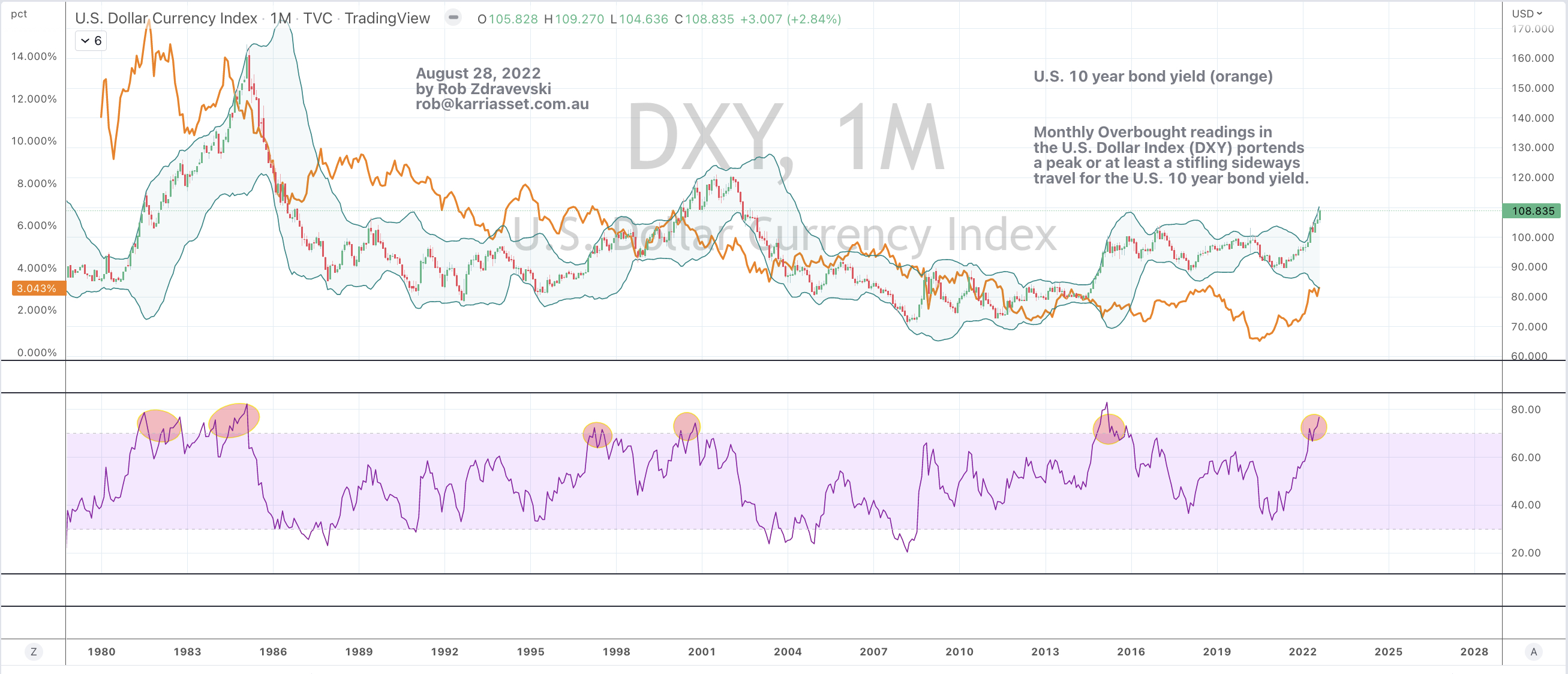
It is the 4th notable time that the DXY hits a monthly Overbought RSI reading.

Monthly Overbought readings in the U.S. Dollar Index (DXY) portends a peak or at least some stifling and sideways travel for the U.S. 10 year bond yield.

Even through the rate hike mania of the early 1980’s, if you queued off the DXY peaks, the abatement in the 10 year bond yield held true.

Tip: RSI Overbought readings can stay Overbought for much longer than many expect.

August 29, 2022

by Rob Zdravevski

rob@karriasset.com.au

Fed is designing the slowdown

In the April 15, 2022 edition of Macro Extremes, I noted that until that moment, the U.S. 10 year bond yield had never registered an Overbought reading on a Monthly basis…….and it stayed there for the past few months.

Furthermore, it coincided with the yield trading up to 2.5 standard deviations above its monthly rolling mean.

The chart below shows circles and boxes when it has hit both 2.5 and 3 standard deviations.

Why the reprise of this topic?

I don’t believe Jerome Powell’s 2022 Jackson Hole declaration that the Fed will earnestly raise rates higher will actually happen.

I won’t bother speculating whether rates are raised once or twice as 2022 comes to a close but I think Mr Powell is now trying to increase the rhetoric and use as much media messaging to help manufacture a slowdown or a decline in demand, if you will.

Yesterday’s note touches on the quantum of the rate increases from the troughs.

Even the peak of Volker’s hikes signalled the beginning of a ‘bottoming process’ for the equity market.

In fact, many of the peaks in the monthly chart below correlated with lows in the S&P 500.

August 28, 2022

by Rob Zdravevski

rob@karriasset.com.au

Taming inflation, ask Brazil

Brazil was amongst the first of nations to commence raising interest rates.

They started from a base of 2% in March 2021.

At its August 3, 2022 meeting, Brazil’s Central bank increased interest rates a further 50 basis points bringing its rate to 13.75%.

This was the 12th consecutive raise making for a cumulative 1,175 basis point increase.

This represents a quantum of nearly 7 fold increase.

Brazil’s inflation rate in July 2022 fell to 10.1%, down from June’s 11.9% reading.

Incidentally, Brazil’s inflation target rate is 3.5%.

In contrast, the U.S. Fed Funds Rate has risen from 0.25% to its current 2.5% representing a 10 fold increase. The current inflation rate in the United States is 8.5%.

Is the quantum of the rate increase more relevant rather than the absolute percentage rate?

If so, will one more rate hike in the U.S. be enough?

Brazil, Chile, Mexico and other commodity sensitive and exporting countries all started raising interest rates, aggressively and a year before G8 nations.

Why?

As paraphrased in the following posts written over the past year, “inflation is a tax that the poor can’t afford to pay”.

Although, more precisely, the citizens of those nations carry an average household debt as a percentage of GDP nearing 26%.

While the “% of household debt to GDP” for the citizens in the United States, Canada, United Kingdom and Australia range from 80% to 125%, with Australian’s being the highest.

For the rising cost of tomatoes, fuel or lettuce…..hiking rates too aggressively would ‘crucify’ the indebted households in the developed world and more importantly (for some, many or government) it would stifle their largest asset class………residential real estate.

August 27, 2022

by Rob Zdravevski

rob@karriasset.com.au

Macro Extremes (week ending August 26, 2022)

The following assets (on a weekly timeframe) registered an Overbought or Oversold reading and/or have traded more than 2.5 standard deviations above or below its rolling mean.

Extremes “above” the Mean (at least 2.5 standard deviations)

U.K. 10 year government bond yields

AUD/GBP (3rd consecutive week)

AUD/EUR

Overbought (RSI > 70)

U.S. 2 year government bond yield

U.S. Dollar Index

The Overbought Quinella – Both Overbought and Traded at > 2.5 standard deviations above the weekly mean)

Istanbul Stock Exchange (BIST)

Dutch TTF Gas

Japan Korean LNG Marker price


Extremes “below” the Mean (at least 2.5 standard deviations)

NZD/AUD

Oversold (RSI < 30)

U.S. 5 year minus U.S.3 month government bond yield ‘spread’

Turkish 10 year government bond yields

Hot Rolled Coiled Steel

Tin

EUR/USD

GBP/USD

CNH/USD

DKK/USD

KRW/USD

INR/USD

SEK/USD

The Oversold Quinella – Both Overbought and Traded at > 2.5 standard deviations above the weekly mean)

None

Notes & Ideas:

The big news over the past week mostly occurred on its last business day where U.S. equity indices were poised to finish the week flat.

Other notable news was the renewed strength in the U.S. Dollar and subsequent oversold readings in various currencies, as this weeks list shows,

And the extraordinary surge in LNG and Dutch TTF Gas prices.

There is an undertone seen in the Japanese 10’s (at 0.22%) saying the world is reasonably OK.

Commensurately, the Copper/Gold Ratio is firming to tell us the same.

Keep in mind, that the lows in equities seen in June 2022 haven’t been breached although I’m watching keenly for any emergence of corporate earnings downgrades in Q3.

In other news, Turkish government bonds continued to bid aggressively. In fact, since the late March 2022 highs of 26%, many must of thought that Turkey’s ‘uncreditworthiness’ was overstated, for now their 10’s are yielding 13%.

In fact, Istanbul’s equity index has risen 52% since that March peak in government bond yields.

In similar, albeit shorter contrast, the U.S. 10 year bond yield peaked at 3.497% on June 14, 2022, when the S&P 500 then saw an intra-day low of 3,637. The SPX has rallied 19% over the next 2 months.

The Baltic Dry Index declined again and has done so for 6 consecutive weeks. It has fallen 6% over the past 3 months. 25% of that swoon was seen in the recent fortnight.

Over the same timeframe, U.S. RBOB Gasoline prices have declined 37% from $4.25 to its present levels of $2.68.

The larger advancers over the past week comprised of; 

Aluminium 4.9%, Rotterdam Coal 3.2%, China Coal 15.9%, Bloomberg Commodity Index 1.9%, WTI Crude 2.9%, Iron Ore 2.9%, Gasoil 9.8%, Heating Oil 8.3%, JKM LNG 20.7%, Coffee 11.6%, Sugar 2.1%, CRB Index 2.4%, Cotton 2%, Dutch TTF Gas 41.7%, Urea 20.2% for both U.S. Gulf and Middle East prices, Brent Crude 5.2%, Corn 6.8%, Oats 3.9%, Soybean 4.1%, Wheat 4.4%, HSCEI 3%, Hang Seng 2% and Istanbul’s BIST Index rose 1.6%.

The group of decliners included;

Baltic Dry Index (12.2%),  Lean Hogs (2.7%), Nickel (2.6%), Orange Juice (3.6%), Platinum (3.7%), Gasoline (11.3%), AEX (2%), KBW Banking Index (4%), CAC (3.4%), DAX (4.2%), Dow Jones Industrials (4.2%), DJ Transports (2.7%), IBEX (3.3%), S&P MidCap 400 (3%), Nasdaq 100 (4.8%), Copenhagen (2.6%), Stockholm (4%), Russell 2000 (2.9%), SMI (1.9%), SOX (5.2%), S&P 500 (4%), Nasdaq Biotech Index (3.4%), Nasdaq Composite (4.4%) and the S&P SmallCap 600 fell 3.3% 

August 27 2022

by Rob Zdravevski

rob@karriasset.com.au 
ESG opposition heats up

The ESG investment tug of war led by ideology, favours and politics will be ultimately weighed up in returns.

The Florida State Board of Administration passed a resolution Tuesday that all decisions related to the investment management of the Florida Retirement System will not include ESG considerations.

https://www.pionline.com/esg/florida-state-board-backs-desantis-resolution-ban-esg-considerations-managing-pension-plan

Make your own case for or against ESG investing, advocacy or activism, but this ‘decree’ just sounds extraordinary.

Or does it?

Does this decision tell us that ESG investing is deemed to lose its lustre?

It is within the trustees realm and objective to set investment strategy but one can’t help Governor Ron DeSantis’ ability to influence the other two trustees,

https://www.sbafla.com/fsb/Trustees,CouncilsCommittees/Trustees.aspx

The irony of this announcement lies in the ‘G’ of ESG.

The 3 trustees are all politicians from the current sitting government.

That can hardly count as prudent fiduciary governance.

If you take a look at the trustees and boards of government employee pension funds such as those in Australia……no politicians appear in the line up.

That can’t say they are devoid of influence, however none of them are the Governor, Premier, Treasurer nor Attorney General of the state.

Are the trustees telling us……

using ESG screens exclude the state’s pension money from other investing opportunities?

they think that exposure to ESG qualified corporations won’t produce an adequate return for the pensions target?

they oppose supporting the Wall Street ESG movement?

they are influenced by lobby groups supporting energy, mining and firearms industries?

After all, companies which aren’t scoring well in ESG rankings are/will have difficulty financing and shareholders.

This is part of my recent notes where I have mentioned the importance of watching “the financing mix, the shareholder mix and the energy mix’.

$240 billion of Florida’s state retirement money can help, not withstanding the other 15 states whom have signed anti-ESG bills.

https://www.reuters.com/legal/legalindustry/challenge-investing-face-state-anti-esg-legislation-2022-08-24/

Whether or not, DeSantis wins the Republican presidential nomination, look for Ashley Moody (Florida’s Attorney-General) to get a plumb job in the ’next’ republican federal government.

And there are always jobs waiting when your political career is over, but before that comes political donations.

August 26, 2022

by Rob Zdravevski

rob@karriasset.com.au

#ESG

#Florida

Chinese Industrial Production & Iron Ore

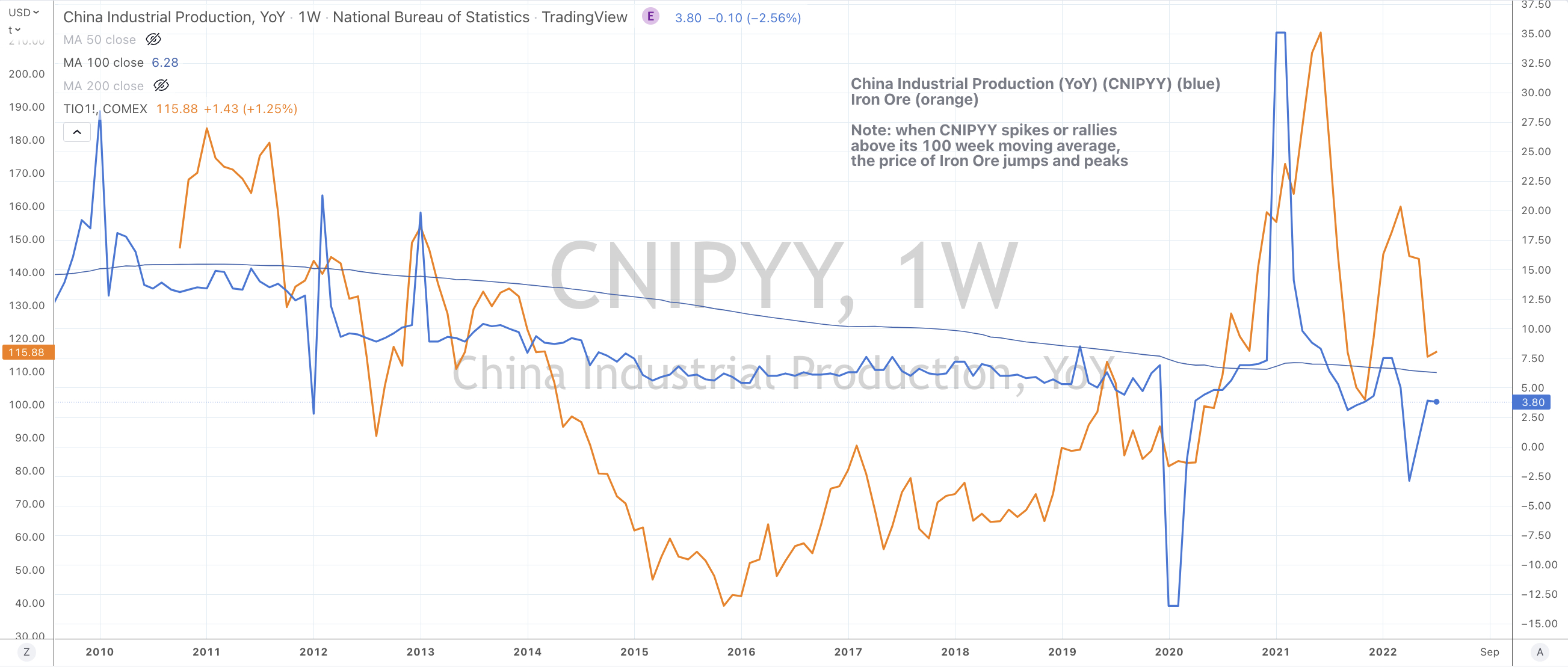
China Industrial Production (CNIPYY) and the price of Iron Ore have a seemingly symbiotic relationship.

I found it interesting (or coincidental) that when CNIPYY spikes or rallies above its 100 week moving average, the price of Iron Ore jumps and peaks.

I think the price of Iron Ore is closer to seeing a low. I’m look for it to touch the $96-$98 mark.

If that occurs, you should see corollaries in Chinese stock indices, the price of Rio Tinto and selected steel companies.

Incidentally, the 10 year average of the CNIPYY has been ~ 11.

August 25, 2022

by Rob Zdravevski

rob@karriasset.com.au

A pullback in gas prices will affect stockmarkets

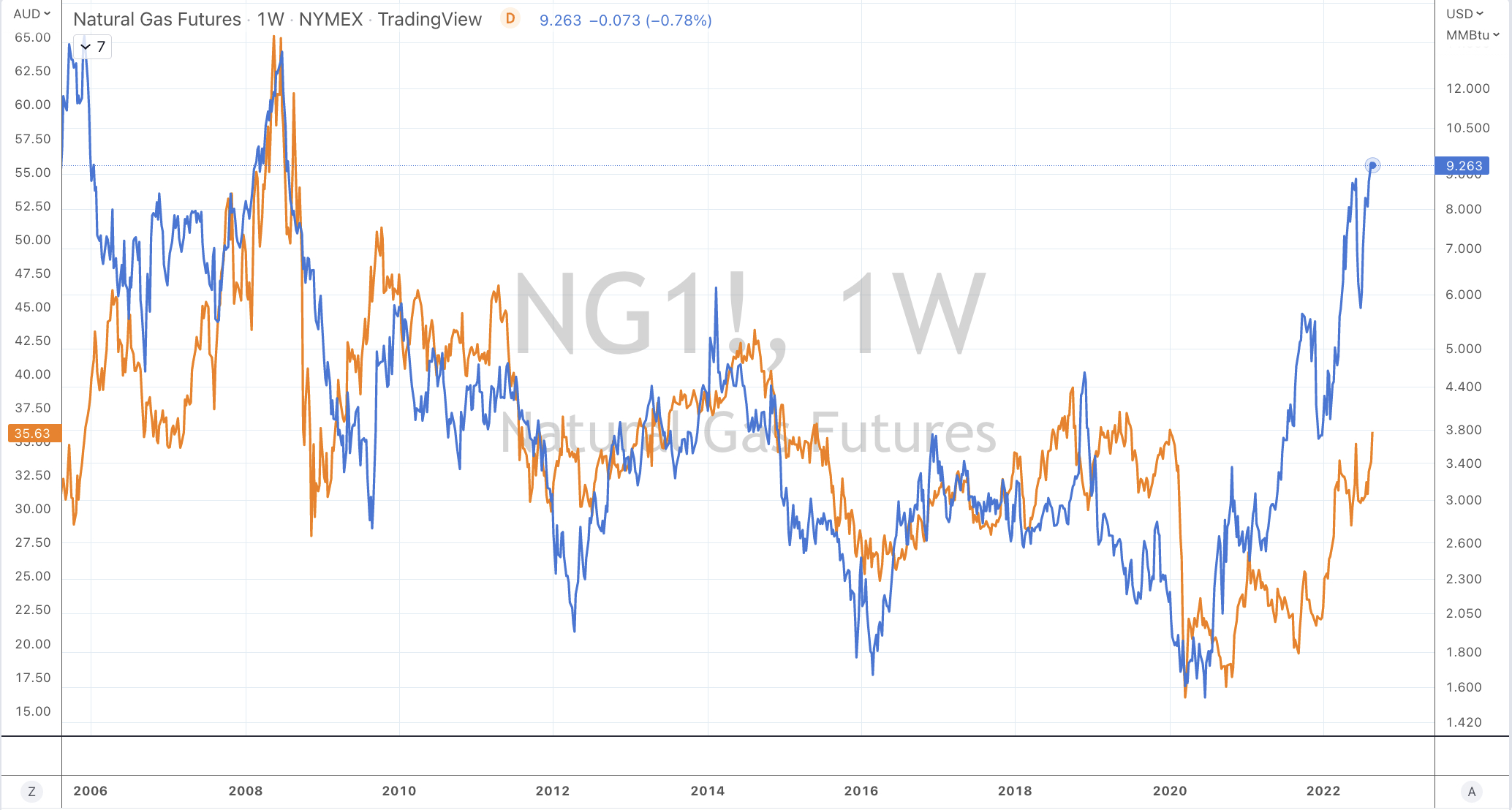
I’m calling Natural Gas prices back to the $5 mark.

In yesterday’s note, I expressed the extremes at which it is currently trading.

and below is a chart of Woodside’s stock price overlaid the U.S. Natural Gas price…..Woodside is the orange line.

August 25, 2022

by Rob Zdravevski

rob@karriasset.com.au