September 11, 2017 Leave a comment
Everything is OK. A 23 year low in the VIX.
June 9, 2017 Leave a comment
A low reading in the VIX suggests little or less equity market volatility. It could mean that the world is OK and perhaps there is ‘smooth sailing’ ahead.
To the contrarian, a low VIX could be a signal of an expected reversal, whereby the VIX rises and investor fear increases. Often, such fear translates into declining asset prices.
23 years ago (December 1993) the VIX was trading at the same level which it is today.
Over the next 6 years, the VIX quadrupled. This tells us that volatility has increased but back then I don’t recall an overwhelming sentiment of fear.
How we read the VIX Index is not always the same.
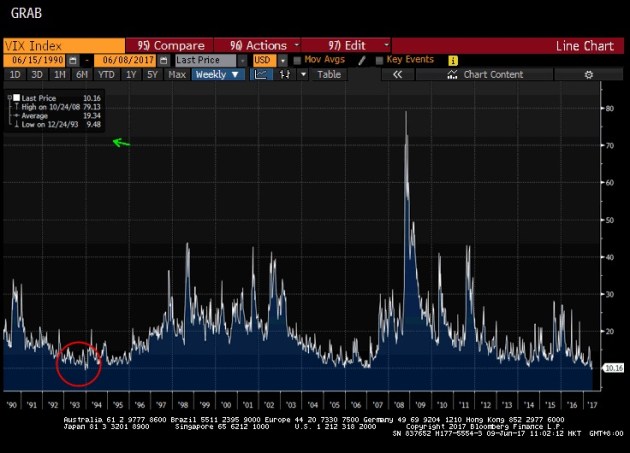
How did the equity market react to a rising VIX?
Commencing in 1993 (with subdued trading volumes) up until 1999, the S&P 500 Index (see chart below) trebled in value.
In 1993, the markets were 6 years into recovery following the 1987 stock market crash and Bill Clinton was a year into his presidency. Incidentally, in December ’93, the S&P 500 was trading 43% higher than its 1987 pre-crash peak.
And it wasn’t until another 3 years (Dec ’96) until Alan Greenspan made his “irrational exuberance” speech.
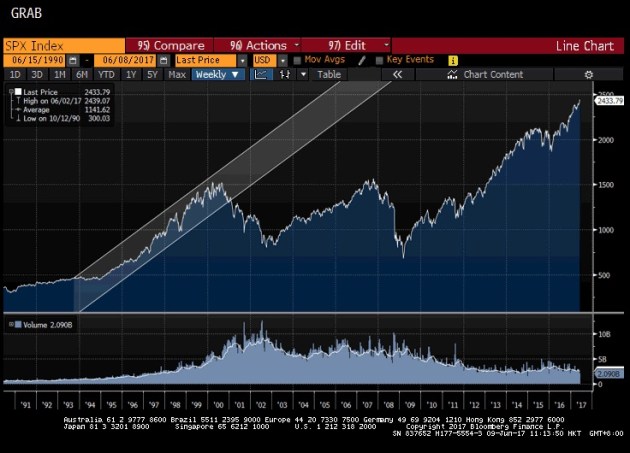
Unlike, the 2008 -2009 spike in the VIX which resulted in a sizeable decline in equity prices, the 1993-1999 period was prosperous for equity investors, even though volatility was rising or at least it was according to the VIX Index.
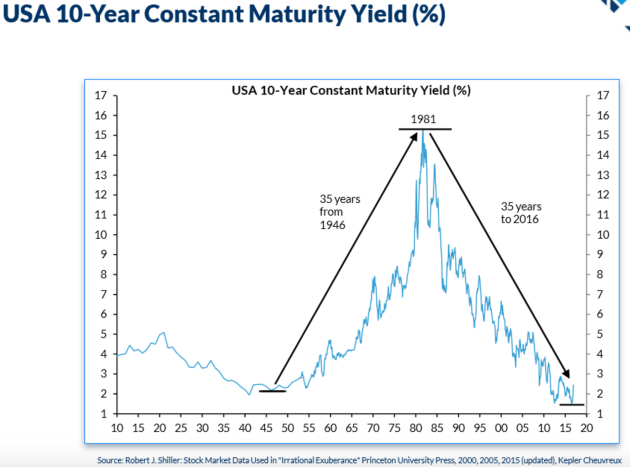
On the interest rate front, even though the yield in the U.S. Treasury 10 year bond (see chart below) shows a spike in interest rates from 5.3% up to 8% between late ’93 and late ’94, interest rates resumed their downtrend trend down reaching 4.3% in 1998. While we saw fluctuations (volatility) in interest rates, it was interesting to note that the average yield over this period was 6.2%.
Even more so, the average interest rate over this 37 year chart is also 6.2%, as displayed in the data box in the top right hand corner of the image.
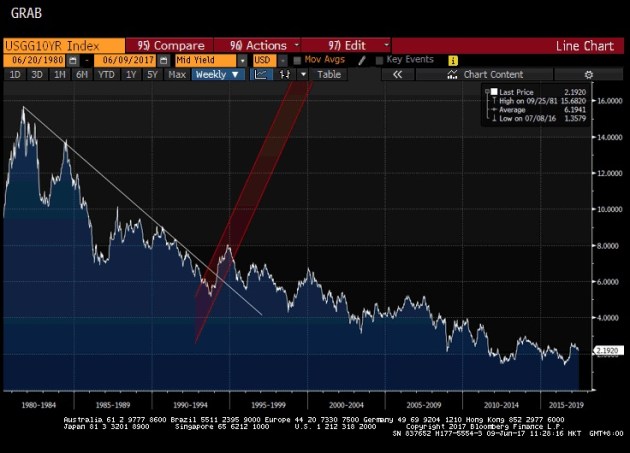
So, between 1993 – 1999, the VIX (volatility) increased, equity prices also rose and interest rates stayed low.
Today, the VIX is at historically low levels, we have subdued trading volumes (arguably with low investor participation), the S&P 500 is 8 years into a recovery following the 2008-2009 “crash” and its trading at levels 54% higher than the pre “crash” high.
It is plausible that interest rates continue to stay low, that the VIX rises from its 23 year low and equity prices climb.
After all, no one has made an ‘irrational exuberance’ speech.
Waiting for complete certainty means it’s too late
May 25, 2017 Leave a comment
“. . . information generally follows the well-known 80/20 rule: the first 80 percent of the available information is gathered in the first 20 percent of the time spent. The value of in-depth fundamental analysis is subject to diminishing marginal returns.”
“Most investors strive fruitlessly for certainty and precision, avoiding situations in which information is difficult to obtain. Yet high uncertainty is frequently accompanied by low prices. By the time the uncertainty is resolved, prices are likely to have risen. Investors frequently benefit from making investment decisions with less than perfect knowledge and are well rewarded for bearing the risk of uncertainty. The time other investors spend delving into the last unanswered detail may cost them the chance to buy in at prices so low that they offer a margin of safety despite the incomplete information.”
Source: Margin of Safety, Seth Klarman, 2007
Going wrong with Aussie banks
May 25, 2017 Leave a comment
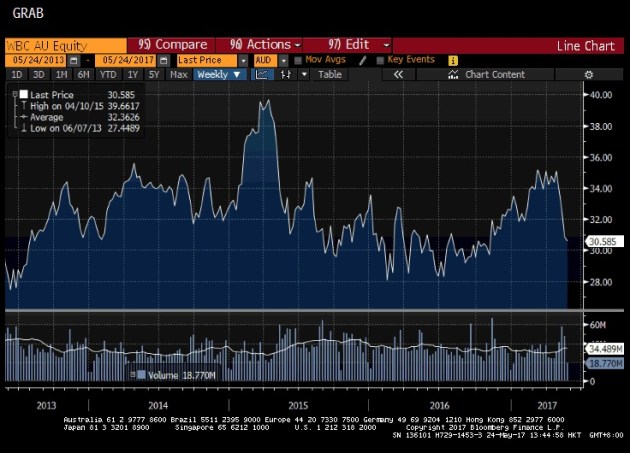
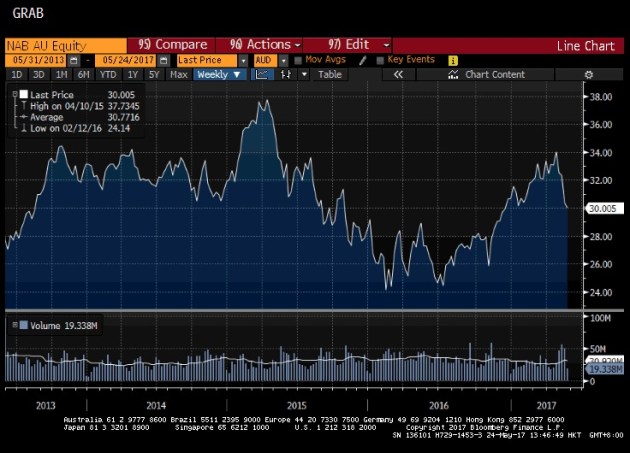
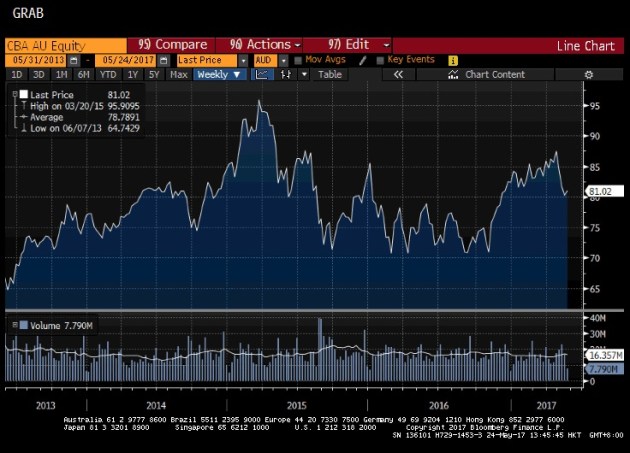
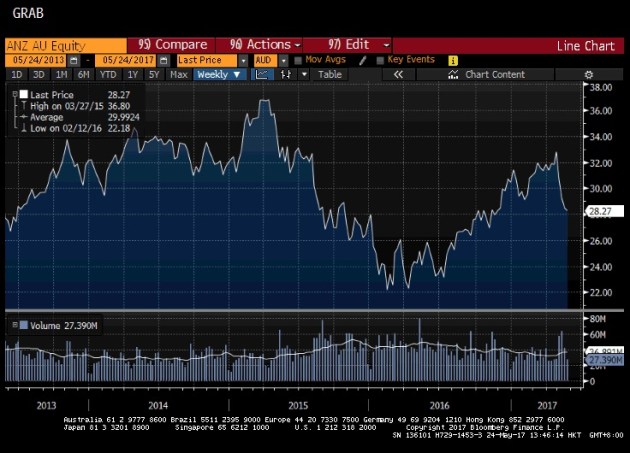
For investors in Australian banks, the stock charts (below) of the four major Australian banks (ANZ, Commonwealth, NAB and Westpac) show that over the past 4 years it has been possible to have either lost money or currently show a capital loss.
It all depends when you bought them.
It is concerning that retail investors often elbow their mates in the ribs and re-affirm that “you can’t go wrong owning bank shares”.
Well, yes you can.
As an extension of my recent post about the misnomer of “blue chips” being the major qualifier of asset quality and safety, these charts shows without any reference for fundamental valuation analysis that investors can do themselves a disservice by not being intellectually honest.


“So, you just stick with blue chips”
May 9, 2017 Leave a comment
When I meet people and get talking about my business of being an investment advisor, it is a natural progression in the conversation that they ask about my investing and analysis style.
I start by telling them that I am a value investor. “Oh, like Warren Buffet!”, they respond. Well, “no” I say, because I’m not Warren Buffet for all the obvious reasons. I have a style and philosophy based on analysing a company, its business, their management, its products or services, the balance sheet, income statement, cash flows etc etc.
This helps me to build a basis for whether I investigate and analyse the company any further, let alone try to determine whether it’s current stock price is attractive enough to become a shareholder.
The listener, then usually responds with, “So, you just stick with buying the blue chips, don’t you”.
Here lies the shortcomings of many amateur investors. They think that buying “blue chips” circumvents the need to perform analysis. Many amateur investors just don’t do enough “work” prior to making investment decisions. This type of investor thinks that if you “just buy blue chips”, then you are safe and OK.
I can tell you that this is simply not the case.
In short, if you don’t buy your assets cheap enough leaving you with a margin of safety or error, then your capital is always vulnerable to a loss.
Being an investor who looks for bargains, means that you look for assets of any kind which present value. The asset or security doesn’t come with a pre-determined label of “blue-chip” or any other descriptor.
You can buy a house in a “dress circle” part of town, but if you pay too much, you can lose money.
Buying “Blue Chip” is not the saving grace when investing, if you pay the wrong price.
Separate interest rates for Western Australia?
March 18, 2017 Leave a comment
I read a newspaper article which cited that borrowers in Western Australia may be disadvantaged by the interest rate policy being set by the Reserve Bank of Australia.
It was written that the RBA may be concerned about the rising property prices in Sydney & Melbourne and (in order to temper housing affordability issues) may influence an increase in interest rates.
The article then quoted a Western Australian property “expert” who expressed concern that any rate rise will hurt an already lagging and subdued Perth property market.
I think the author should have either asked the question or argued the point, “should Australia have more than one official Central Bank lending rate”?
Perhaps an even lower borrowing interest rate for those living west of the 130th meridian?
The (my) answer is no!
I do hope that the Reserve Bank of Australia isn’t placing too high of a weighting on eastern seaboard property prices when formulating interest rate policy.
After all, banking lending practices remain quite tight and I think alternative Australian lenders aren’t engaging in the worrisome practices of 10 years ago.
Credit may be historically cheap but lending isn’t loose yet. The RBA would be looking at status of the lending and banking markets rather than whether people are engaged in the greater fool theory in Sydney or Melbourne real estate.
(Un)commercial banking
March 18, 2017 Leave a comment
So the cost of money has never been cheaper in Australia, yet commercial banks are not being commercial. My anecdotal reports tell me that they are reluctant to lend unless they have an abnormally high amount of security (collateral).
At this point, a bank should increase its lending rate when they are taking greater risk, but I am hearing that they don’t have the commercial ability to do so. Australian banks remain firm in their rules and as a result are not facilitating the credit requirements of smaller to mid sized Australian companies.
I could pick on another and greater offensive fact. The Reserve Bank of Australia’s official cash rate is 1.5% and Australian banks are lending money at 5% for home loans. This is 350 basis points above the Reserve Bank’s cash rate. Quite a juicy spread especially when its secured against bricks and mortar and your salary from your job probably counts on it too.
I would dare suggest that banks in no other developed world charge that high of a spread above the cash rate, than which the Australian banks do.
and the interest rates are much higher for business loans.
Oh… but here is NAB coming to rescue offering unsecured $50,000 business loans where “Your track record and the strength of your business is all you need to apply”.
for a friendly 13.85% p.a. interest rate.
It’s either time for Australian businesses to start courting cheaper foreign capital or Australian private funders, whether it’s other smaller companies or individuals who are willing to be the “bank” that the “uncommercial” banks aren’t prepared to be.
There are little new jobs
March 1, 2017 Leave a comment
When a cafe opens up and claims they are creating 7 new jobs, this is actually not the fact. It is generally from the same labour pool that already exists in the immediate community.
This fact doesn’t vary too much should you see a new manufacturing plant being established, yet employers and embarrassingly so, politicians, claim the creation of new jobs. We need to remember that it is mostly existent labour transferring to a new workplace.
Does that mean new employment numbers when reported by the government are not true?
Probably so…

