Unloved CHF = buy equities

When the CAD/CHF is declining, ‘they’ are selling the Loonie and huddling into the safety of the Swissie.

This happens when ‘we’ don’t fancy a risky environment. That also means risker assets such as equities are also being aggressively disposed.

While not to be used in isolation, the study below shows 16 moments (over the past 40 years) when the CAD/CHF registered a Monthly RSI reading of less than 33.

When it does, perhaps ponder increasing your asset allocation towards equities.

The nuance is which equities (market) to buy.

Currently, it’s close but not there yet.

And remember, currencies don’t lie or tell stories.

September 2, 2024

by Rob Zdravevski

rob@karriasset.com.au

Screenshot

Currencies don’t tell lies

When analysing moves in capital markets, I believe currencies (and credit) before trusting equities.

Currencies don’t tell lies. Equities do.

and also nobody takes a currency on a institutional investing roadshow……

August 21, 2024

by Rob Zdravevski

rob@karriasset.com.au

Yen rises 11% against the Aussie

The only thing you are forced to decide is to choose a #currency.

This is applicable when making, settling or holding an investment.

Holding cash is also an investment and many of the ‘truly’ global investors also ponder which (mix of) currency to hold their cash in.

Recently, I have highlighting the extreme weakness at which the #Japanese Yen has been trading at and more specifically, the Australian Dollar’s strength again the Yen (which is a good indicator of investors risk appetite).

Prompts to buy the Yen appeared in my weekly macro extremes publication and in this recent “Bigger Calls” newsletter.

https://mailchi.mp/karriasset/the-bigger-calls-q3-2024

If I chose the worst entry point (over the past 5-7 weeks) to have bought #Yen and sold #AUD, the current return would resemble at least 8% over the past 3 weeks or perhaps 11% if your timing was impeccable.

I think that is a bit more than interest earned in an Australian term deposit?

As a standalone #FX trade with the AUD/JPY trading at 95.40, it is now in the category of “good enough”.

August 4, 2024

by Rob Zdravevski

rob@karriasset.com.au

Screenshot

AUD/USD remains sideways

Whilst the AUD/USD is currently in a medium and longer term upward trend, I think that it looks constrained around the 0.6750 – 0.6722 mark.

My read is that it needs make a ‘higher high’. If not, the AUD/USD will continue its digestive and consolidation pattern lower.

and so….it would go for commodities and bond yields.

May 16, 2024

by Rob Zdravevski

rob@karriasset.com.au

Screenshot

Macro Extremes (week ending May 3, 2024)

A weekly Macro, Cross Asset review of prices trading at extremes which may generate future investment ideas and opportunities.

The following assets (on a weekly timeframe) either registered an Overbought or Oversold reading and/or have traded more than 2.5 standard deviations above or below its rolling mean.

  • denotes multiple week inclusion

Extremes “above” the Mean (at least 2.5 standard deviations)

Australian 2, 3, 5 & 10 year government bond yields *

Japanese 2 year government bond yield

South Korean 10 year government bond yield *

Copper/Gold Ratio

U.S. 5 year government bond yield minus U.S. 5 year inflation breakeven rate *

Newcastle Coal

Oats

AUD/IDR *

AUD/THB *

Hang Seng China Enterprises Index (HSCEI) *

Hang Seng Index *

J’burg 40 

Singapore Straits Times Index *

Overbought (RSI > 70)

Russian 10 year government bond yield 

AEX

Budapest

Malaysia’s KLSE *

Pakistan’s KSE Index *

FTSE 250

and Turkiye’s BIST 100 *

The Overbought Quinella (Both Overbought and Traded at > 2.5 standard deviations above the weekly mean)

Brazilian 10 year government bond yields 

Copper

Extremes “below” the Mean (at least 2.5 standard deviations)

SHY

PHP/USD *

Dow Jones Transports *

And Indonesia’s IDX30 *

Oversold (RSI < 30)

Lithium Hydroxide

North European Hot Rolled Coil Steel

The Oversold Quinella (Both Oversold and Traded at < 2.5 standard deviations below the weekly mean)

Lumber

Urea

Notes & Ideas:

Government bond yields fell.

Many streaks were broken such as the 5 week winning streak in Canadian and South Korean 10’s along with all the yields across the British curve.

Chinese 10 year bond yields is no longer oversold as its yield rose.

Equities were mostly higher.

However, selected European bourses did see weakness.

China’s A50 Index and the U.S. KBW Bank Index have risen 7.5% and 5.2% respectively, over the past 3 weeks.

IBEX, MIB, & Stockholm’s OSX 30 aren’t overbought anymore.

The HSCEI and Hang Seng both rose 4.5% for the week, adding to last week’s 9% advance.

Furthermore, the Hang Seng and U.S. (KRE) Regional Banks Index are in a 3 week winning streak.

The SOX finished flat following last week’s stunning 10% rise.

Karachi broke its 6 week winning streak.

The Nasdaq Transports has declined for 5 consecutive weeks.

And Toronto’s TSX registered a bearish outside reversal week.

Commodities were mostly lower, again.

Weakness was seen in Cocoa, Coffee, Precious Metals, Oils and Distillates.

Strength was evident in Base Metals, Coal, Gases and Grains.

Some of the grains have strung 3 weeks of consecutive gains.

Aluminium, Tin & Nickel are not overbought anymore, nor is Cocoa, Coffee or Gold (in any currency).

Cocoa has fallen 31% in the past fortnight and has broken its overbought streak of 27 weeks.

While Australian Coking Coal isn’t oversold this week.

Robusta Coffee has fell 15% accounting for nearly half of the 39% rise seen in the prior 9 weeks.

Cotton has fallen for 8 consecutive weeks while Rubber has sunk for 6 weeks straight.

Iron Ore in a 5 week winning streak.

U.S. Hot Rolled Coil Steel performed a bearish weekly outside reversal.

And Lithium Hydroxide has now spent 42 consecutive weeks in weekly oversold territory.

Currencies are providing stealth guidance for the health of various asset trends.

The big news was the strength in the Japanese Yen and it’s no longer at last weeks extremes.

The AUD rose against all except the Yen.

The Canadian Loonie fell while the Euro was mixed.

The British Pound fell with the exception of the USD pair.

The Thai Baht broke its 7 week losing streak against the USD.

And the USD/SEK registered a outside weekly bearish week.

The larger advancers over the past week comprised of;

Australian Coking Coal 3.2%, Baltic Dry Index 9%, China Coking Coal 4.7%, Tin 2%, Newcastle Coal 5.8%, Natural Gas 11.4%, Platinum 4.7%, Dutch TTF Gas 5.5%, Uranium 5.5%, Corn 2.3%, Oats 7.9%, Soybeans 3.2%, China A50 2%, HSCEI 4.4%, Hang Seng 4.7%, Russell 2000 1.8%, KRE Regional Bank Index 3%, FTSE 250 1.7%, Nasdaq Biotechs 5.9%, Chile 2.6% and the BIST 100 rose 3.6%.

For reference, the S&P 500 rose 0.6% for the week.

The group of largest decliners from the week included;

Aluminium (1.9%), Cocoa (23.1%), WTI Crude (6.9%), Cotton (3.5%), Lean Hogs (2%), Heating Oil (4.7%), Coffee (Arabica) (10.4%), Lumber (2.7%), Lithium (5.7%), Gasoline (6.9%), Coffee (Robusta) (14.7%), SPGSCI (3.8%), CRB Index (3.5%), Brent Crude Oil (6%), Gasoil (5.3%), Urea Middle East (2.1%), Silver in AUD (3.6%), Silver in USD (2.4%), Gold in AUD (2.7%), Gold in CHF (2.6%), Gold in EUR (2.2%), Gold in GBP (2%), Gold in ZAR (3%), CAC (1.6%), MIB (1.8%) and Spain’s IBEX fell 2.7%.

May 5, 2024

by Rob Zdravevski

rob@karriasset.com.au

Putting the use of the word ‘crisis’ in context

Last Friday September 23rd, the British Pound started seeing accelerated weakness against various currencies and most prominently against the U.S. Dollar. The ‘noise’ of calling it a crisis continued on Monday September 26th.

Readers of the September 24th edition (last week’s) of ‘Macro Extremes’ would have seen the GBP was already featured in the Oversold section.

From its close of 1.1256 on Thursday September 22nd it has fallen to an intra-day low of 1.04. Albeit a 7.5% move within 2 days is worthy of note.

Today, the GBP/USD is almost back to its price seen (1.1168) on that Thursday. Quite a roundtrip but hardly a crisis and more appropriately a reminder to taking a look if prices were already at an extreme and understanding if this is a continuation of an existing downtrend or an exhaustive move which catches the ‘noise-worshippers’ out?

On the week, the GBP/USD rose 2.8%.

Yet….we don’t hear the word ‘crisis’ being bandied about.

Some FX traders have lost 6% in a week, shorting the British Pound against the USD, at its lowest ever level.

Cleverly, I hope there were many bought Sterling at Sterling at what was nearly a 4-sigma event.

The previous all-time low vs USD was 1.0545 seen in March 1985.

Inversely, this past week we saw the Australian Dollar fall 3.1% against the Euro, it sank 4.7% versus the British Pound, declined 1.9% compared to the USD and has fallen 5.2% against the Yen in the past 3 weeks.

Once again, perspective and context is advised.

October 2, 2022

by Rob Zdravevski

rob@karriasset.com.au

The AUD/USD is nearing a low

On September 7, 2022, I dispensed comments to clients about my views on the AUD/USD.

I cited how perverse it was that the Aussie was strong versus the EUR, GBP and JPY….

while it continued to weaken against the USD.

This so called perverse scenario is because you don’t generally see AUD strength against other G-8 currencies whilst it inversely exhibits weakness against the USD.

Then, I thought it was appropriate for operational businesses (whether requiring to do so physically or for hedging purposes) is to…….

1) take your strong AUD and buy either GBP, EUR or JPY (the Aussie has since weakened 1.4% against these crosses)

but then…..

2) prepare to sell your strong USD and buy AUD 

Back then (Sept 7th), the AUDUSD was trading at 0.6717.

My advice said that it needs to trade below 0.6680 if it is to make a move to 0.6464.

But I noted that the AUD/USD is within the process of being in the lower quintile (the last legs) of the larger downtrend which commenced at 0.7600 in April 2022.

Now, I think it’s time to prepare for the 2nd piece of that previous commentary.

Overnight, the AUD/USD broke below the 0.6680 level mentioned.

At the time of writing it is now trading at 0.6590.

It has weakened 2.6% since September 7th, 2022.

The velocity of the downtrend is increasing, albeit slightly.

However we are nearing interim support of 0.6560

I still see the 0.6460 region as major support.

My work and probability suggests locking in hedges or actually Selling USD / Buying AUD around this 0.6580 – 0.6460 mark is prudent.

A visit to 0.6340 would be an outlier 4 standard deviation, only seen twice in the past 20 years.

  • not personal advice, see disclaimer

September 22, 2022

by Rob Zdravevski

rob@karriasset.com.au

Watching Currencies – AUD/JPY

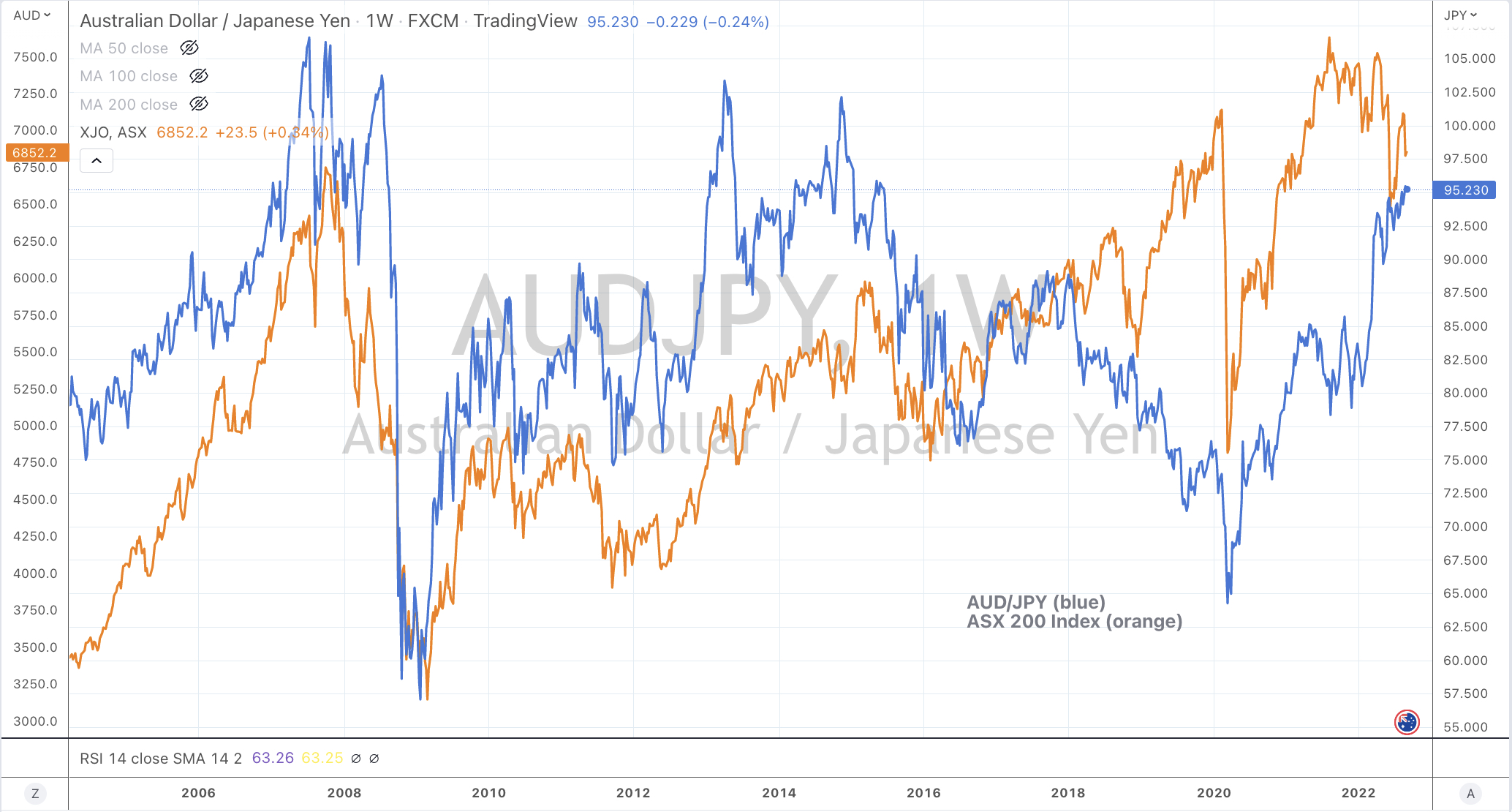
Correlations – AUD/JPY and the ASX 200 Index

September 5, 2022
by Rob Zdravevski
rob@karriasset.com.au
Watching Currencies – AUD/JPY

Correlations – AUD/JPY and Australian 2 year government bond yield

September 5, 2022
by Rob Zdravevski
rob@karriasset.com.au