Re-unifying nations is only M&A

“With the exception of warfare, [M&A] is how assets are transferred on this planet”, said Chairman and CEO of Vista Equity Partners, Robert F. Smith.

It is plausible that Russia and China employ a Merger and Acquisition strategy in re-unifying Ukraine and Taiwan respectively, rather than warfare.

Warfare suits the United States well, for 20% of its annual military expenditure is towards the procurement of weapons.

That’s a $100 billion which gets paid to a defense industry that is searching for sales especially after withdrawals from Iraq and Afghanistan.

Can you imagine what the defense industry lobbyists are saying in Washington ?

January 31, 2022

by Rob Zdravevski

rob@karriasset.com.au

The Fed won’t hike 5, 6 or 7 times

Here is something to put in your diary and check at the end of 2022.

https://www.bloomberg.com/news/articles/2022-01-29/goldman-sachs-predicts-fed-will-raise-rates-five-times-this-year?sref=qLOW1ygh

Goldman Sachs joins the others below, where they think the Fed will raise rates 5 times this year.

“Bank of America Corp. now predicts seven rate hikes in 2022 and BNP Paribas SA forecasts six, while JPMorgan Chase & Co. and Deutsche Bank AG see five.”

Personally, I think their views are ridiculous and far-fetched.

My view is quite different.

I think the Fed raises rates twice this year and then corrects their actions with a rate cut.

My playbook suggests the Fed will hike and react to what the U.S. 2 year treasury note has done, which paints them as being behind the curve. They may be trying to temper inflation, which is mainly being driven by high commodity prices, disrupted supply chains and oddly, a tight labour market.

Politically, they will will feel pressure to do so, if at least to put a lid on U.S. gasoline prices.

But they won’t put rates up too much, for finally, inflation has reached the target rate that they have been wishing it would reach for many years.

As the government’s teat is removed from many and workforce participation increases (possibly because they lose money in their crypto portfolios), supply chains are rectified and commodity prices seriously mean revert, we should see inflation peaking (about now) and a lower GDP print for the March quarter, all without any meaningful rate hikes.

Excessive hikes will hurt GDP growth.

hint: mid term elections are coming in November 2022.

This may not sink in until after the May 4th Fed meeting.

More on the positioning of the investment playbook later.

January 31, 2022

by Rob Zdravevski

rob@karriasset.com.au

Macro Extremes (week ending January 28, 2022)

Extremes “above” the Mean (at least 2.5 standard deviations)

Japanese 10 year government bond yields

U.S. 10 year government bond yields

TBX

US dollar Index (DXY)

Orange Juice

Nickel;

Soybean

Palladium

Overbought (RSI > 70)

Australian 2 and 5 year bond yields

U.S. 5 year government bond yields

Greek 10 year government bond yields

Russian 10 year bond yields

Australian Coal

CRB Index

Bloomberg Commodity Index

Cotton

Heating Oil

Gasoil

The Overbought Quinella – Both Overbought and Traded at > 2.5 standard deviations above the weekly mean)

U.S. 2 year government bond yields

Iron Ore

Extremes “below” the Mean (at least 2.5 standard deviations)

Chinese government 10 year bond yields

Amsterdam’s AEX Index

Shanghai Composite

CSI 300

Dow Jones Industrial Average

Nasdaq 100

Nikkei 225

S&P 400 MidCap

Russell 2000

S&P 500

Nasdaq Transports

ASX 200

And the Copenhagen and Helsinki indices

Oversold (RSI < 30)

EUR/USD

DKK/USD

KRW/USD

SEK/USD

RUB/USD

The Oversold Quinella – Both Overbought and Traded at > 2.5 standard deviations above the weekly mean)

Hot Rolled Coil Steel (HRC) 

Korea’s KOSPI Index

Notes & Ideas:

The intra-week volatility was something to behold although we tend to see 5-12 days per year where stocks and markets are up and down 3% either way, all within a single day.

After all of the wickedness, the Nasdaq was flat for the week, while the Dow Jone Industrials and S&P 500 were up 1% for the week.

Koprea’s KOSPI hit a 14 month low and features in this week’s Oversold ‘extreme’ list.

In other news, the AUD versus the USD, fell 2.5%, the German 10 years could trade out of their negative yield.

Aussie 10 year bond yields traded to a high of 2.05% before closing the week at 1.92%, while the Australian 2’s touched 1.03% to close the week at 0.95%.

Amongst the panic, interesting Gold and Silver didn’t find a safe haven bid, instead they fell 2.3% and 8.3% respectively.

Energy had a strong week, as it enters Overbought extremes (subjectively suggesting that geopolitical tensions are mainly factored in), Softs generally rose while Dr. Copper looks like rolling over.

Steel remains Oversold, as HRC prices fell 18%.

In the face of diplomacy tensions, Russia’s MOEX Index rose 1.4%.

And as predicated in last week’s edition, the ASX 200 Index did trade down to an extreme 2.5 standard deviation reading below its weekly mean.

The larger advancers over the past week comprised of; 

Rotterdam Coal 12.6% (up 45% in 3 weeks), WTI Crude 2% (up 15% in 4 weeks), Gasoil 4.3%, Iron Ore 6.4%, JKM 6.1%, Coffee 1.7%, Natural Gas 16%, Brent Crude 3.4%, Dutch TTF Gas 16.2%, CRB Index 1.8%, Gasoline 3.9%, Heating Oil 3.5%, Lean Hogs 2%, Aluminium 3.4%, Corn 3.2%, Soybean 3.9%, Oats 8.4%, Palladium 12.9%, Cotton 2.5%, Brazil’s Bovespa 2.7% and Russia’s MOEX Index rose 1.4%.

The group of decliners included ;

Baltic Dry Index (2.4%) (having fallen 80% in 5 weeks), Copper (4.7%), Orange Juice (3.5%), Platinum (2.8%), Silver (8.3%), Urea (17.5%), Sugar (3.7%), Nickel 6.9%, Lumber (10.4%), HRC (17.9%), Gold (2.3%), Cocoa (3.2%), Silver (8.3%), Uranium (2.4%), Shanghai Composite (4.6%), AEX (2.6%), China’s CSI 300 (4.5%), DAX (1.8%), MIB (1.8%), HSCEI (6.6%), Hang Seng (5.7%), Kospi (6%), Nikkei (2.9%), Sensex (3%), Copenhagen (2.8%), Stockholm (2%), Helsinki (2.4%), Philadelphia SOX (3.8%), Switzerland’s SMI (2%) and Australia’s ASX 200 fell (4.7%).

January 29, 2022

by Rob Zdravevski

rob@karriasset.com.au

Could Russia re-unify Ukraine?

I still think Russia won’t invade Ukraine.

They could possibly take control of the nation without any military force.

What if Russia ‘acquires’ Ukraine without invading?

Let’s call it a re-unification.

What could NATO and the U.S. do then ?

It’s plausible that Russia deploys economic pressure and fiscal support behind the shadows of other military proxies.

Keep in mind, that Ukraine is the poorest country in Europe and could be tempted to be re-unified.

My recent posts have mentioned the back story being Oil and Gas 

https://www.linkedin.com/posts/robzdravevski_russia-biden-usa-activity-6889888130896404480-iX-n

This article citing the ‘Politics of Gas’ is dated July 13, 2021

Then I started writing this article on October 7, 2021

Within, I mention that Germany had until January 8th to commission the NordStream pipeline which didn’t happen.

But I wanted to highlight the link to a book which Antony Blinken’s wrote in 1987, titled, “Ally versus Ally: America, Europe, and the Siberian Pipeline Crisis”

Furthermore, I wrote this on November 23, 2021, 

https://www.linkedin.com/posts/robzdravevski_biden-orders-release-of-us-oil-reserves-activity-6869041890155741184-1Hu_

In a game of Chess, it’s ideal to acquire the King with the least amount of moves, noise and carnage.

Barreling through all the pawns, making a lot of bluster and publicly announcing your moves, seldom wins. 

I’ll post another set of points behind my thinking over the weekend.

January 28, 2022

by Rob Zdravevski

rob@karriasset.com.au
Chilean Interest Rates Have Doubled

Chile raises interest rates by 1.5% to 5.5%.

https://www.bloomberg.com/news/articles/2022-01-26/chile-surprises-markets-with-150-basis-point-interest-rate-hike?sref=qLOW1ygh


A month ago, it increased rates by 1.25%.


Rates have now  doubled within 35 days, moving from 2.75% to 5.5%.This has also driven the Chilean Peso higher by 10% within the past month.

Although, this was also a move by the Chilean central bank playing catch-up to the the 10 year bond market for Chilean 10’s already doubled in the preceding 10 months.

Upon announcing the last 2 rate hikes, the 10’s fell and held steady to meet where the central bank have moved up to.

G7 central banks are facing a similar scenario of being behind the curve, that the market is already throwing them.

I understand some extent of the G7’s wait and see stance because Chile’s risk is that have hiked too aggressively.

If they have and they need to adjust rates lower, the correlation of Chilean 10′ to the USD price of Copper may remain in sync.


Importantly, Chile is yet another commodity sensitive country to raise rates in order to stifle inflation.


https://www.linkedin.com/posts/robzdravevski_economy-interestrates-growth-activity-6853984783878426624-ywFq

Similarly to Australia, its central bank inflation target is 2%-3%.

While Australia printed an inflation rate of 3.5%, Chile’s inflation came in at 7%.


Incidentally, Canada’s inflation target is 2% and their inflation for the December quarter just came in at 4.5%. Their central bank governor has just signalled higher rates are coming.


This will be equally interesting to watch, because Canada’s citizen’s are as heavily indebted as the Australian’s.


As per my post, the citizen’s of Chile, Mexico, Brazil, Russia don’t have such a heavy debt burden.It’s the rising cost of living that hurts them more, not servicing interest repayments.


Albeit Chile has a good to high standard of living and is considered the richest country in South America, its GDP per capita basis is similar to Trinidad & Tobago, Romania, Bulgaria and the Seychelles.


Hence, I’ll repeat a sentence from my post, Inflation remains a tax that the ‘poor’ can’t afford to pay.


What is even more interesting is Chile’s share of the world’s copper exports.


47% of Chile’s exports are Copper related (equalling $32 billion worth) making them the world’s largest exporter of such.


https://oec.world/en/profile/country/chl#Profile

While Chile exports 31% of world’s annual Copper Ore, (Peru is 2nd at 20%), it also produces and exports 22% of the world’s refined copper. Russia is next largest at 7%.


Similar to ‘Petro-Nations’ needing Petro-Dollars, Chile needs Copper receipts….and perhaps it needs to export more Copper in order to make up for the less Peso’s being received.


This would likely result in more Copper hitting the market, especially while Copper is trading near 10 year highs.

January 28, 2022

by Rob Zdravevski

rob@karriasset.com.au
Urea’s 28% decline isn’t a surprise

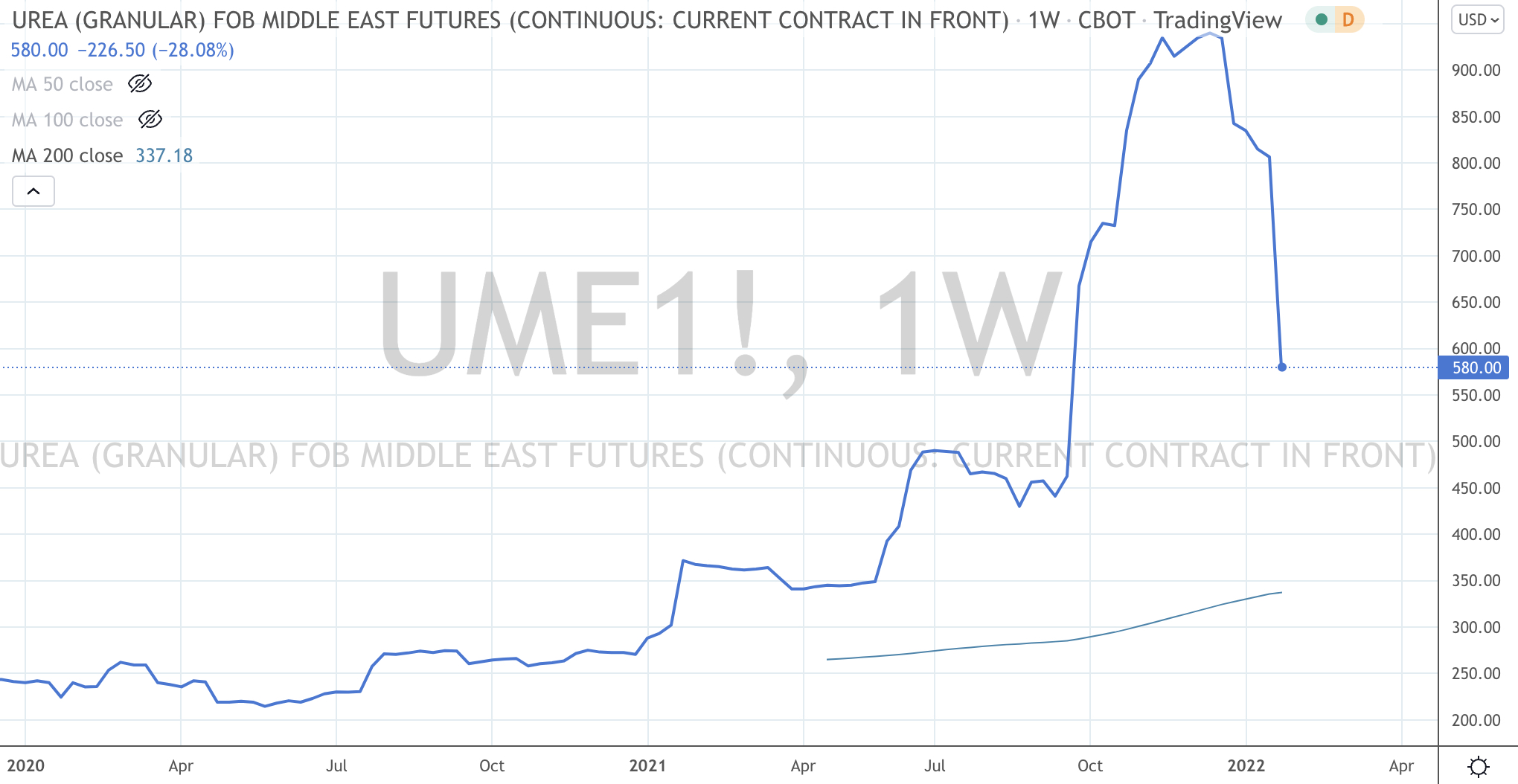
The price of Urea fell 28% last night

4 months ago, I posted this about another parabolic price move…this time it was Urea.

https://www.linkedin.com/posts/robzdravevski_another-observation-of-perverse-price-action-activity-6851803815264579584-5in7

More recently, this post correlated the shortage of AdBlue with rising Urea prices.

https://www.linkedin.com/posts/robzdravevski_adblue-diesel-activity-6879698001863032832-t86h

It’s not about whether you buy it or trade it; these type of posts are about when to stay away.

Once again, parabola’s mean revert and markets find a way to either add supply or temper demand, as prices dictate.

I’m expecting more mean reversion and a $380-$420 price into 2023.

January 28, 2022

by Rob Zdravevski

rob@karriasset.com.au
Amazon most oversold in 13 years

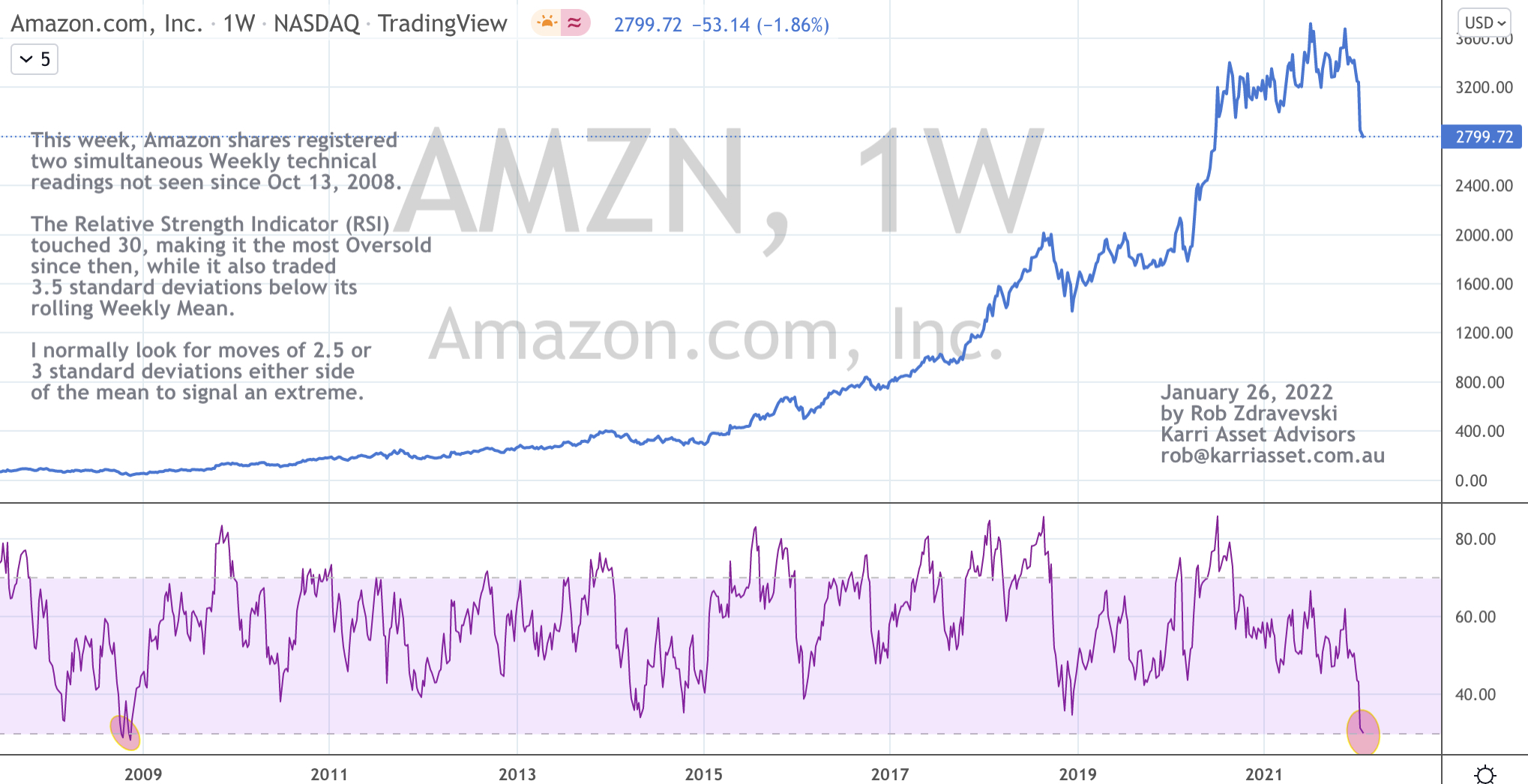
Amazon stock has fallen 26% from its mid November 2021 high.

For a little drama…..it has erased $463 billion of its market capitalisation within 2 months……

But the positive news is….

Simultaneously this week, #amazon shares registered two Weekly technical readings last seen 13 years ago (Oct 13, 2008).

The Relative Strength Indicator (RSI) touched 30, making it the most Oversold since then, while it also traded 3.5 standard deviations below its rolling Weekly Mean.

I normally look for moves of 2.5 or 3 standard deviations either side of the mean to signal an extreme.

Furthermore, Amazon should use this swoon in its price to announce the spin-off of its Amazon Web Services (AWS) business (at a probable market cap of a trillion dollars) so its done on their terms, rather than having government trust-busters telling them to do so.

January 26, 2022

by Rob Zdravevski

rob@karriasset.com.au

Google’s earnings are a bellwether

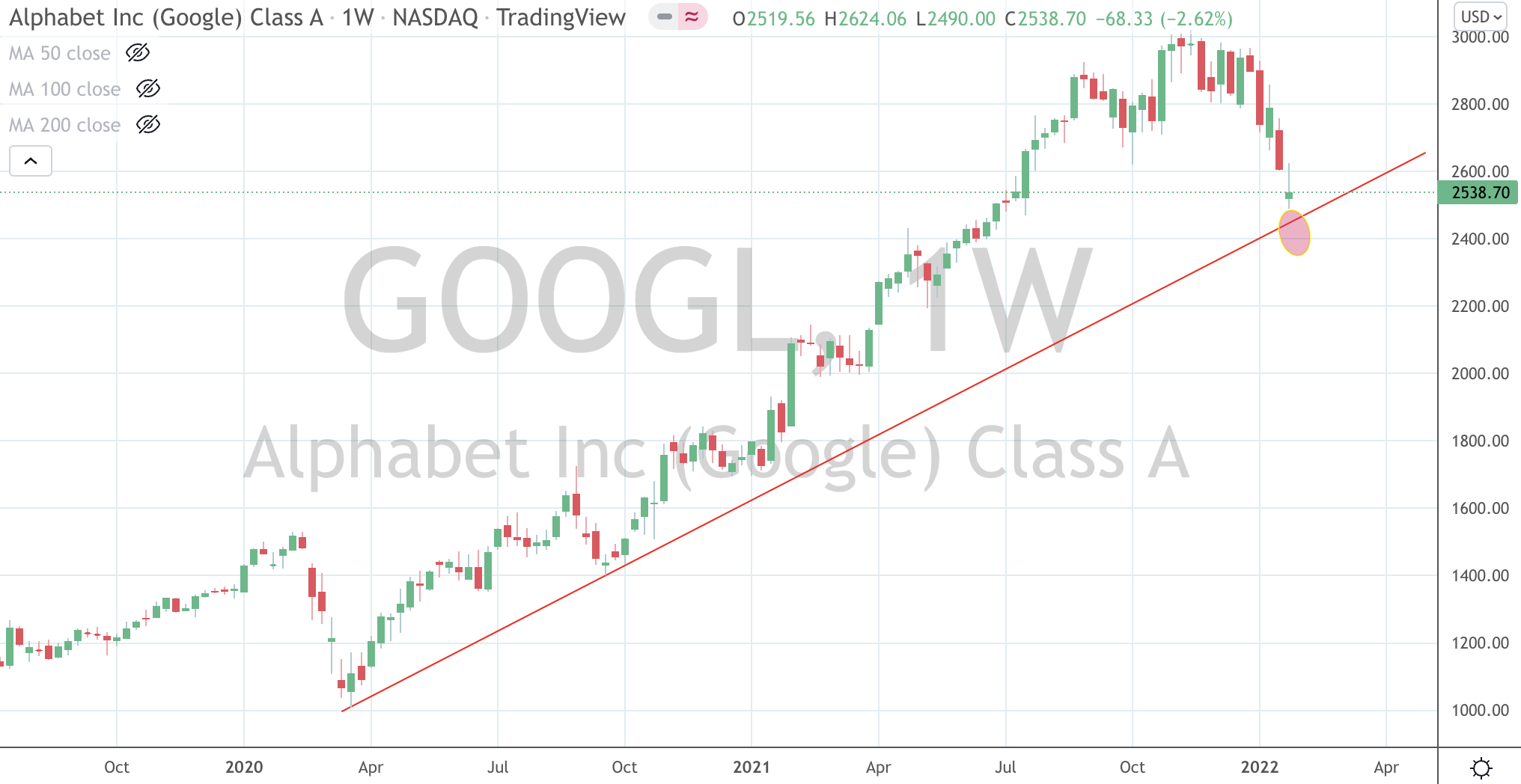
If you had to watch only one stock this earnings season, I think it should be Alphabet.

I remember when Cisco Systems was the quarterly earnings bellwether?

They (Google) report earnings on February 1st, 2022.

To coincide with today’s post about picking a bottom in the Nasdaq, in order to keep its current bullish trend intact, GOOGL needs to hold the support line on the chart below, which is around the $2,450 mark.

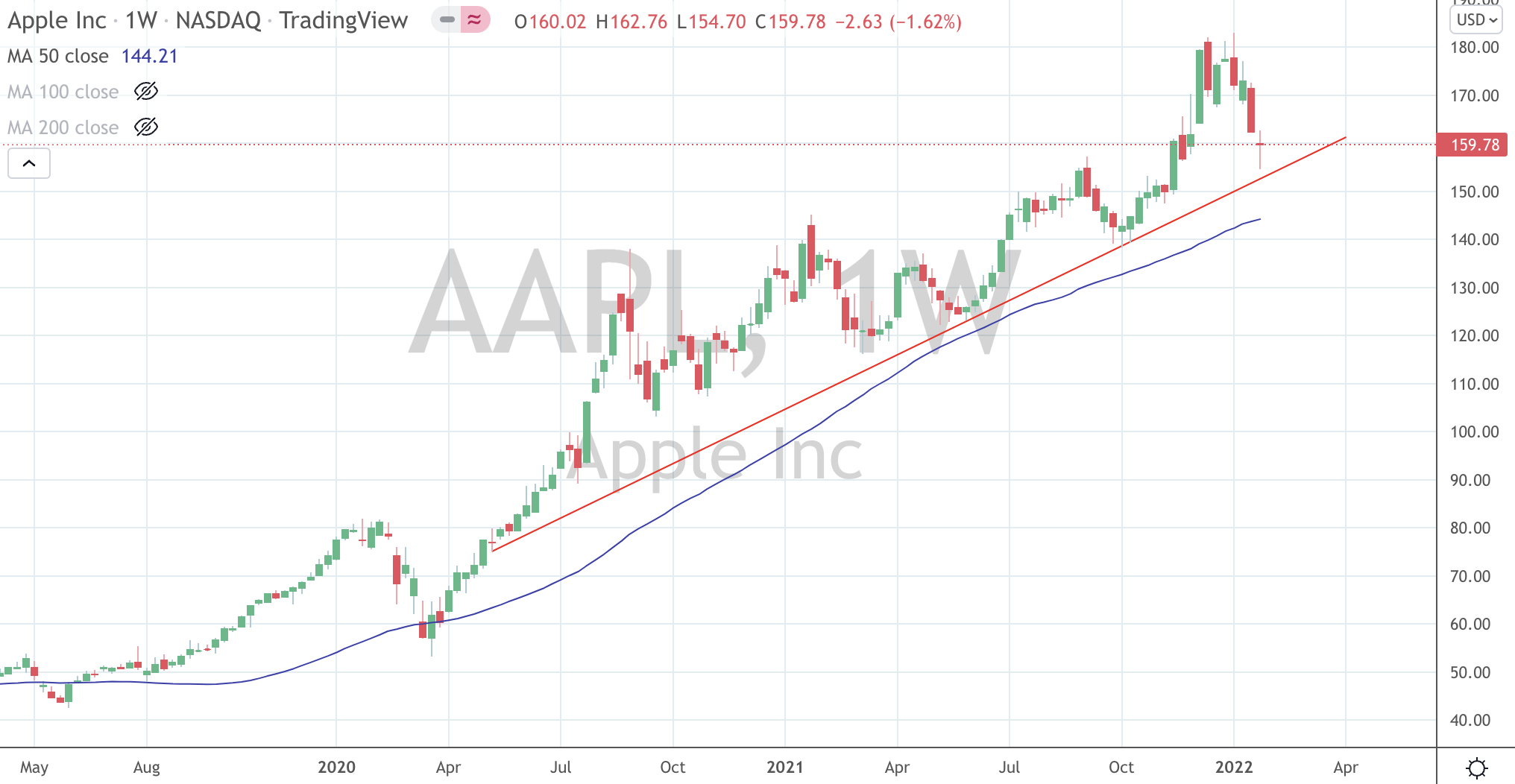
In other news, Microsoft reported earnings after today’s close and we’ll see how their price action plays out, while Apple reports earnings on January 27th.

All three of these stocks are on or above similar support lines. (MSFT’s is right on the edge).

Meanwhile, the other three of the “FAANGM’s gang, being Netflix, Amazon and Facebook have already broken below their corresponding (or sympathetic) support lines.

Incidentally, Tesla reports quarterly earning on January 26th (U.S. time) and their stock will be interesting to watch too. Not because I consider them anywhere near a bellwether, but rather they are a proxy for cult and sentiment.

To put it simply, if Alphabet (Google) breaks below that support line on a weekly closing basis, then they may be the last straw that broke the camel’s back……….

thus my the probability of my Nasdaq low story is de-bunked and I’ll revise the next wave and targets at lower levels.

January 26, 2022

by Rob Zdravevski

rob@karriasset.com.au
Short term rates in Australia rise 9 fold

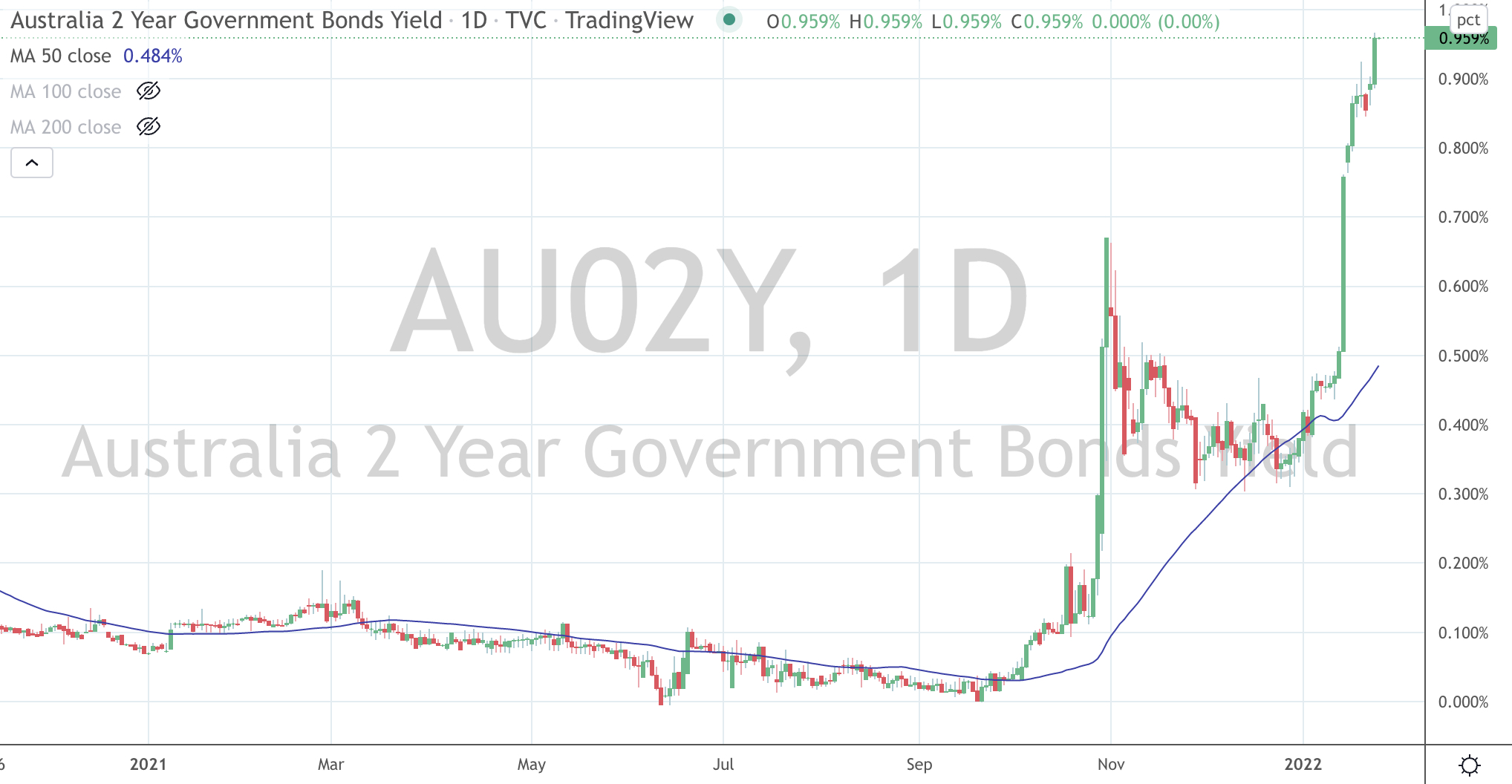
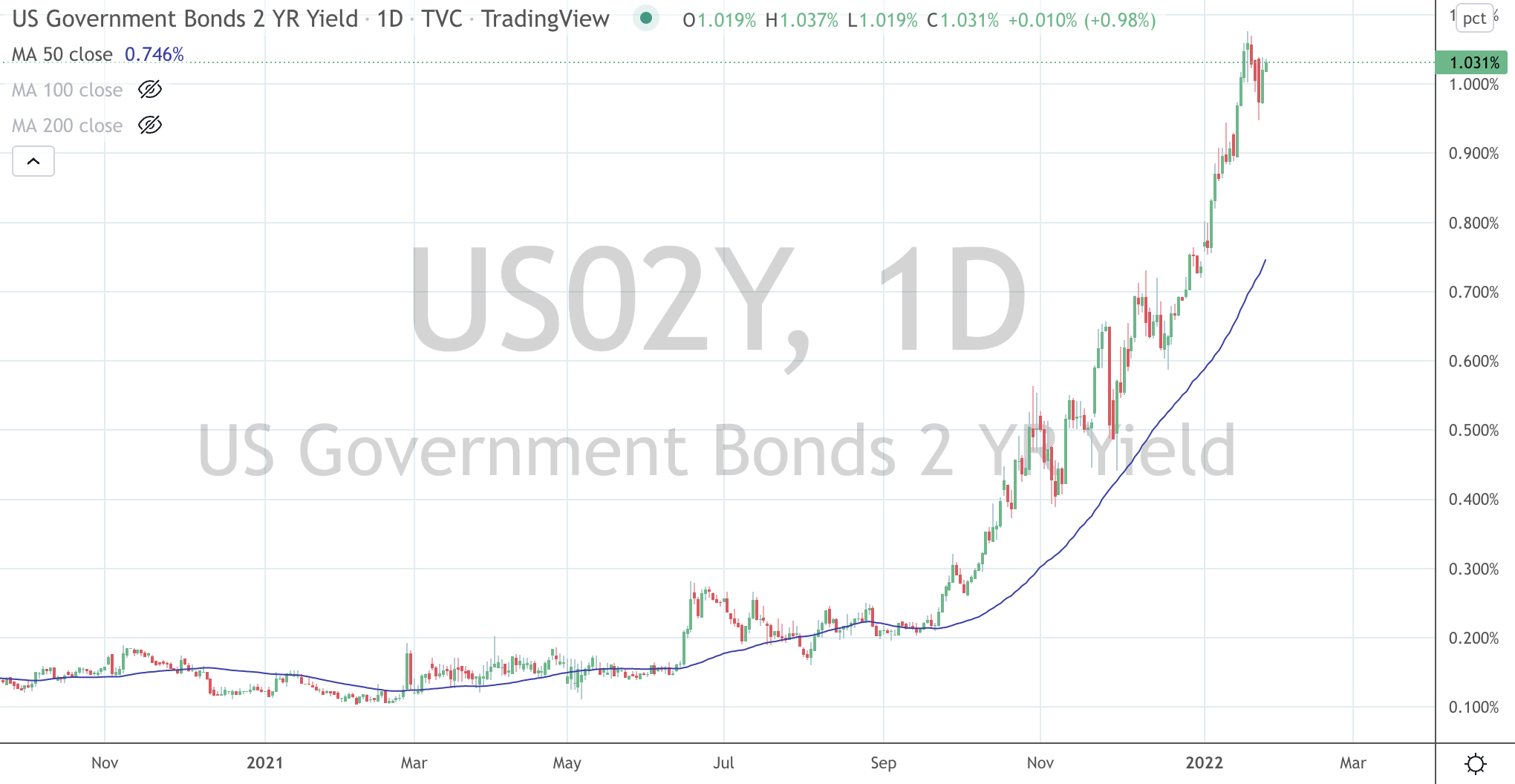
I want to highlight the parabolas seen in short term rates, namely the Aussie and U.S. 2 years bond yields.

Beyond the shape, most striking is the quantum.

The cost of short-term money in Australia has risen 9 fold from 0.1% to 0.9% in only 4 months.

In the U.S., they have quintupled from 0.2% to 1% in 4 months.

I’ve never seen that before. This makes for a serious parabolic shape.

The nearest comparable was when Aussie 2’s rose (only doubling) from 5% to 10% in 1994 and from 2.5% to 5% in 2009.

And they took 10 months to do that.

Let’s forget the ‘quantum’ thing for a moment. I’ve not seen the Aussie 2’s trade at 80 basis points above their 50 week moving average for 2 decades.

(another chart for a different post)

Yes, I know, we are coming off a low base, but the quantum does matter if you are fully laden with debt or your mathematics become acute when servicing your interest payments, especially after they have just quadrupled or more.

It also can matter when Central Banks have kept rates at 0% – 0.25%.

This is a topic I have been presenting about over the past year. It’s summarised as ‘how the bond market may force the central banks to increase rates against their own policy wishes’.

Australian banks have been raising fixed interest home loan rates.

One thing to watch out for though, it that I think inflation is peaking at this juncture and we may have lower GDP prints in the next couple quarters. So I can also understand the Central Banks wait and see stance.

I have more work to do in deciphering the probability of a peak in these 2 year yields, because Overbought can stay Overbought for much longer than Oversold’s do…….but it’s only the 9th Weekly Overbought reading in the U.S. 2’s seen over the past 22 years.

For the Australian 2’s, this is only 6th time they are in Weekly Overbought territory in 27 years.

But I’ll remind readers of the sharp retracements that tend to follow a parabolic move.

The other work I’m doing to correlate the 2’s ascendancy and peaks with timing the entry into selected ‘growth’ names that I like in stocks.

January 26, 2022

by Rob Zdravevski

rob@karriasset.com.au

I’m very pleased with my calls to raise cash

My latest newsletter reflects and summarises the “Move To Cash” calls I made in various editions during Q4 of 2021.

https://mailchi.mp/karriasset/reviewing-my-calls-to-sell-and-raise-cash