40 years of peaks in Australian bond yields

At what stage, during 7 distinct moments over the past 40 years should one have bet that the Australian 2 year bond yield should venture too much further beyond the extremes circled below?

Today, this yield is trading at 3.90%. Most recently, it spent 6 weeks between 4.10% and 4.30%.

See you at the mean reversion?

August 2, 2023

by Rob Zdravevski

rob@karriasset.com.au

Expanding breadth can be exhausting

Amidst waning volume, the Russell 2000 yet to make higher highs than January 2023, let alone last August of 2022, whilst presently trading at 2.5 standard deviations above its weekly mean.

#exhaustion

August 1, 2023

by Rob Zdravevski

rob@karriasset.com.au

Heating Oil is too hot to touch

The picture below shows Heating Oil’s story of mean reversion and its recent bounce, now trading at some stretched percentages above a specific mean.

Observe the pendulum. Going long here doesn’t provide a margin of safety.

My Macro Extremes’ publication from this past weekend listed Heating Oil, Gasoline and Distillates returning to Overbought territory.

August 1, 2023

by Rob Zdravevski

rob@karriasset.com.au

Chile cuts interest rates with soft hands

To achieve a soft landing, you need ‘soft hands’.

Ask any baseball infielder the importance of having ‘soft hands’.

In an example of managing monetary policy the way it should be done, without political fear or favour…….Chile cuts interest rates by 1%.

They are going to the where the ‘puck’ is going to be, not where it has been.

2 years ago, I started writing how Chile was addressing inflation ahead of other countries.

While referencing their income and GDP per capita, where I cited that “inflation is a tax that the poor can’t afford to pay”, the commodity sensitive (emerging) nations hiked rates much earlier than the G-12 nations.

Chile, Mexico, Brazil have all been ahead of the curve, while the central banks of the countries with the most indebted citizens have needed to tread carefully, in order not to ‘break’ things including the residential housing market.

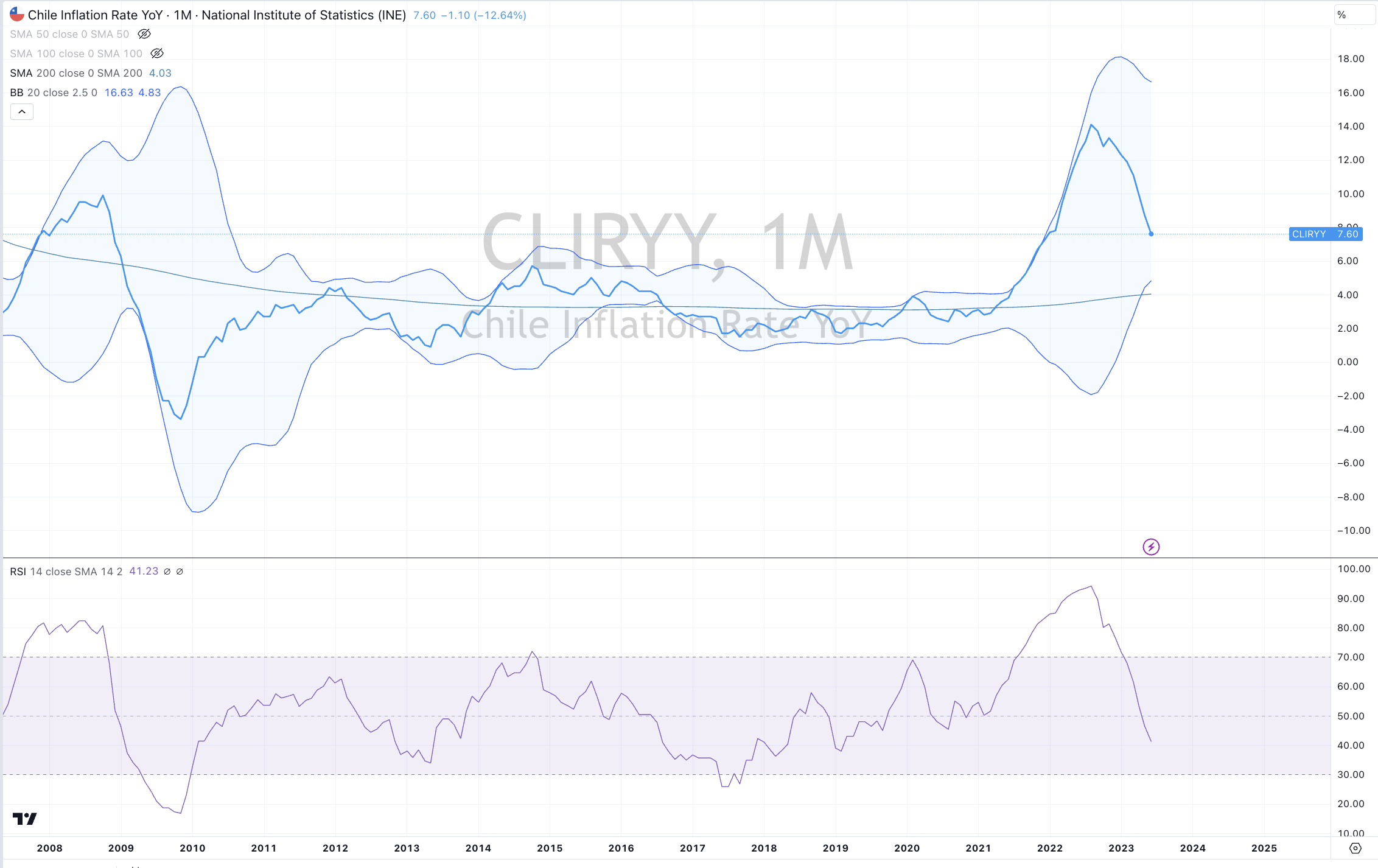
To give you an example of their pre-emptive action, the chart below shows the Chilean inflation rate.

While inflation has already turned lower, I’ll assume that they expect the lagging reaction to their aggressive hikes to take on a greater effect.

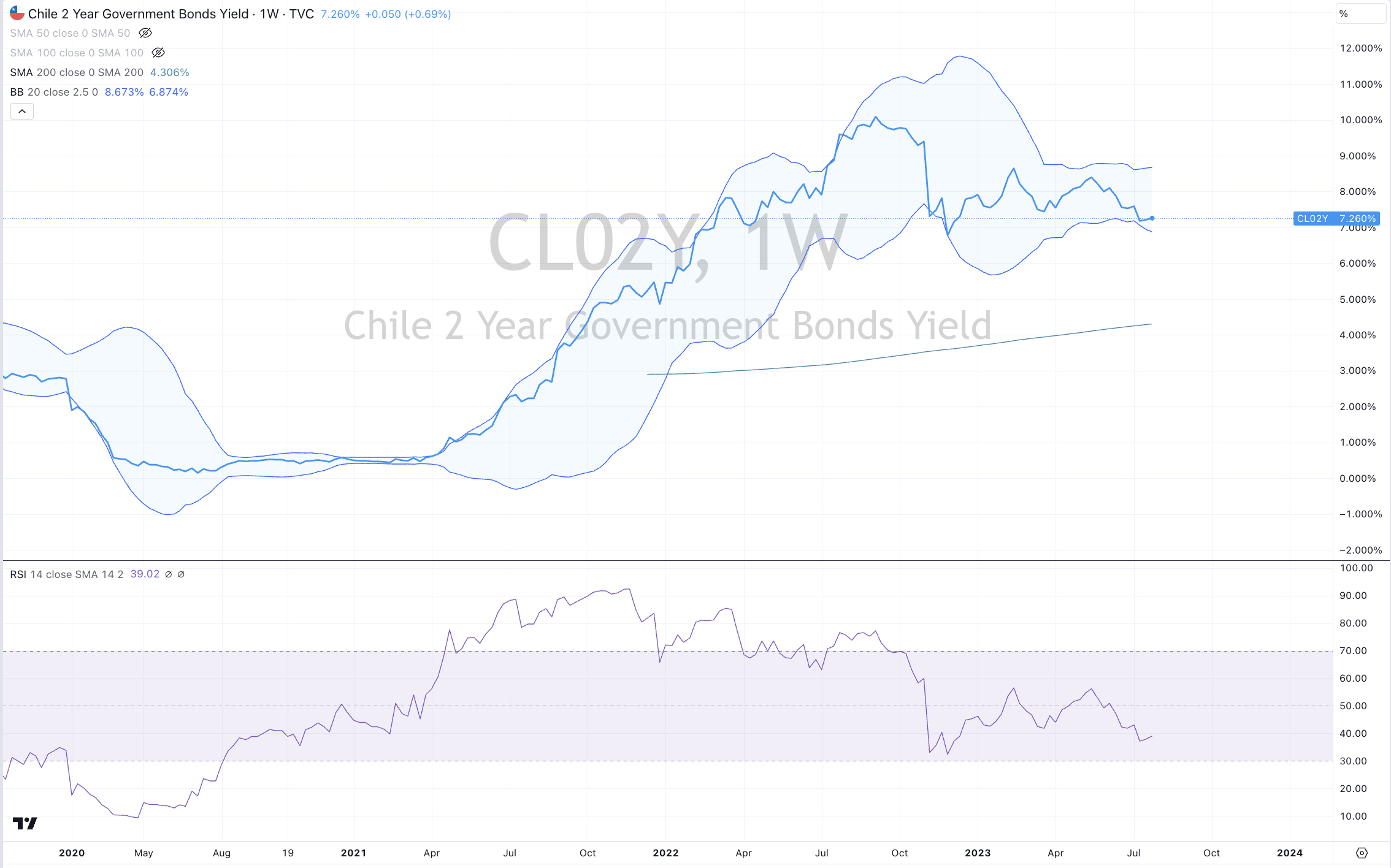
And you can see the Chile government 2 year bond yield also moving lower

This rate cut will also assist Chilean companies with their feasibility and financing of various mining projects.

Also, last month, I found this interview with the Chilean Finance Minister, Mario Marcel very interesting.

Incidentally, he previously served as the Governor of Chile’s Central Bank.

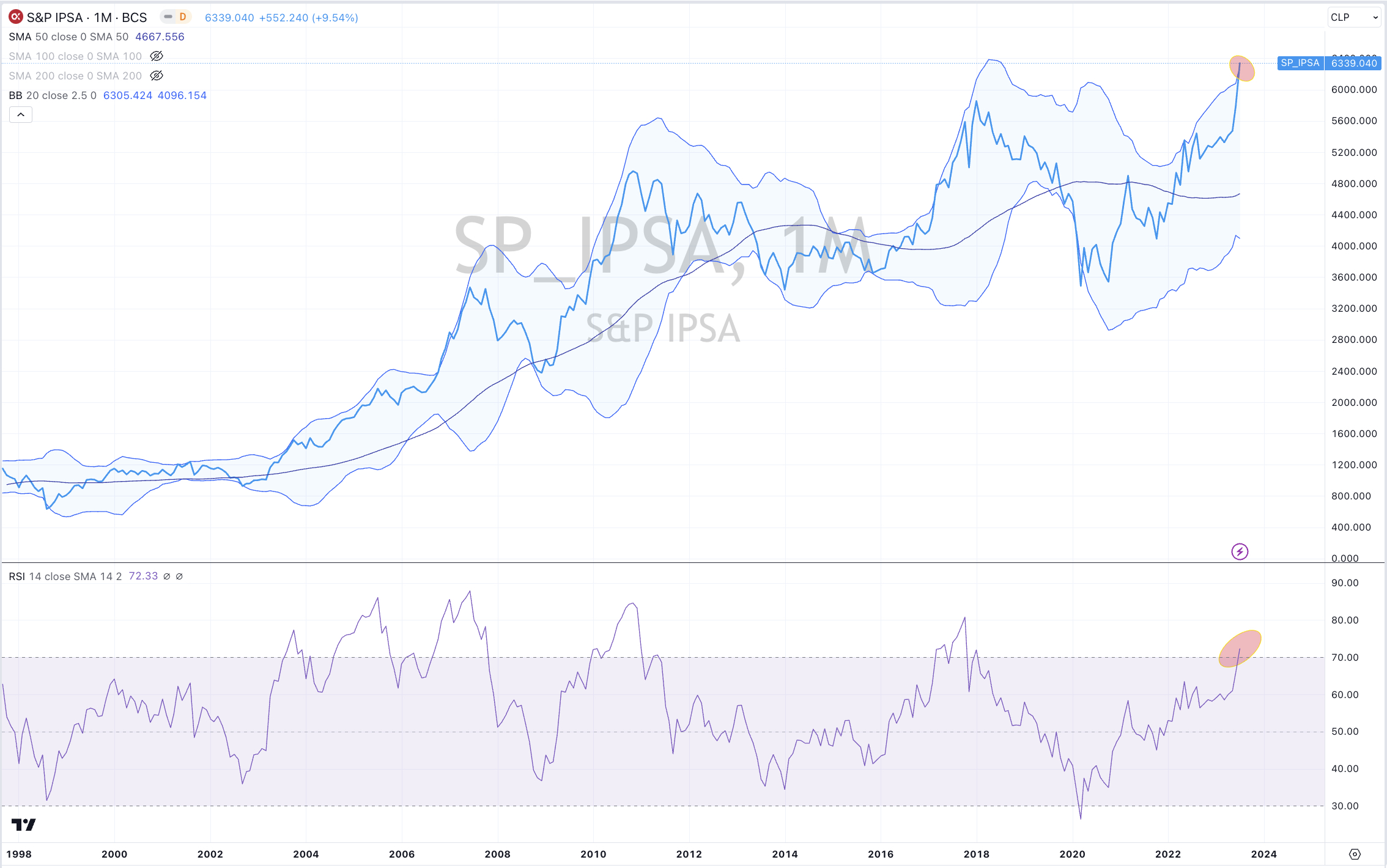
Perhaps perversely, this rate cut occurs while Chile’s stock market is touching some overbought historically overbought levels. It has risen 52% since it’s first rate hike in July 2021 and is now at an all-time high.

This is another example of markets looking much forward than many expect.

The S&P 500 and Nasdaq 100 have risen 2.5% and 11% respectively since the U.S. Federal Reserve Bank’s first rate hike in March 2022.

Since Australia’s Reserve Bank delivered its first rate hike (May 2022), the ASX 200 Index has responded with a rise of 3.7%.

This news in Chile translates into taking profit and re-weighting Chilean equity exposure lower.

My expected retracement in Chile’s IPSA Index should also stifle the latest run in the copper price and give me an opportunity to enter selected commodities on any forthcoming dip.

July 31, 2023

by Rob Zdravevski

rob@karriasset.com.au

Macro Extremes (week ending July 28, 2023)

A weekly Macro, Cross Asset review of prices trading at extremes which may generate future investment ideas and opportunities.

The following assets (on a weekly timeframe) either registered an Overbought or Oversold reading and/or have traded more than 2.5 standard deviations above or below its rolling mean.

Extremes “above” the Mean (at least 2.5 standard deviations)

U.S. 10 year breakeven inflation rate

Japanese Government 10 year bond yield

Cotton

Gasoil

Heating Oil

Gasoline 

Orange Juice

Urea (both U.S. Gulf and Middle East prices)

Wheat

S&P SmallCap 600

KBW Bank Index

KRE Regional Bank Index

Indonesia 30 Index

Overbought (RSI > 70)

Russian 10 year government bond yields

U.S. 3 month bill yields

Cocoa 

MXN/USD

COP/USD

S&P 500

Nasdaq Composite Index

India’s Nifty 50 and Sensex

Turkiye’s BIST 100

Chile’s IPSA and IGPA equity indices

And Russia’s MOEX equity index

The Overbought Quinella – Both Overbought and Traded at > 2.5 standard deviations above the weekly mean)

Dow Jones Transports

Extremes “below” the Mean (at least 2.5 standard deviations)

Chilean 2 year government and yield 

Oversold (RSI < 30)

Newcastle Coal

The Oversold Quinella – Both Oversold and Traded at < 2.5 standard deviations below the weekly mean)

None 

Notes & Ideas:

Most of the currencies at extremes in last weeks edition are no longer so.

The AUD and EUR were weaker and the JPY was stronger.

Overall, the USD was stronger (it bounced off its oversold levels) except against most Asian currencies and the South African Rand.

The Rand continues to strengthen and the AUD/ZAR continuous to plummet.

The AUD/JPY pair had a bearish outside reversal week.

And the CHF/AUD is in a 6 week rising streak.

The big story in equities is that the S&P 500 is now overbought.

In fact, many equities are now appearing in that category.

The Dow Jones Transports registered a quinella overbought reading this week while rising for its 5th consecutive week and producing a 20% return over the past 8 weeks.

The KRE Regional Banking Index has posted an impressive 22% return in its 5 week winning streak. 

The U.S. Mid Cap indices took a breather from being overbought, while the Russell 2000 was only a hair away from back-t0-back overbought weeks.

Shanghai, the CSI 300, HSCEO, Hang Seng and Mexico bourses all produced an outside bullish reversal week. 

And the Nasdaq 100 in now in its 10th week of being overbought.

In commodities, most energy was stronger while precious metals, gases and steel related commodities were weaker.

It has been over a year since Gasoline, Heating Oil and Distillates traded at overbought extremes.

Cattle eased lower from overbought territory.

Lumber and Hot Rolled Coil Steel have fallen 11% and 8% respectively over the past 2 weeks.

Cocoa is now in its 8th week of being overbought, 

while WTI Crude Oil and Diesel (Gasoil) are in a 5 week winning streak.

Yields were generally lower this past week, except for Japan.

The Japanese 10’s attracted the most attention during the week.

And the Aussie 10-2 yield spread has risen to its weekly mid-point.

The larger advancers over the past week comprised of;

Aluminium 1.7%, Brent Crude 4.8%, Baltic Dry Index 13.5%, Cocoa 3.2%, Coking Coal 2.7%, WTI Crude 5%, Gasoil 9.9%, Gold 1.8%, Copper 3%, Heating Oil 8.2%, Tin 2.6%, Newcastle Coal 6.1%, Orange Juice 5.7%, Gasoline 3.2%, S&P GSCI 2.8%, Urea U.S. Gulf 13.8%, Urea Middle East 10.3%, Shanghai 3.4%, CSI 300 4.5%, AEX 2.7%, DAX 1.8%, DJ Transports 2.9%, MIB 2.2%, HSCEI 6.1%, Hang Seng 4.4%, MOEX 2.9%, Nasdaq Composite 2%, Nasdaq 100 2.1%, SOX 4.1%, Strait Times 2.8%, BIST 5.7%, KLSE 2.6%, Mexico 2.3% and KRE 5.1%.

The group of decliners included;

Rotterdam Coal (3.6%), Iron Ore 4.3%, Hot Rolled Coil Steel (4.3%), Coffee (2.4%), Lumber (5.4%), JKM LNG (5%), Natural Gas (3%), Palladium 3.7%, Platinum (2.8%), Sugar (4.4%), Dutch TTF Gas (4.6%), Oats (2%) and the Copenhagen bourse fell 2.6%

July 30, 2023

by Rob Zdravevski

rob@karriasset.com.au

Commodity bullishness – illustrated

Strategically, I am becoming bullish on commodities.

Tactically, it’ll be down to timing and selecting the specific investments to express this view.

German inflation and bonds yields should also decline

Talk in financial media says Germany has a stubbornly sticky inflation problem.

I see it has already ticked lower, as represented by the blue line in the chart below.

Currently, its 6.38% and I think it can converge lower towards its 200 week moving average to somewhere around the 4.60% mark (+/- 30 basis points)

Commensurately, German 2 year bond yields (orange line) should fall to the 1.60% (+/- 20 basis points) area.

July 26, 2023

by Rob Zdravevski

rob@karriasset.com.au

Extreme in CHF strength

When the CHF/AUD is overbought (telling us that the Swissie is quite strong against the Aussie) then I prepare to add a little more exposure to the ASX 200.

Although, acknowledging that it’s an extension of a rally rather than a notable low.

July 26, 2023

by Rob Zdravevski

rob@karriasset.com.au


and just like that, 10% p.a. compounded

The owners of the Washington Commanders NFL team achieved a 10% p.a. compounded return on their purchase price of $800 million in 1999. They are being sold for $6.05 billion.

A fancy house in Toorak, Melbourne was sold for $43 million. It was bought for $108,000 in 1968.

That is also a 10% p.a. compounded return.

Both marquee assets and let’s say scarce and tightly held.

Valuations aside, large numbers can create awe when reported in the media.

#compounding

The anatomy of climbing an equity wall of worry

When the RSI on the VIX Index trades at a reading of 38 or below (note it has never registered a weekly oversold reading of below 30), the S&P 500 embarks on a rally against an economic backdrop of trying and testing conditions or headwinds.

This climb up a ‘wall of worry’ tends to exhaust itself when the RSI registers a 

reading of 64 while the upward equity trend can last between 6 and 24 months.

An RSI above 64 and ultimately a reading above 70, is then when we see ‘absolute’ worry.

For now, I’ll be wary of my equity allocation and exposure as any further index advance isn’t evolving from a base of bargain hunting.

July 24, 2023

by Rob Zdravevski

rob@karriasset.com.au