Vapour, Rays and Draft won’t pay the nation’s bills

“He {Labor federal Treasurer Jim Chalmers} has warned that the budget cannot rely on temporary revenue windfalls from high export prices for iron ore, coal and gas.”

https://www.afr.com/policy/economy/tax-revenue-near-limit-but-budget-is-still-in-deficit-20220915-p5biea

…..but Australia is heavily reliant on those commodities, their exports and the tax revenues.

This plays into the pragmatic comments Greg Sheridan made in his article titled “Our Climate Fantasy” dated July 30, 2022 (The Australian newspaper).

To paraphrase some of the article,

‘Australia has many projects set to go and it is important that Prime Minister Albanese rejects bans for the commencement of new gas and coal projects’.

“Resources and minerals are irreplaceable in our economy”

“moving to net zero will be expensive and reduce our living standards”

Australia needs to continue to develop its resources to help pay for the running a country this large (in area).

Whilst there is no capital gains garnered from the largest (subsidised) asset class in the country, being owner-occupied residential real estate, revenues from a dwindling individual tax paying base let alone the manufacturing or financial are not enough to cover the gap.

One needs to keep in mind that Australia can’t export solar, wind or hydro energy.

How reliant is Australia on ’these’ commodities?

Of the total credits of goods exported (FY 21-22) being $534 billion, metals ore and minerals ($172bn), coal $113bn), other metals ($14bn) and fuels ($87bn) accounted for $386 billion or 72% of all exports. (source: Australian Bureau of Statistics) 

And as reluctance to finance new project grows in lock step with shareholder ESG related pressures, the opportunities lie with the incumbents in those industries.

Climate activists are seemingly unaware of the financial and commercial reality behind notions such as government receipts, or being the lowest cost producer, the cost of building alternative power sources and the need for base load power for the modern world many enjoy.

I don’t think exporting fitness supplements, television programming, insurance or financial services adds up to much.

p.s. don’t bother replying to me using your laptop, mobile phone or internet connection let alone physical mail for it all requires some form of hydrocarbon, silver, silica, copper, chemical….in order for the message t0 be constructed and sent. If you are reading this, you are likely to be utilising many or all of those components.

Ahhhh…is carrier pigeon considered animal cruelty?

September 24, 2022

bv Rob Zdravevski

rob@karriasset.com.au

More about Natural Gas prices

I’ve received a host of correspondence about my Natural Gas views.

So here is one chart which narrows down my price and time target.

If I was to have stab, I see $5 in Natural Gas being reached in the last days of October or into the first 10 days of November 2022.

This is all coincides with a bunch of measures which I tabulate.

Then have a think of the economic and GDP positives this would low price and perhaps inflationary reprieve would have.

#Fed isn’t reading the prevailing market prices at all.

September 23, 2022

by Rob Zdravevski

rob@karriasset.com.au
Copper

The Copper scarcity theme remains intact. Timing and how you express your investment view will be my focus.

It was wrong to chase copper related equities and an equivalent Chicago copper price a $5.00.

“They” are now, somewhere between 30% and 60% lower than the price was 3 months ago.

https://www.bloomberg.com/news/articles/2022-09-21/copper-prices-fall-despite-signs-of-looming-crucial-metal-shortage?sref=qLOW1ygh

The AUD/USD is nearing a low

On September 7, 2022, I dispensed comments to clients about my views on the AUD/USD.

I cited how perverse it was that the Aussie was strong versus the EUR, GBP and JPY….

while it continued to weaken against the USD.

This so called perverse scenario is because you don’t generally see AUD strength against other G-8 currencies whilst it inversely exhibits weakness against the USD.

Then, I thought it was appropriate for operational businesses (whether requiring to do so physically or for hedging purposes) is to…….

1) take your strong AUD and buy either GBP, EUR or JPY (the Aussie has since weakened 1.4% against these crosses)

but then…..

2) prepare to sell your strong USD and buy AUD 

Back then (Sept 7th), the AUDUSD was trading at 0.6717.

My advice said that it needs to trade below 0.6680 if it is to make a move to 0.6464.

But I noted that the AUD/USD is within the process of being in the lower quintile (the last legs) of the larger downtrend which commenced at 0.7600 in April 2022.

Now, I think it’s time to prepare for the 2nd piece of that previous commentary.

Overnight, the AUD/USD broke below the 0.6680 level mentioned.

At the time of writing it is now trading at 0.6590.

It has weakened 2.6% since September 7th, 2022.

The velocity of the downtrend is increasing, albeit slightly.

However we are nearing interim support of 0.6560

I still see the 0.6460 region as major support.

My work and probability suggests locking in hedges or actually Selling USD / Buying AUD around this 0.6580 – 0.6460 mark is prudent.

A visit to 0.6340 would be an outlier 4 standard deviation, only seen twice in the past 20 years.

  • not personal advice, see disclaimer

September 22, 2022

by Rob Zdravevski

rob@karriasset.com.au
Jon Bon Jovi said, ‘we’re half way there’

On August 24th, I wrote this note warning of a peak in Natural Gas prices.

Natural Gas peaked at $10.02 on August 23rd

A day later, this note cited a pending decline will affect certain stocks or the stockmarket in general.

Since August 25, the price of Natural Gas is 23% lower and the S&P 500 has declined 10%.

Commensurately, the share price of Oil & Gas companies have generally eased.

Some examples include Woodside and Exxon Mobil falling 9% while Occidental swooned 16%.

In that note, I called a $5 target for Natural Gas.

Well…….3 days ago NG traded down to $7.40.

To channel lyrics from a Bon Jovi song,

‘We’re half way there”.

I’m not sure if I want to insert the other half of that lyric being “Whoa, livin’ on a prayer” as my thesis seems to be based on more than a prayer.

But we are seeing deflationary news being presented right in front of our very eyes.

Gas, Oil and Gas (and derivative products such as Gasoline, Heating Oil and Distillate) prices have been falling for some months. So I remind myself that inflation reports publish lagging data and with the energy complex being both a large weighting of the inflation calculation and the last holdout in a broader decline amongst a host of commodity prices………

I’m amazed that the market pundits are ‘counting’ the rise in prices into their inflation argument but not acknowledging the subsequent decline in those prices as being plausible causes for an abating effect in future inflation readings.

Energy inputs are falling and this will have various positive effects on business and the consumer.

Time will tell.

September 22, 2022

by Rob Zdravevski

rob @karriasset.com.au

Notable low for S&P 500 isn’t in yet

The vertical lines show the significance when the Japanese 10 year bond yield is (on a weekly chart) simultaneously OVERSOLD and trading 2.5 standard deviations and BELOW its rolling weekly mean.

Around the same time, the S&P 500 also registers a notable low.

There have been 9 such moments over the past 15 years when probability suggests nibbling and adding to your holdings.

BoJ and Fed news this week will be helpful shaping the JGB yield but this study suggests the S&P 500 low isn’t there yet. This doesn’t necessarily mean a lower low, but rather a ‘notable’ low.

September 20, 2022

by Rob Zdravevski

rob@karriasset.com.au

31% decline is losing some steam

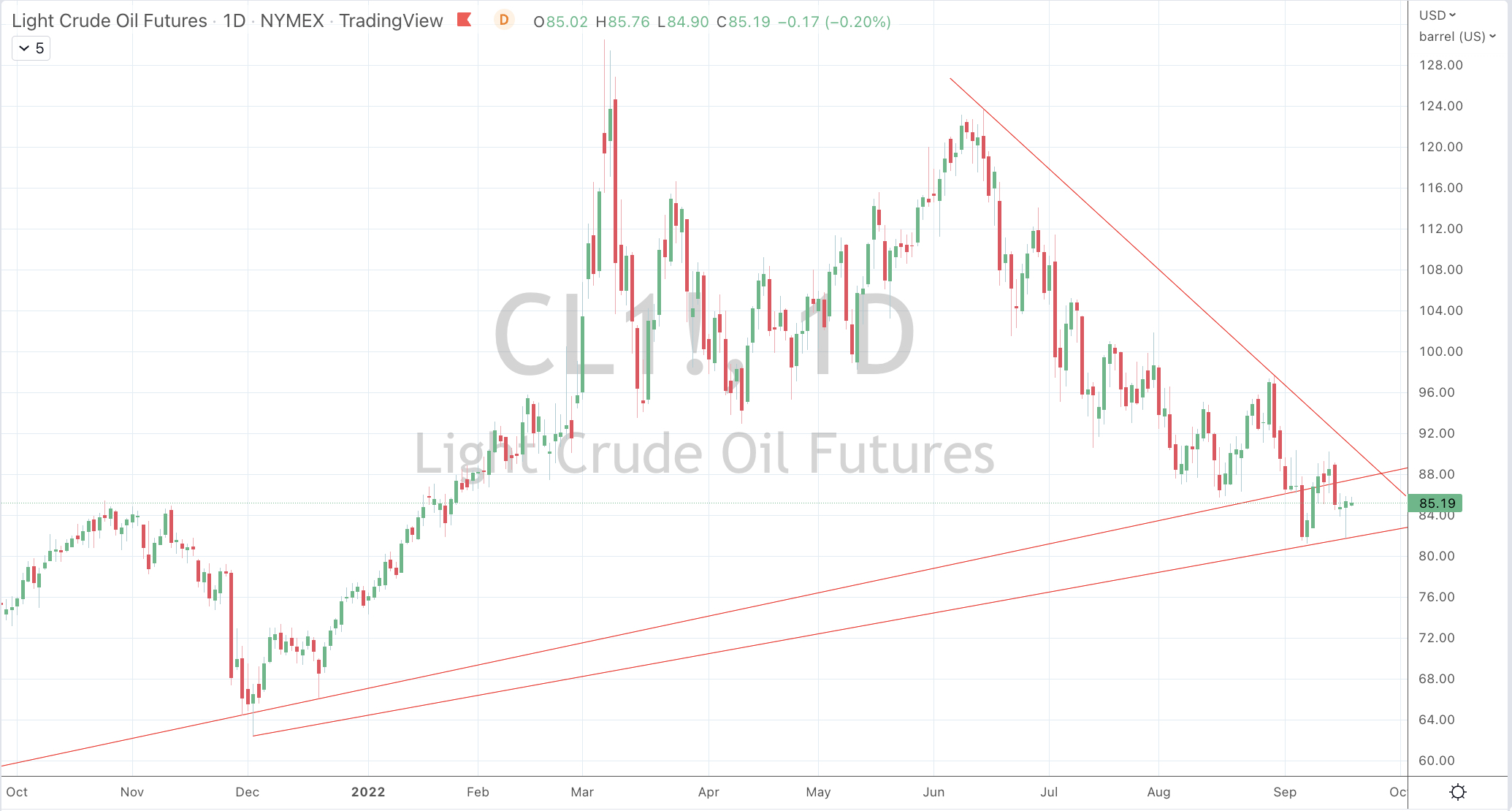
Here are some WTI Crude Oil trend lines I’m watching.

The downward trend remains intact, however on a daily basis it’ll need a quick drop of $2-$3 in order to add some strength to this trend, otherwise we can kiss a visit to $77.50 and any notion of ~ $65 good bye for the time being.

Should this trend wane, it will correspond with the AUD/USD and the CRB Index finding a floor.

September 20, 2022

by Rob Zdravevski

rob@karriasset.com.au
A trough in Bitcoin volatility portends a S&P 500 bottom

Bitcoin’s price action, trend and sentiment suggests it tests somewhere around the US$16,000 mark. +/- $600.

A drop in Bitcoin’s 30 day volatility precedes a trough in the price of BTC/USD which precedes ‘one more decline’ in the S&P 500 before itself finds a floor.

This would put my S&P 500 target around 3,645.

A bottoming process which builds into a rally in these two markets would cause much damage to all those huddled on the other side of the boat.

p.s. The direction Bitcoin also has reasonably good correlation with the Australian Dollar and commodity prices.

September 20, 2022

by Rob Zdravevski

rob@karriasset.com.au
Picking out the cheap commodities

I am constructively bullish about commodity prices, however that opinion is not broad nor blindly so.

I’m working on how to express my best ‘absolute’ view in a specific commodity or theme. Buying scarcity and those who have capacity will be a key criteria.

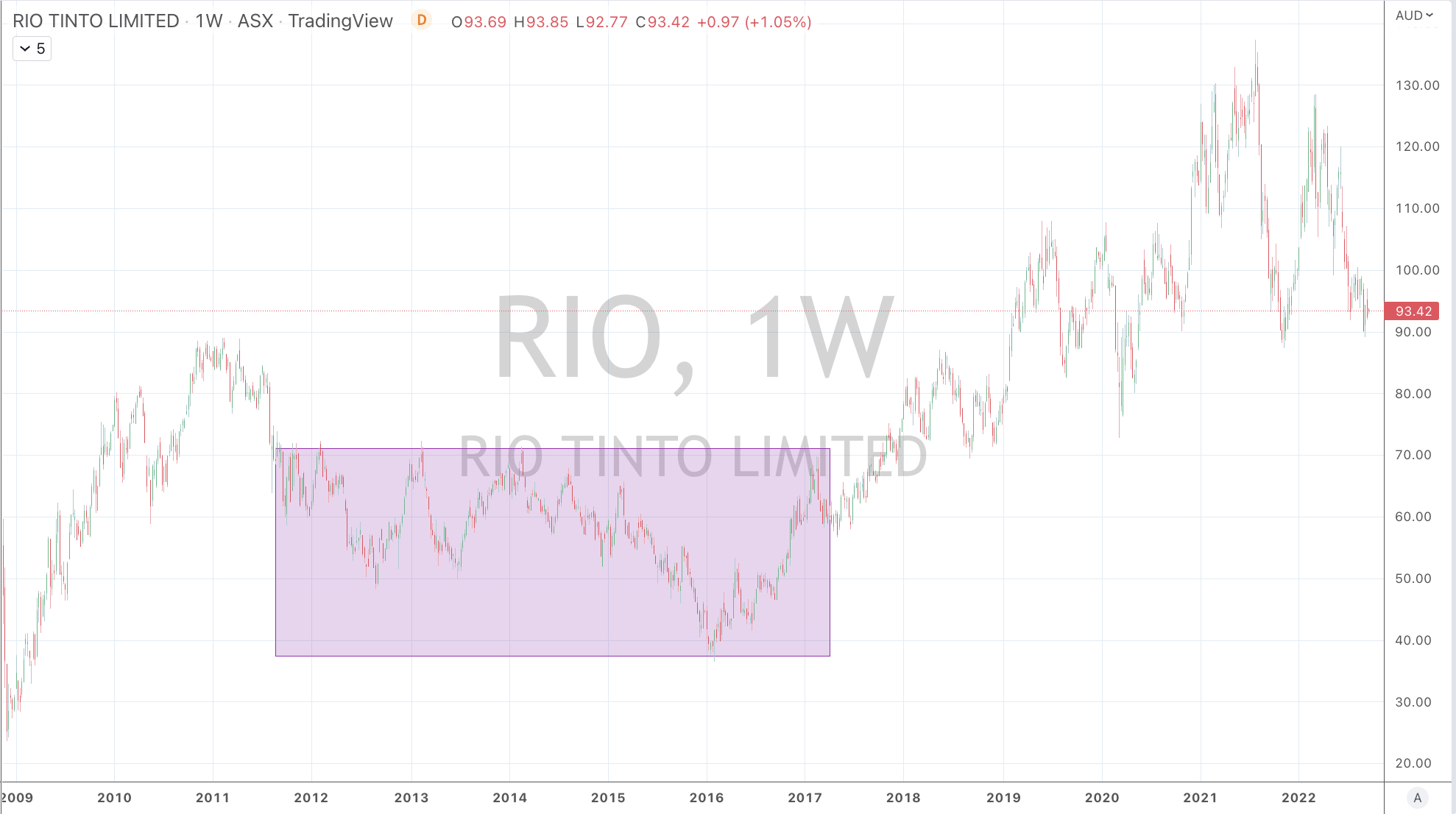
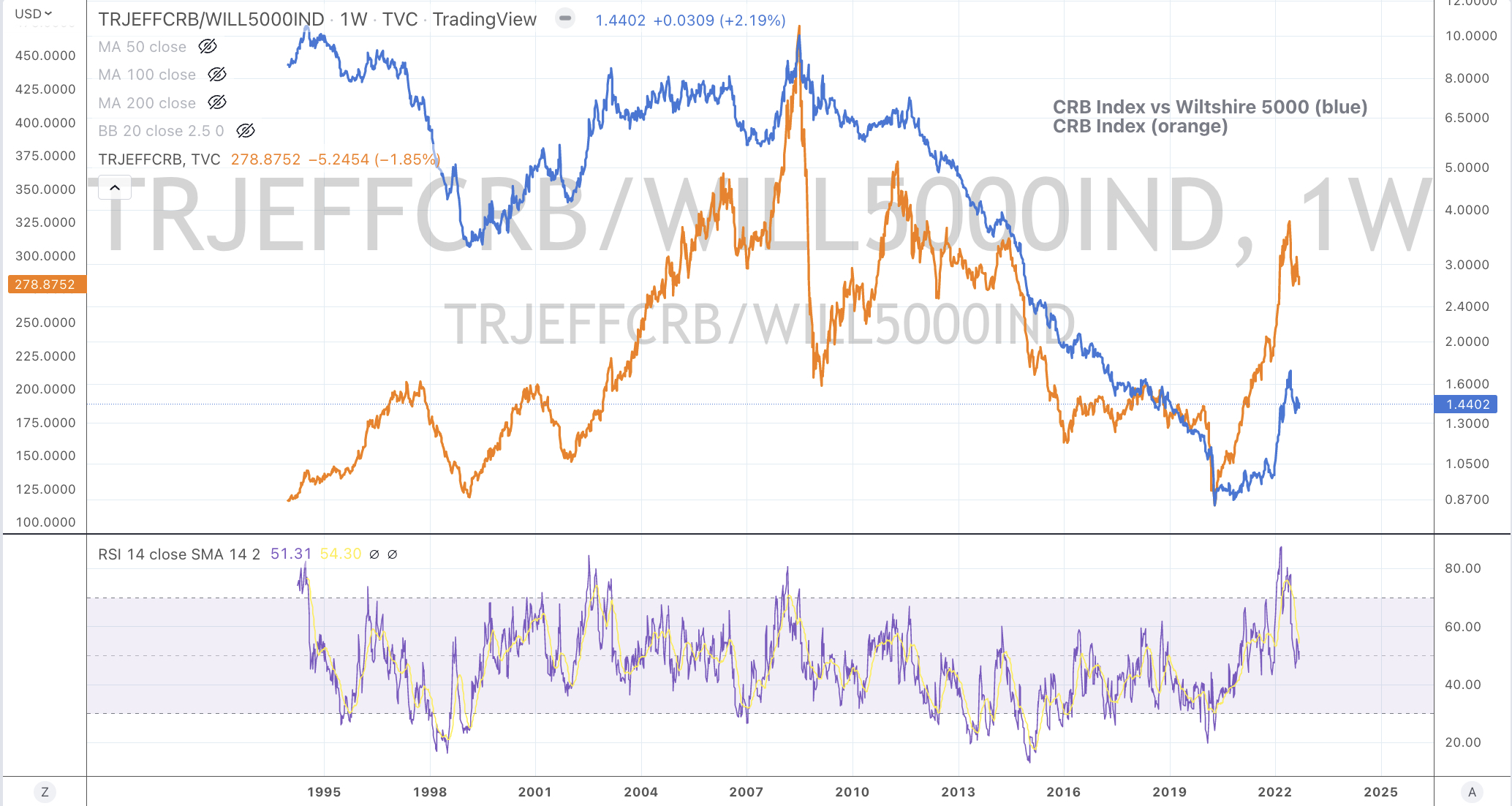
I remind myself that commodities can trade sideways (as Rio Tinto did for 7 years) and the broader CRB Index had for a 10 year bear market.

While I find analysis on a ‘relative basis’ irksome, commodities are nearing another visit to being inexpensive relative to equities, as the CRB Index to Wilshire 5000 chart shows.

September 19, 2022

by Rob Zdravevski

rob@karriasset.com.au

Australia is not in recession.

As much as I dislike the time spent speculating on such a definition, if I’m forced to pass an opinion, it’s looking like a mid cycle slowdown.

Irrespective, businesses adjust and we trade through the cycle.

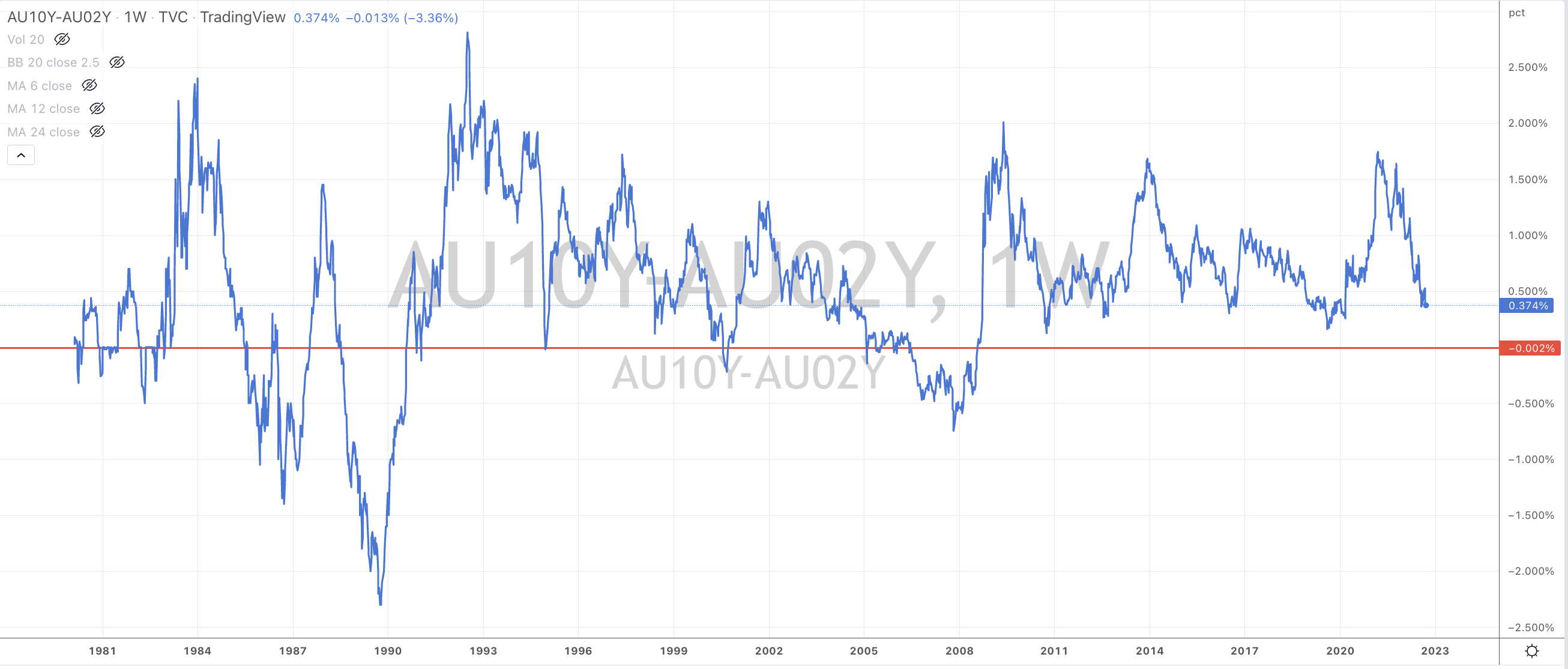
Over the past 40 years, studies show that recessions are officially registered somewhere between 18 months and 22 months following the inversion of a country’s yield curve, being when the difference between the 2 year and 10 year bond yield trades into a negative percentage.

The jury is still out whether the 5 year minus 3 month yield is a better indicator to watch.

So back to the traditional 10 year minus 2 year…..and unlike the United States, the Australian yield curve is not inverted.

The red line in the chart below represents 0.00%.

The two things occurring which I think will invert this curve are;

1) an overzealous Reserve Bank of Australia hiking rates too much trying to correct the overly accommodating and subsidising government fiscal policy errors and;

2) a government which cuts off the nations (commodity supply and capacity) ‘nose to spite its own face’ by crimping production and export of gas, coal, iron ore and other minerals.

September 19, 2022

by Rob Zdravevski

rob@karriasset.com.au