Drill Rig count rises

The monthly Worldwide Rig Count is out from Baker Hughes

FYI, this data is a monthly census of “active” drilling rigs exploring for or developing oil or natural gas.

A modest global increase of 1.5% was seen from the previous month.

In the attached PDF I encourage readers to look at which regions are closing in on a similar amount of rigs ‘in action’ as see in February 2020. Some are nearly there.

It’s quite telling though.

The Europeans are lagging as they are curtailed by ESG influences.

Latin America needs petro-dollars more desperately than others.

The Middle East can refrain drilling in order to will higher prices.

While the USA is a hair away from their February 2020 levels, driven by political rhetoric of oil independence and a government customer needing to replenish their dwindling Strategic Petroleum Reserve.

Needless to say or see, the number of Oil and Natural Gas drilling rigs being put to work isn’t in a declining trend.

October 9, 2022

by Rob Zdravevski

rob@karriasset.com.au

Macro Extremes (week ending October 7, 2022)

The following assets (on a weekly timeframe) registered an Overbought or Oversold reading and/or have traded more than 2.5 standard deviations above or below its rolling mean.

Extremes “above” the Mean (at least 2.5 standard deviations)

TBX

Orange Juice

Overbought (RSI > 70)

U.S. Dollar Index (DXY)

U.S. 2,5, 10, 20 and 30 year government bond yields

German 2, 5 & 10 year government bond yields

British 5 year government bond yields

Spanish, French, British, Greek, Italian, Korean & Portuguese 10 year government bond yields

The Overbought Quinella – Both Overbought and Traded at > 2.5 standard deviations above the weekly mean)

TBT

Extremes “below” the Mean (at least 2.5 standard deviations)

Rotterdam Coal

CAD/USD

AUD/SGD

Oversold (RSI < 30)

Tin

Hot Rolled Coil Steel (HRC)

TLT

IEF & IEI

AUD/USD

GBP/USD

EUR/USD

NZD/USD

DKK/USD

SGD/USD

JPY/USD

ZAR/USD

KRW/USD

SEK/USD

IDR/USD

And Taiwan’s TAIEX equity index

The Oversold Quinella – Both Overbought and Traded at > 2.5 standard deviations above the weekly mean)

None

Notes & Ideas:

The big news for the week was that many equity markets posted a reasonable positive return for the week even following Friday’s drubbing.

For example, the Philadelphia Semiconductor Index (SOX) rose 2% for the week even after a 6% plunge in Friday’s trading session alone.

The second biggest news was that most of the energy complex (attributing much to the CRB Index percentages rise) had a cracker of a week with Gasoline, Brent, Heating Oil and Diesel rose somewhere between 15% and 26% in a single week……all except Gas, including Natural Gas which saw an intra-week low of $6.30 and closing in on my $5.00 target.

Dutch TTF Gas and the Japan-Korean LNG Marker have fallen considerably in past weeks.

Rotterdam delivered coal has tanked 34% in the past 5 weeks and now registered a move towards its lower end of the standard deviations pendulum.

Bond yields remain Overbought even though some eased off from last week’s highs (except for Gilts). There still seems there is time to accumulate government bonds, if they are part of your asset allocation.

And the persistent strength of the U.S. Dollar meant that a list of currencies ae trading at notable lows and weakness.

The AUD/USD closed at its lowest price in 2.5 years

The JPY/USD is at it weakest level since August 1998, while the AUD/JPY is 7% weaker from its heights and extremes reported weeks ago.

Hong Kong related/linked equity markets bounced following last week’s Oversold readings

Brazil’s BOVESPA has risen 22% since its July 11 2022, low. All this in the midst of a contentious Presidential election and rising interest rates?

In fact, on September 22nd, 2022, Brazil’s central bank decided to keep its rates unchanged following 12 consecutive increases which commenced in early 2021.

And lastly, the Baltic Dry Index has risen 81% in the past 5 weeks.

The larger advancers over the past week comprised of; 

Aluminium 6.4%, Bloomberg Commodity Index 5.1%, Baltic Dry Index 11.4%, Cocoa 1.8%, China Coal 8.1%, WTI Crude 16.4%, Gasoil 26.6%, Lean Hogs 4.2%, Heating Oil 19.3%, Lumber 5.5%, Platinum 6.8%, Gasoline 15.4%, Sugar 5.7%, Silver 6.4%, CRB Index 6.5%, Florida Urea 2%, Brent Crude 15.3%, Middle East Urea 5.7%, Silver in AUD 6.5%, Silver in USD 5.8%, Gold in AUD 2.7%, Gold in USD 2%, KBW Banks 1.8%, CAC 1.8%, DJ Industrials 2%, DJ Transports 3.5%, HSCEI 2.7%, Hang Seng 3%, Bovespa 5.8%, KOSPI 3.6%, S&P Midcap 400 2.9%, Nikkei 4.6%, Oslo 3.1%, Russell 2000 2.3%, SOX 2.2%, TAIEX 2.1%, Istanbul’s BIST 12.1%, S&P SmallCap 600 2.6% and Australia’s ASX 200 4.5% (although I expect 2% of that to be erased during this Monday’s session in reaction to U.S. action seen on Friday).

The group of decliners included;

Rotterdam Coal(17.1%), Hot Rolled Coil Steel ‘HRC’ (3.6%), JKM (11%), Tin (2%), Dutch TTF Gas (17.3%), Oats (2.8%), Rice (2%), Wheat (4.5%), Shanghai Composite fell 2%.

October 8, 2022

By Rob Zdravevski

rob@karriasset.com.au   

Story telling about current markets

I have attached a presentation I have been giving over the past 2 weeks.

It’s where I talk and try to put into perspective where the pendulum currently is, within the current market goings-on.

I touch on extremes in pessimism and sentiment measures, surveys and ratios.

Followed by a brief visit showing the extremes in interest rates. The corollary is that the rising cost of capital crimps profit margins and crucified valuations of equities whose cashflows and profits are years from materialising. So the pondering is what if these rates temper and abate?

I show you that forward consensus earnings estimates are moving lower and that P/E Ratios aren’t demanding, especially if you exclude the still overvalued “growth” and unprofitable companies.

I spend a little time chatting about currencies and the extremes that many are sitting at.

Then I move onto bond yields and yield spreads.

You’ll see that many equity indices are at their lower ebb.

and I finish up marrying up moments when commodities are undervalued compared to equities.

Of course, there is more to this analysis (than looking at P/E ratios) and ultimately narrowing down investment decisions, but it reminds me that much is nearer to the bottom than the top.

I paraphrased that last sentence in my recent newsletter, which was title, “Preparing for the last decile”

October 7, 2022

by Rob Zdravevski

rob@karriasset.com.au
Awaiting a SOX buying moment

The SOX index has traded down to 2.5 standard deviations below its rolling weekly mean and registered
an Oversold weekly reading on 3 occasions in the past 15 years.

I’m awaiting a 4th occurrence

October 7, 2022

by Rob Zdravevski

rob@karriasset.com.au
Following a $10 bounce, Oil is now a marginal trade

Further to today’s note about Oil, OPEC and Oversold break-even inflation rates…….

This note told you,

…..when Oil hit my long-standing lower target of $77.50 (trading to $76.25 intra-day).

That was 7 trading sessions ago and it coincided within the Oversold weekly reading for the 5 year break-even inflation rate.

Oil has bounced $10 since then.

Today, Oil has a short term upward trend developing,

but its only a trend.

At $87, it’s in no-mans land.

It could go $13 up or $13 down.

With new money, it’s a marginal trade or position to take.

Following a couple weeks of trade, I’m betting that WTI Crude sees $74 before it sees $100.

October 6, 2022

by Rob Zdravevski

rob@karriasset.com.au

American inflation rates tells OPEC when to cut production

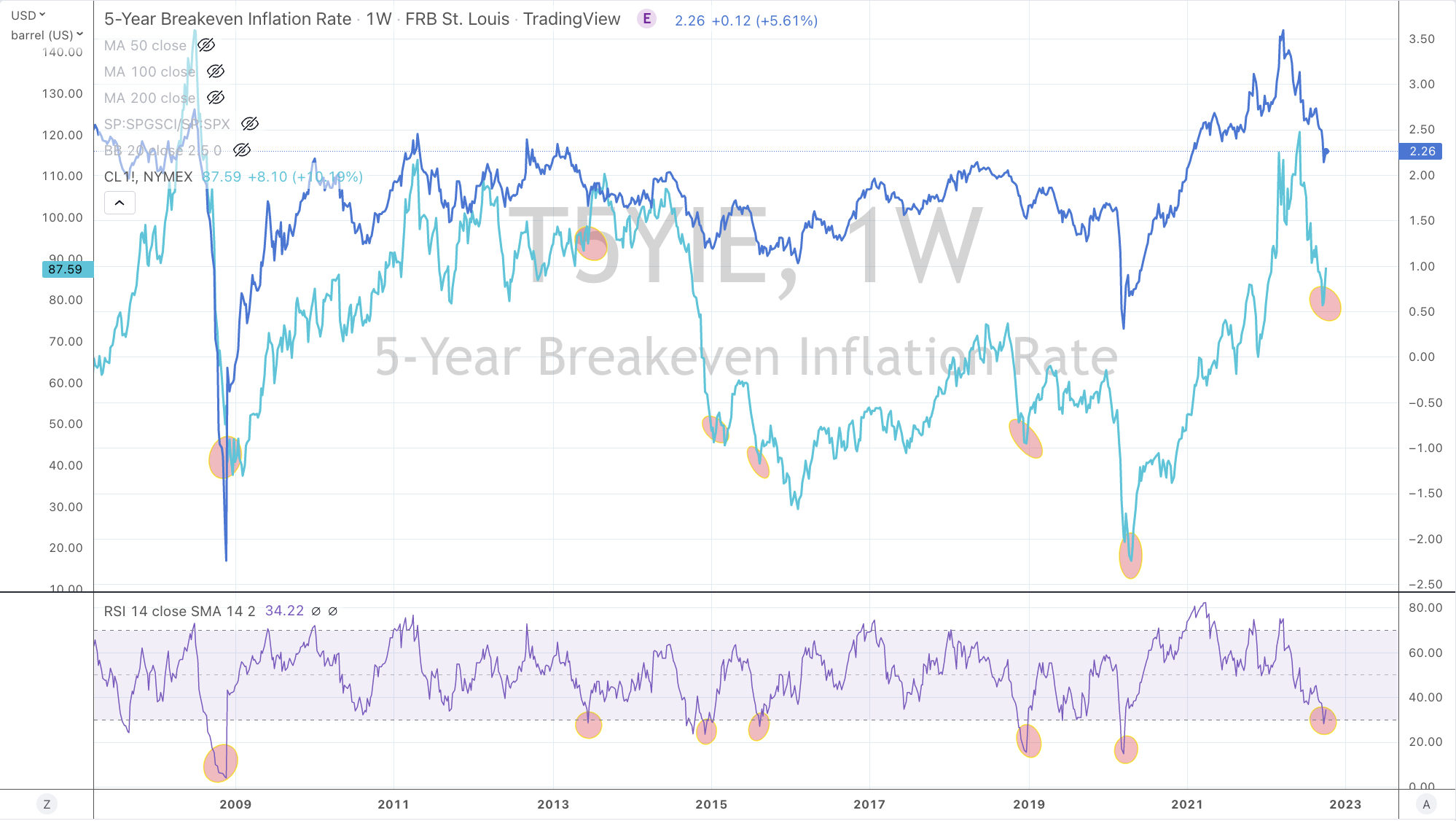
Here is a lovely chart showing the price of WTI Crude compared to U.S. 5 year break-even inflation rate.

To which the St. Louis Fed says about the latter, ‘the value implies what market participants expect inflation to be in the next 5 years, on average.’

Each value dance wonderfully together.

The better part of the chart is the lower bit where the RSI (Overbought/Oversold) indicator appears.

Whenever the 5 year breakeven inflation rate is Oversold (as this weekly chart shows), the WTI Crude Oil price finds a floor from which to advance.

We saw an Oversold 5 year b/e rate last week.

This week’s OPEC production cut announcement wasn’t a surprise because this Oversold moment in the U.S. 5 year break-even inflation rate tends to coincide with OPEC announcing production cuts.

Of course, Biden isn’t happy that OPEC have cut production.

Furthermore, Biden has virtually released all of the nation’s Special Petroleum Reserves. While he probably thinks it was his strategy sending Gasoline prices lower, when it was in fact a combination of other falling commodity prices (which is deflationary), mean reversion in the oil price and rising credit forces at work.

No to mention the importance of Biden needing lower domestic petroleum prices to aide his mid-term election hopes.

OPEC’s production cut may seem to be mathematically synchronised to the United State’s own inflation break-even rates but I think it is equally loaded with a little political payback.

Funnily, the U.S. isn’t pleased with this announcement and have passed on their views but it’s difficult to have a say into a club of which you’re not a member of.

Keep in mind, this study doesn’t assist the decision of when to sell your Oil.

There are other indicators for that.

October 6, 2022

by Rob Zdravevski

rob@karriasset.com.au

Lower interest rates is the uncrowded trade

I don’t know why people make it so difficult for themselves.

The bond market is ‘more correct’ than the rhetoric or ‘tough talk’ that central bankers provide.

The former isn’t emotional while the latter is and susceptible to biases.

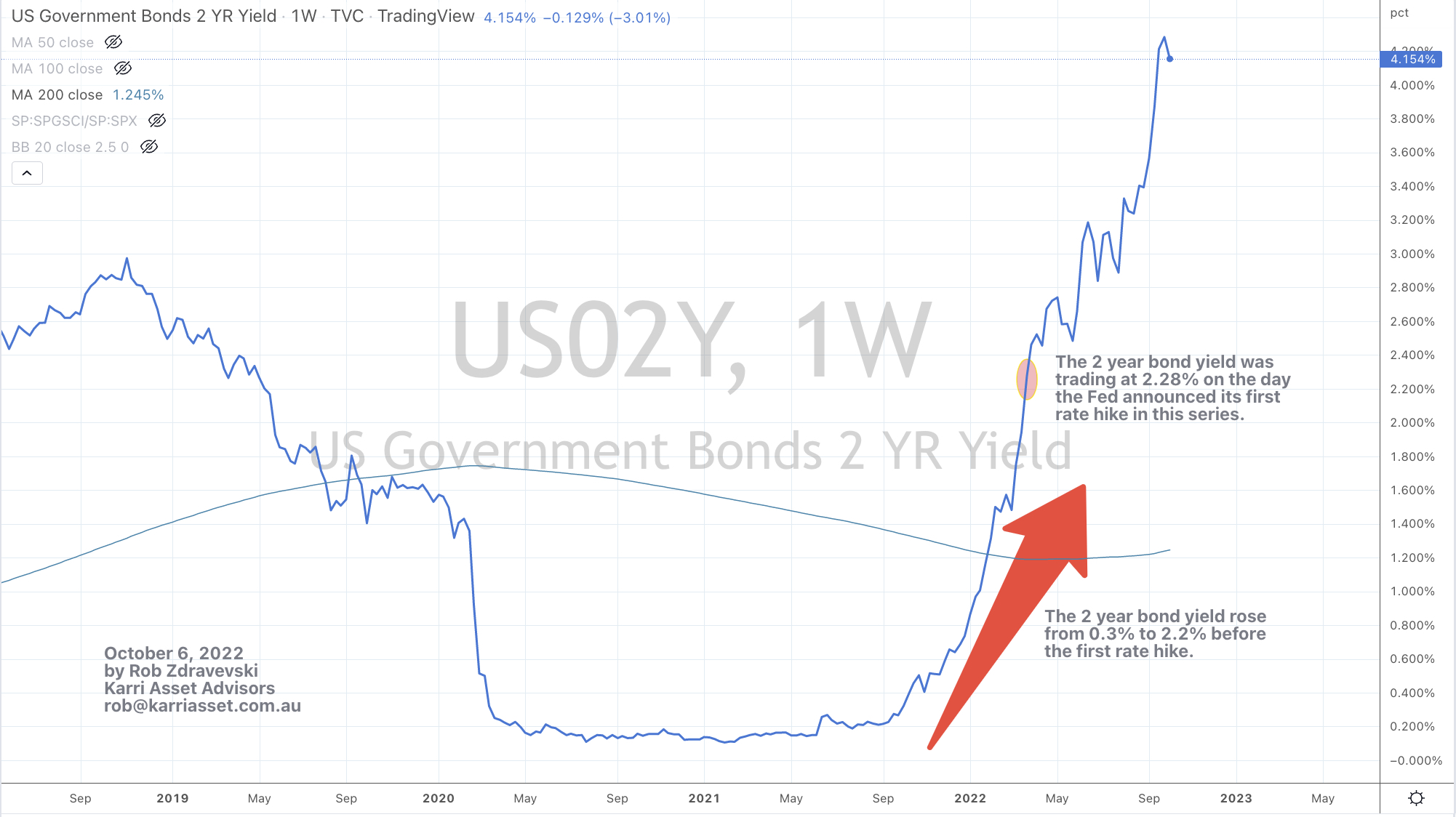
The U.S. 2 year bond yield started rising and forecasting higher interest rates in October 2021, when it passed the 0.30% level.

By the time the Federal Reserve announced its first rate hike on March 17th, 2022, the U.S. 2 year bond yield was 2.20%

I think it is a waste of time speculating or debating if the Fed will ‘pivot’ and change direction.

Firstly, a reversal of current direction is not an automatic occurrence. The Fed can keep rates where they are for a little more.

Secondly and more importantly, the bond market will tell you more.

Currently, 2 year bonds are yielding 4.15%.

Much is priced in and now poised at stretched levels.

The chart below shows the Fed raising rates by a factor of 12 from the 0.25% low.

This is in belated sync with the 11 to 13 fold hikes seen in many other economies while those commodity sensitive nations (where the citizens are least indebted compared to those in the G10) such as Brazil, Chile and Mexico all started hiking rates (trying to fight inflation) between March 2021 and June 2021.

The most crowded trade, thesis and belief is still – for higher rates.

Not many are calling lower rates.

I am.

For various reasons, I think this U.S. 2 year bond yield falls back to the 2.30%-2.60% range in the coming 10-20 months.

Does this mean that the Fed cuts rates into the next year?

Perhaps, Yes. Maybe taking the Fed Funds Rate to 2.75%

But I can’t see how they can raise rates another 1% with out ‘breaking something’.

October 6, 2022

by Rob Zdravevski

rob@karriasset.com.au

Amazon is consolidating nicely

Why AMZN’s $102 price low seen on May 9th, 2022 may hold?

This was one of 3 moments when AMZN stock price mean reverted to/or below its 200 week moving average, traded 2.5 standard deviations below its rolling weekly mean and registered a weekly RSI Oversold reading.

October 3, 2022

by Rob Zdravevski

rob@karriasset.com.au
Historic stretched lows in Hang Seng

Percentage which the Hang Seng Index is trading below its 200 week moving average.

October 3, 2022

Lower Copper means lower bond yields

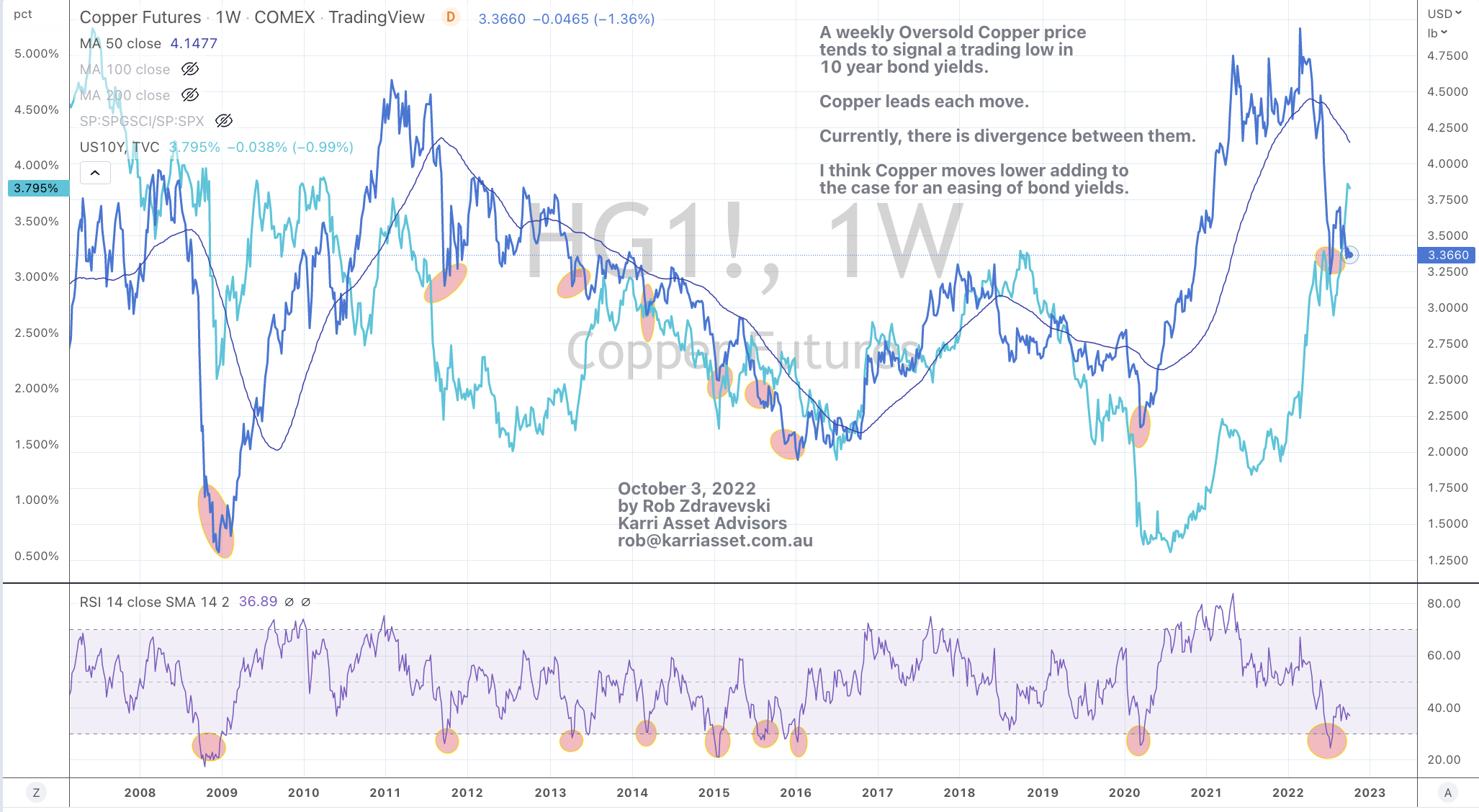
A weekly Oversold Copper price tends to signal a trading low in 10 year bond yields.

Copper leads each move.

Currently, there is divergence between them.

I think Copper moves lower adding to the case for an easing of bond yields.

October 3, 2022

by Rob Zdravevski

rob@karriasset.com.au