Banking stocks are made for trading

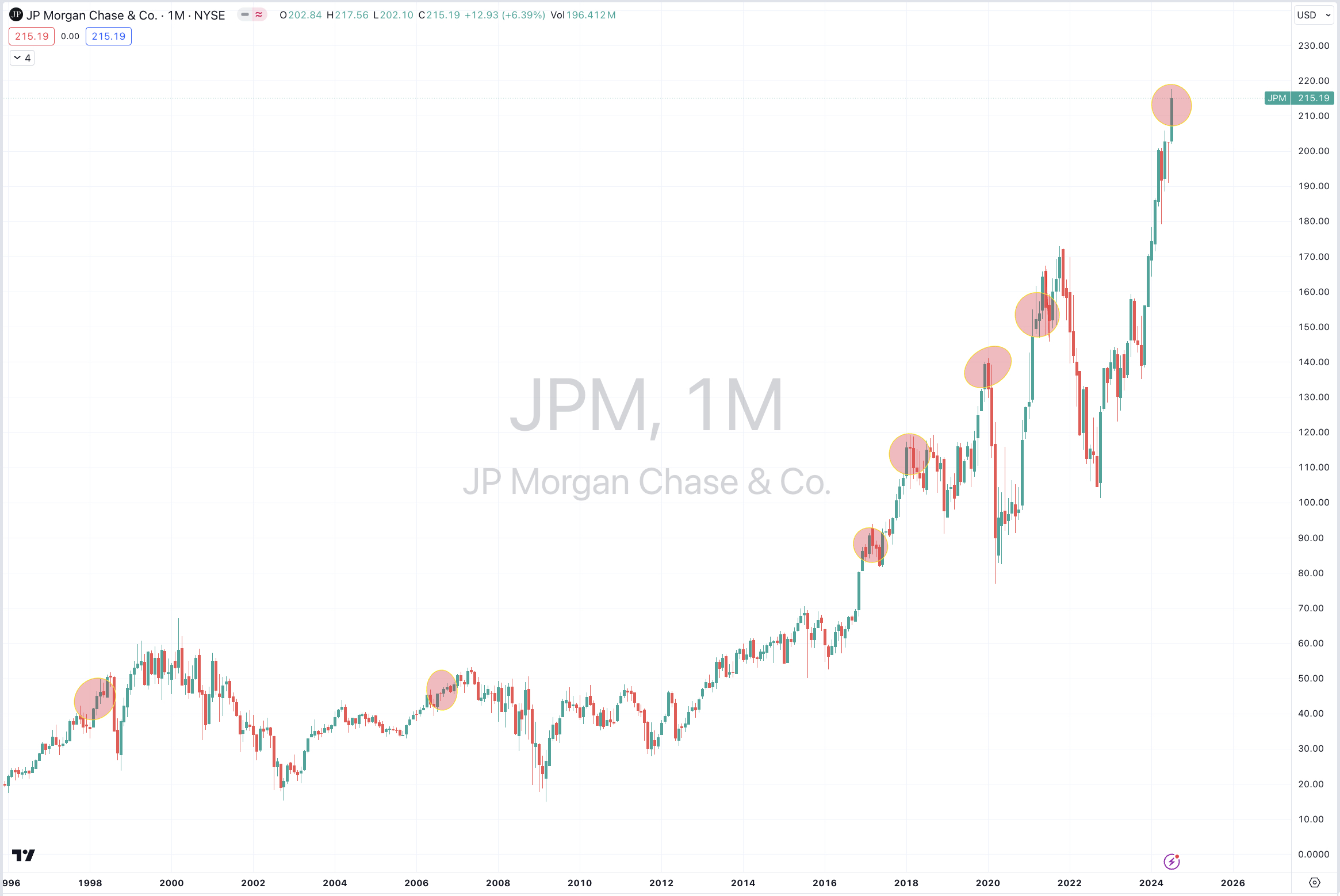
The circles in the chart below suggest moments when to accumulate shares in Wells Fargo & Co. #WFC.US

These are the moments when the stock price has traded below its 200 week moving average and also 2.5 standard deviations below its rolling weekly mean.

This study is only focused on the buying moment and not the selling moments.

Owning #WellsFargo stock hasn’t been synonymous with a ‘set and forget’ strategy. This is the case with many #banking stocks around the world.

Indeed, there are times when you should ponder selling the stock.

For example, today’s Wells Fargo stock price is still the same price it was 10 years ago.

And it hasn’t been an extraordinary compounder over the last 20 years either with an approx. annual return of 4.6%.

At ~ $54, I’m taking the ‘fat part of the trade’.

February 26, 2024

by Rob Zdravevski

rob@karriasset.com.au

Screenshot

Macro Extremes (week ending February 23, 2024)

A weekly Macro, Cross Asset review of prices trading at extremes which may generate future investment ideas and opportunities.

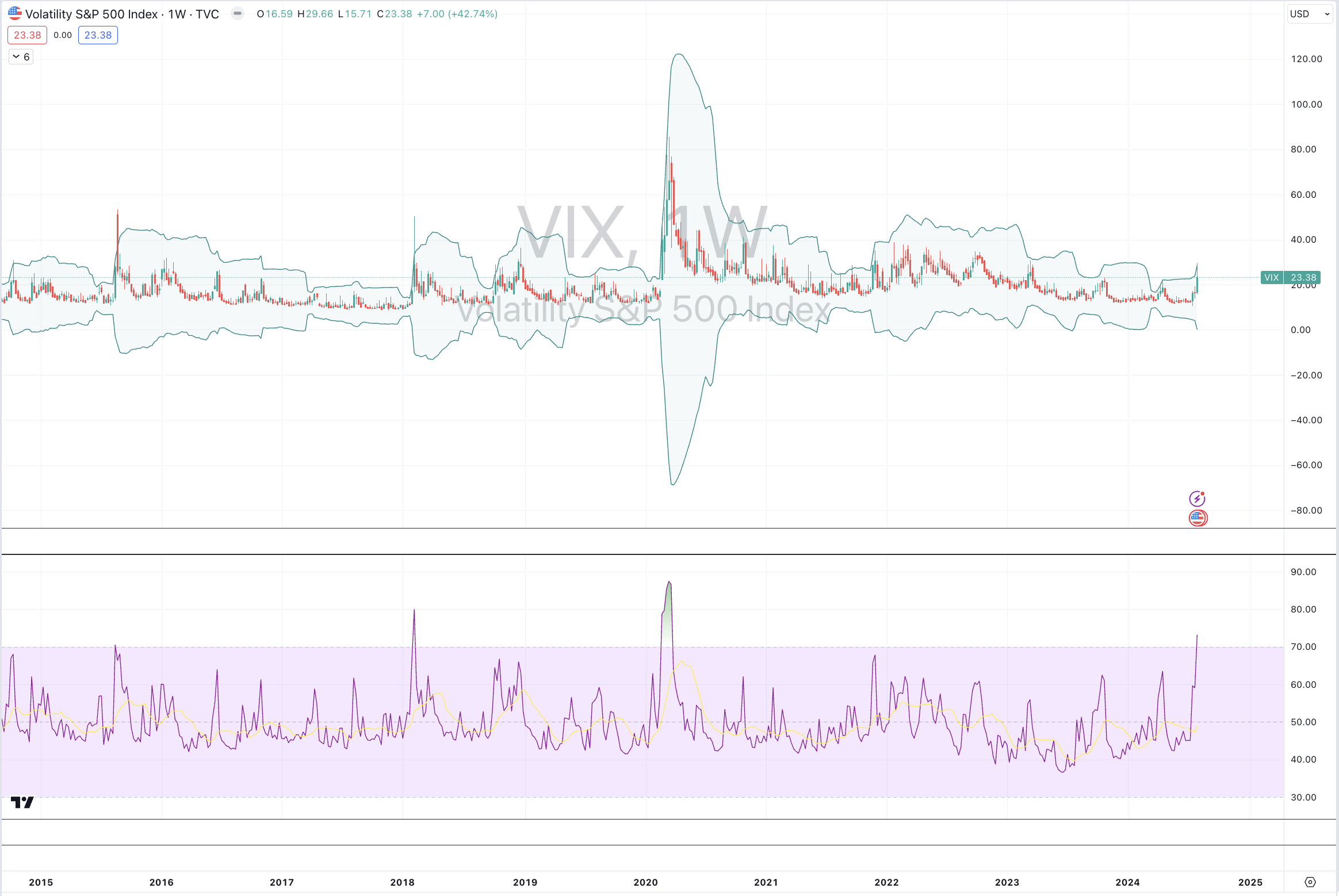
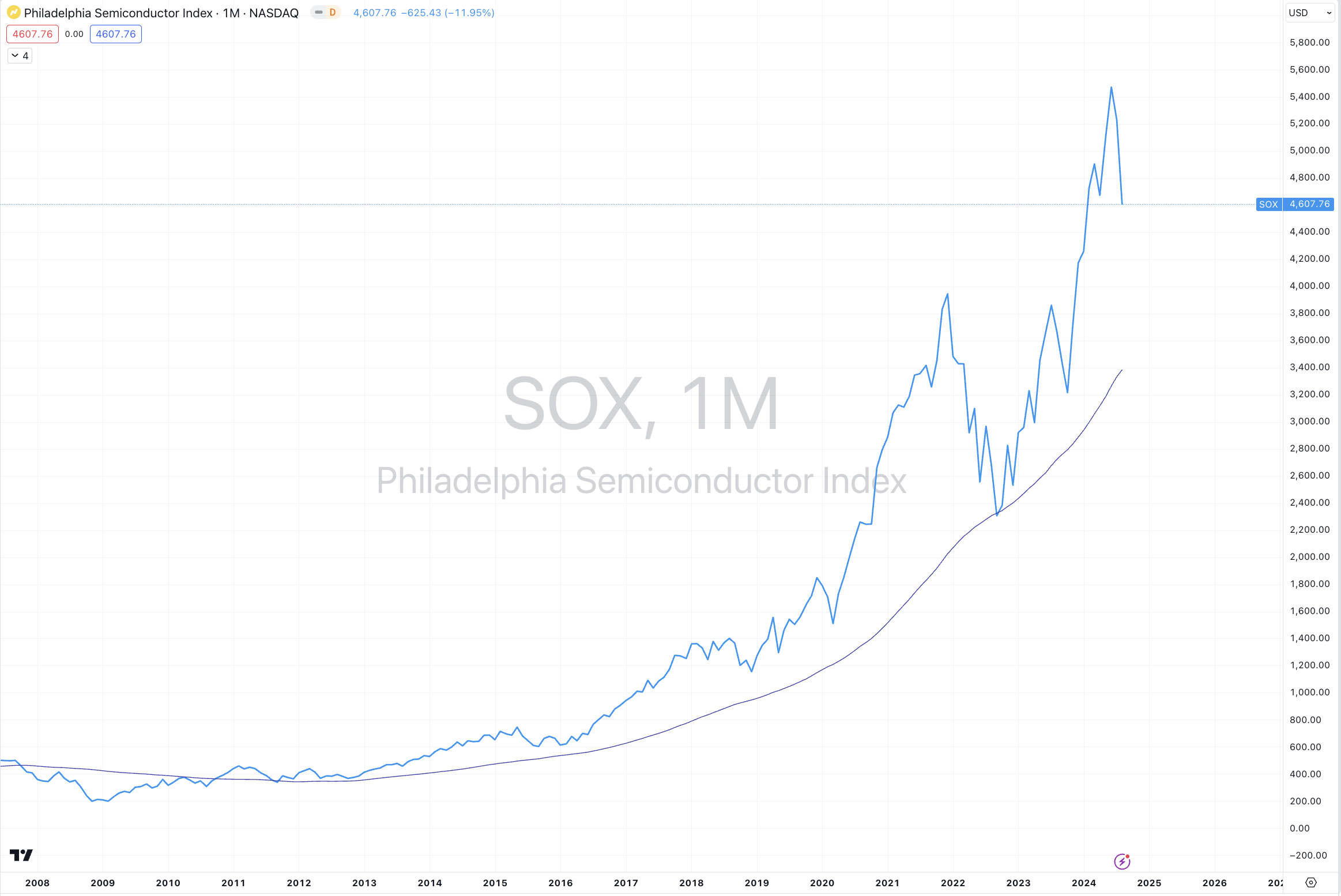
The following assets (on a weekly timeframe) either registered an Overbought or Oversold reading and/or have traded more than 2.5 standard deviations above or below its rolling mean.

Extremes “above” the Mean (at least 2.5 standard deviations

U.S. 3 month bond yield

Lean Hogs

NZD/AUD

Overbought (RSI > 70)

Rubber

AEX

Budapest

DAX

Dow Jones Industrial Average

Italy’s MIB

Egypt 30 Index

Nasdaq Composite

Nasdaq 100

Nasdaq Transportation Index

NIFTY 50

Nikkei 225

Philadelphia Semiconductor Index (SOX)

TAIEX

BIST 100

And the S&P 500 Index

The Overbought Quinella – Both Overbought and Traded at > 2.5 standard deviations above the weekly mean)

Cocoa (in U.S. and London)

KLSE

Extremes “below” the Mean (at least 2.5 standard deviations)

None

Oversold (RSI < 30)

China 10 year government bond yield

JKM LNG

Lithium Hydroxide

Dutch TTF Gas

Corn 

Soybean

The Oversold Quinella – Both Oversold and Traded at < 2.5 standard deviations below the weekly mean)

None

Notes & Ideas:

Government bond yields had a boring week.

Most stayed within 10 basis either side of last week’s close.

Equities were stronger, however there were some losers too.

The Nasdaq 100, Composite and Transports are all back in overbought territory after having a breather last week. The first two had bullish ‘outside’ weeks while the Nasdaq transports hit an all-time high.

Bullish outside reversal weeks were also seen in Thailand’s SET and Malaysia’s KLSE.

The latter is revealing on the back of a weak Ringgit.

The S&P 500 is still overbought. It has risen for 15 of its past 17 weeks.

The CAC and DAX made a new all-time highs.

The Dow Jones Industrial Average has now spent the past 11 weeks in overbought territory.

Amsterdam’s AEX continues to make new all-time highs.

The Philippines Stock Exchange has put together a 5 week winning streak.

Italy’s MIB has traded to its highest point since June 2008.

Turkiye’s BIST has risen for 8 consecutive weeks making for a 24% (in TRY terms) return.

And the Shaghai Compsoite, CSI 300 and the HSCEI has have risen 10% over the past couple weeks……in amongst all of that pessimism.

Commodities were mostly weaker. 

Uranium isn’t overbought anymore.

Nickel isn’t oversold.

Hot Rolled Coil Steel is nearing an extreme,

Cattle is streaking ahead, positing 8 consecutive winning weeks and closing higher in 10 of the past 11 weeks.

Nickel, Palladium, Cocoa and shipping rates had a good week.

Energy prices, industrial metals, grains, Coffee were the largest losers.

Lithium Hydroxide prices was unchanged for the week, once again, again.

Lithium Hydroxide has now spent 33 consecutive weeks in weekly oversold territory.

Heating Oil has fallen 9.5% in the past week and trading it must be a nightmare.

Cotton broke its 6 week winning streak.

Soybeans and Corn are registering oversold extremes. 

Soybeans are in a 10 week losing streak and have fallen 14 of the past 15 weeks.

And Henry Hub Natural Gas prices made an new all-time lows.

Currencies was were the action was.

The U.S. Dollar (DXY) Index broke its 7 week winning streak.

The AUD was firmer. The CAD was lower. The EUR mixed. The GBP stronger. The JPY weaker.

The AUD/JPY saw its highest intra-week levels and close since December 8, 2014, although its not at an overbought extreme. 

GBP/JPY is at its highest price since August 3, 2015.

The Japanese Yen has fallen for 7 of the past 8 weeks versus USD.

MYR/USD – all time low, suggests buying Malaysian Ringgit 

Colombian Peso is in a 8 week losing streak again the USD.

DKK/USD broke its 5 week losing streak.

The IDR/USD is in a 4 week losing streak.

The Singapore Dollar broke its 7 week losing streak vs USD.

And the ZAR/USD had a bearish outside reversal week.

The larger advancers over the past week comprised of;

Baltic Dry Index 15.9%, Lean Hogs 2.3%, Newcastle Coal 1.9%, Nickel on LME 7.1%, Nickel on CX 3.6%, Orange Juice 2.1%, Palladium 3.8%, Rice 2%, Wheat 1.8%, Shanghai 4.9%, CSI 300 3.7%, CAC 2.6%, China A50 2.6%, DAX 1.8%, DJ Transports 1.9%, MIB 3.1%, HSCEI 3.7%, HSI 2.4%, IBEX 2.5%, Pakistan’s KSE 4.9%, Nasdaq Biotechs 1.8%, SMI 1.7%, SOX 1.9%, Nasdaq Transports 2.7% and S&P 500 rose 1.7%.

The group of largest decliners from the week included;

Aluminium (2.1%), WTI Crude (2.5%), Heating Oil (4.2%), JKM LNG (5.2%), Coffee (3.4%), JKM LNG in Yen (5%), Tin (3.8%), Gasoline (2.7%), Robusta Coffee (3.5%), Sugar (2%), SPGSCI (1.4%), Dutch TTF Gas (7.6%), Brent Crude (1.9%), Gasoil (1.7%), Uranium (5.9%), Silver in AUD (2.5%), Silver in USD (2%), Corn (4%), oats (4.7%), Soybeans (2.9%), MOEX (3.1%), KRE Regional Banks (1.7%), Chile (2.3%) and the ASX Materials fell 1.7%. 

February 25, 2024

by Rob Zdravevski

rob@karriasset.com.au
What if the unemployment rate doubles?

I’m conditioning myself to see U.S. #unemployment rate between 5.5% – 6% within 30 months.

Opining that it should hold the current 3.7% levels is fighting against (my work on) probability and more so when you consider the quantum change seen in interest rates.

I’ll give you a floor of 3.3%.

What if the #unemploymentrate nearly doubles?

What do various capital markets look like with a 6% U.S. unemployment rate?

In business, wage pressure would certainly ease.

It’s not a very sharp outlook for residential real estate, especially if you lose your job.

February 25, 2024

by Rob Zdravevski

rob@karriasset.com.au
Screenshot

Form a view, reporting it doesn’t help

The Shanghai Composite and CSI 300 Index have risen 10% over the past 2 or 3 weeks.

Media reports simply reporting this adds little value.

https://www.bloomberg.com/news/articles/2024-02-24/enjoy-the-rally-while-it-lasts-is-china-stock-traders-new-mantra?sref=qLOW1ygh

My subjective observation of recent pessimism along with my empirical analysis lead to my weekend publication, “Macro Extremes” listing these indices in the ‘extreme oversold’ category in the few weeks prior to this ‘reported’ news.

While this rebound is encouraging, it should be treated as a ‘trade’ for now. This means I expect a small pullback. Some ‘sideways’ travel and consolidation would also be constructive for China’s equity indices.

A couple weeks ago, I highlighted 7 moments (in a private note) when the CSI 300 provided an entry point which pointed to reasonably probability of a trading bounce.

Today’s situation is also labelled as one of those.

February 25, 2024

by Rob Zdravevski

rob@karriasset.com.au

Screenshot

some scenarios about Lend Lease

Whilst I acquaint myself with the numbers and the fundamental business of ‘beleaguered’ Australian property development company, Lend Lease (LLC.ASX)…….the decline in the stock price has been merciless.

Lend Lease’s current stock price is A$6.04

18 months prior, there were some other anecdotal concerns about the company which crossed my desk.

But the recent declining ‘wave’ (since August 2023) where the stock price has fallen 30% has seen 420 million shares traded, which equals 62% of its free floating shares on issue.

Subjectively, when 60%+ of the company’s shares have turned over, within a certain period, I start think that the last ‘hold-out’ has folded and thrown in their hand.

For some initial sport, I think this stock may trade down to the $5.20 – $5.70 range.

Alternatively, I think a ‘consortia’ will appear with a bid to buy the whole business at $5.60 per share, making it a ‘take-under’ from today’s price.

Not all acquisitions occur at a premium price.

But perhaps I may conclude that it’s better to own the debt rather than the equity….should I come to any decision at all.

February 23, 2024

by Rob Zdravevski

rob@karriasset.com.au

Screenshot

Nickel…..too early?

Perhaps early but not too late to by #nickel ?

Tuning in to the headline and operational mining pessimism seen amongst Nickel producers (explorers have their own issues)……Nickel prices on the LME are trading at ‘extremes’.

February 23, 2024

by Rob Zdravevski

rob@karriasset.com.au
Screenshot

Looking for lower entry points in Uranium

Long time readers of my blog would confirm that I have had a structural bullish view on #uranium for some years.

For now (at least 3 or 4 weeks ago) the collective uranium basket is full.

If I could express what I think is next, through the NYSE listed share price of #Cameco, I’ll await for CCJ.N to come back to the $27-$30 mark somewhere in the May-July 2024 timeframe before adding some more.

February 23, 2024

by Rob Zdravevski

rob@karriasset.com.au

Screenshot

Scarcity lies in public not private

I have attached a graphic to illustrate the number of companies listed on the ASX as they fall within various market capitalisation bands. They are also expressed as a percentage of the total amount of listed entities.

In October 2000 I first wrote a note about the shrinking amount of companies listed on the Australian Stock Exchange in the form of phrase which I refer to as “de-equitisation”.

Then in November 2023, I reprised the topic with this note,

While more Australian publicly listed companies will ‘take too early’, I think that the opportunity continues to lie within the public markets rather than the fantastically touted ‘private equity’ market.

Since the great American de-equitisation commenced, 20 years ago, the S&P 500 has risen at an annual compounded rate of approximately 8.6%. Some reports of private equity funds suggest that they rose around an average annual rate of return of 11.4%.

Whilst there is a notable difference, the S&P 500 metric is a cash return.

I can’t tell if those private equity returns involved much leverage at very low terms of borrowing rates…..but I suspect so.

Today, interest rates aren’t as comparatively low.

Buying scarcity is my motto and Australia (and the world) has exponentially more privately held companies that publicly listed.

February 23, 2024

by Rob Zdravevski

rob@karriasset.com.au

Dislocation between Natural Gas and energy equities

Something looks undone between the price of #Woodside #Energy (WDS.ASX) and the Henry Hub #Naturalgas price.

You find this similar picture applies to the equity prices of other energy companies.

#correlation

February 20, 2024

by Rob Zdravevski

rob@karriasset.com.au

Screenshot

Macro Extremes (week ending February 16th, 2024)

A weekly Macro, Cross Asset review of prices trading at extremes which may generate future investment ideas and opportunities.

The following assets (on a weekly timeframe) either registered an Overbought or Oversold reading and/or have traded more than 2.5 standard deviations above or below its rolling mean.

Extremes “above” the Mean (at least 2.5 standard deviations

10 year Russian government bond yields

Lean Hogs

Tin

Overbought (RSI > 70)

Cotton 

Cocoa

Rubber

Uranium

Robusta Coffee

AEX

Italy’s MIB

KLSE

Dow Jones Industrial Average

NIFTY 50

Nasdaq Transportation Index

Egypt 30 Index

Philadelphia Semiconductor Index (SOX)

TAIEX

Budapest

And the S&P 500 Index

The Overbought Quinella – Both Overbought and Traded at > 2.5 standard deviations above the weekly mean)

Nikkei 225

Russia’s MOEX Index

Turkiye’s BIST 100 Index

Extremes “below” the Mean (at least 2.5 standard deviations)

Shanghai Composite

Oslo’s OBX Index

Wheat

Oversold (RSI < 30)

JKM LNG

Lithium Hydroxide

Nickel on India’s MCX Exchange

Corn 

Soybean

The Oversold Quinella – Both Oversold and Traded at < 2.5 standard deviations below the weekly mean)

China 10 year government bond yield

Notes & Ideas:

Government bond yields were higher for week, again.

As mentioned in last week’s edition, many yields continue to move higher back towards the middle of their recent ranges.

German 10’s closed at their highest weekly close since November 20, 2023.

The Australian 10 year minus U.S. 10 year bond yield spread is in a 4 week losing streak.

The British 5 year’s are in a 5 week winning streak as are the Japanese 2’s. The latter have moved from 0.00% to 0.14% in that time.

Equities were stronger, however there were some losers too.

The Nasdaq 100, Composite and Transports aren’t overbought anymore, breaking wither their 4th or 5th consecutive weeks of advance.

The S&P 500 is still overbought but it did break its 5 week winning streak. It has risen for 14 of its past 16 weeks.

The CAC made a new all-time high.

The DAX performed a weekly outside bullish reversal which can be interpreted as a continuation of its rising trend.

Inversely, the Dow Jones Transports ‘did’ an outside bearish reversal, as ‘did’ the Nasdaq 100.

The Dow Jones Industrial Average broke its 5 week winning streak while it has now spent the past 10 weeks in overbought territory.

The S&P 500 is also in a 5 week winning streak and has risen for 14 of its past 15 weeks.

Amsterdam’s AEX continues to make new all-time highs.

Last week’s report that the Russell 2000 and the S&P MidCap 400 both performed a bullish outside reversal week has resulted in those indices bucking the declines seen in the other major U.S. indices.

Turkiye’s BIST has risen for 7 consecutive weeks making for a 22% (in TRY terms) return.

And the HSCEI has risen 6.5% over the past weeks……in amongst all of that pessimism.

Commodities were mixed with the notable advancers and decliners listed below. 

Cocoa and Sugar broke their respective 5 and 6 week winning streaks.

Precious metals had a good week. 

Softs and Grains were clearly weaker.

Energy was mostly weak, with Natural Gas tanking again.

WTI Crude outperformed Brent Crude.

Lithium Hydroxide prices was unchanged for the week, once again. 

Is this called consolidation or digestion?

Lithium Hydroxide has now spent 32 consecutive weeks in weekly oversold territory.

Cattle is in a 7 week winning streak and has closed higher in 9 of the past 10 weeks.

Heating Oil continues its roller coaster. This week it fell 5%, the prior week it rose 11%, the week before that it fell 6% and the week before that saw it rise 7%. Mamma Mia !

Cotton is in a 6 week winning streak.

Soybeans and Corn are registering oversold extremes. 

Soybeans are in a 9 week losing streak and have fallen 13 of the past 14 weeks.

Henry Hub Natural Gas prices made an new all-time lows, having fallen 28% ion the past 3 weeks while JKM LNG are trading at their lowest close since December 20, 2020.

And Rice performed a weekly outside bearish reversal.

Amongst currencies, the collective U.S. Dollar (DXY) Index is in a 7 week winning streak.

The U.S. Dollar has risen for 7 consecutive weeks against the Chilean Peso which perhaps correlates with the tempered commodity prices of late.

The AUD rose for the week across its pairs, the CAD was slightly lower.

While against specific pairs, the U.S. Dollar has risen for the past 5 or 6 weeks.

The AUD has slight gains, thus putting an end to its consecutive losing streaks against many pairs such as the 6 week losing streak for the AUD/SGD.

The Yen was weaker, again which dances well with the risk-on temperament seen in equities.

The larger advancers over the past week comprised of;

Baltic Dry Index 4.2%, WTI Crude 2.5%, Cotton 2.9%, Lean Hogs 4.9%, Copper 4.3%, Lumber 2.1%, Tin 6.3%, Nickel 2.7%, Palladium 9.6%, Platinum 4%, Silver in AUD 3.5%, Oats 2.1%, Shanghai 5%, CSI 300 5.8%, KBW Bank Index 1.9%, China A50 2.8%, MIB 1.9%, HSCEI 4%, Hang Seng 3.8%, Indonesia 2.5%, KRE Regional Bank Index 1.8%, Nikkei 225 4.3%, Helsinki 1.8%, Stockholm 2.4%, S&P 600 Value 2%, SMI 2%, Chile 4.9%, STI 2.7%, TAEIX 2.8%, FTSE 100 1.8%, BIST 2.3% and the ASX Industrials rose 1.8%.

The group of largest decliners from the week included;

Rotterdam Coal (1.6%), Cocoa (4.6%), Heating Oil (5.3%), Hot Rolled Coil Steel (1.7%0, Coffee (2.5%), Newcastle Coal (2.3%), Natural Gas (12.9%), Sugar (3.9%), Dutch TTF Gas (8.5%), Gasoil (3.9%), Corn (2.9%), Rice (3.2%), Wheat (5.9%), Cocoa (2.7%), Robusta Coffee (2.4%), DJ Transports (3.6%), Nasdaq Composite (1.3%), Nasdaq 100 (1.5%), Oslo (1.9%), S&P 500 (0.4%) and Pakistan’s Karachi KSE 30 fell 5.6%.

February 18, 2024

by Rob Zdravevski

rob@karriasset.com.au