Cheaper corn is good for tortilla sales

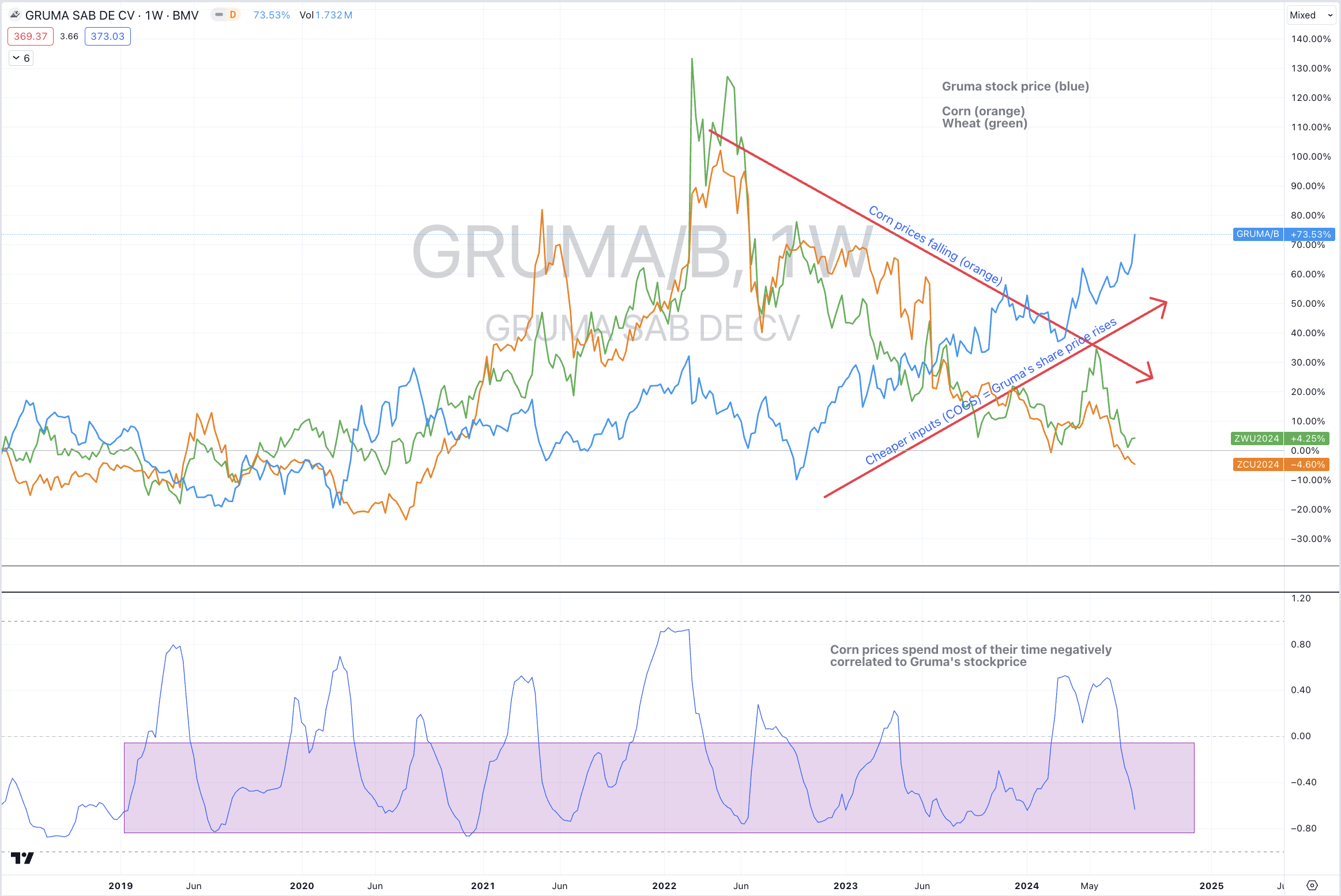
See how declining #corn and #wheat prices are good for the share price of Mexican based food company, Gruma.

They are negatively correlated.

Cheaper ‘inputs’ equates to lower ‘cost of goods sold’ for Gruma.

#Gruma makes corn flour, both wheat and corn tortillas, snacks along with flatbreads and pitas.

Mission is one of their most known brands.

Today, Corn and Wheat are ‘troughing’ while Gruma’s stock price is approaching overbought levels.

Readers may also be interested to note the correlation which the #inflation rate has with price of corn and wheat.

August 8, 2024

by Rob Zdravevski

rob@karriasset.com.au

Screenshot

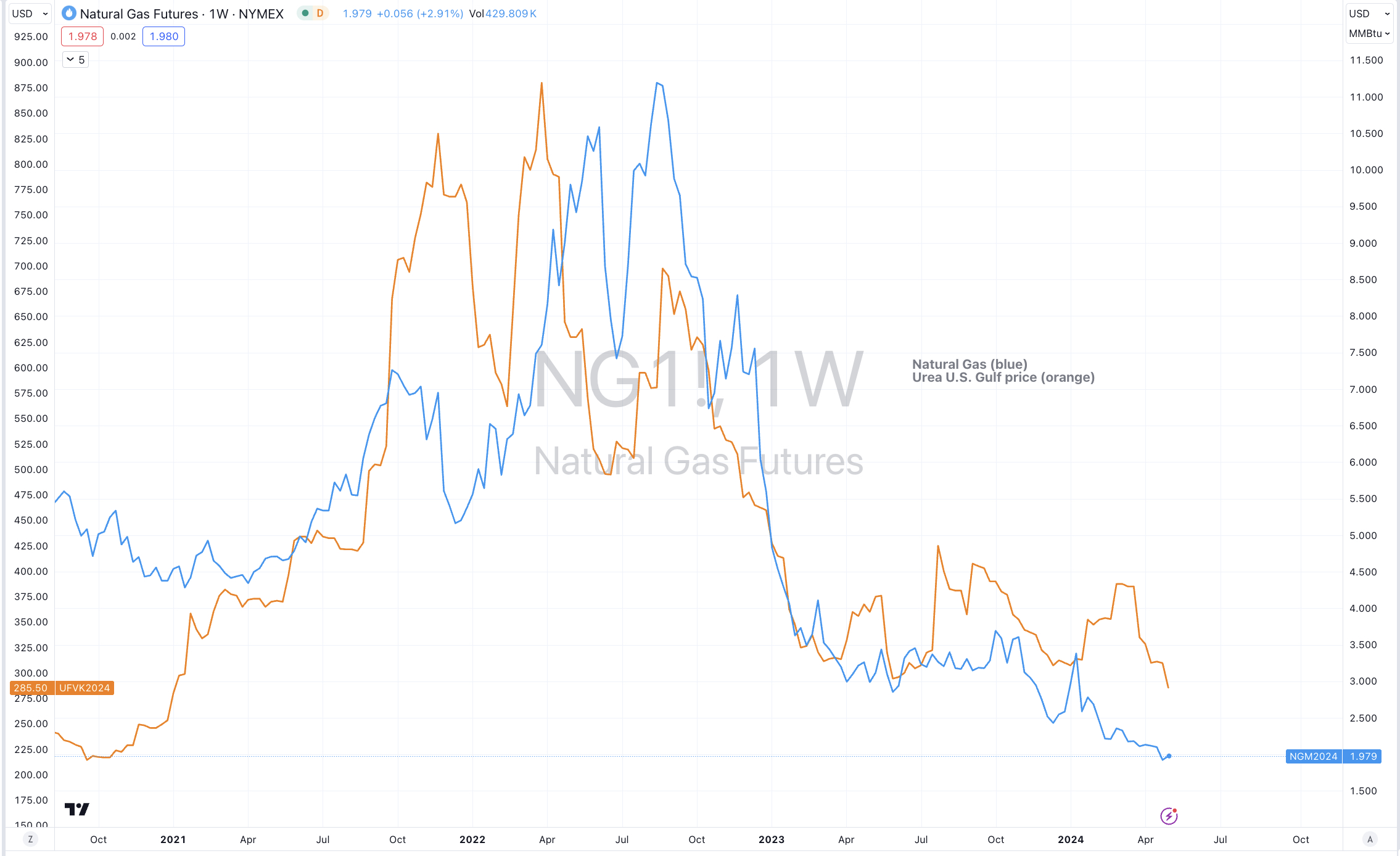
Urea, Natural Gas and things fertiliser are nearing lows

Following my pithy comment about food, calories and fertiliser,
readers can track my historical posts about this topic here,

https://lnkd.in/gJ-2rQh8

There is continuity in those posts about the relationship that fertiliser prices have with the price of Natural Gas.

The chart below is the latest illustration and update between the U.S. Gulf Urea price and the Henry Hub Natural Gas price.

May 2, 2024
by Rob Zdravevski
rob@karriasset.com.au

Screenshot

It’s quiet on the food front

I remember all of that noise around Urea, Fertiliser, Nitrogen, Grains and the world requiring calories……

……now not so much.

#contrarian

No one is buying Wheat

Wheat is at an all-time low.

In the chart below I circled the buying frenzy when #Russia invaded #Ukraine and the whole wold became experts on #wheat shipments out of Odessa.

This was supplemented with pundit commentary that the world was facing a calorie shortage.

Today, wheat is nearing an oversold extreme and no one is talking about it.

Is being ‘Gluten Free’ the new Electric Vehicles dictum?

The 2nd derivative is that food companies now have cheaper inputs.

I wish Barilla #pasta was publicly listed.

Its good for the importers, bad for the exporters.

Good for the processors, bad for the growers.

March 17, 2024

by Rob Zdravevski

Karri Asset Advisors

rob@karriasset.com.au

Screenshot
Screenshot

Parabolic Cocoa

The parabolic move of the year (so far) goes to Cocoa.

Historically, such parabolas are usually thumped and mean reversion is honoured quickly.

The most recent #parabolic price moves were seen in Natural Gas and Wheat in the earlier phases of the Russian/Ukrainian War.

The attached monthly chart goes back to 1984.

The Empirical Rule states that 99.7% of data or prices observed following a normal distribution lies within 3 standard deviations.

Today, #cocoa is at 3.5 standard deviations.

While the upward move is astonishing, but I do wonder, with such probabilities, who is buying Cocoa at such prices?

Other extremes are seen in the distance above moving averages and the width of the Bollinger bands.

In the meantime, the stock prices of Hershey, Nestle and Barry Callebaut are wallowing at their recent lows.

March 16, 2024

by Rob Zdravevski

rob@karriasset.com.au

Screenshot

Wheat’s 2nd and 3rd derivative relationships

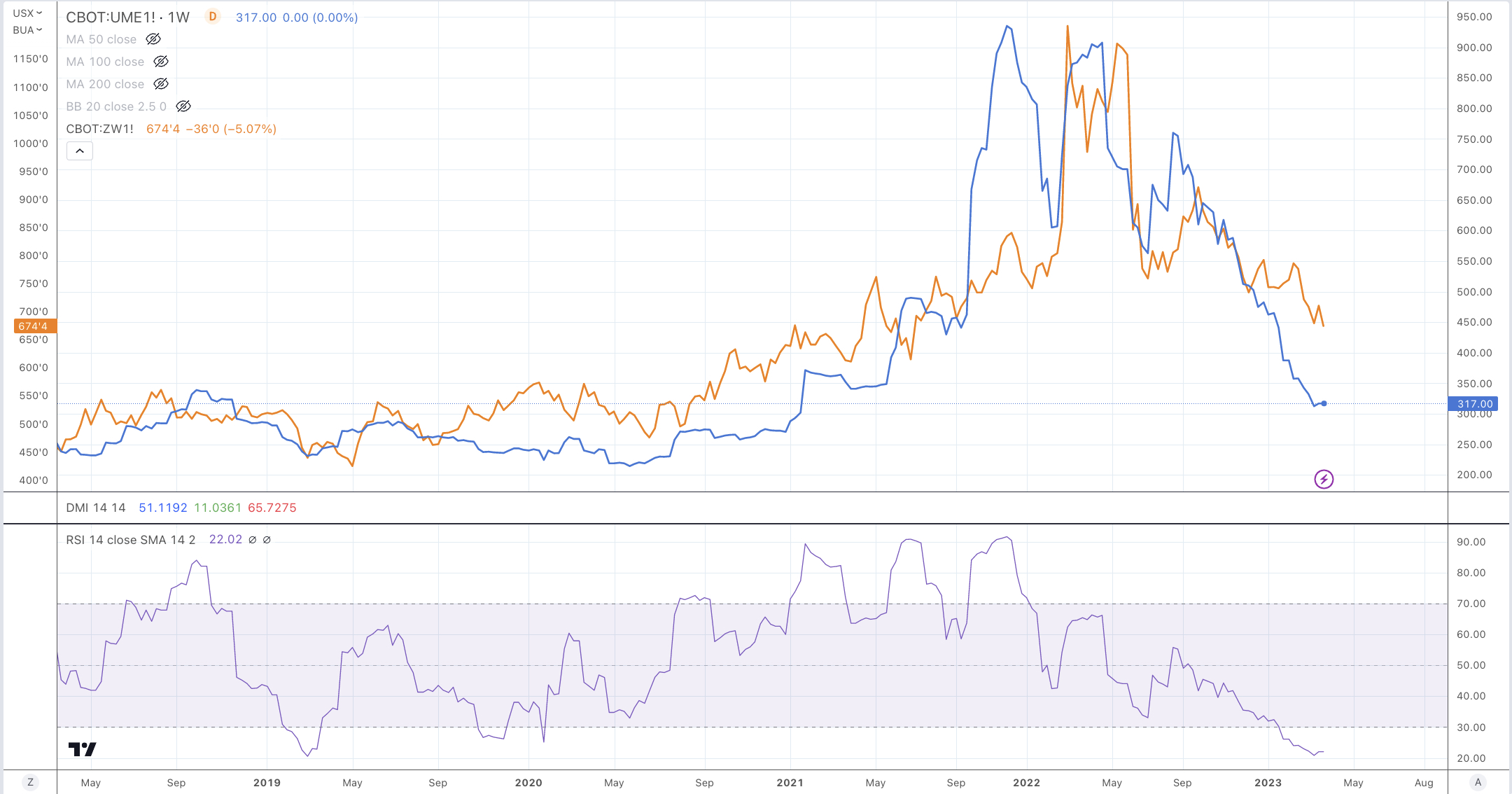
I don’t think that the low in Wheat’s has been seen yet.

Here is the wheat price overlaid with Urea……

March 24, 2023

by Rob Zdravevski

rob@karriasset.com.au

Buying fertiliser when it smells

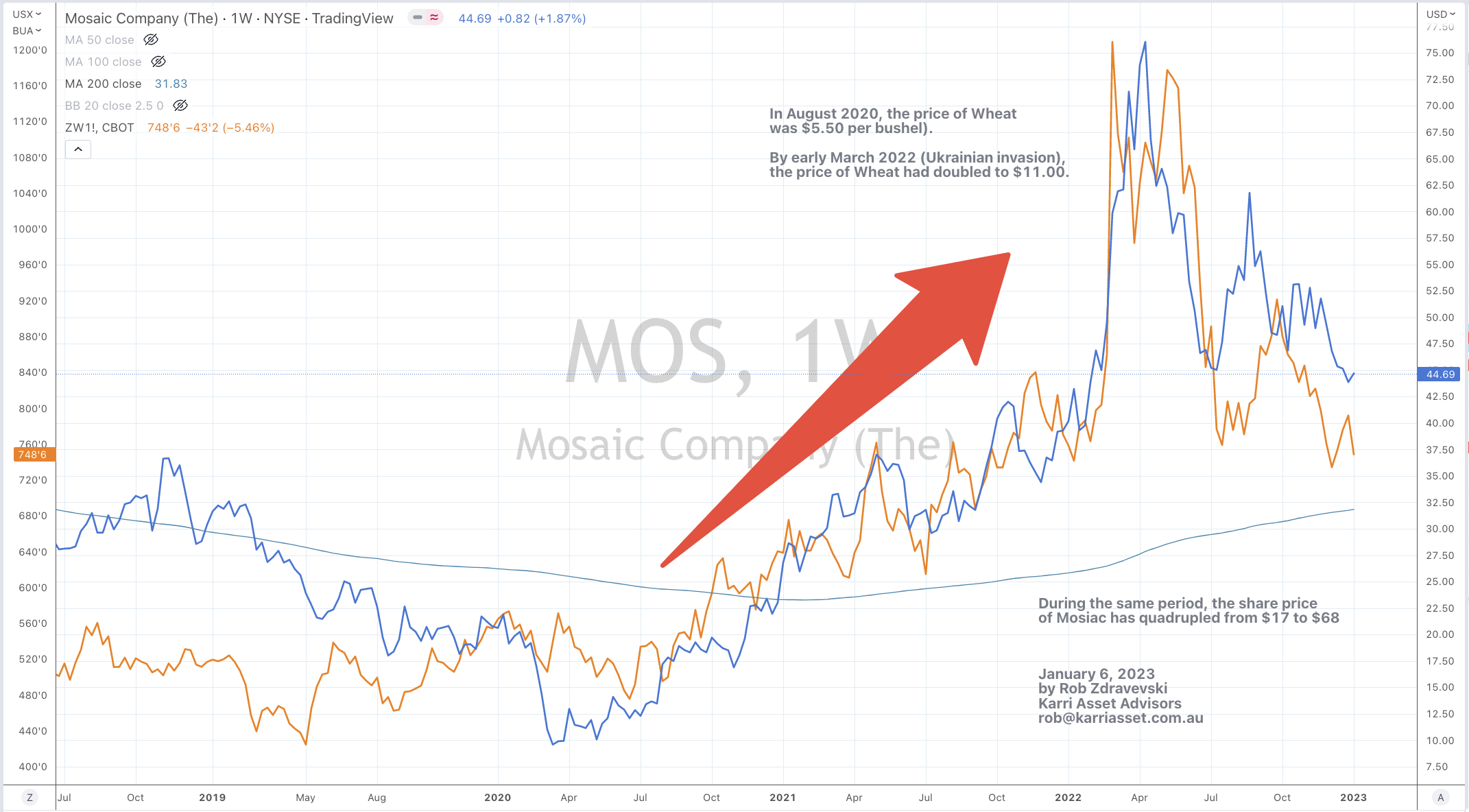
In August 2020, the price of Wheat was $5.50 per bushel).

By early March 2022 (Ukrainian invasion), the price of Wheat had doubled to $11.00.

During the same period, the share price of Mosiac has quadrupled from $17 to $68.

This is a story of correlation and the operational leverage that equities can provide.

It’s also a story about identifying extremes especially at the peaks and respecting mean reversion, particularly following frenzied parabolic price moves.

Now, the price of Wheat and Mosiac Company (one of the world’s largest fertiliser companies) are both trading below pre-Ukraine invasion levels.

Today, I am queuing for Oversold extremes in soft commodities and related sector equities.

January 6, 2023

by Rob Zdravevski

rob@karriasset.com.au

Sowing too many Oats

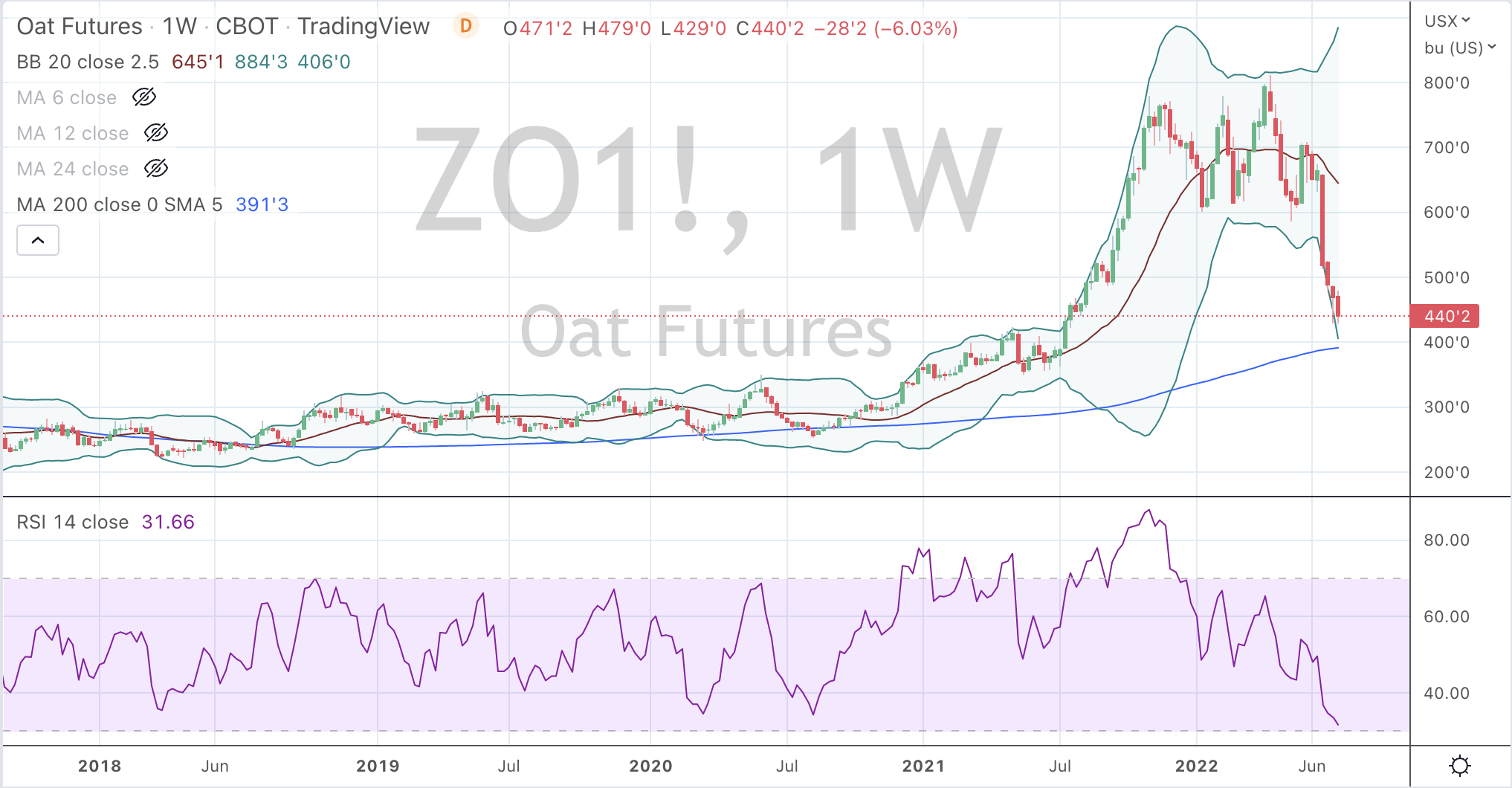
This weekly price chart of Oats tells me its set up is looking good for a low around the $3.94 mark in the coming 2-3 weeks.

A further decline of 10% is sympathetic to the trajectory of other ‘softs’ such as Rice, Wheat, Corn and Soybeans.

I think Cotton and Coffee have substantially more to downside than others. More on that in a future note.

The price of Oats nearly trebled through 2020- 2021 and then stayed elevated for 6 months.

However, this is a story about;

  • not chasing prices which are at extreme percentages above whatever mean you choose to obey;
  • observing euphoria and not running with the herd;
  • if you did, take the ‘fat part of the trade’ and;
  • allow for the probability of mean reversion.

Furthermore, farmers would have been well advised that an extreme run in price is often short-lived before considering crop rotation,

as would have buyers of agricultural land.

It was a sellers market.

When we combine an increase in inventories and higher fertiliser prices amidst a mid-cycle slowdown, prices are now declining towards the other end of the pendulum.

Canada is the world’s largest exporter of Oats, Russia is the largest grower whilst the U.S. and Germany account for 50% of the global Oats import market. Oats yield 50% more per acre than Wheat.

Lower Oats prices will benefit the likes of Kelloggs, Hain Celestial & Nestle.

Those ‘middle-men’ who have built up inventories will soon (next 6 months) be seen selling at a discount or loss.

It will soon be a buyers market.

July 13, 2022

by Rob Zdravevski

rob@karriasset.com.au

Pasta consumption still growing

Lately, I’ve been writing about the price of wheat, which prompted a review of a post I wrote in 2012 where I discuss one of my favourite uses of (durum) wheat, being Pasta.


In the original 2012 post I was willing Great Britain to lift its consumption game.

https://robzdravevski.com/2012/09/02/global-pasta-consumption-room-for-growth/


The source of the figures below is from possibly one of the world’s most important organisations, being the International Pasta Organisation. Watch out OPEC…..


They have a clear mission…… THEY ARE NON PROFIT ASSOCIATION DEDICATED TO INCREASE PASTA CONSUMPTION AND AWARENESS…….


Here is a list of the average amount of kilograms of pasta each resident in the following country consumed in 2011


Italy 26.0 kg 

Venezuela 13.0 kg

Tunisia 11.9 kg
Greece 10.4 kg

USA 8.8 kg
Chile 8.4 kg

France 8.0 kg
Germany 7.9 kg
Argentina 7.2 kg

Iran 7.0 kg

Portugal 6.6 kg

Turkey 6.4 kg
Brazil 6.4 kg

Czech Republic  6.0 kg
U.K. 2.5 kg

Then. in 2019, they consumed…..


Italy 23.1 kg 

Tunisia 17 kg

Venezuela 12 kg

Greece 11.4 kg

Chile 9.5 kg

USA 9 kg
Argentina 8.7 kg

Turkey 8.6 kg

Iran 8.7 kg

France 8.1 kg

Germany 7.7 kg

Portugal 6.5 kg

Czech Republic  6.5 kg

Brazil 5.8 kg

U.K. 3.5 kg


Surprisingly, Italian and Brazilian consumption declined through the decade.

Argentine and Turkish consumption increased handsomely, while Tunisians and Brits ate 40% more pasta on a per capital basis.


Incidentally, the largest pasta consumption market is the United States at 2.7 million tons, followed by Italy at 1.4 million tons and then Brazil is third at 1.2 million tons.

Overall, total global pasta production has grown from 12.5 million tons in 2011 to 16 million in 2019.

I wonder if many Italians emigrated to Argentina over that time to account for the decline in Italy and an increase in Argentina ??

January 7, 2021

by Rob Zdravevski

rob@karriasset.com.au
Kneading the dough

Lock in your Wheat price.

Yesterdays outside bearish reversal aides my Short Call on Wheat.

Currently trading at $8.50 on CBOT,

Looking for an initial downside target into the $7.81-$7.67 range.

$7.75 to be specific.

The medium term target surrounds the $7.12 area.

November 25, 2021

by Rob Zdravevski

rob@karriasset.com.au
#wheat