The energy dominos are falling one by one

Now that RBOB Gasoline, Natural Gas, Dutch TTF Gas and the JKM LNG Marker prices have halved, I think other commodities in the energy complex are at a critical juncture.

While I remain cautious and specifically bearish on crude oil prices (I expect WTI Crude to move towards $65-$68 from its current $84.50), the larger declines could be seen in Heating Oil and Diesel (Gasoil).

They are currently trading at $3.95 and $10.82 respectively.

Both Heating Oil and Gasoil remain in downtrends across various timeframes and now I am watching a few more indicators to confirm strength and the next leg downwards.

If so, there could be 40% further downside in Heating Oil and Gasoil.

This view all seems quite perverse as the Northern Hemisphere winter approaches.

p.s. the largest use of diesel is in transportation, not electricity generators

I’ll write when/if the probability of this increases.

October 25, 2022
by Rob Zdravevski
rob@karriasset.com.au
Energy stocks correlations

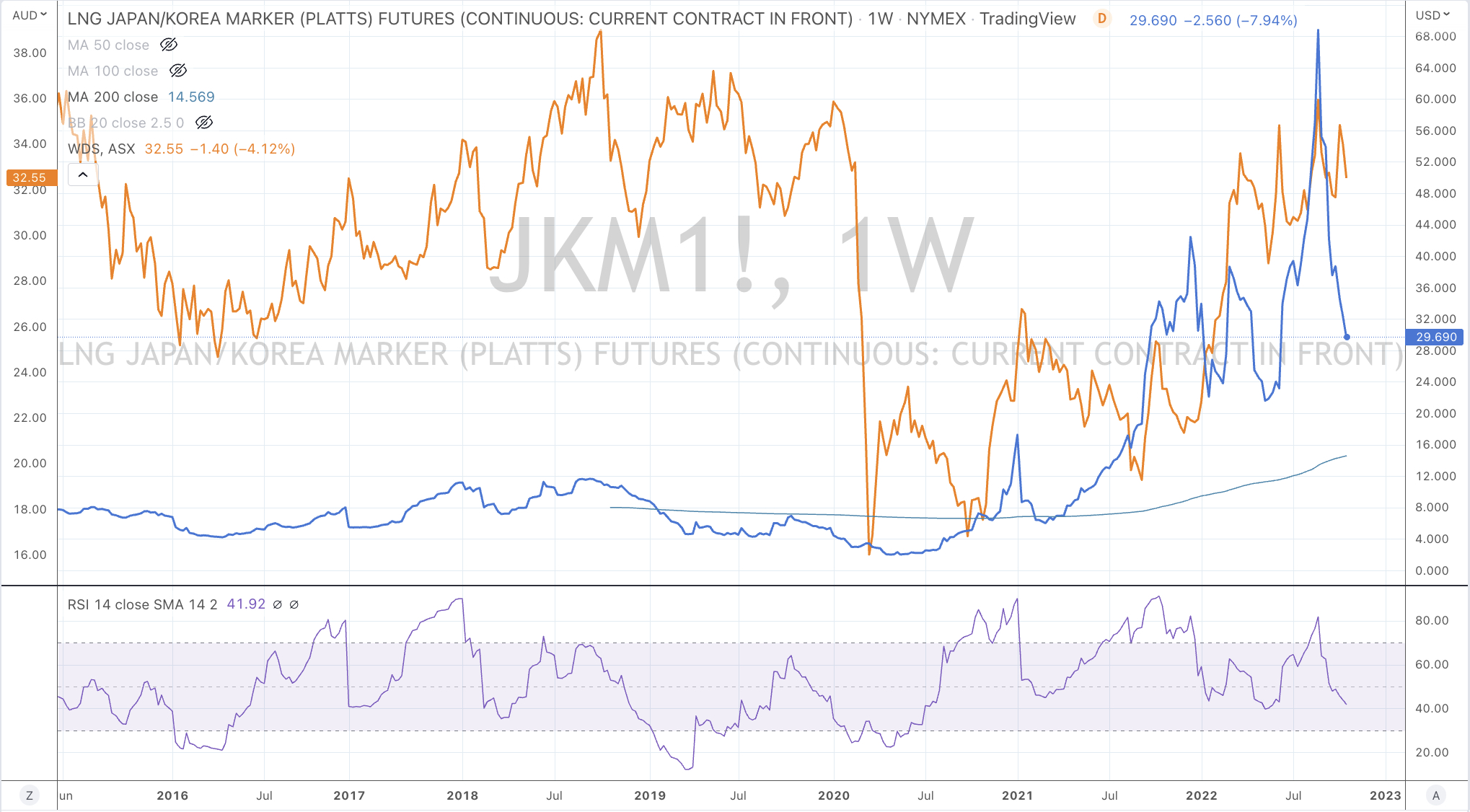
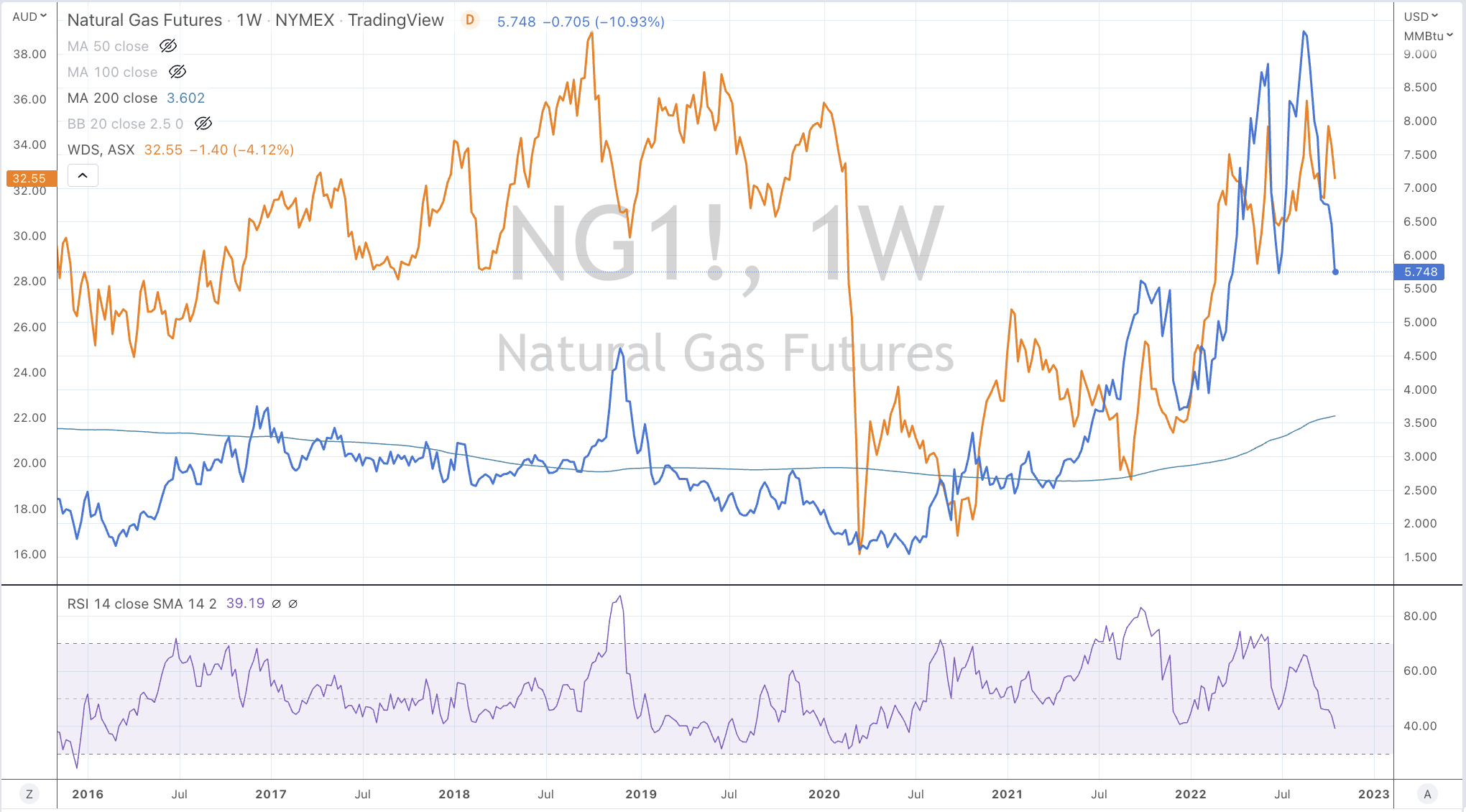
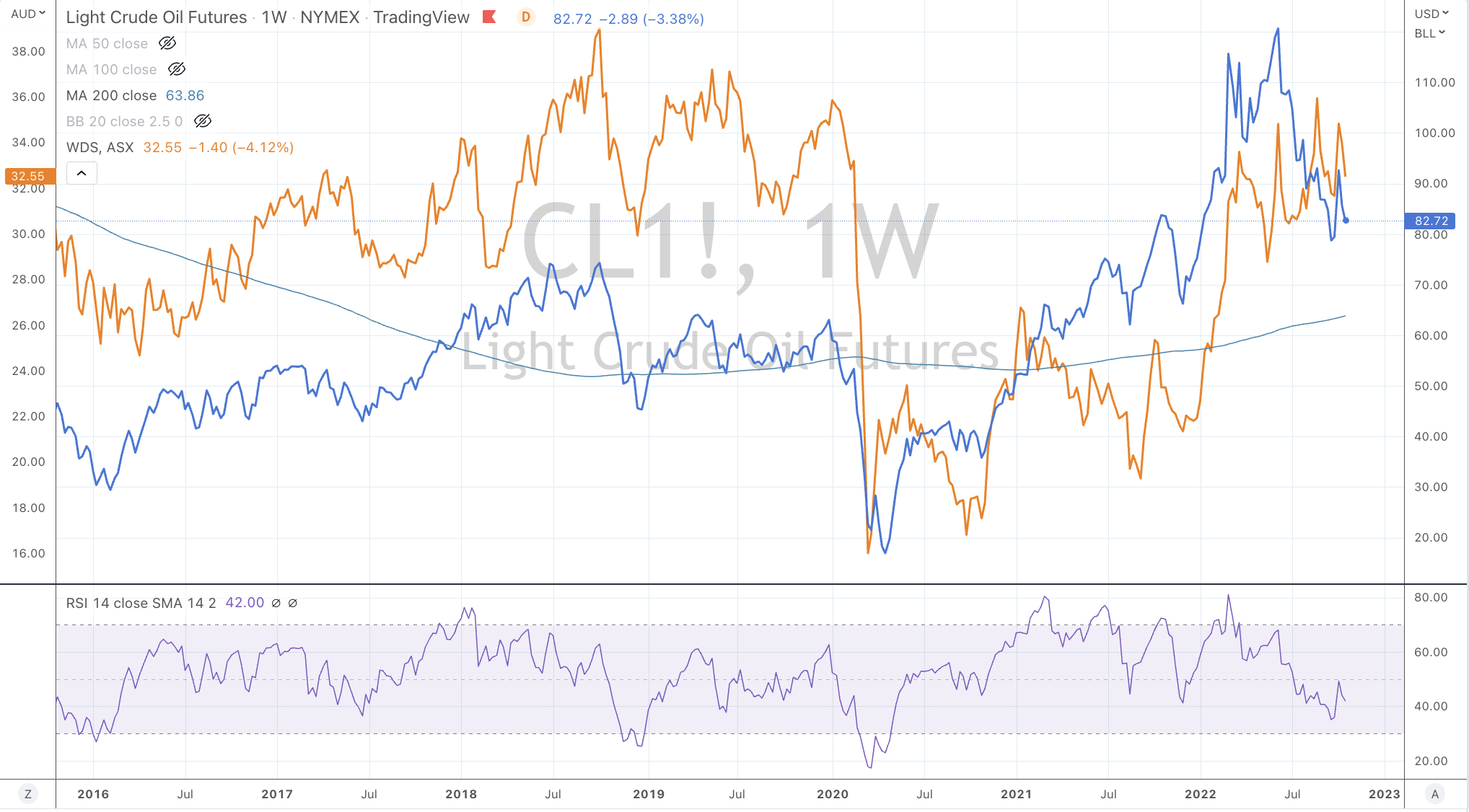
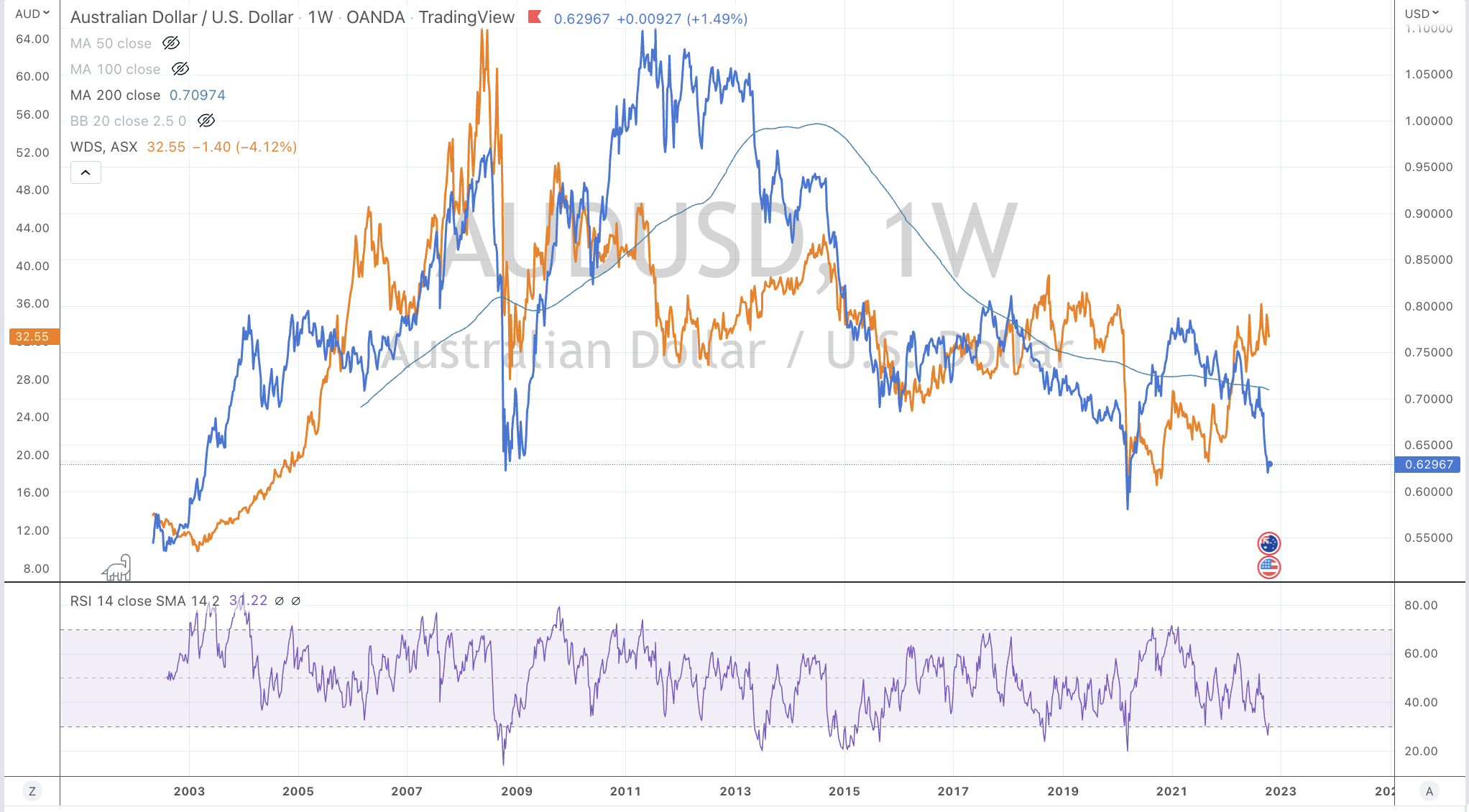
The next directional move in Woodside shares hinge on the direction in and or a combination of the Japan/Korea LNG Marker, the U.S. Natural Gas price, the West Texas Intermediate (WTI) Crude Oil prices along with the AUD/USD.

The charts below show the various correlations between Woodside shares and those assets.

My analysis of Woodside shares suggests that has a further 15% downside risk to $28, which is where I will be a buyer.

I may perform this exercise across other energy related equities.

JKM LNG Marker (in blue) versus Woodside

Henry Hub Natural Gas (in blue) versus Woodside

WTI Crude Oil (in blue) versus Woodside 

AUD/USD (in blue) versus Woodside 

October 19, 2022

by Rob Zdravevski

rob@karriasset.com.au
It always remains about Oil

Did anyone find the irony and hypocrisy in the Biden Administrations disapproval over OPEC+’s decision to cut oil production quotas at their recent meeting?

President Biden et al. aren’t thrilled with the decisions, which should invariably send oil prices higher.

It did.

WTI Crude and Brent Crude rose 16.5% and 15% for the week, respectively.

So, does Biden actually want OPEC+ to pump, produce and export more oil?

But isn’t this against his climate policy?

Well, this is another hypocrisy of his.

It’s not a question about why he is releasing so much oil from the U.S. Special Petroleum Reserve. That answer is to win votes this November 2022.

But it inevitable that when more Oil is released, then more Oil is burned and used.

And this story goes round and round and round.

It’s relevant to identify the price-taker and who is the price-maker.

October 9, 2022

by Rob Zdravevski

rob@karriasset.com.au
Drill Rig count rises

The monthly Worldwide Rig Count is out from Baker Hughes

FYI, this data is a monthly census of “active” drilling rigs exploring for or developing oil or natural gas.

A modest global increase of 1.5% was seen from the previous month.

In the attached PDF I encourage readers to look at which regions are closing in on a similar amount of rigs ‘in action’ as see in February 2020. Some are nearly there.

It’s quite telling though.

The Europeans are lagging as they are curtailed by ESG influences.

Latin America needs petro-dollars more desperately than others.

The Middle East can refrain drilling in order to will higher prices.

While the USA is a hair away from their February 2020 levels, driven by political rhetoric of oil independence and a government customer needing to replenish their dwindling Strategic Petroleum Reserve.

Needless to say or see, the number of Oil and Natural Gas drilling rigs being put to work isn’t in a declining trend.

October 9, 2022

by Rob Zdravevski

rob@karriasset.com.au
Following a $10 bounce, Oil is now a marginal trade

Further to today’s note about Oil, OPEC and Oversold break-even inflation rates…….

This note told you,

…..when Oil hit my long-standing lower target of $77.50 (trading to $76.25 intra-day).

That was 7 trading sessions ago and it coincided within the Oversold weekly reading for the 5 year break-even inflation rate.

Oil has bounced $10 since then.

Today, Oil has a short term upward trend developing,

but its only a trend.

At $87, it’s in no-mans land.

It could go $13 up or $13 down.

With new money, it’s a marginal trade or position to take.

Following a couple weeks of trade, I’m betting that WTI Crude sees $74 before it sees $100.

October 6, 2022

by Rob Zdravevski

rob@karriasset.com.au
American inflation rates tells OPEC when to cut production

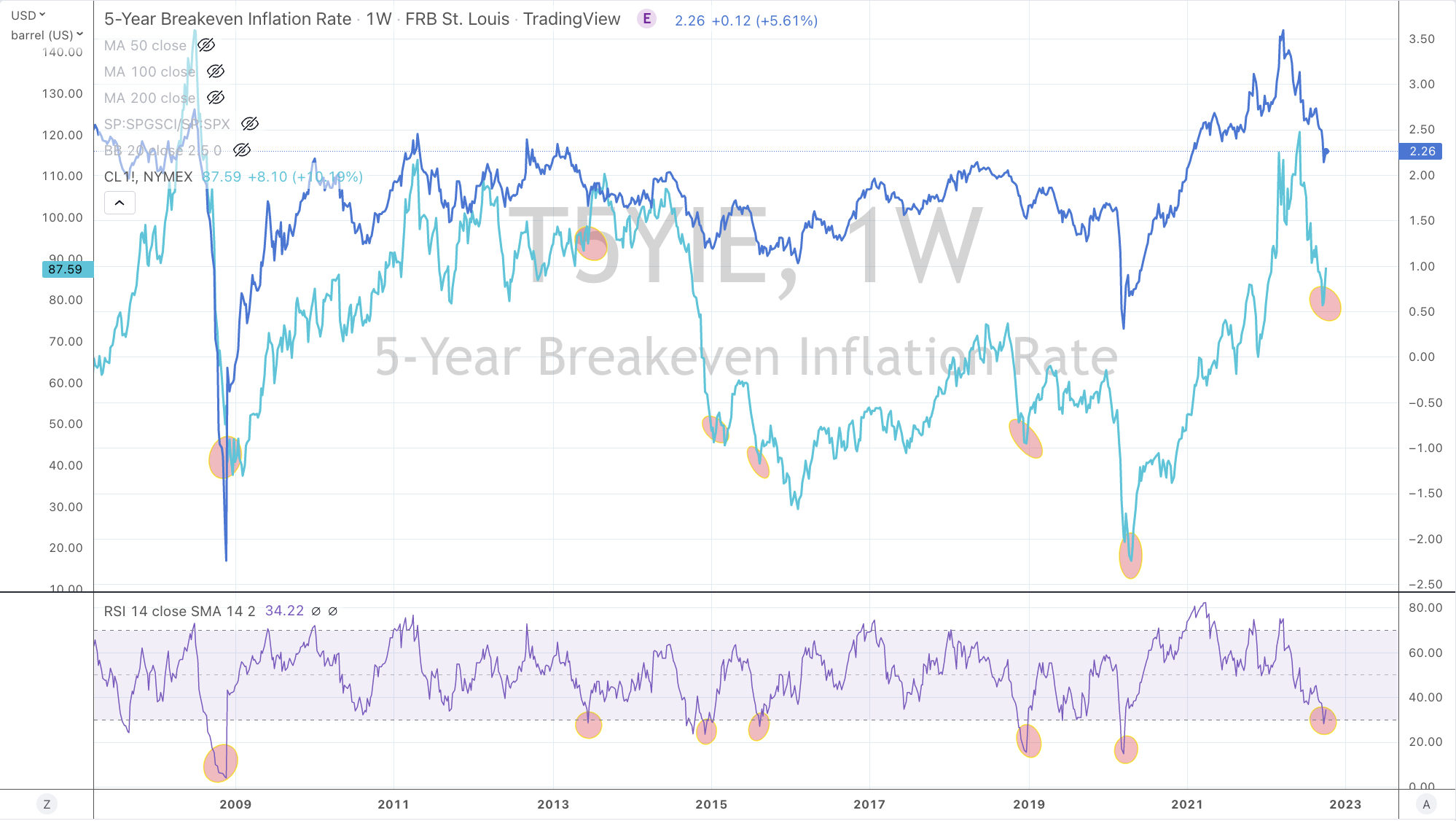
Here is a lovely chart showing the price of WTI Crude compared to U.S. 5 year break-even inflation rate.

To which the St. Louis Fed says about the latter, ‘the value implies what market participants expect inflation to be in the next 5 years, on average.’

Each value dance wonderfully together.

The better part of the chart is the lower bit where the RSI (Overbought/Oversold) indicator appears.

Whenever the 5 year breakeven inflation rate is Oversold (as this weekly chart shows), the WTI Crude Oil price finds a floor from which to advance.

We saw an Oversold 5 year b/e rate last week.

This week’s OPEC production cut announcement wasn’t a surprise because this Oversold moment in the U.S. 5 year break-even inflation rate tends to coincide with OPEC announcing production cuts.

Of course, Biden isn’t happy that OPEC have cut production.

Furthermore, Biden has virtually released all of the nation’s Special Petroleum Reserves. While he probably thinks it was his strategy sending Gasoline prices lower, when it was in fact a combination of other falling commodity prices (which is deflationary), mean reversion in the oil price and rising credit forces at work.

No to mention the importance of Biden needing lower domestic petroleum prices to aide his mid-term election hopes.

OPEC’s production cut may seem to be mathematically synchronised to the United State’s own inflation break-even rates but I think it is equally loaded with a little political payback.

Funnily, the U.S. isn’t pleased with this announcement and have passed on their views but it’s difficult to have a say into a club of which you’re not a member of.

Keep in mind, this study doesn’t assist the decision of when to sell your Oil.

There are other indicators for that.

October 6, 2022

by Rob Zdravevski

rob@karriasset.com.au
Crude Oil and AUD/USD watch

3 days ago, I wrote that Oil needed a quick drop of ‘$2 or $3’ in order to extend some strength in oil’s current downtrend.

WTI Crude fell $4.75 on Friday, closing its trading week at $78.74

Equally, the AUD/USD exhibited expected weakness during Friday’s session. It closed at 0.6531.

So, I’ll watch for how the AUD/USD and WTI Crude symbiotically test their next respective levels of 0.6464 and $77.50, as neither ‘daily’ downtrends are confirming continuing strength.

Hint: probability is rising that we are at the tail-end (+/- 3%-6%) of the downdraft in both assets.

September 24, 2022

by Rob Zdravevski

rob@karriasset.com.au

31% decline is losing some steam

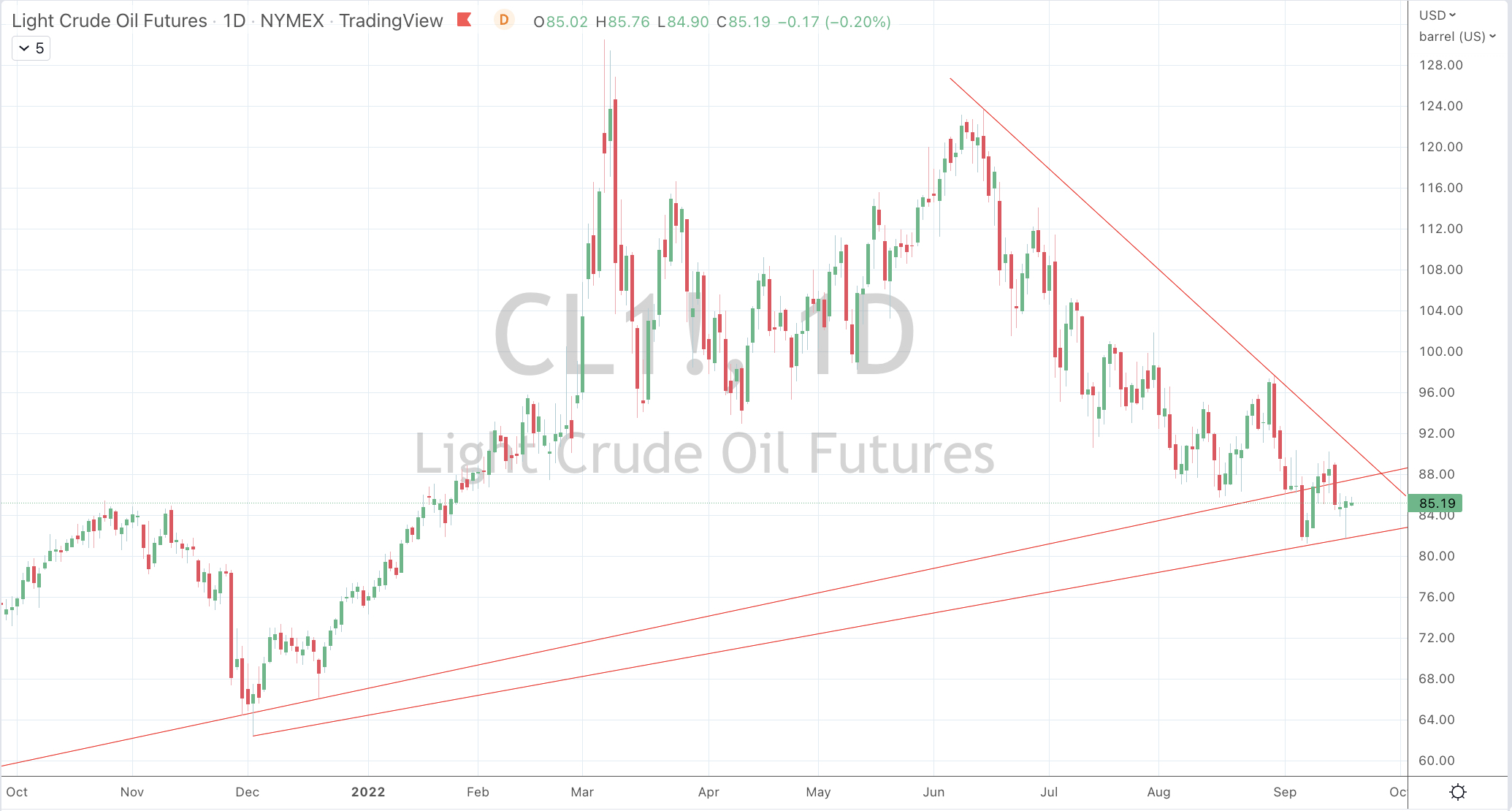
Here are some WTI Crude Oil trend lines I’m watching.

The downward trend remains intact, however on a daily basis it’ll need a quick drop of $2-$3 in order to add some strength to this trend, otherwise we can kiss a visit to $77.50 and any notion of ~ $65 good bye for the time being.

Should this trend wane, it will correspond with the AUD/USD and the CRB Index finding a floor.

September 20, 2022

by Rob Zdravevski

rob@karriasset.com.au

Watching Currencies – AUD/JPY and Crude Oil

Correlations – AUD/JPY and Crude Oil

September 5, 2022
by Rob Zdravevski
rob@karriasset.com.au

The Americas are drilling, ROW are not

Canadian rig count leaps 30% on the month.

In fact, over the past 2 months, the Canadians have doubled the amount of rigs put to work.

Even with that effort, the Canadians are still 25% below its February 2020 peak.

While if we only look at the U.S. and Latin America, they are a whisker away from its February 2020 number.

Uncannily, Europe, Africa and the Middle East all have approximately 29% less rigs cranking away than seen in February 2020.

Globally we’ve seen 2 consecutive months of a 4% increase in rigs (count) deployed.

Total global rig count is closing in on the March 2020 figure, not close to February 2020 and still some way to go towards any month back to 2017. 

So, the Americas are trying but the rest of world is tempered.

August 15, 2022

by Rob Zdravevski

rob@karriasset.com.au