Macro Extremes (week ending February 9, 2024)

A weekly Macro, Cross Asset review of prices trading at extremes which may generate future investment ideas and opportunities.

The following assets (on a weekly timeframe) either registered an Overbought or Oversold reading and/or have traded more than 2.5 standard deviations above or below its rolling mean.

Extremes “above” the Mean (at least 2.5 standard deviations

Cotton

Gasoil

NZD/AUD

Overbought (RSI > 70)

Uranium

Rice

Robusta Coffee

AEX

Italy’s MIB

Nikkei 225

Dow Jones Industrial Average

Nasdaq 100

Nasdaq Composite

Nasdaq Transportation Index

Egypt 30 Index

Philadelphia Semiconductor Index (SOX)

And the S&P 500 Index

The Overbought Quinella – Both Overbought and Traded at > 2.5 standard deviations above the weekly mean)

Cocoa

Russia’s MOEX Index

Turkiye’s BIST 100 Index

Extremes “below” the Mean (at least 2.5 standard deviations)

Shanghai Composite

Oslo’s OBX Index

Oversold (RSI < 30)

Chile 2 year government bond yield

JKM LNG

Lithium Hydroxide

Nickel on India’s MCX Exchange

Corn 

Soybean

The Oversold Quinella – Both Oversold and Traded at < 2.5 standard deviations below the weekly mean)

China 10 year government bond yield

Notes & Ideas:

Government bond yields were higher for week.

Many of them are on the move higher back towards the middle of their recent ranges.

German 10’s closed at their highest weekly close since November 30, 2023.

Equities were stronger, however there were some losers too.

The Dow Jones Industrial Average has put together a 5 week winning streak and has spent the past 9 weeks in overbought territory.

The S&P 500 is also in a 5 week winning streak and has risen for 14 of its past 15 weeks.

Amsterdam’s AEX made a new all-time high.

The Nasdaq Composite are yet to reach a new all-time high but it did close at its highest weekly close while stretching a 5 week winning streak.

The Nasdaq Transportation Index made an all-time high and weekly close. It has risen 10% in the past 4 weeks.

The Russell 2000 and the S&P MidCap 400 both performed a bullish outside reversal week.

And Turkiye’s BIST has risen for 5 consecutive weeks making for a 19% (in TRY terms) return.

Commodities were generally stronger with the notable advancers and decliners listed below. 

The big news was that Lithium Hydroxide prices were unchanged for the week.

Does being ‘unchanged” qualify to end its 13 week consecutive losing streak?

Lean Hogs aren’t overbought but Cotton and Gasoil (Diesel) is.

Cattle is in a 6 week winning streak and has closed higher in 8 of the past 9 weeks. Furthermore, Cattle is trading at extended percentages (41%) above its 200 week moving average.

Heating Oil continues its roller coaster. This week it rose 10%, last week it fell 6% and the week before that saw it rise 7%. Mamma Mia !

Sugar is in a 6 week winning streak.

Soybeans and Corn are registering oversold extremes. 

Soybeans are in a 8 week losing streak and have fallen 12 of the past 13 weeks.

It’s worth to note that Henry Hub Natural Gas prices are a whisker away from making new all-time lows while JKM LNG are trading at their lowest close since December 20, 2020.

And Lithium Hydroxide has now spent 32 consecutive weeks in weekly oversold territory.

Amongst currencies, the collective U.S. Dollar (DXY) Index is in a 4 week winning streak.

While against specific pairs, the U.S. Dollar has risen for the past 5 or 6 weeks.

The AUD has slight gains, thus putting an end to its consecutive losing streaks against many pairs such as the 6 week losing streak for the AUD/SGD.

The Yen was weaker.

And the GBP/USD is in a 4 week losing streak.

The larger advancers over the past week comprised of;

Baltic Dry Index 9.8%, Cocoa 11.8%, WTI Crude Oil 5.8%, Cotton 5.4%, Heating Oil 10.3%, Cattle 2.3%, Newcastle Coal 4.8%, Gasoline 8.9%, S&P GSCI 3.5%, CRB Index 2.5%, Brent Crude Oil 5.8%, Gasoil 12.9%, Rice 2.6%, Robusta Coffee 3.2%, Shanghai Composite 5%, CSI 300 5.8%, AEX 3.6%, China A50 5.3%, DJ Transports 2.6%, HSCEI 1.7%, Russell 2000 2.5%, Nasdaq Composite 2.3%, S&P MidCap 400 1.6%, Nasdaq 100 1.8%, Nikkei 225 2%, Copenhagen 1.6%, SOX 5.3%, Nasdaq Transports 2.8%, BIST 4.4% and the S&P 500 rose 1.4%

The group of largest decliners from the week included;

Rotterdam Coal (2.8%), Lean Hogs (2.2%), Copper (3.5%), Hot Rolled Coil Steel (2.9%), Natural Gas (11.2%), Nickel (2.1%), Orange Juice (2.1%), Palladium (8.4%), Platinum (2.6%), Dutch TTF Gas (7.5%), Uranium (4.1%), Corn (3.1%), Austria (2.4%), IBEX (1.7%), Oslo (2.5%), Helsinki (2%), SMI (1.3%), ASX Materials (3%) and the ASX 200 Index fell 0.7%.

February 11, 2024

by Rob Zdravevski

rob@karriasset.com.au
Macro Extremes (week ending December 8, 2023)

A weekly Macro, Cross Asset review of prices trading at extremes which may generate future investment ideas and opportunities.

The following assets (on a weekly timeframe) either registered an Overbought or Oversold reading and/or have traded more than 2.5 standard deviations above or below its rolling mean.

Extremes “above” the Mean (at least 2.5 standard deviations

SHY – 1-3 year Treasury ETF

Baltic Dry Index

Coffee

Silver

Gold

IBEX

Overbought (RSI > 70)

Cocoa

Iron Ore

Uranium

The Overbought Quinella – Both Overbought and Traded at > 2.5 standard deviations above the weekly mean)

U.S. Midwest Hot Rolled Coil Steel 

India’s NIFTY and SENSEX equity indices

Extremes “below” the Mean (at least 2.5 standard deviations)

German and U.S. 2 year government bond yields 

German 5 year government bond yield

British, French, Greek, German, Spanish, Swiss and Portuguese 10 year government bond yields

U.S. 10 year break-even inflation yield rate

Bloomberg Commodity Index

S&P Goldman Sachs Commodity Index

Thomson Reuters CRB Index

Cattle

Natural Gas

Brent Crude Oil

EUR/JPY

GBP/JPY

Oversold (RSI < 30)

Chilean 2 year government bond yield

Lithium Hydroxide

Palladium

CSI 300 Index

The Oversold Quinella – Both Oversold and Traded at < 2.5 standard deviations below the weekly mean)

JKM LNG 

Notes & Ideas:

Government bond yields again fell everywhere, with the exception of British 2’s and 3’s, Japanese bond yields and U.S. ‘shorter’ duration collection of the 2’s, 5’s, 7’s and 10’s.

The U.S. 20’s and 30 year bond yields fell. Not long ago, the consensus called yields ‘higher for longer’ but only when they reached the 5% level.

You kinda wish they could make that call when yields were marching higher through the 2% mark. 

The TLT (20+ year) ETF stock price has risen 13.4% over the past 7 weeks. Prior to this advance, that ETF appeared as an ‘oversold extreme’.

The BoA 5-7 year corporate bond yield is hovering at the same yield as July 24, 2023.

The Canadian 10’s are yield at their lowest level since July 10, 2023, British 10’s are back to May 2022 levels and German 10’s are at their lowest since April 10, 2023. 

Japanese 10’s had a bullish outside reversal week.

Chilean 2 year yields have fallen for 6 consecutive weeks, while South Korean 10’s have declined for 7 straight weeks.

Equities were mainly higher for the week extending most gains from the preceding 2 weeks.

Most indices end the week with return of between 1% – 1.6%.

U.S. Banks had another big week.

The KRE Regional Banks index has risen 23% over the last 6 weeks.

Chinese indices dominated the losers for the week, again with the CSI 300 appearing in this week’s oversold list and now at the same price as seen in February 11, 2019.

The Hang Seng is at its lowest price since July 10, 2023

Germany’s DAX is at an all-time high but not yet overbought.

The following indices have risen for 6 consecutive weeks; AEX, DAX, DJ Industrials, Nasdaq Composite and Nasdaq 100, KOSPI, Sensex, Copenhagen and the S&P 500

India’s SENSEX seems to be amongst the most extended of bourses, as it trades at 31% above its 200 week moving average.

Brazil’s BOVESPA broke its 6 winning streak while the TAEIX’s 5 consecutive weeks of advance came to an end. 

And Mexico’s IPC Index extends its weekly winning streak to 7.

Commodities were mostly lower. The major losers over the week are listed below.

Coal, Steel, Tin, Cocoa and Wheat were the few which rose.

In fact, Newcastle Coal has risen 18% in the past fortnight.

U.S. MidWest Hot Rolled Coil Steel added to recent gains.

The Baltic Dry Index took a breather from its massive rally.

During its 7 week losing streak, WTI Crude Oil has sunken 19%.

Brent Crude reached an oversold extreme this week for the first time since March 2023.

Heating Oil has declined 6.5% in the past 2 weeks.

Dutch TTF Gas has fallen 32% over the past 6 weeks.

Natural Gas has slumped 30% over the past 5 weeks.

This week, the broader commodity indices reached an oversold extreme.

And relatively versus equities they are too.

Gold eased following last week’s media and LinkedIn hype

Silver, dramatically more so.

Following last week’s registration of an overbought extreme, Gold in USD fell 3.3% for the week. Silver as priced in USD tanked 10%. Not exactly the attributes of something being a store of value.

Mean reversing beckons for some commodity prices.

Orange Juice has fallen 10% in the past 2 weeks.

Uranium remains overbought for a 17th consecutive week.

Lithium Hydroxide prices are now oversold for 22 consecutive weeks.

Iron Ore broke its 7 winning streak as it fell 0.2% for the week.

While Cocoa has locked in weekly gains in 9 of its past 10, rising 25% over that time.

Amongst currencies, the Australian Dollar lower, taking a break from recent advances.

The Loonie was mostly higher against its pairs, the Euro was mixed and the GBP was weaker.

The USD was former everywhere except against the Yen,

Because the Japanese Yen rose strongly against all others.

#riskoff

The larger advancers over the past week comprised of;

Rotterdam Coal 2.7%, Cocoa 1.7%, Cotton 2.5%, HRC 4.1%, Tin 2.2%, Newcastle Coal 14.2%, Rubber 2.1%, Wheat 4.8%, DAX 2.2%, KRE Regional Bank Index 3.2%, FTSE 260 1.6%, NIFTY 3.5%, Stockholm 2.8%, SENSEX 3%, SMI 1.7%, ASX Materials 2% and the ASX 200 rose 1.7%.

For some other comparisons for the week, , the S&P Small Cap 600 advanced 1.3%, Russell 2000 climbed 1%, Nasdaq Composite rose 0.7% and S&P 500 closed 0.2% higher.

The group of decliners included;

Aluminium (3%), Bloomberg Commodity Index (3.6%), Baltic Dry Index (21.9%), WTI Crude (4.2%), Copper (2.2%), Heating Oil (3.2%), JKM LNG (1.7%), Coffee (3.9%), Cattle (2.3%), Lithium (4.9%), Natural Gas (8.3%), Nickel (1.6%), Orange Juice (5.8%), Palladium (5.8%), Platinum (1.7%), Gasoline (3.4%), Sugar (6.9%), SPGSCI (3.1%), CRB (2.9%), Dutch TTF Gas (11.3%), Brent Crude (4.1%), Gasoil (4%), Silver in AUD 8.3%), Silver in USD (9.7%), Gold in AUD (1.8%), Gold in CAD (2.6%), Gold in USD (3.3%), Oats (7.6%), Soybeans (1.6%), Shanghai (2.2%), CSI 300 (2.4%), China A50 (2.7%), DJ Transports (1.6%), HSCEI (2.8%), Hang Seng (3%) and the Nikkei 225 fell 3.4%

December 10, 2023

by Rob Zdravevski

rob@karriasset.com.au

Spanish yields tell me inflation will bounce

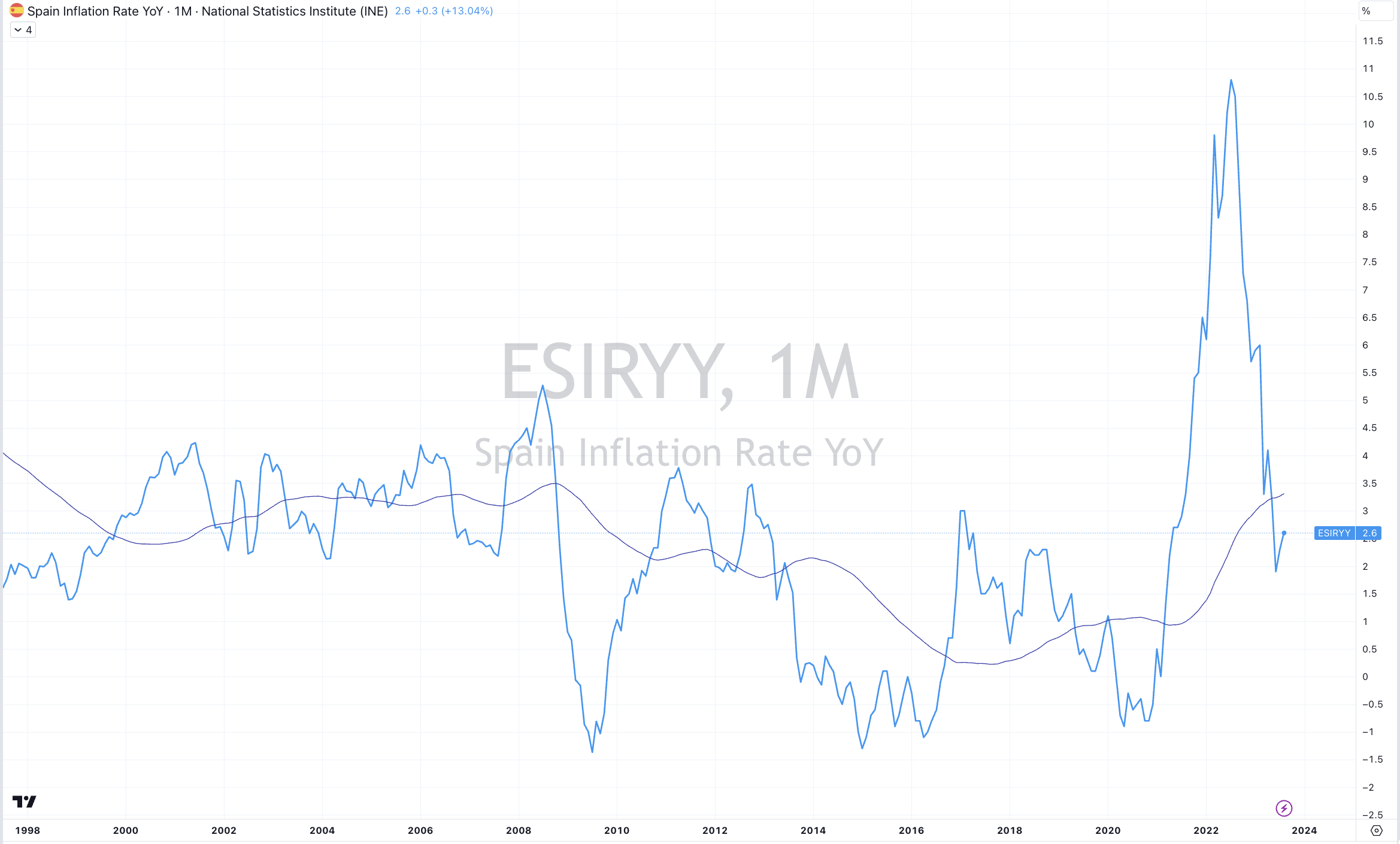
Spanish inflation was in the news this past week, reporting a rise from July’s 2.1% reading to 2.4% for the month of August 2023.

However, the main story of the Spanish inflation rate appears in the first chart below.

Mean reversion beckoned, especially following parabolic price moves.

The second chart shows the Spanish 2 year government bond yield compared to the same inflation rate.

The ‘stubbornness’ of the bond yield (in orange) holding up at 3.42% tells me that inflation move back higher.

I’ll watch for the 4.5% region as the first stop.

September 2, 2023

by Rob Zdravevski

rob@karriasset.com.au

Canadian inflation and interest rates

In my continuing story of expecting abating inflation….

Canadian inflation rates have completed their mean reversion to its 50 month moving average, as illustrated by the blue line in the chart below.

There may be one more lower print over the next month or so……

I expect Canadian interest rates to decline but not back to any type of mean.

I’ll look for the Canadian 2 year bond yields (currently 4.60%) to fall to the 4.20% – 4.05% range before rates embark on their next wave higher.

Until then, recent buyers of bonds will make money, perhaps equity like returns?

While that is playing out, I’m then looking for a 3rd wave of inflation in the form of ‘excuse inflation’ as prices of raw materials and finished products remain stubborn with sellers reluctant to discount and adjust.

It should be a short lived 3rd wave of inflation before meaningful demand destruction takes the upper hand and forces the sellers hand.

A later date, we’ll look for much more lower interest rates for the Canadian 2’s, maybe around 2.40% in a year’s time?

June 28, 2023

by Rob Zdravevski

rob@karriasset.com.au
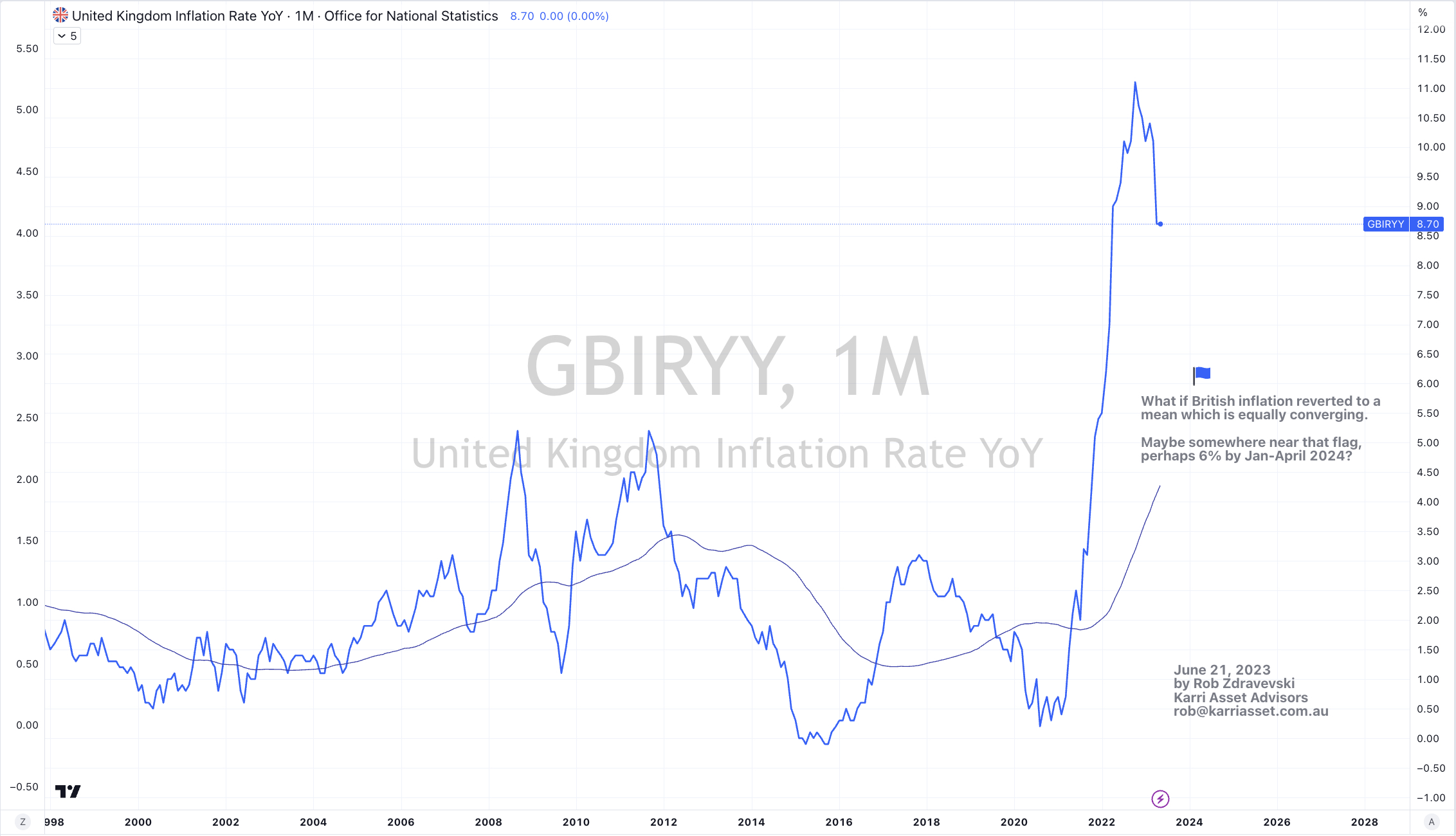
British inflation should mean revert

What if British inflation reverted to a mean which is equally converging.

Maybe somewhere near that flag, perhaps 6% by Jan-April 2024?

June 21, 2023
by Rob Zdravevski
rob@karriasset.com.au

Brazilians do it better

The blue line in the attached chart represents the Brazilian 2 year bond yield.

It has fallen from 14.8% to 11.4%.

The orange line plots Brazil’s inflation rate.

It has abated from 12% to 4%.

Today, Brazil’s inflation rate is back to where it spent most of 2018 and 2019. Funnily, it’s also at the same level as the United States.

The Brazilian central bank started hiking rates in March 2021. That was 1 year before G10 nations did.

Brazil’s central bank rates increased by a factor of 7.

From 2% to 13.75%.

They stopped raising rates in September 2022 and now for the 6th consecutive meeting have paused.

https://www.bloomberg.com/news/articles/2023-05-03/brazil-central-bank-keeps-interest-rate-rebuffing-lula-s-pressure?sref=qLOW1ygh

It would bode well for the central banks of other commodity sensitive economies such as Australia and Canada to study Brazil’s interest rate strategy, although Aussie and Canadian citizens are amongst the most indebted households in the world.

This poses a social and political risk to those central banks possibly ‘breaking the system’.

Brazilians are not so indebted.

While I expect the Brazilian 2 year bond yield to converge towards its 200 week moving average, perhaps somewhere close to 9.20%, for now bond yields are oversold and they should now hold these levels and move a little higher as will inflation.

p.s. at the bottom of this page are 3 links of recent articles I have written on the topic Brazilian interest rates.

June 16, 2023

by Rob Zdravevski

rob@karriasset.com.au

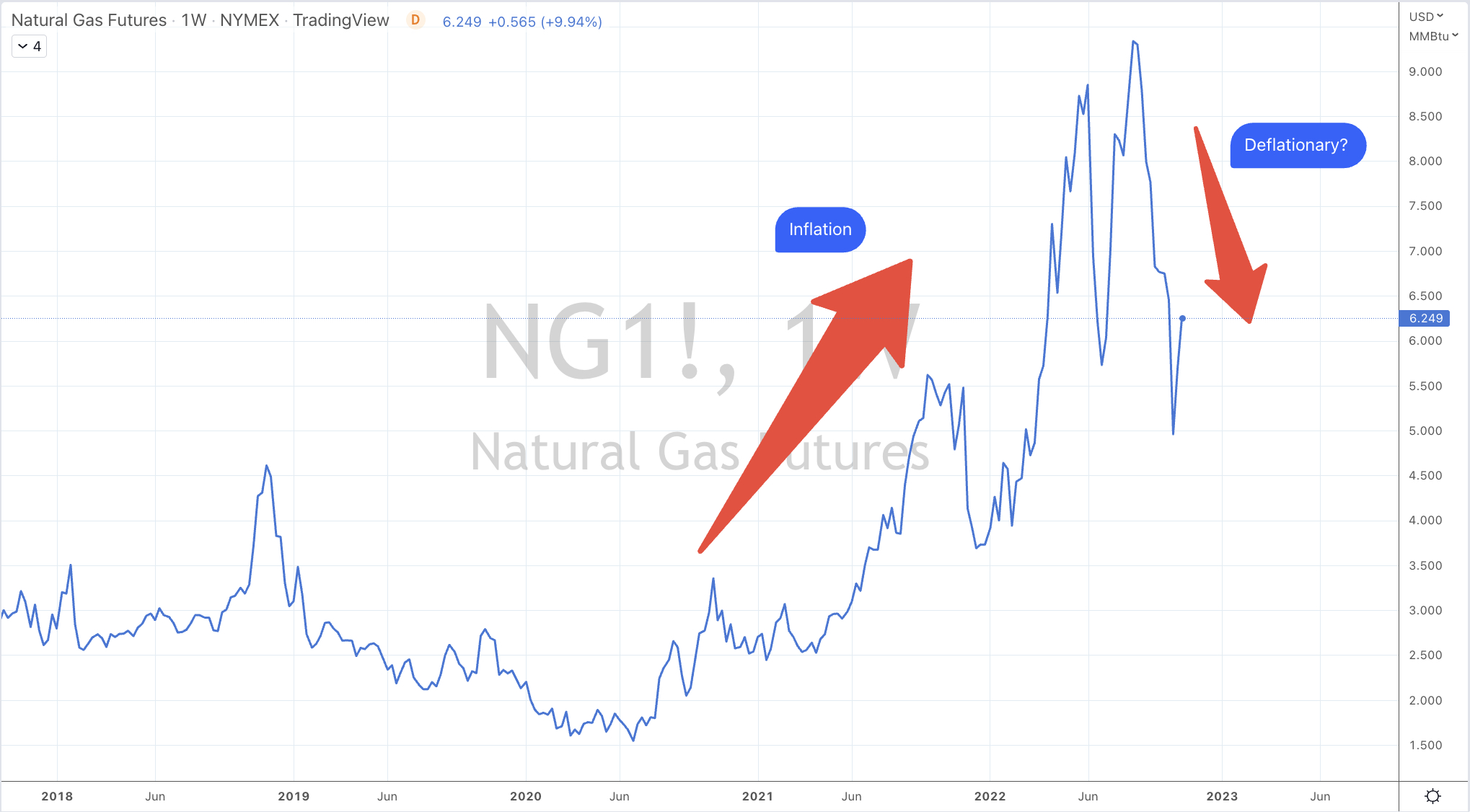
A low in Natural Gas means a lot of things

Natural Gas is trading at a price where it’s flirting around historical percentages below its 200 week moving average.

Coupled with entering weekly oversold territory, my interest is heightened.

Prior to initiating a long position, I’ll need to combine a few other studies and allow some variance on the price entry.

note: a bottoming Natural Gas price could also end the abatement seen in inflation along with a few other correlated prices and measures.

June 12, 2023

by Rob Zdravevski

rob@karriasset.com.au

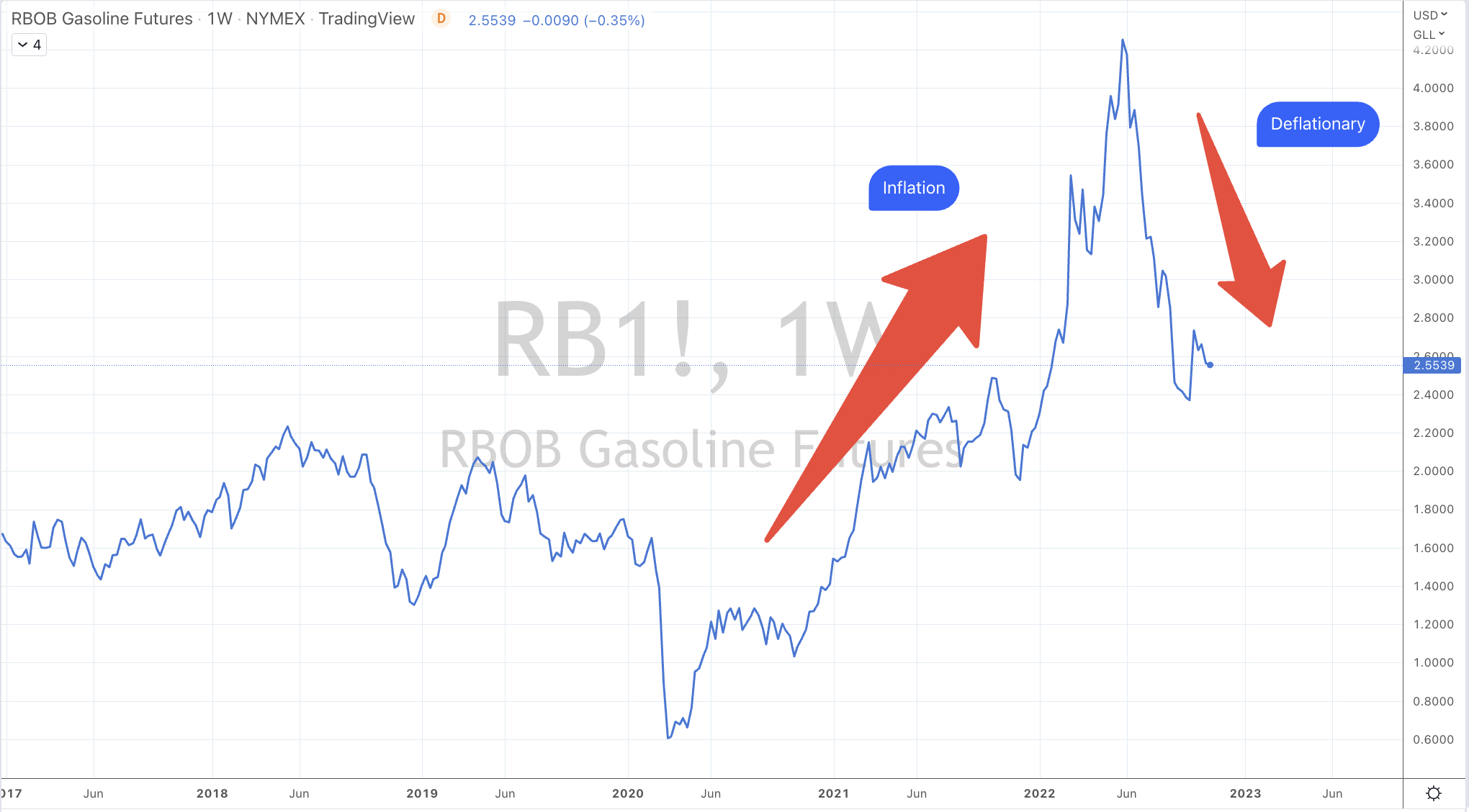
Today’s prices look deflationary

Due to secular underinvestment and the resulting tightness in various industries, I think inflation will stay at levels higher than we’ve been accustomed over the past 25 years.

This is the ‘new’ calculation and consideration for the next decade or so.

However, in the nearer term, I do think they will abate from the current levels of 7%, 8% or 9% being seen today.

If I’m pressed for a figure, let’s say 4% or 5%.

If pundits could cite and prove today’s inflation rate is a result of the rising prices seen across a host of commodities, shelter, groceries, services, etc……why are we (collectively) not acknowledging that falling prices may temper inflation?

Keep in mind that official inflation rates report the prices seen yesterday.

I have collated various charts showing prices rising and since falling.

Remember all of that palaver about soaring Lumber and Steel prices?

Take a look at them now.

This is part of my argument that inflation has ‘peaked’ and so have government bond yields.

I mean, I think we are in the last decile or so.

Other parts of my argument for lower prices in various assets/commodities and a subsequent abatement of inflation has been a combination of my long-term mean reversion thesis along with my written notes about the factor and velocity of interest rate hikes.

The last holdout in price declines remains in various energy prices such as Diesel and Heating Oil.

Interestingly, Crude Oil prices have only fallen 30% from their peak, they are now trading at prices last seen in 2011 – 2013, when U.S. inflation, at that time was being reported between 1.5% – 3%.

Back then, we weren’t making an overall ‘hoo-ha’ that inflation was about to scream higher.

Obviously there is more to this analysis and many variables from renewed supply chain disruptions coupled with continued tighter labour markets and pent-up demand when China fully reemerges from COVID lock-down could thwart this thesis.

Not assigning reasonable probability that these falling prices may/will contribute to lower inflation reports in coming quarters is something that may catch investors or the market, out.

The result of abating inflation will have an affect on suffering longer duration assets, the strong U.S. Dollar and interest rates, which have risen between 11-14 fold from their mid-2020 lows.

Once (if) that happens, then we move onto figuring out where inflation and prices move to from that moment.

November 1, 2022

by Rob Zdravevski

rob@karriasset.com.au
American inflation rates tells OPEC when to cut production

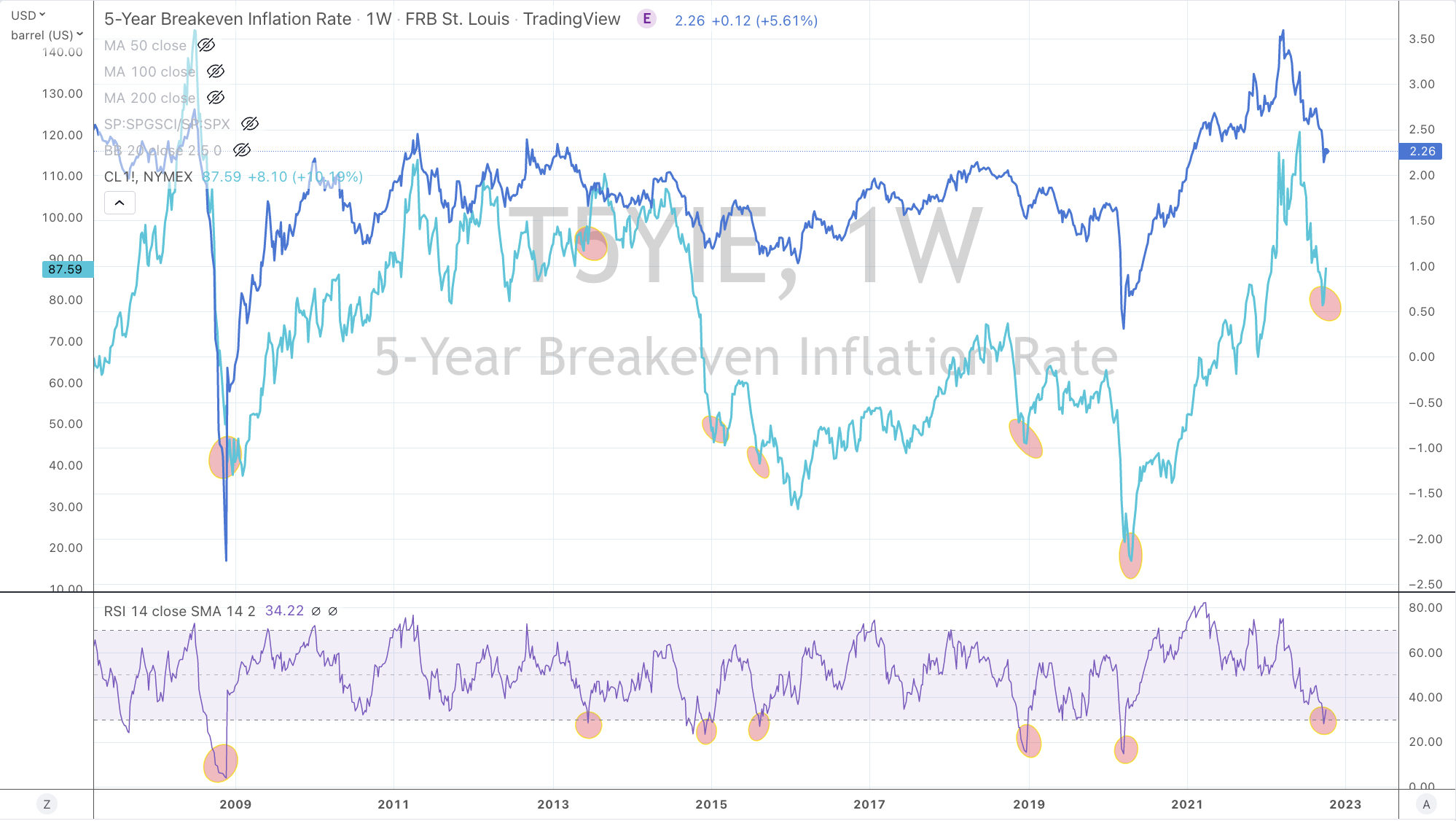
Here is a lovely chart showing the price of WTI Crude compared to U.S. 5 year break-even inflation rate.

To which the St. Louis Fed says about the latter, ‘the value implies what market participants expect inflation to be in the next 5 years, on average.’

Each value dance wonderfully together.

The better part of the chart is the lower bit where the RSI (Overbought/Oversold) indicator appears.

Whenever the 5 year breakeven inflation rate is Oversold (as this weekly chart shows), the WTI Crude Oil price finds a floor from which to advance.

We saw an Oversold 5 year b/e rate last week.

This week’s OPEC production cut announcement wasn’t a surprise because this Oversold moment in the U.S. 5 year break-even inflation rate tends to coincide with OPEC announcing production cuts.

Of course, Biden isn’t happy that OPEC have cut production.

Furthermore, Biden has virtually released all of the nation’s Special Petroleum Reserves. While he probably thinks it was his strategy sending Gasoline prices lower, when it was in fact a combination of other falling commodity prices (which is deflationary), mean reversion in the oil price and rising credit forces at work.

No to mention the importance of Biden needing lower domestic petroleum prices to aide his mid-term election hopes.

OPEC’s production cut may seem to be mathematically synchronised to the United State’s own inflation break-even rates but I think it is equally loaded with a little political payback.

Funnily, the U.S. isn’t pleased with this announcement and have passed on their views but it’s difficult to have a say into a club of which you’re not a member of.

Keep in mind, this study doesn’t assist the decision of when to sell your Oil.

There are other indicators for that.

October 6, 2022

by Rob Zdravevski

rob@karriasset.com.au

Watching Currencies – AUD/JPY

Correlations – AUD/JPY and the Australian Inflation Rate

September 5, 2022
by Rob Zdravevski
rob@karriasset.com.au