Macro Extremes (week ending December 15, 2023)

A weekly Macro, Cross Asset review of prices trading at extremes which may generate future investment ideas and opportunities.

The following assets (on a weekly timeframe) either registered an Overbought or Oversold reading and/or have traded more than 2.5 standard deviations above or below its rolling mean.

Extremes “above” the Mean (at least 2.5 standard deviations

IEI

SHY – 1-3 year Treasury ETF

Coffee

AUD/EUR

AUD/INR

AUD/SGD

CNH/USD

NZD/USD

KBW U.S. Bank Index

KRE U.S. Regional bank Index

Stockholm

ASX Materials Index

Overbought (RSI > 70)

Cocoa

Uranium

Nasdaq 100

The Overbought Quinella – Both Overbought and Traded at > 2.5 standard deviations above the weekly mean)

Brazil’s BOVESPA

Mexico’s IPC Index

India’s NIFTY and SENSEX equity indices

And the Philadelphia Semiconductor Index (SOX)

Extremes “below” the Mean (at least 2.5 standard deviations)

BoA 5-7 year corporate bond yields

German, U.S. and British 2 year government bond yields 

British 3 year government bond yield

German, British and U.S. 5 year government bond yield

Canadian, Swiss, German, Spanish, French, South Korean, British, Portuguese and Swedish 10 year government bond yields

U.S. 5 year bond yield minus the 5 year break-even inflation yield rate

U.S. 5 year minus 3 month yield spread

Bloomberg Commodity Index

S&P Goldman Sachs Commodity Index

Thomson Reuters CRB Index

Sugar

Natural Gas

Brent Crude Oil

GBP/JPY

USD/JPY

USD/SGD

USD/ZAR

And Russia’s MOEX Index

Oversold (RSI < 30)

Chilean 2 year government bond yield

Lithium Hydroxide

CSI 300 Index

The Oversold Quinella – Both Oversold and Traded at < 2.5 standard deviations below the weekly mean)

JKM LNG 

Greek 10 yer government bond yields

Notes & Ideas:

Government bond yields again fell everywhere, again.

And so I emphasis and reflect on the euphoria of weeks ago when the consensus couldn’t possibly allow any probability that interest rates could decline.

For example, 8 weeks ago, the U.S. 5 yer bond yield appeared in this publication as an overbought extreme when it was trading at 5%. Today, that yield is 3.91%. Someone has lost a lot of money ‘shorting’ the hype at the wrong end of the pendulum.

Aussie 10 year yields have fallen 6 of the past 7 weeks as have the New Zealand 10’s and the U.S. 20’s.

The Swiss 10’s have mean reverted.

n.b. maybe its time to lock-ion cheap Swiss borrowing rates soon?

The South Korean 10’s are are in a 8 week losing streak.

And the IEI ETF has posted a 4% capital gain over the past 8 weeks.

Of course, that wouldn’t be good enough anymore, especially when equities have rose 15% over the same time……????

The TLT (20+ year) ETF stock price has risen 18.2% over the past 9 weeks. Prior to this advance, that ETF appeared as an ‘oversold extreme’.

The BoA 5-7 year corporate bond yield is hovering at the same yield as May 2023.

The Canadian 10’s and British 10’s yields at their lowest level since May 2023, British 10’s are back to May 2022 levels and German 10’s are at their lowest since December 2022. 

Equities were mostly higher for the week extending most gains from the preceding 3 weeks.

Some of the weekly gains were impressive.

Inversely, most of Europe’s equity indices finished the week either +/- 0.3% from last week’s close.

Spain’s IBEX fell and so it’s not an ‘overbought extreme’. Other new entrants have entered that category this week.

The Nasdaq 100 being one of them.

Most indices end the week with return of between 1% – 1.6%.

The week that U.S. Banks ’twas larger than the previous week. 

The KRE Regional Banks Index rose 8% for the week and has soared 31% over the past 7 weeks. The market has forgotten about Silicon Valley Bank collapse and all of this analyses about various banks “held to maturity” debt investments…..

It’s now 2.5 standard deviations above its rolling weekly mean.

Chinese indices were mostly lower again, although a couple of them posted gains of 2% for the week. 

The Hang Seng had a bullish outside reversal week as did Malaysia’s KLSE Index.

The CSI 300 is now at the same price as seen in February 11, 2019 while also being in a 5 week losing streak.

The China A50 Index is in a 6 week losing streak and is nearly oversold.

Germany’s DAX is at an all-time high but not yet overbought. Comically, it broke its 6 week winning streak by feebly posting a decline of 0.1% for the week.

The CAC and BOVESPA are also at all-time highs.

The Dow Jones Industrials is a whisker from an overbought quinella. 

The S&P MidCap 400 makes it 5 straight winning weeks.

The following indices have risen for 7 consecutive weeks; AEX, DJ Industrials, Nasdaq Composite and Nasdaq 100, KOSPI, NIFTY, Sensex, Copenhagen and the S&P 500.

The S&P Small Cap 600 was strong but it yet to make a ‘higher high’ but the Russell 2000 did so.

India’s SENSEX seems to be amongst the most extended of bourses, as it trades at 34% above its 200 week moving average.

While all are watching the Nasdaq, Sweden’s OMX Stockholm Index has climbed 17% over the past 17 weeks.

And Mexico’s IPC Index surged 5% to extend its weekly winning streak to 8 as it registers an overbought quinella. Since appearing in the overbought section of this publication, this index has risen 18% during this streak, outperforming the Nasdaq 100 by 4% over that time…..

Commodities were mixed.

Palladium soared 26%. It’s not oversold anymore.

Livestock, Uranium, Aluminium and Coffee were firmer.

Coal, Urea, Gas and Sugar prices were lower.

Grains were muted.

The Baltic Dry Index, Gold and Silver fell out of overbought territory this past week.

Cattle prices momentarily rose, thus removing them from an oversold extreme.

Following a 6 week losing streak (accounting for a cumulative 21% decline), Sugar is now in an oversold trough.

Aluminium had an outside bullish reversal week.

The Bloomberg Commodity Index mean reverted, to its 200 week moving average.

Cocoa broke its 8 week rising streak, yet remains overbought for 8 consecutive weeks.

Newcastle Coal gave up 7% of its previous fortnight gain of 18%.

China Coking Coal has built a 5 week winning streak.

Both WTI and Brent Crude broke their 7 week losing streak rising 0.3% and 1.3% respectively.

Although, Brent Crude is in its 2nd week of an oversold extreme.

Dutch TTF Gas tanked 14% and has now fallen 46% over the past 7 weeks.

Natural Gas fell 3.5% for the week even though it rose 4% during Friday’s session.

Natural Gas has slumped 34% during its 6 week losing streak.

For a 2nd week, the broader commodity indices remain at oversold extremes.

And relatively versus equities they are too.

Non U.S. denominated Gold prices eased for a 2nd week, while Silver caught a bid following last week’s 10% shellacking. 

Orange Juice is in a 4 week losing streak and is trading at 108% above its 200 week moving average.  

Uranium remains overbought for a 18th consecutive week.

Lithium Hydroxide prices are now oversold for 23 consecutive weeks.

JKM LNG has fallen 7 of the past 8 weeks, declining 24% over that time.

And Iron Ore isn’t overbought anymore.

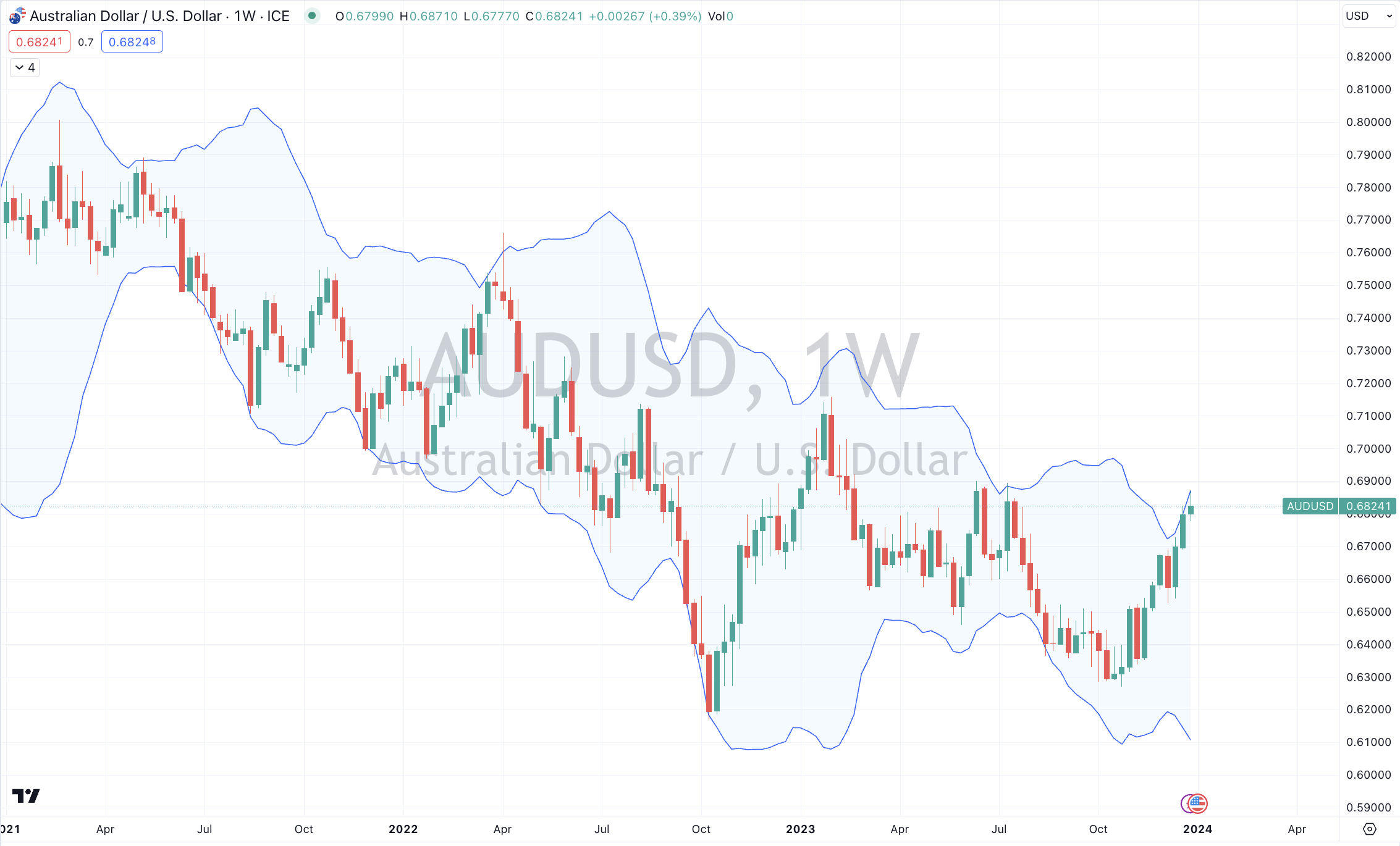
Amongst currencies, the Australian Dollar was firmer, resuming the advances of previous weeks.

The Loonie was higher again, the Euro was mixed again and the Yen was stronger again.

Collectively, the U.S. Dollar was weaker most everywhere.

In fact, against the USD, the Yen is in a 5 week winning streak.

Lastly, the USD/ZAR had a bearish outside reverse week.

The larger advancers over the past week comprised of;

Aluminium 4.7%, China Coking Coal 3%, Lean Hogs 4.4%, Copper 1.6%, Heating Oil 1.5%, Coffee 6.9%, Lumber 1.8%, Cattle 1.7%, Nickel 1.8%, Palladium 26.4%, Platinum 3.6%, Gasoline 4.1%, Gasoil 2.1%, Uranium 4.8%, Silver AUD 1.8%, Silver USD 3.7%, Oats 5.6%, KBW Banks 8.1%, DJ Industrials 2.9%, Dj Transports 5.3%, HSCEI 1.8%, HSI 2.8%, BOVESPA 2.4%, S&P Small Cap 600 5.8%, Russell 2000 5.6%, Nasdaq Composite 2.9%, KRE Regional Banks 8.1%, KOSPI 1.8%, FTSE 250 2.7%, S&P Midcap 400 4%, Nasdaq Biotech 6.1%, Nasdaq 100 3.4%, Nikkei 225 2.1%, NIFTY 2.3%, S&P Midcap 600 (not 400) 5.1%, Stockholm 3.2%, SENSEX 2.4%, Chile 3.2%, S&P 500 2.5%, TAIEX 1.7%, Nasdaq Transports 4.9%, ASX 200 3.4%, ASX Materials 4%, ASX Industrials 2.5%, ASX Small Caps 3.2% and the SOX soared 9.1%.

The group of decliners included;

Rotterdam Coal (4.8%), Baltic Dry Index (2.9%), Cotton (1.9%), DXY (2%), JKM LNG (10.2%), Lithium (1.9%), Newcastle Coal (7.1%), Natural Gas (3.5%), Sugar (5.9%), Dutch TTF Gas (14%), Urea U.S. Gulf (3.2%), Urea Middle East (2.6%), Shanghai Composite (0.9%), CSI 300 (1.7%) and Spain’s IBEX fell 1.3%.

December 17, 2023

by Rob Zdravevski

rob@karriasset.com.au
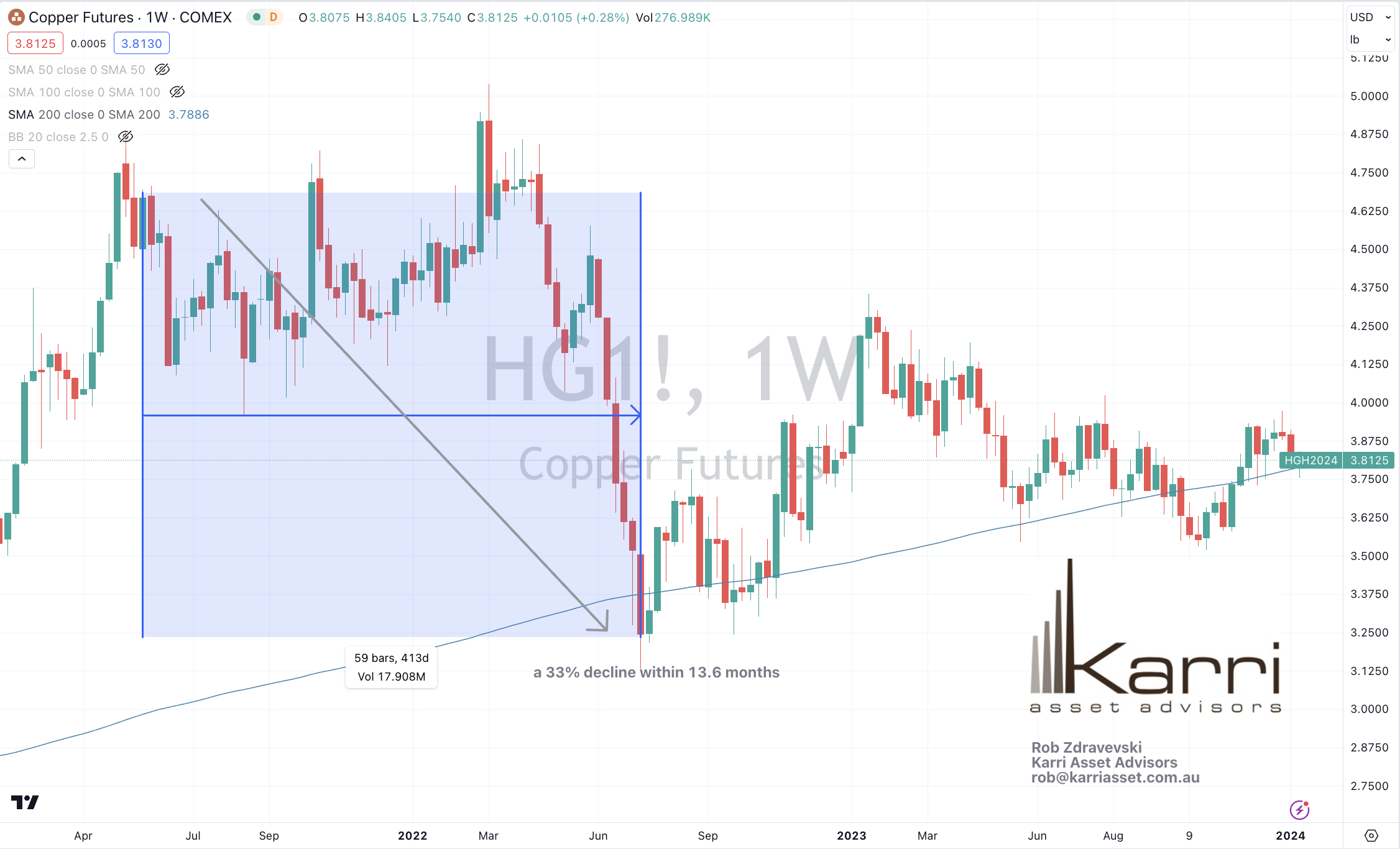
A note for commodity bargain hunters

The Bloomberg #Commodity Index completed a longer term mean reversion that I have been waiting for.

That surge is prices around early 2022 told me to stay way and wait.

It was too late to chase the commodity trade and since then, it has been too early to meaningfully allocate money to that asset class

Lately, I’ve been writing about my ‘warming to commodities’.

While I have recently commenced advising clients to accumulate specific assets, I am still waiting for a few more studies to confirm moving a larger allocation into other commodities related investments.

#BCOM

December 17, 2023

by Rob Zdravevski

rob@karriasset.com.au

Now that Small Caps have rallied….

When ‘no one is long small caps’, I published a study (Sept 1, ’23) designed as preparation to buy U.S. Small Caps.

The buying moment presented itself on Friday October 9, 2023.

Since then, the S&P Small Cap Index (and ETF) has risen 17.5%.

If you picked the exact low (seen 2 weeks later) then your return would look like 22%……

but we (at Karri Asset Advisors) are about catching the ‘fat part of the trade’.

2 months on, I am now preparing to sell.

Beyond various empirical analysis that I conduct, other reasons include that I subjectively dislike the price action. It’s not constructive and I think the small cap indices can ‘give up’ nearly all of those gains in the coming month(s).

December 15, 2023

by Rob Zdravevski

rob@karriasset.com.au

Timing, Probability or Both

The Nasdaq 100 closed at 16,562.

It is 1% away from a) trading at 2.5 standard deviations above its rolling weekly mean and b) registering a weekly overbought reading.

Incidentally, it has moved from 2.5 standard deviations (SD) below its weekly mean to 2.5 SD’s above, within 8 weeks.

It is also trading at 27% above its 200 week moving average.

(readers of my posts will recognise that pattern).

It is in the midst of a 7 week winning streak.

Also, the Nasdaq 100 is yet to make a new ‘higher high’. That high of 16,765 was seen in November 2021.

Lastly, there are ‘gaps’ below. I’m watching the one at 14,421.

A 12% decline from today’s price would only represent a 38% retracement of this particular advance which commenced in December 2022.

What would be wrong with a 12% for an index which has risen 56% over the past 12 months?

Subjectively, the ‘Magnificent 7’ make up more than 50% of the Nasdaq 100’s market cap and they account for 30% of the S&P 500 market capitalisation.

Many others are welcome to initiate a ‘long position’ at today’s prices on the basis that a ‘break-out’ will provide them with what they are looking for.

December 14, 2023

by Rob Zdravevski

rob@karriasset.com.au
Bugger this, take me private

Diversified mining company, Anglo American plc announces that it will reduce production in order to cut costs and boost profitability.

https://www.ft.com/content/9e794642-f7f3-497a-ac02-e02b63cb96aa

OK, that seems logical and prudent….

In fact, why dig up the stuff if you are losing money on it or your costs are rising and crimping your margins?

but due to this news, the stock price fell 19% last Friday and 6% more in the following 2 days of trade.

Obviously, this would not happen if it was a privately held company.

And so, I think we’ll see a growing trend of listed companies becoming owned by private equity, sovereign and pension funds.

Benefits of such a trend would include allowing executives to move away from ‘short-termism’ and thus freeing up time that they currently spend appeasing public shareholders.

But the best part is not being forced to produce and grow at any expense, pressured by shareholder expectations and you also have most (if not all) of your funding and borrowing covered.

December 13, 2023

by Rob Zdravevski

rob@karriasset.com.au

Indian equities are ‘toppy’

A warning sign for those allocating money towards the Indian equity market….

Reprising a November 28, 2023 note where I allude to the stretched extreme of India’s equity market and in particular the SENSEX Index,

the study below updates the most recent percentage figure that the SENSEX is trading above its 200 week moving average.

While Indian equity markets have resembled an ‘investible’ market over the past decade, there are times when to tune into the peaks and troughs when deploying capital there.

It seems to be a dance between mean reversion and mean convergence.

Anecdotally, folks are expressing interest in Indian equities.

Inversely, the Chinese equity market hasn’t resembled anything close to being investible for more than 15 years.

December 12, 2023

by Rob Zdravevski

rob@karriasset.com.au

Commodities are cheaper versus equities

This study shows you the occurrences when Commodities are cheaper (Oversold) relative to Equities.

We are nearing another of those moments, both relatively and absolute.

Inversely, it’s also when to trim broader equities exposure.

My clients (especially family offices and financial advisory firms) have found this work valuable in assisting their strategic asset allocation decision-making.

December 11, 2023

by Rob Zdravevski

rob@karriasset.com.au

Macro Extremes (week ending December 8, 2023)

A weekly Macro, Cross Asset review of prices trading at extremes which may generate future investment ideas and opportunities.

The following assets (on a weekly timeframe) either registered an Overbought or Oversold reading and/or have traded more than 2.5 standard deviations above or below its rolling mean.

Extremes “above” the Mean (at least 2.5 standard deviations

SHY – 1-3 year Treasury ETF

Baltic Dry Index

Coffee

Silver

Gold

IBEX

Overbought (RSI > 70)

Cocoa

Iron Ore

Uranium

The Overbought Quinella – Both Overbought and Traded at > 2.5 standard deviations above the weekly mean)

U.S. Midwest Hot Rolled Coil Steel 

India’s NIFTY and SENSEX equity indices

Extremes “below” the Mean (at least 2.5 standard deviations)

German and U.S. 2 year government bond yields 

German 5 year government bond yield

British, French, Greek, German, Spanish, Swiss and Portuguese 10 year government bond yields

U.S. 10 year break-even inflation yield rate

Bloomberg Commodity Index

S&P Goldman Sachs Commodity Index

Thomson Reuters CRB Index

Cattle

Natural Gas

Brent Crude Oil

EUR/JPY

GBP/JPY

Oversold (RSI < 30)

Chilean 2 year government bond yield

Lithium Hydroxide

Palladium

CSI 300 Index

The Oversold Quinella – Both Oversold and Traded at < 2.5 standard deviations below the weekly mean)

JKM LNG 

Notes & Ideas:

Government bond yields again fell everywhere, with the exception of British 2’s and 3’s, Japanese bond yields and U.S. ‘shorter’ duration collection of the 2’s, 5’s, 7’s and 10’s.

The U.S. 20’s and 30 year bond yields fell. Not long ago, the consensus called yields ‘higher for longer’ but only when they reached the 5% level.

You kinda wish they could make that call when yields were marching higher through the 2% mark. 

The TLT (20+ year) ETF stock price has risen 13.4% over the past 7 weeks. Prior to this advance, that ETF appeared as an ‘oversold extreme’.

The BoA 5-7 year corporate bond yield is hovering at the same yield as July 24, 2023.

The Canadian 10’s are yield at their lowest level since July 10, 2023, British 10’s are back to May 2022 levels and German 10’s are at their lowest since April 10, 2023. 

Japanese 10’s had a bullish outside reversal week.

Chilean 2 year yields have fallen for 6 consecutive weeks, while South Korean 10’s have declined for 7 straight weeks.

Equities were mainly higher for the week extending most gains from the preceding 2 weeks.

Most indices end the week with return of between 1% – 1.6%.

U.S. Banks had another big week.

The KRE Regional Banks index has risen 23% over the last 6 weeks.

Chinese indices dominated the losers for the week, again with the CSI 300 appearing in this week’s oversold list and now at the same price as seen in February 11, 2019.

The Hang Seng is at its lowest price since July 10, 2023

Germany’s DAX is at an all-time high but not yet overbought.

The following indices have risen for 6 consecutive weeks; AEX, DAX, DJ Industrials, Nasdaq Composite and Nasdaq 100, KOSPI, Sensex, Copenhagen and the S&P 500

India’s SENSEX seems to be amongst the most extended of bourses, as it trades at 31% above its 200 week moving average.

Brazil’s BOVESPA broke its 6 winning streak while the TAEIX’s 5 consecutive weeks of advance came to an end. 

And Mexico’s IPC Index extends its weekly winning streak to 7.

Commodities were mostly lower. The major losers over the week are listed below.

Coal, Steel, Tin, Cocoa and Wheat were the few which rose.

In fact, Newcastle Coal has risen 18% in the past fortnight.

U.S. MidWest Hot Rolled Coil Steel added to recent gains.

The Baltic Dry Index took a breather from its massive rally.

During its 7 week losing streak, WTI Crude Oil has sunken 19%.

Brent Crude reached an oversold extreme this week for the first time since March 2023.

Heating Oil has declined 6.5% in the past 2 weeks.

Dutch TTF Gas has fallen 32% over the past 6 weeks.

Natural Gas has slumped 30% over the past 5 weeks.

This week, the broader commodity indices reached an oversold extreme.

And relatively versus equities they are too.

Gold eased following last week’s media and LinkedIn hype

Silver, dramatically more so.

Following last week’s registration of an overbought extreme, Gold in USD fell 3.3% for the week. Silver as priced in USD tanked 10%. Not exactly the attributes of something being a store of value.

Mean reversing beckons for some commodity prices.

Orange Juice has fallen 10% in the past 2 weeks.

Uranium remains overbought for a 17th consecutive week.

Lithium Hydroxide prices are now oversold for 22 consecutive weeks.

Iron Ore broke its 7 winning streak as it fell 0.2% for the week.

While Cocoa has locked in weekly gains in 9 of its past 10, rising 25% over that time.

Amongst currencies, the Australian Dollar lower, taking a break from recent advances.

The Loonie was mostly higher against its pairs, the Euro was mixed and the GBP was weaker.

The USD was former everywhere except against the Yen,

Because the Japanese Yen rose strongly against all others.

#riskoff

The larger advancers over the past week comprised of;

Rotterdam Coal 2.7%, Cocoa 1.7%, Cotton 2.5%, HRC 4.1%, Tin 2.2%, Newcastle Coal 14.2%, Rubber 2.1%, Wheat 4.8%, DAX 2.2%, KRE Regional Bank Index 3.2%, FTSE 260 1.6%, NIFTY 3.5%, Stockholm 2.8%, SENSEX 3%, SMI 1.7%, ASX Materials 2% and the ASX 200 rose 1.7%.

For some other comparisons for the week, , the S&P Small Cap 600 advanced 1.3%, Russell 2000 climbed 1%, Nasdaq Composite rose 0.7% and S&P 500 closed 0.2% higher.

The group of decliners included;

Aluminium (3%), Bloomberg Commodity Index (3.6%), Baltic Dry Index (21.9%), WTI Crude (4.2%), Copper (2.2%), Heating Oil (3.2%), JKM LNG (1.7%), Coffee (3.9%), Cattle (2.3%), Lithium (4.9%), Natural Gas (8.3%), Nickel (1.6%), Orange Juice (5.8%), Palladium (5.8%), Platinum (1.7%), Gasoline (3.4%), Sugar (6.9%), SPGSCI (3.1%), CRB (2.9%), Dutch TTF Gas (11.3%), Brent Crude (4.1%), Gasoil (4%), Silver in AUD 8.3%), Silver in USD (9.7%), Gold in AUD (1.8%), Gold in CAD (2.6%), Gold in USD (3.3%), Oats (7.6%), Soybeans (1.6%), Shanghai (2.2%), CSI 300 (2.4%), China A50 (2.7%), DJ Transports (1.6%), HSCEI (2.8%), Hang Seng (3%) and the Nikkei 225 fell 3.4%

December 10, 2023

by Rob Zdravevski

rob@karriasset.com.au

Sell Gold / Buy Platinum

I’ve been subtly chirping about my interest in Palladium and Platinum prices.

For those you like pairs trades, I see a Short Gold / Long Platinum opportunity.

While this may be sacrilege for those nutty gold bugs to read, I’m being rather objective.

The chart below shows Platinum and Gold plotted over each other while the lower study is the correlation coefficient.

Just because they are both precious metals, it doesn’t mean they move in tandem let alone correlated.

The rectangles show not too many moments when the correlation was close to 1.

Otherwise, there were many times when Platinum and Gold were negatively correlated.

December 8, 2023

by Rob Zdravevski

rob@karriasset.com.au

Crude Oil drop is washing out the ‘longs’

WTI Crude Oil saw the $70 target within 3 days.

This post link alluded to seeing it within “next 10 days”.

The price is now $69.20, at the time of writing.

Now, I’m thinking the next move for WTI Crude Oil is towards $67.80 – $65.90 area, which may be seen quickly, perhaps the end of Monday’s U.S. trading session.

My buying interest is heightened.

Interestingly, WTI Crude Oil prices are in their 7th consecutive week of declines and now I don’t see any geopolitical risk premium.

December 7, 2023

by Rob Zdravevski

rob@karriasset.com.au