Investment Thesis: Long Platinum

November 14, 2020

by Rob Zdravevski

Investment Thesis: Long Platinum 

A bet that the Internal Combustion Engine still has 30 years of life

The Discount:

Colloquially, Platinum is considered more precious than Gold.

When it comes to pricing, Platinum has traded at either par or $200-$300 an ounce higher than the price of Gold.

In early 2015, Platinum started to consistently trade at a discount to the price of Gold.

Today, Platinum is trading at $1,000 below the price of Gold.

We haven’t seen such a percentage discount spread in 35 years.

Subjectively, there is a euphoria behind Gold’s prospects while Platinum is seemingly unloved which seems to have widened the discount.
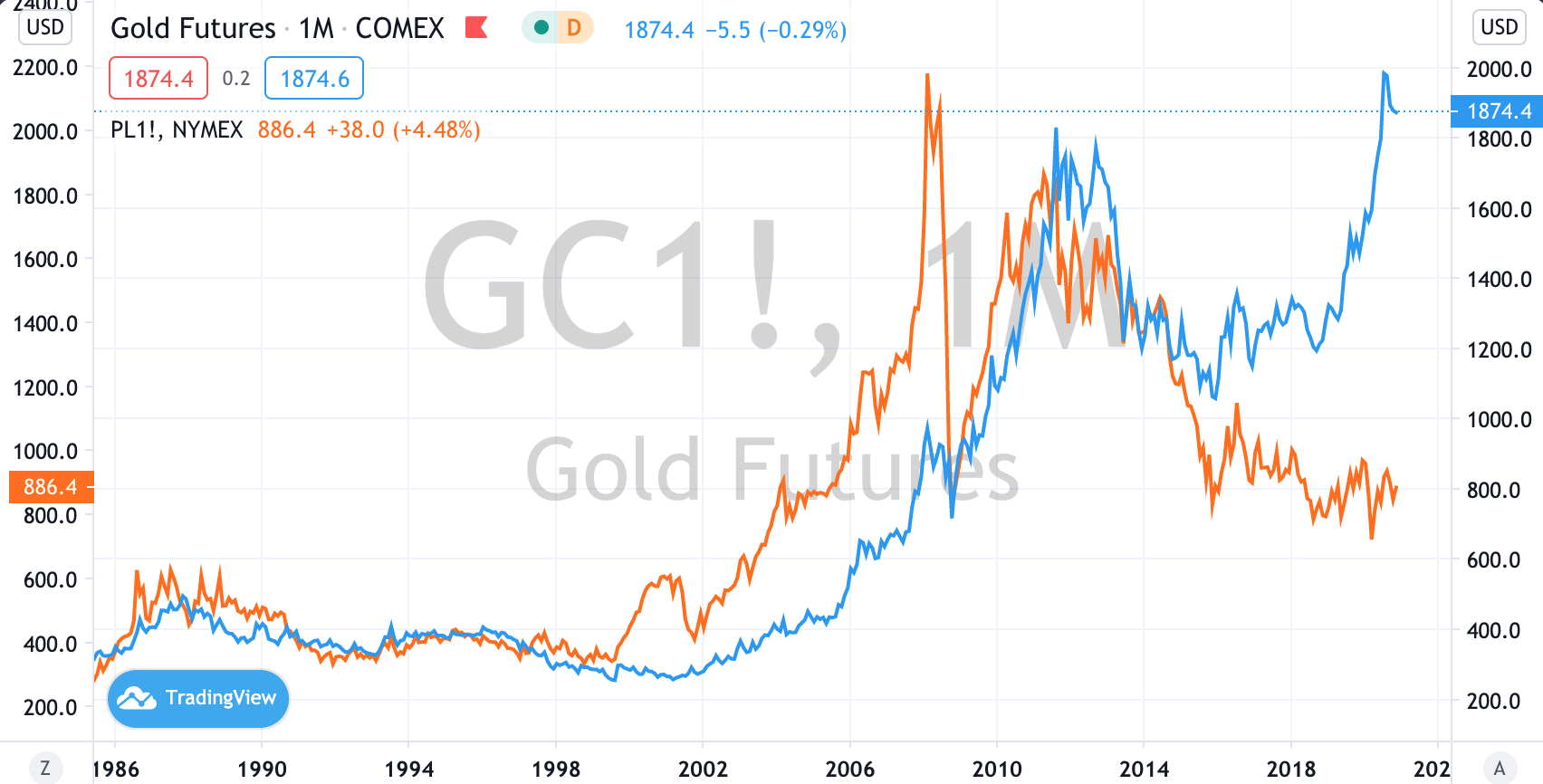
Platinum (in orange) compared to Gold (blue line)

Production & Supply:

At least 70% of the world’s Platinum production is sourced from South Africa’s Bushveld region.

This allows us to easily monitor supply disruptions, labour disputes and political machinations.

COVID-19 has also seen the South African Government restrict mine production to a capacity of 50% and in turn, mining companies have elected to place various mines in ‘care and maintenance’. 

Coupled with a latency in re-starting production, there is a distortion in price and supply upon us.

Industrial Use & a substitute for Palladium:

On the demand front, Platinum is used in ……..

jewellery, dental fillings, medical/laboratory instruments, turbine blades, computer hard disks, in the chemical industry (nitric acid, benzene, silicone), as compounds in chemotherapy drugs, as a catalyst making fuel cells more efficient and in motor vehicle engine catalytic converters. 

Catalytic converters (in cars, trucks and buses) account for 50% of its utility.

On the topic of automobile catalytic converters, Palladium has been the preferred metal amongst manufacturers and rightfully so due to its lower price.

On an industrial basis, being Long Platinum is to take a view that the proliferation of vehicle electrification will take longer than suggested. 

This is certainly a contrarian view.

Although, it has been noted that whenever Palladium trades at twice the price of Platinum, manufacturers opt for the cheaper Platinum substitute. 

Today, Palladium is trading at $2,457 is trading nearly 3 times Platinum’s current price of $887. 

The price of Platinum appears in orange, while Palladium is in blue.

Mean Reversion

Gold is currently trading at 64% above its 200 day moving average (on a monthly basis) while Platinum is 27% below its monthly 200 DMA. It is plausible to expect a convergence and mean reversion in both assets.

See this link.

https://robzdravevski.com/2020/08/20/gold-and-percentage-extremes-above-its-200-day-moving-average/

When pondering how this gap will narrow, a rising Platinum price seems more probable than a collapse in the Gold price in the current asset and ‘expected’ price inflation environment.

Correlation to CME Futures Contract Margins:

The case for an interim peak (for Gold) also lies in my historical analysis of futures contract margin requirements tend to coincide with an extreme in the price of Gold.

See this link.   

https://robzdravevski.com/2020/09/06/margins-on-gold-futures-have-tripled/

Platinum’s futures margin requirements are not reaching any historical peaks. In fact, I think there is growing probability that Platinum margins are decreased soon.

The Internal Combustion Engine (ICE)

It’s unlikely that automobile manufacturers will walk away from the capital expenditure spent on engine development and assembly, while synthetic fuels are making ICE’s even more cleaner.

Commensurate to introducing electric vehicles into their stable, auto companies have also made statements that they still expect the ICE to be part of their business for the next 30 years.

Incumbent industry and job protectionism is another topic that won’t dissipate anytime soon.

Electric Vehicles (EV)

While their purchase is subsidised in many jurisdictions, EV’s remain expensive and have yet to reach a pricing equilibrium making them affordable and a mass viable financial alternative to owning an ICE vehicle.

The EV charging network isn’t widespread and will require notable investment while facing a formidable fuel retailing industry. Range anxiety and the speed of re-charging also remains a challenge.  

Hence, EV’s account for 2.5% of global car sales and 1% of the global car ‘population’.

Bloomberg New Energy Finance predicts that electric vehicles (EVs) will hit 10% of global passenger vehicle sales in 2025, with that number rising to 28% in 2030 and 58% in 2040.

I’m not hanging onto the past and while EV market penetration should grow; we are still making cars, trucks and buses with ICE’s.

Government & Tax

Government love things which they know how to tax; items such as tobacco, alcohol and fuel.

The fuel excise tax is a hefty component of many government revenues and the funds raised assist with maintaining not only roads & bridges, but also hospitals and schools.
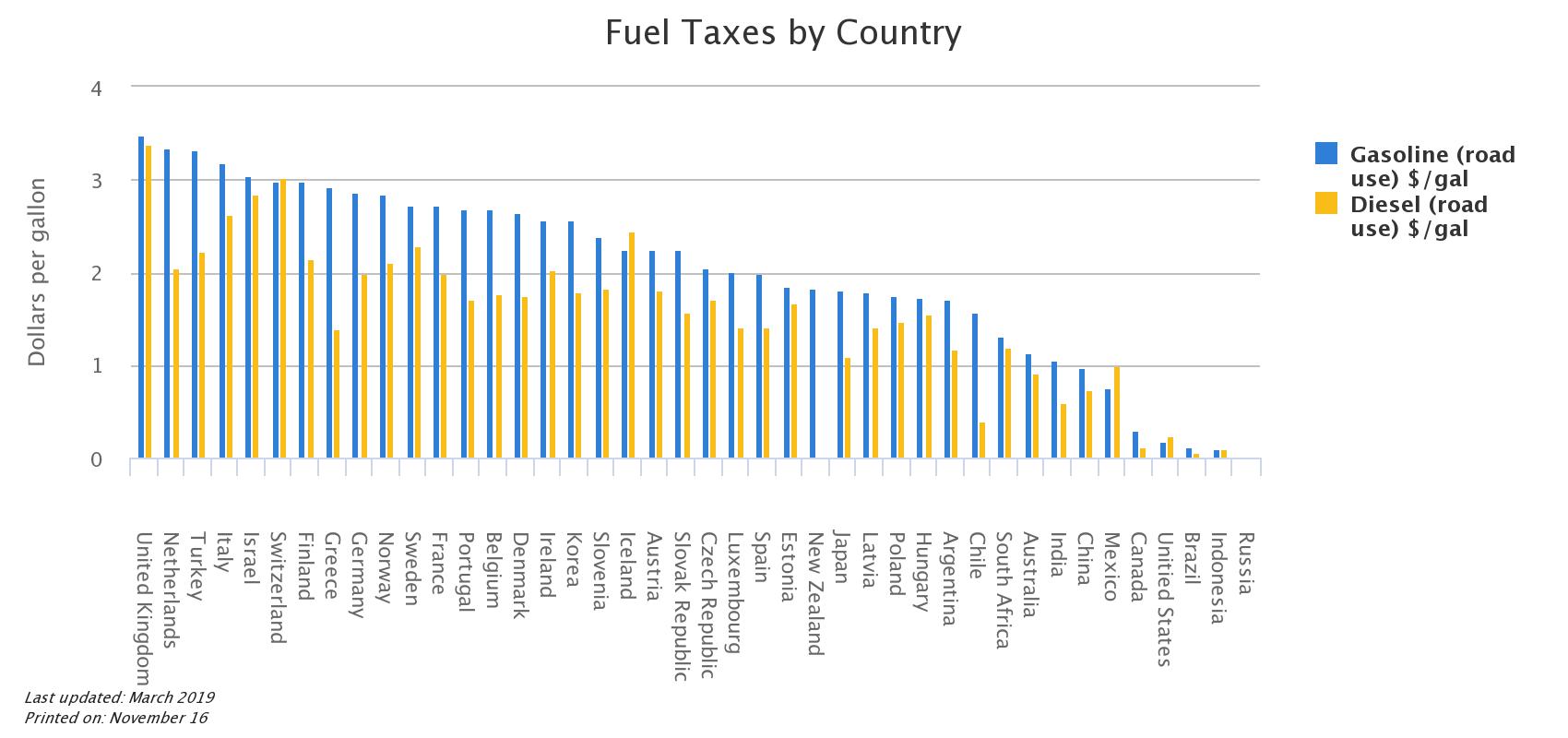
source: https://afdc.energy.gov/

EV’s are currently not providing a comparable revenue replacement for potential lost petroleum taxes.

Another challenge for governments is figuring out how to tax the electricity trickle from your residential power outlet, the solar panels located on your roof or from a public charging station.

We are now seeing governments announces “road usage taxes” for EV’s.

Please see my disclaimer.

Thinking about China

Lately, I have been debating the case;

-that China is not a military threat to Australia or the United States,

– how China won’t become the sole global power and,

– why it’s currency won’t dethrone the U.S. Dollar as the reserve currency

The links below to these recent interviews featuring Niall Ferguson and Geoff Raby helped solidify my views.

https://lnkd.in/gYyK5iA

https://lnkd.in/gwezfRq

November 13, 2020
by Rob Zdravevski
rob@karriasset.com.au

Extraordinary returns in 8 days

From their closing prices on Friday October 30th, 2020 (in only 8 trading days), this list of selected equity indices, commodities and currencies have produced the following returns.

Spain’s IBEX 20%
France’s CAC 20%
Italy’s MIB + 16.2%
KBW (U.S.) Bank Index 15.8%
Germany’s DAX 14%
The U.K.’s FTSE 13%
Russell 200 (small cap) 12.9%
Russia’s MOEX 12.8%
MidCap 400 11%
Singapore’s Strait Times 11%
Japan’s Nikkei 10.1%
Hong Kong’s Hang Seng 9%
DJ Transports 8.9%
Australia’s ASX 200 + 8.8%
India’s Nifty 50 8.6%
S&P 500 8.4%
HSCEI 8.3%
Korea’s Kospi 8.2%
Nasdaq 6%
Shanghai Composite 3.8%

Gold in USD 0.2%
Gold in AUD (3.7%)

Lumber 17%
Heating Oil 16.7%
Brent Crude Oil 16.2%
Corn 7%
Iron Ore 5.2%
Platinum 5%

UK 10 Year (10’s) Government Bond Yield +52%
Australian 10’s yield +19%
Canadian 10’s +16.7%
U.S. 10’s +12%

and currencies;
AUD 3.8%
NZD 4%
Bitcoin + 13.6%

November 11, 2020
by Rob Zdravevski
rob@karriasset.com.au

This is an outsized streak

For ASX 200 index watchers, I produced the image below at the mid-point of todays trading session.

The index has since risen a further 0.3% (to 6,442) but overall, the ‘fat part’ of the trade has been seen.

You are now looking at an index which has risen 8.7% over 8 consecutive days. A time streak not seen since mid February 2018 and October 2017.

P.S. most rising streaks lose steam on their fifth day.

In those previous 8-9 day rising streaks, the ASX rose 4.5% & 4.8% respectively.

Coincidentally, the ASX 200 is now 2 standard deviations above its daily mean.

And as the commentary in the chart mentions, there are ‘gaps’ to fill.

Market timing does matter and it’s important to observe when the pendulum is at the height of its arc.

Psychologically, I ask 3 questions to those chasing this market higher today.

a) how much more gain are you trying to squeeze out following such an abnormal run?

b) have you quantified how much risk you are taking for this ‘extra’ gain?

c) what is the probability of this daily streak continuing tomorrow?

November 11, 2020
by Rob Zdravevski
rob@karriasset.com.au

More colour to the latest moves

The link below is today’s newsletter with added commentary about the recent market machinations.

https://mailchi.mp/karriasset/wicked-markets-carry-surprises

A fun day for trading nerds

Monday’s action in global capital markets was one of those fascinating trading days which occur a handful of times in a given year.

Silver fell 7.6%,
Gold declined 4.5%,
Oil rose 6%,
The S&P 500 climbed 3.9% and then gave up gains to close up 1.2%,
The Nasdaq was up 1.5% at its highest point and then reversed (not good) to close DOWN 2.1%,
Pfizer had good news about a vaccine so it soared 15.4% but ending the day up 7.7%,
its peer, Merck advanced 6% (in sympathy) to only retreat and close unchanged,
the KBW Bank Index rose 13.5% (an amazing move for an index),
and a couple U.S. bank stocks held in client portfolios surged 18% (and I’m not happy ’cause it shouldn’t be doing this),
U.S. 10 year bond yields screamed 14% higher moving from 0.81% to 0.93%,
in the previous day trade (Friday), they had already increased 7% (from 0.76% to 0.81%)

while Spain’s unloved IBEX and the FTSE 100 respectively added 8.5% and 4.5% in a single day.

These indices have risen 15.6% and 11% since being mentioned in my recent newsletter.

So, it was a day of “reversals”, “gap-ups” and momentum chasing while it has been a few days where some unnatural owners and participants have set themselves up to be hurt and some became spooked.

November 10, 2020
by Rob Zdravevski
rob@karriasset.com.au

Industry Super Funds – Lenders of First Resort

There is a growing trend in the Australian superannuation industry landscape.

We’ve seen large super funds investing in infrastructure (tollroads, airports), agriculture (avocados), pastoral enterprises and finance property development.

Now, behemoths such as AustralianSuper are ‘lending to’ or underwrite the acquisition of businesses and assets in receivership.

One recent example is AustralianSuper’s partnering with resources private equity fund, RCF in a distressed lithium ‘play’.

Surely, these mega funds will be courted increasingly because if you think Private Equity is regarded as ‘patient capital’, then quadruple that timeline and you’ll resemble a large industry pension fund.

The larger topic is to see Industry Super Funds become a mainstream lender to business, ultimately unlocking a nearly $3 trillion pile of money.

This has been discussed for a couple years.

Perhaps Super Funds can provide a banking lending service?

November 8, 2020
by Rob Zdravevski
rob@karriasset.com.au

https://www.afr.com/street-talk/aussuper-piles-into-230m-pilbara-deal-to-buy-altura-20201028-p569b3

https://www.afr.com/wealth/superannuation/industry-super-funds-ready-to-lend-to-business-20180902-h14u7u

A year’s worth of return within a week…..

Wow ! What to do ?

In 4 trading days (since Friday’s October 30th close) the S&P 500, Russell 2000 and MidCap 400 have risen 7.5%.

The Nasdaq 100 has soared 9.2%.

A year’s worth of return within a week…..

We are only 5 days into the month and I sense fund managers being concerned about underperforming their benchmarks.

Indeed, markets tend to move where they can do the most damage….and going up is also damaging, especially if you are not invested.

#momentum#FOMO

November 6, 2020
by Rob Zdravevski
rob@karriasset.com.au

Bitcoin is silently screaming

A month ago, I wrote the post linked below, the currencies mentioned have held their supports as did Bitcoin.

Since then, Bitcoin has advanced 40% in the past 30 days.

https://robzdravevski.com/2020/10/05/short-term-aud-fx-range/

November 5, 2020
by Rob Zdravevski
rob@karriasset.com.au

Bullish on banks, because…

My reasons for turning bullish on bank stocks include:

a) I expect longer dated interest rates to rise (reminding me of the 3-6-3 rule, pay 3% on the deposits, lend money out at 6% and be on the golf course by 3pm)

b) this means their net interest margins should increase

c) banks have taken their medicine and paid their fines for past indiscretions (it’s not new news)

d) banks have already made extraordinary provisions for COVID-19

e) in turn, I expect them to revise and lower these provisions to account for the quicker than expected business recovery.

November 5, 2020
By Rob Zdravevski
rob@karriasset.com.au