ASX 200 Registers Rare Monthly Overbought Reading

This month, the ASX 200 has touched a “rare” Monthly (not weekly, but monthly) Overbought reading.

For the lack of a better word, I’m calling it rare as the chart below covers 35 years and this level has only been (generally) visited 5 times prior.

Such a moment is worth noting but it’s not an absolute ‘sell’ signal.

My work suggests a greater probability for higher prices or a ‘melt-up’ before we see a peak.

For now the upward trend remains intact and I’ll look for the index to touch 2.5 standard deviations (the upper end of the bands illustrated) above its mean before searching for exhaustion of the current bull market.

Keep in mind that prices can stay ‘overbought’ longer than expected and the constituents (and their weightings) have changed over the course of this charts history.

August 15, 2021

by Rob Zdravevski

rob@karriasset.com.au
Chalice making Lower Highs & Lower Lows

As I’m calling for lower prices across selected commodities over the next 6-10 months, the stock price of ASX listed Gold, Nickel & Copper explorer, Chalice Mining (CHN) seems further susceptible even following a 30% decline from its late May 2021 $9.34 high.

Today, the stock price is $6.35 which gives its a market capitalisation of A$2.33 billion.

Lately, it’s making lower highs and lower lows with an important support level nearing.

See my chart below.

August 13, 2021
by Rob Zdravevski
rob@robzdravevski

Share Buy-Backs is not a return of cash

15 months ago, I began accumulating CBA shares around the $60 mark.

At $98 and $103, I was a seller.
A very satisfying result culminating with the company coming through with a terrific profit result…

but now CBA are buying back their own shares, at a record high price in the region of $105 per share.

https://www.afr.com/companies/financial-services/cba-in-10b-cash-splash-20210810-p58hh0

I’ll continue to be critical of such decisions.

Firstly, a share buy-back is not a “return of cash” to shareholders,
Secondly, it’s a poor decision to buy your own shares at historically high metrics (2.5 times book value to name one),
Thirdly, it’s a lazy capital allocation decision by management and the board.

With all this profit and cash, they can’t seem to use (some or part of $10 billion) to invest back into the business?

The easy thing to do is to buy your own shares (at their all-time highs) and send a few more billion out in dividends.

I hope CBA doesn’t need to raise capital in a couple years time but at least such a buy-back will improve or dress up the EPS. ROI or Total Shareholder Return figures.

Heaven forbid if any executive remuneration is based on improving any of those metrics.

😲🙊🤯

But at a later date, they can always use the beefed up equity price to acquire businesses.

by Rob Zdravevski
rob@karriasset.com.au
August 12, 2021

The Case for Higher Equities, a Stronger USD and Weaker Commodities


The US 10’s are yielding 1.33% and the Aussie 10’s are 1.20%.

That spread (difference) between the US 10 Government Bond Yield and the Australian 10 Year equivalent is currently 0.13%.

But the figure doesn’t really matter, it’s the direction of the trend which is of greater importance.

As we see today………a rising trend (and when coupled with a break above a trend line) portends greener pastures for equity prices.

Below you will find a ‘close-up’ of a Weekly chart, highlighting the current ‘break-out’, while the 40 year chart (on a Monthly basis) illustrates a rising trend (of the spread) equating to an advancing S&P 500 (SPX), while a decline trend results in a lower or sideways travel.

A rising trend in this interest rate differential tend to also equate to a stronger US Dollar, which in turn means a weaker AUD.

Which…..also correlates to weaker commodity prices.

This is an indicator worth watching for your macro and longer term positioning.

Who would think we’d see a stronger US Dollar?

Rising yields on U.S. Treasuries will prolong the advance in the Dollar.

And rising interest rates add to debt servicing stress which can lead to Sovereign Debt pressure (there is no use calling it a crisis, until it becomes one) at which point the U.S. Dollar remains the currency of ‘last resort’.

This can lead to more buying of the U.S. Dollar.

See how this scenario can develop?

August 11, 2021

by Rob Zdravevski

rob@karriasset.com.au
Governments & Crypto

Regarding alternative currencies, a functioning (not Nicaragua) government doesn’t like competition.

Nat Gas may halve before it doubles again

Lately, I’ve been calling an interim top in Crude, highlighting extreme overboughts in Gasoline, Heating Oil and Distillates and a peak in the Australian Dollar.

Natural Gas has also touched some extreme overboughts where a Long trading exit target of $4.07 was hit.

Now, I think petroleum prices ease lower over the medium term while Natural Gas may nearly halve in price in the next 10 months or so.

Crude prices lead Natural Gas prices. Crude is down $12 since I made my recent ‘top’ call.

Below is picture of how I think it may play out.

You can see the resistance and supports it needs to test or break and this will help tell me if I’m wrong.

If the scenario below evolves, you’ll also see weaker (commodity) currencies such as the AUD and CAD while the U.S. Dollar strengthens.

August 9, 2021

by Rob Zdravevski

rob@karriasset.com.au

Biden’s Game Plan

There are 2 things Biden will never forget and try his darnest to prevent occurring under his Presidency.

In 2014, (under Obama) the Democrats lost control of the House in a crushing loss to the Republicans.

Back then, Obama didn’t spend (honouring austerity policy) and was soft on China 🇨🇳.

https://obamawhitehouse.archives.gov/the-press-office/2014/11/11/fact-sheet-president-obama-s-visit-china

Biden will never forget.

To not lose the House majority….he is doing the opposite.

Biden sees China as the world’s single most dangerous comprehensive threat to democracy, individual liberty and U.S. national security

and he is earnest to pass a massive infrastructure spending bill to offset the failed effort in 2009.

August 9, 2021
by Rob Zdravevski
rob@karriasset.com.au

Macro Extremes (week ending August 6, 2021)

The following assets (on a weekly timeframe) registered an Overbought reading or traded more than 2.5 standard deviations above its rolling mean.

Extremes “above” the Mean (at least 2.5 standard deviations)

Nil

Overbought (RSI > 70)

Tin (for the 15th week)

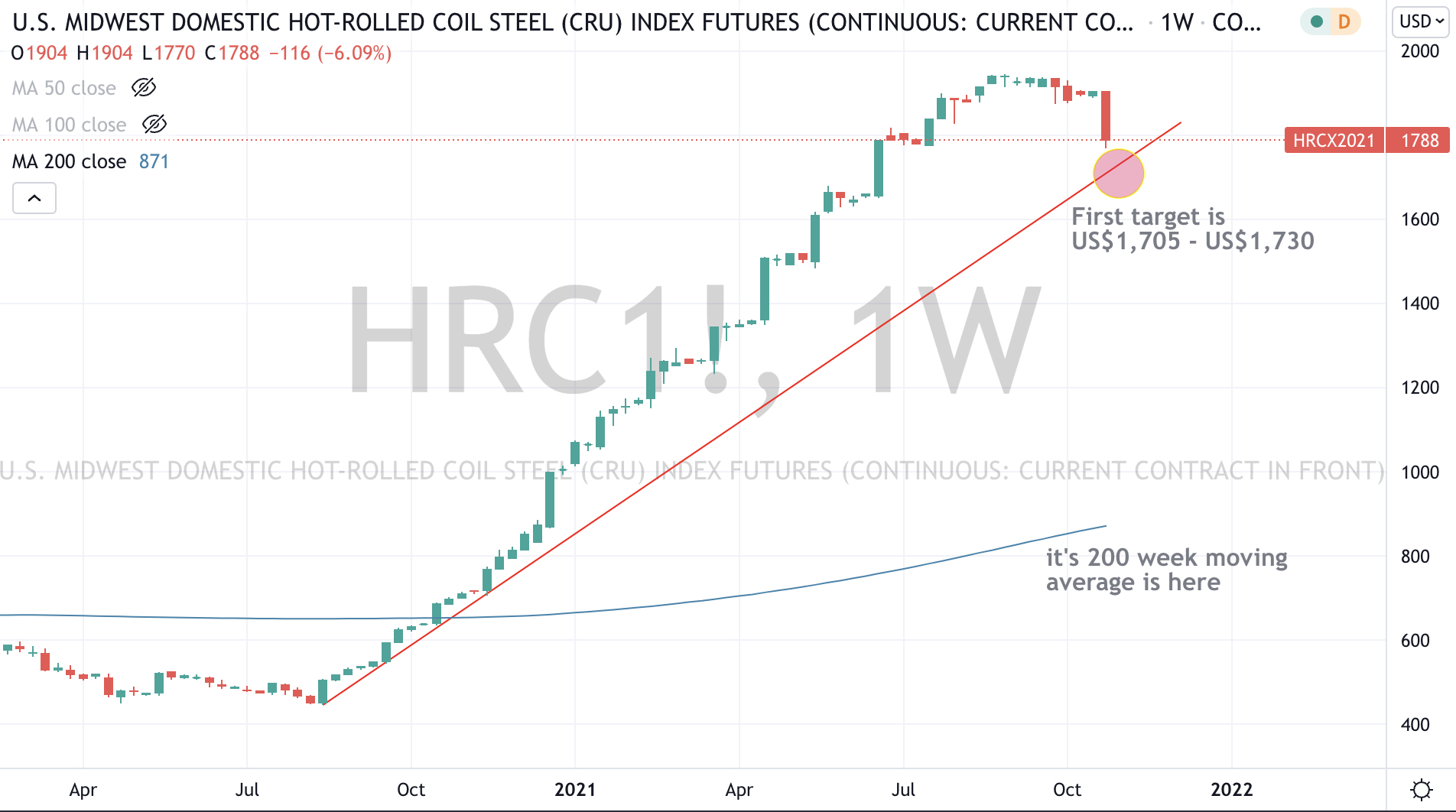
Hot Rolled Coil Steel (for the 45th consecutive week)

Natural Gas

Switzerland’s SMI equity index (for the 9th week)

Australia’s ASX 200 (for the 3rd week) 

India’s NIFTY-50 equity index

France’s CAC-40 index

the S&P 500 and Nasdaq 100

and the Stockholm, Copenhagen and Helsinki equity indices.

The Overbought Quinella – Both Overbought and Traded at > 2.5 standard deviations above the weekly mean)

Amsterdam’s AEX index

Assets (securities) within my immediate universe which touched the other side of the extreme, being Oversold (where the RSI is < 30) or were at least 2.5 standard deviations below its mean are;

Extremes “below” the Mean (at least 2.5 standard deviations)

the US Government 5 and 10 year bond yields,

the UK, Canadian and German 10’s,

AUD/JPY (signifying a strong Yen versus a weaker AUD),

AUD/GBP (telling us the Pound is strengthening),

the Hang Seng Index, 

the Hang Seng China Enterprises Index (now at the same price as March 2020 and 25% below its mid-Feb 2021 high)

Oversold (RSI < 30)

Nil

The Oversold Quinella – Both Oversold and Traded at < 2.5 standard deviations above the weekly mean)

 Chinese Government 10 year bond yield (suggesting bonds where being bought aggressively) 

Notable deletions from last week’s list include;

a weaker Korean Won, which since strengthened,

Gasoil, Heating Oil ,Gasoline all declined from their higher prices,

as did Coffee and Orange Juice.

Notes & Ideas:

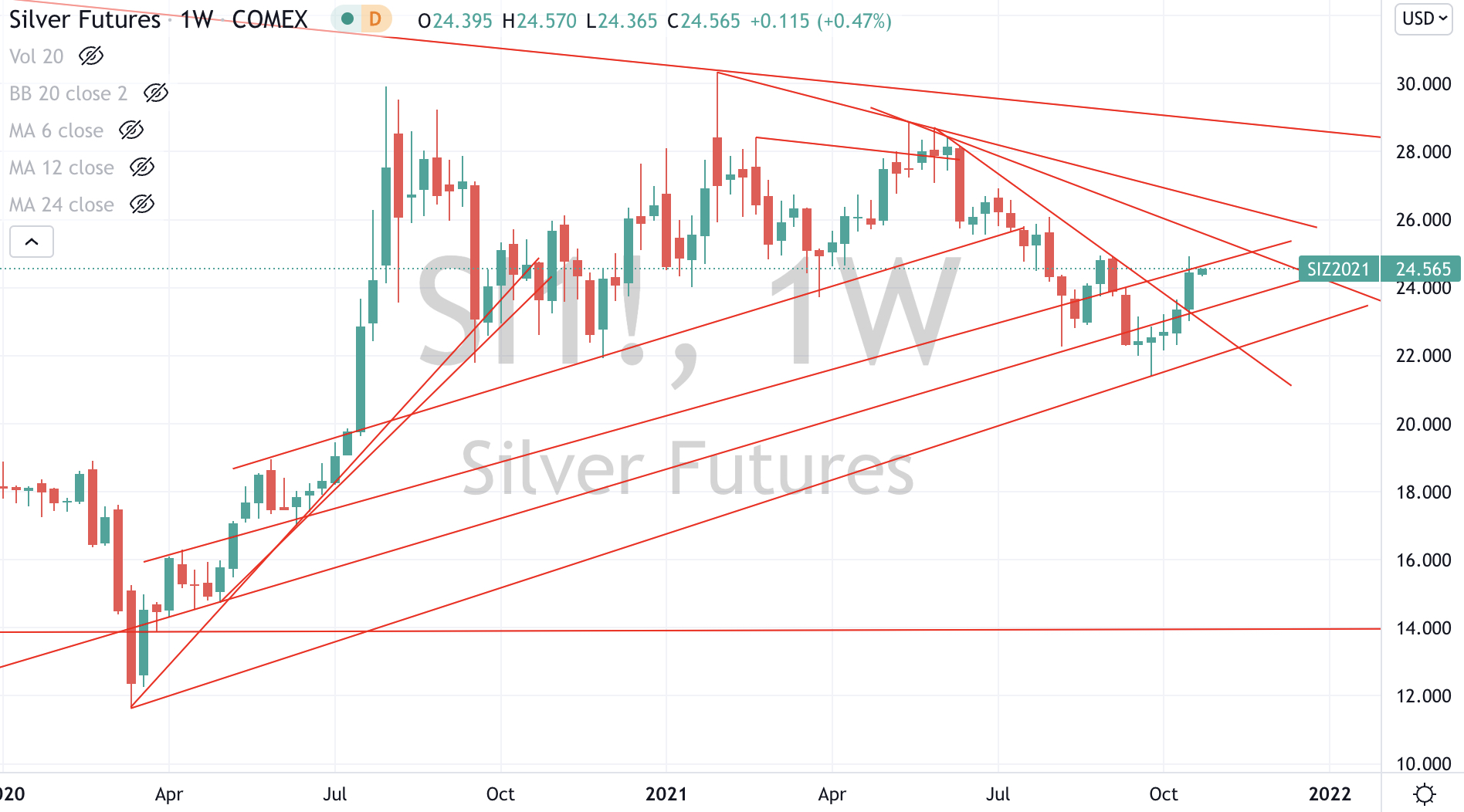
The decliners included Brent Crude (6.5%), WTI Crude (7.6%), Gasoil (5.4%), Heating Oil (5%), Lumber (11%), Platinum (7%), Gasoline (3%), Silver (4.8%), Copper (3%).

Advancers were dominated by soft commodities where Sugar rose 4.3% for the week and Wheat & Corn advanced 2%, Bitcoin was +8%, Ethereum rose 14% and Natural Gas climbed 5.8%.

Much action was again seen in falling government bond yields with the U.S. 10 year touching a low of 1.127% before bouncing and closing the week at 1.30%, which is higher than last week’s 1.23% close.

The 10’s remain bound in a larger range but we watch it as broader capital markets could become explosive is the 10’s break decisively either below 1.25% or above 1.65%.

In fact, we saw a bullish outside reversal week for the U.S. 10’s. 

Now, probability of higher yields increases, which means bonds will be sold and a likelihood that monies are moved into equities.

Next weekend, look for news headlines reporting that the ‘reflation trade’ has returned. Banks and Cyclicals are the immediate beneficiaries of such money flows.

Another signal boding well for higher equity prices, is the troughing in the AUD/JPY price and the Japanese 10 Year bond yield rose from 0.00% to 0.022%. Not a big deal to some, but significant to me. Risk appetites are about to reverse and increase.

The 10’s remain bound in a larger range but we watch it broader capital markets could become explosive is the 10’s break decisively either below 1.25% or above 1.65%.

The risk of lower commodity prices remains as the U.S. Dollar Index (DXY) strengthens and trends higher.

In turn, lower commodities would be welcome relief to ‘end-producers’ benefitting from lower input costs.

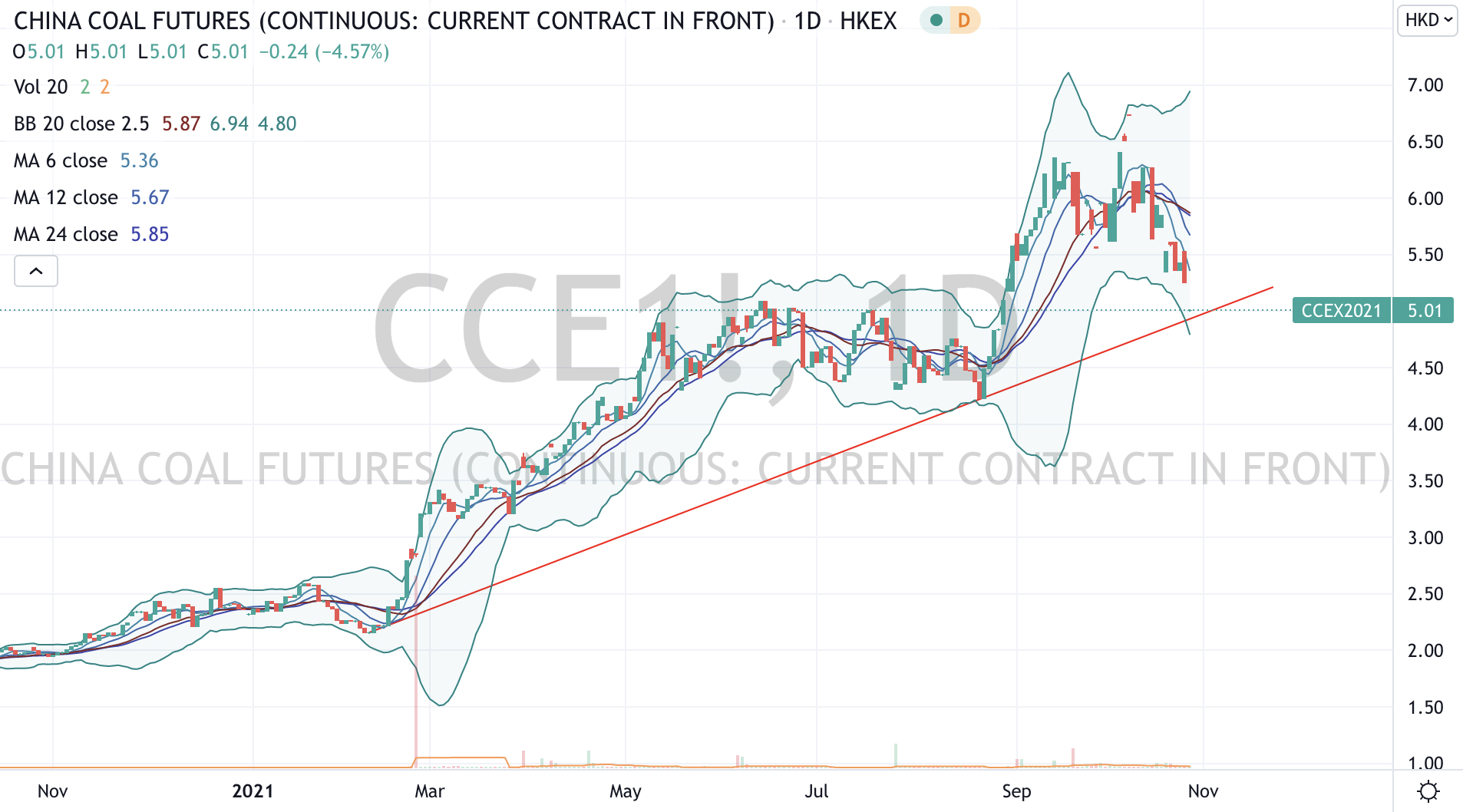
Such an example is currently being seen with Iron Ore now back at prices seen in April 2021, but when coupled with extended high prices in Hot Rolled Coil Steel being beneficial for steel producers.

No cryptocurrencies registered any Extreme readings.

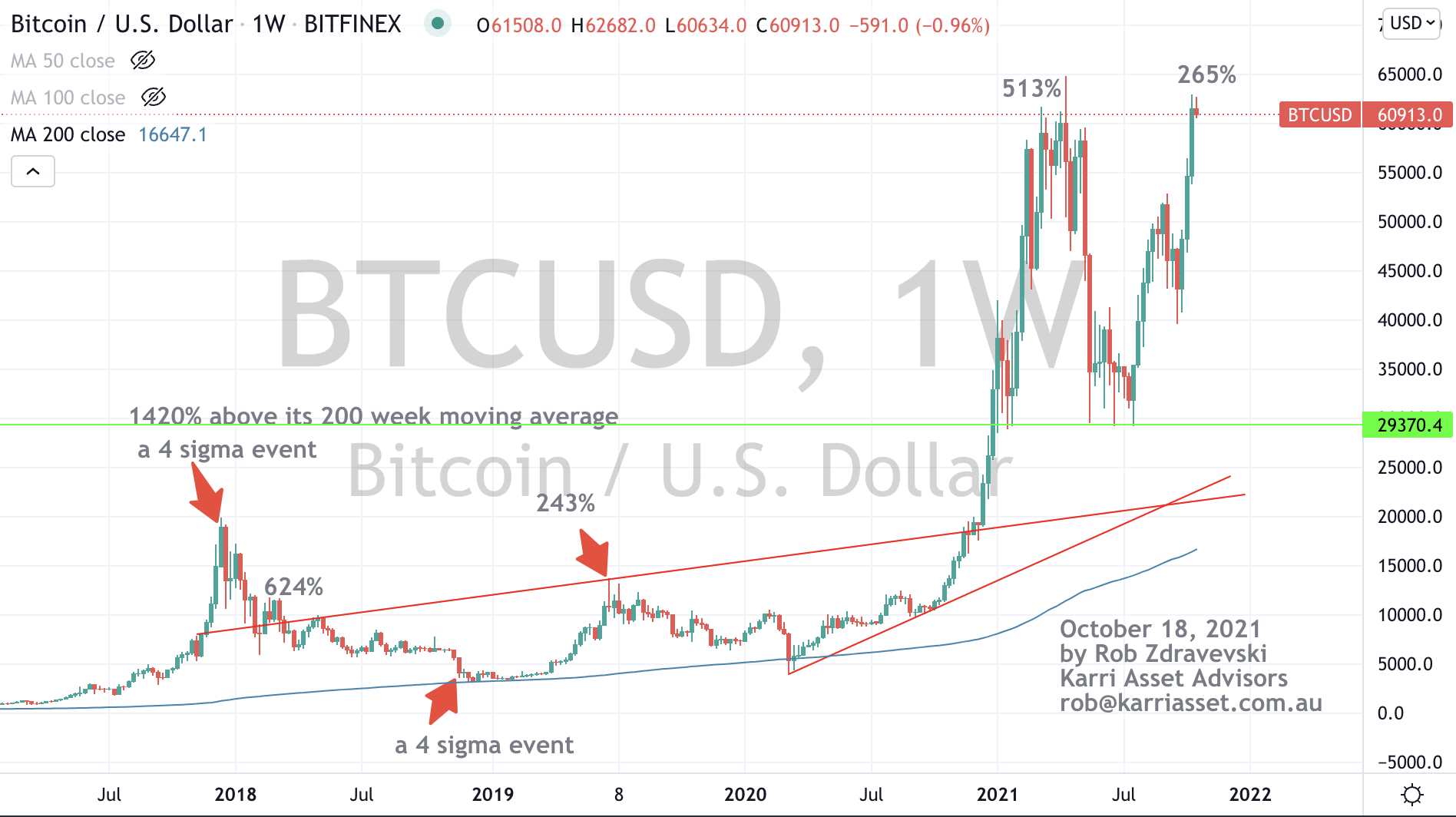
And lastly, Bitcoin is trading 200% above its 200 Week Moving Average, which is higher than last week’s 193% reading and notably higher than the reading of 140% seen 2 weeks ago, while certainly lower when compared to its 466% peak in mid-April 2021.

August 7, 2021

by Rob Zdravevski

rob@karriasset.com.au
Crypto – next move is government’s

Will Governments displace, disrupt or just takeover digital currency?

https://amp.ft.com/content/14b0fc81-ac17-4436-89ac-09d71c15d2af

The Delicate Game of Interest Rates & Inflation

Brazil lifts interest rates by 1% to 5.25%. It’s seen as its most aggressive move since 2016.

2 weeks ago, Russia, (another commodity reliant economy) hiked rates too.

It looks like both central banks are trying to curb inflationary pressures. Rising commodity prices are a notable contributor.

Invariably, rising inflation will send government bond yields higher.

Why are the central banks in other commodity sensitive economies such as Australia and Canada still holding interest rates around the 0.50% mark?

Are the Bank of Canada and the Reserve Bank of Australia foolishly towing the same line as other Western economies?

The British, German and French economies are vastly different.

This may turn out to be a perilous policy error.

Are the BOC and RBA not entirely politically independent?

Can it be that the Russian Central Bank is acting for the good of the economy and citizens or is it because Putin doesn’t need to worry about being re-elected and Scott Morrison does?

Or perhaps it’s because the Household Debt to GDP for Russian’s and Brazilians is 22% and 37% respectively,

while in Canada it’s 113% and Australia’s is a world topping 123% ????

August 6, 2021

by Rob Zdravevski

rob@karriasset.com.au