Another chance to buy Tesla shares (for those who believe or completed their due diligence) is nearing again and I think it’ll be at a price much lower than today’s.
That was the pricing of Tesla stock before the 3 for 1 stock split.In today’s after-market action, following its latest quarterly release sees TSLA shares trading at $208 (or $624 in pre-split prices) The 200 week moving average which I continue to reference in stories I tell, sits at $157.That mean should rol up to the $161 region in the next few weeks.$161 is equal to $483. Which meets and is a little lower than that pre-split target of $519.
8 months earlier, I wrote this note. My timing was off.
While I see rotation in amongst sectors and various buying opportunities in equity markets appear, Tesla is not one of them.
Further risk and declines in Tesla’s stock price and a few other stocks which have distorted indices are the reasons why ‘the market’ could fall further.
Within this ‘market’, continue to pick out the stocks which are cheaper and ripe for some (stock)picking.
If you had to watch only one stock this earnings season, I think it should be Alphabet.
I remember when Cisco Systems was the quarterly earnings bellwether?
They (Google) report earnings on February 1st, 2022.
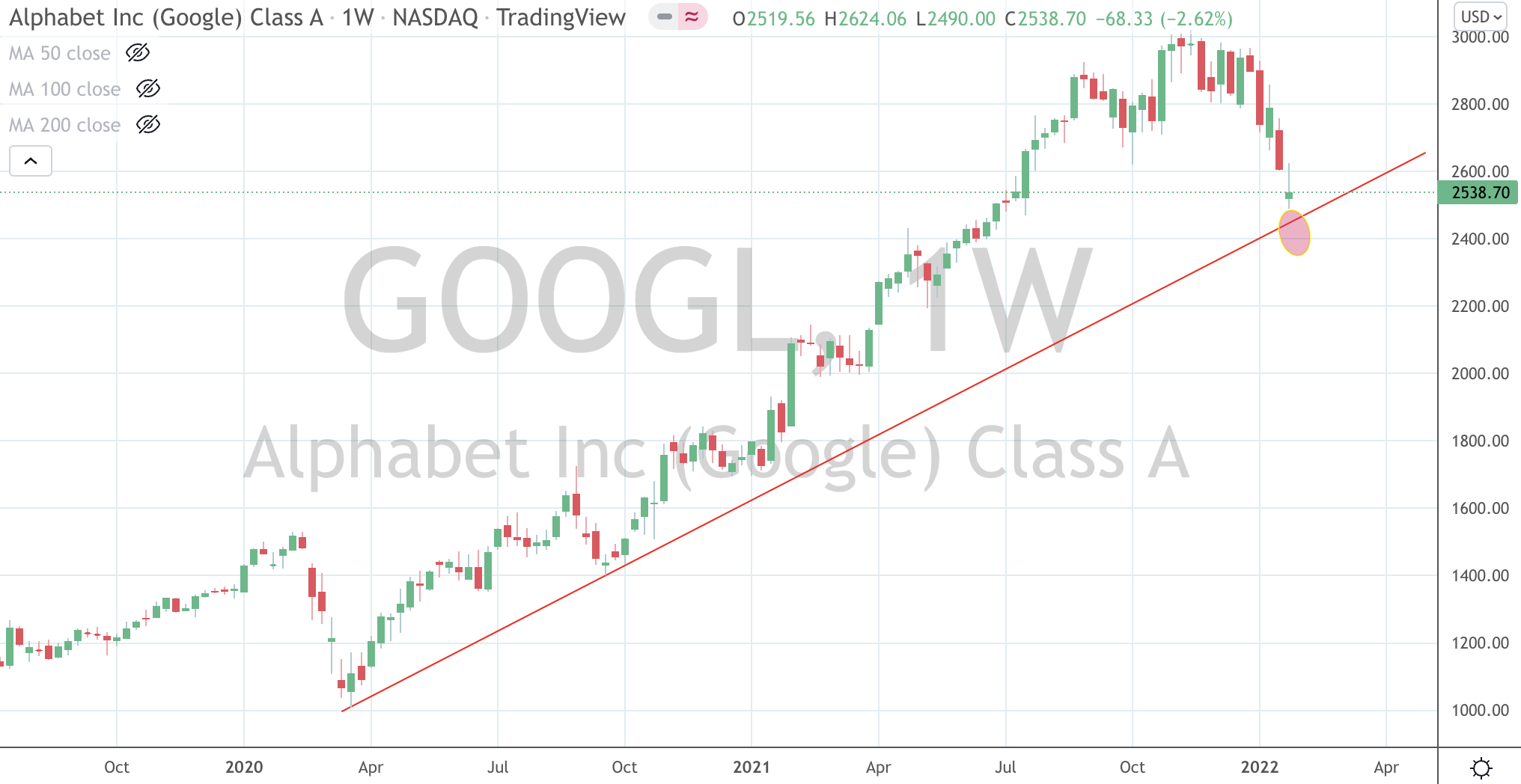
To coincide with today’s post about picking a bottom in the Nasdaq, in order to keep its current bullish trend intact, GOOGL needs to hold the support line on the chart below, which is around the $2,450 mark.
In other news, Microsoft reported earnings after today’s close and we’ll see how their price action plays out, while Apple reports earnings on January 27th.
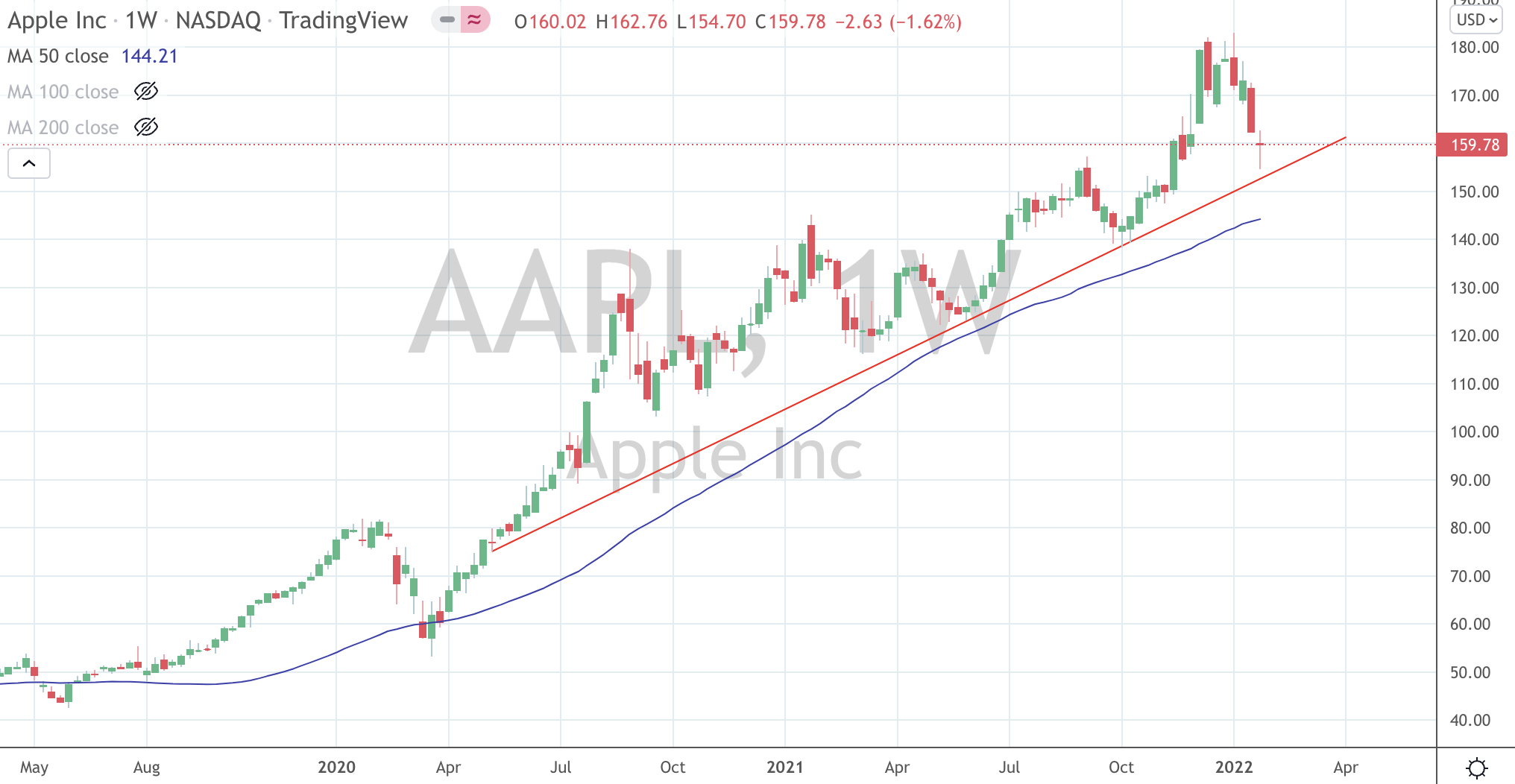
All three of these stocks are on or above similar support lines. (MSFT’s is right on the edge).
Meanwhile, the other three of the “FAANGM’s gang, being Netflix, Amazon and Facebook have already broken below their corresponding (or sympathetic) support lines.
Incidentally, Tesla reports quarterly earning on January 26th (U.S. time) and their stock will be interesting to watch too. Not because I consider them anywhere near a bellwether, but rather they are a proxy for cult and sentiment.
To put it simply, if Alphabet (Google) breaks below that support line on a weekly closing basis, then they may be the last straw that broke the camel’s back……….
thus my the probability of my Nasdaq low story is de-bunked and I’ll revise the next wave and targets at lower levels.
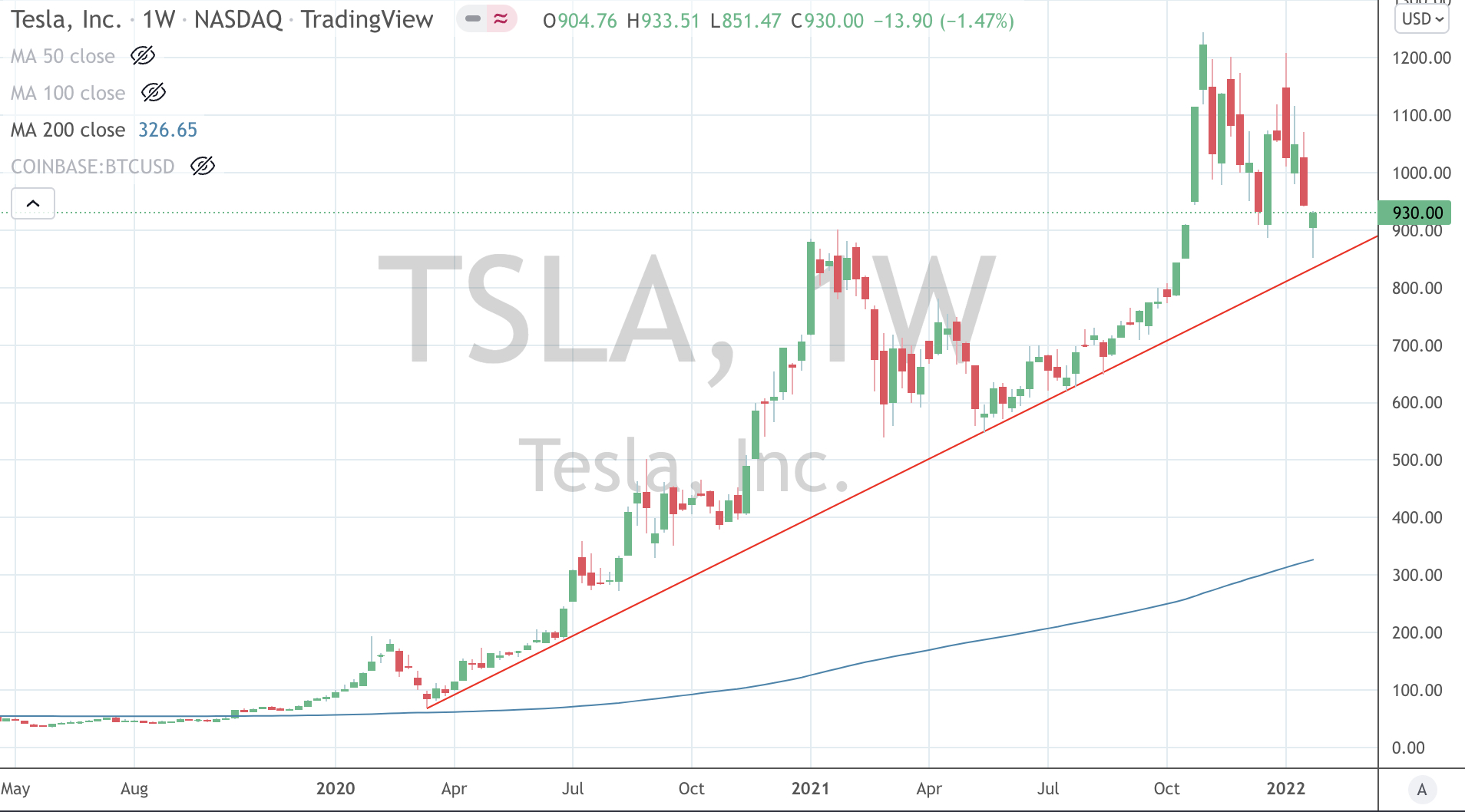
If Tesla’s stock price breaks below $835, $814 is a minor stopping point, beyond that we’ll look for a visit to $650, then $567 while $519 would represent a good shake-out.
This year, IPO’s on U.S. exchanges have raised a record $140 billion, exceeding the $107 billion raised in the height of the 1999 dot-com boom.
It has also been a week when we have seen;
✔️ Tesla announce its 3rd (secondary) equity sale this year. The timing of the previous offerings uncannily occurred at interim market highs;
✔️ the most ridiculous IPO in DoorDash; (stock doubles on its first day, market cap is $60bn vs. $16bn in early 2020)
✔️ and Airbnb premiered on the bourse with an IPO of its own.
The process of pricing of Airbnb’s IPO began between the $44-$50 per share range which was revised to $56-$60 while the final price struck was at $68.
Unlike Facebook’s IPO pricing debacle in 2012, I think Airbnb’s pricing was spot-on.
The after-market demand saw the stock close at $145 on its first day of trading. With $602 million shares outstanding, it now has a market cap of $87 billion.
But on a fully diluted basis (including employee stock, options and restricted units) Airbnb has 700m shares, so its Market Cap is $101 billion.
and DoorDash has 385m shares, which adjusts its Market Cap to $71.5 billion, which is a little bit too much when you are losing $150 million and trading on 30 times revenue.
Tesla continues to add chapters to the investment banking playbook. Using the inflated currency of the company’s common stock, it will sell $5 billion worth of shares to fund its spending plans.
And why not…..The stock price has risen 670% this year. It “only” has net debt of $1 billion which is not a stretch against its $4 billion of EBITDA. Its market cap is $616 billion. The secondary offering is barely 1% of its market cap and it’s not dilutive at all.
Valuations on the company aside, they are classically raising money when (figuratively speaking) they don’t need it and it is far better to sell stock, or borrow money, from a position of strength.
Throw in a recent stock split and an upcoming inclusion into the S&P 500 Index, Tesla will be able to sell another $5 billion worth of shares in the next few months again and even re-finance its debt at lower rates than the 5.3% coupon its paying bondholders for its 2025 maturity.
Incidentally, their timing isn’t too bad either.
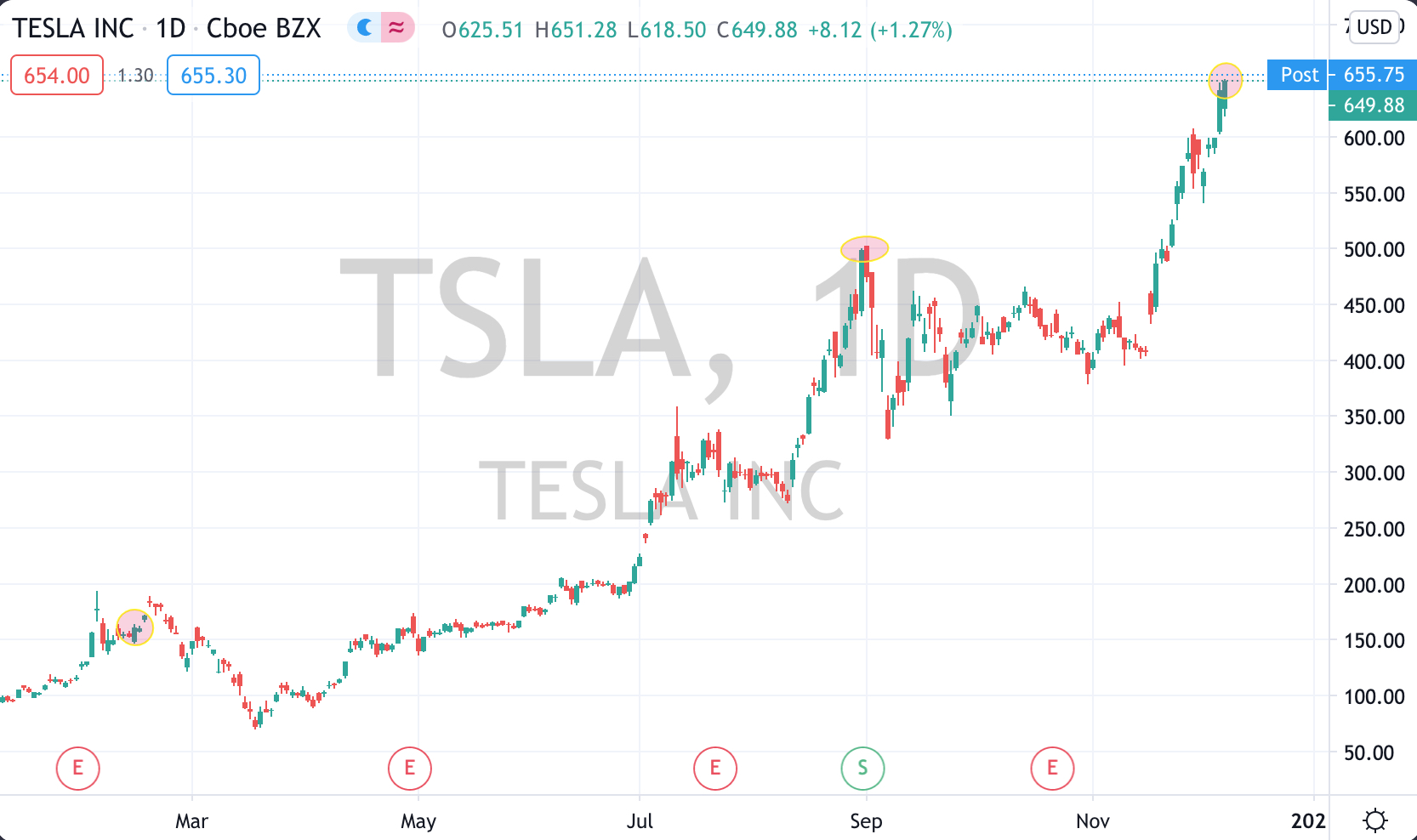
Circles in the chart below denote when Tesla’s previous secondary offerings were announced. A $5bn raise on September 1, 2020 and a $2bn share sale on February 13, 2020.





 rob zdravevski's blog