Macro Extremes (week ending May 10, 2024)

A weekly Macro, Cross Asset review of prices trading at extremes which may generate future investment ideas and opportunities.

The following assets (on a weekly timeframe) either registered an Overbought or Oversold reading and/or have traded more than 2.5 standard deviations above or below its rolling mean.

  • denotes multiple week inclusion

Extremes “above” the Mean (at least 2.5 standard deviations)

Oats *

Hang Seng China Enterprises Index (HSCEI) *

Hang Seng Index *

South Africa 40 *

FTSE 250

Helsinki 

Overbought (RSI > 70)

Russian 10 year government bond yield 

Japanese 2 year government bond yield 

Copper

Gold as priced in USD, GBP, EUR, CHF and CAD

AEX *

Budapest *

DAX

MIB

Stockholm

TAEIX

Malaysia’s KLSE *

Pakistan’s KSE Index *

FTSE 250

and Turkiye’s BIST 100 *

The Overbought Quinella (Both Overbought and Traded at > 2.5 standard deviations above the weekly mean)

Austria’a ATX

Oslo

FTSE 100

Extremes “below” the Mean (at least 2.5 standard deviations)

None

Oversold (RSI < 30)

Lithium Hydroxide *

North European Hot Rolled Coil Steel *

Midwest U.S. Hot Rolled Coil Steel

Lumber *

The Oversold Quinella (Both Oversold and Traded at < 2.5 standard deviations below the weekly mean)

None

Notes & Ideas:

Government bond yields were mixed, with a slight bias higher.

Generally, those yields which were overbought in the recent weeks, fell and those yields that weren’t overbought…rose over the past week.

Equities were mostly higher, with Indian indices amongst the few to decline.

Europe was stronger. Perhaps it was a Eurovision rally?

It has been nearly 3 years since the FTSE 250 has registered an overbought extreme. It has risen 6.5% over the past 3 weeks.

Germany’s DAX, Italy’s MIB, & Stockholm’s OSX 30 are back in overbought territory.

The HSCEI and Hang Seng have both risen 16% in the past 3 weeks.

Furthermore, the Shanghai Composite, CSI 300, the U.S. (KRE) Regional Banks Index and Malaysia’s KLCI Index are in a 4 week winning streaks.

China’s A50 Index and the U.S. KBW Bank Index have risen 7.5% and 8% respectively, over the past 4 weeks.

And the Nasdaq Transports broke its 5 week losing streak.

Commodities were mostly stronger.

Precious Metals, Grains, Gases and Softs were stronger.

Oats are in a 5 week winning streak and have climbed 26.5% over that time.

Urea, Steel and Lumber prices were weaker. Lumber has tanked 20% over the past 7 weeks.

Some of the grains are now seeing 4 weeks of consecutive gains.

Copper and Gold are overbought, while Hot Rolled Coil Steel, Lumber and Lithium are in the oversold category.

Robusta Coffee has fallen 18% over the past fortnight which accounts for nearly half of the 39% rise seen in the prior 10 weeks.

Cotton has fallen for 10 consecutive weeks, sinking 21% over that time and nearing oversold territory.

Over the past fortnight, Platinum has risen 9% while Gasoline has slumped 9%.

The Baltic Dry Index has soared 23% in 2 weeks.

And Lithium Hydroxide has now spent 43 consecutive weeks in weekly oversold territory.

Currencies were generally quiet for the week except for the renewed weakness in the Yen.

The AUD fell against all except the Yen.

The Euro was firmer and the EUR/USD is in a 4 week winning streak.

And the U.S. Dollar rose against everyone except anything called a Peso.

The larger advancers over the past week comprised of;

Baltic Dry Index 13.5%, Cocoa 9.2%, JKM LNG in Yen 6.9%, Tin 6.3%, Natural Gas 5.1%, Orange Juice 6.5%, Palladium 3.5%, Platinum 4.3%, Silver in AUD 6.1%, Gold in AUD 2.6%, Gold in USD 2.5%, Corn 2.1%, Oats 6.1%, Rice 2.7%, Wheat 6.6%, CSI 300 1.7%, AEX 2.6%, ATX 2.7%, KBW 2.7%, Budapest 1.8%, CAC 3.3%, DAX 4.3%, DJ Industrials 2.2%, MIB 3.1%, HSCEI 2.6%, Hang Seng 2.6%, IBEX 2.3%, S&P SmallCap 600 1.7%, Nasdaq Composite 1.1%, KOSPI 1.9%, FTSE 250 2.4%, S&P MidCap 400 2.2%, Nasdaq 100 1.5%, Oslo 3.5%, Copenhagen 2.3%, Helsinki 3.3%, Stockholm 3.5%, SA40 2.7%, SMI 4.3%, SOX 2%, S&P 500 1.9%, TAEIX 1.9%, Nasdaq Transports 2%, TSX 1.7%, FTSE 100 2.7%, Vietnam 1.9%, ASX 200 1.6%, ASX Industrials 1.7%, ASX Small Caps 1.5% and the Tel Aviv 35 rose 3.3%.

The group of largest decliners from the week included;

U.S. Hot Rolled Coil (HRC) Steel (4.1%), Lumber (2.1%), Newcastle Coal (2%), Gasoline (2.2%), Robusta Coffee (2.9%), Urea Middle East (2.3%), NIFTY (1.9%) and India’s SENSEX fell 1.7%.

May 12, 2024

by Rob Zdravevski

rob@karriasset.com.au
Macro Extremes (week ending May 3, 2024)

A weekly Macro, Cross Asset review of prices trading at extremes which may generate future investment ideas and opportunities.

The following assets (on a weekly timeframe) either registered an Overbought or Oversold reading and/or have traded more than 2.5 standard deviations above or below its rolling mean.

  • denotes multiple week inclusion

Extremes “above” the Mean (at least 2.5 standard deviations)

Australian 2, 3, 5 & 10 year government bond yields *

Japanese 2 year government bond yield

South Korean 10 year government bond yield *

Copper/Gold Ratio

U.S. 5 year government bond yield minus U.S. 5 year inflation breakeven rate *

Newcastle Coal

Oats

AUD/IDR *

AUD/THB *

Hang Seng China Enterprises Index (HSCEI) *

Hang Seng Index *

J’burg 40 

Singapore Straits Times Index *

Overbought (RSI > 70)

Russian 10 year government bond yield 

AEX

Budapest

Malaysia’s KLSE *

Pakistan’s KSE Index *

FTSE 250

and Turkiye’s BIST 100 *

The Overbought Quinella (Both Overbought and Traded at > 2.5 standard deviations above the weekly mean)

Brazilian 10 year government bond yields 

Copper

Extremes “below” the Mean (at least 2.5 standard deviations)

SHY

PHP/USD *

Dow Jones Transports *

And Indonesia’s IDX30 *

Oversold (RSI < 30)

Lithium Hydroxide

North European Hot Rolled Coil Steel

The Oversold Quinella (Both Oversold and Traded at < 2.5 standard deviations below the weekly mean)

Lumber

Urea

Notes & Ideas:

Government bond yields fell.

Many streaks were broken such as the 5 week winning streak in Canadian and South Korean 10’s along with all the yields across the British curve.

Chinese 10 year bond yields is no longer oversold as its yield rose.

Equities were mostly higher.

However, selected European bourses did see weakness.

China’s A50 Index and the U.S. KBW Bank Index have risen 7.5% and 5.2% respectively, over the past 3 weeks.

IBEX, MIB, & Stockholm’s OSX 30 aren’t overbought anymore.

The HSCEI and Hang Seng both rose 4.5% for the week, adding to last week’s 9% advance.

Furthermore, the Hang Seng and U.S. (KRE) Regional Banks Index are in a 3 week winning streak.

The SOX finished flat following last week’s stunning 10% rise.

Karachi broke its 6 week winning streak.

The Nasdaq Transports has declined for 5 consecutive weeks.

And Toronto’s TSX registered a bearish outside reversal week.

Commodities were mostly lower, again.

Weakness was seen in Cocoa, Coffee, Precious Metals, Oils and Distillates.

Strength was evident in Base Metals, Coal, Gases and Grains.

Some of the grains have strung 3 weeks of consecutive gains.

Aluminium, Tin & Nickel are not overbought anymore, nor is Cocoa, Coffee or Gold (in any currency).

Cocoa has fallen 31% in the past fortnight and has broken its overbought streak of 27 weeks.

While Australian Coking Coal isn’t oversold this week.

Robusta Coffee has fell 15% accounting for nearly half of the 39% rise seen in the prior 9 weeks.

Cotton has fallen for 8 consecutive weeks while Rubber has sunk for 6 weeks straight.

Iron Ore in a 5 week winning streak.

U.S. Hot Rolled Coil Steel performed a bearish weekly outside reversal.

And Lithium Hydroxide has now spent 42 consecutive weeks in weekly oversold territory.

Currencies are providing stealth guidance for the health of various asset trends.

The big news was the strength in the Japanese Yen and it’s no longer at last weeks extremes.

The AUD rose against all except the Yen.

The Canadian Loonie fell while the Euro was mixed.

The British Pound fell with the exception of the USD pair.

The Thai Baht broke its 7 week losing streak against the USD.

And the USD/SEK registered a outside weekly bearish week.

The larger advancers over the past week comprised of;

Australian Coking Coal 3.2%, Baltic Dry Index 9%, China Coking Coal 4.7%, Tin 2%, Newcastle Coal 5.8%, Natural Gas 11.4%, Platinum 4.7%, Dutch TTF Gas 5.5%, Uranium 5.5%, Corn 2.3%, Oats 7.9%, Soybeans 3.2%, China A50 2%, HSCEI 4.4%, Hang Seng 4.7%, Russell 2000 1.8%, KRE Regional Bank Index 3%, FTSE 250 1.7%, Nasdaq Biotechs 5.9%, Chile 2.6% and the BIST 100 rose 3.6%.

For reference, the S&P 500 rose 0.6% for the week.

The group of largest decliners from the week included;

Aluminium (1.9%), Cocoa (23.1%), WTI Crude (6.9%), Cotton (3.5%), Lean Hogs (2%), Heating Oil (4.7%), Coffee (Arabica) (10.4%), Lumber (2.7%), Lithium (5.7%), Gasoline (6.9%), Coffee (Robusta) (14.7%), SPGSCI (3.8%), CRB Index (3.5%), Brent Crude Oil (6%), Gasoil (5.3%), Urea Middle East (2.1%), Silver in AUD (3.6%), Silver in USD (2.4%), Gold in AUD (2.7%), Gold in CHF (2.6%), Gold in EUR (2.2%), Gold in GBP (2%), Gold in ZAR (3%), CAC (1.6%), MIB (1.8%) and Spain’s IBEX fell 2.7%.

May 5, 2024

by Rob Zdravevski

rob@karriasset.com.au
When Private Equity firms, themselves, go public.

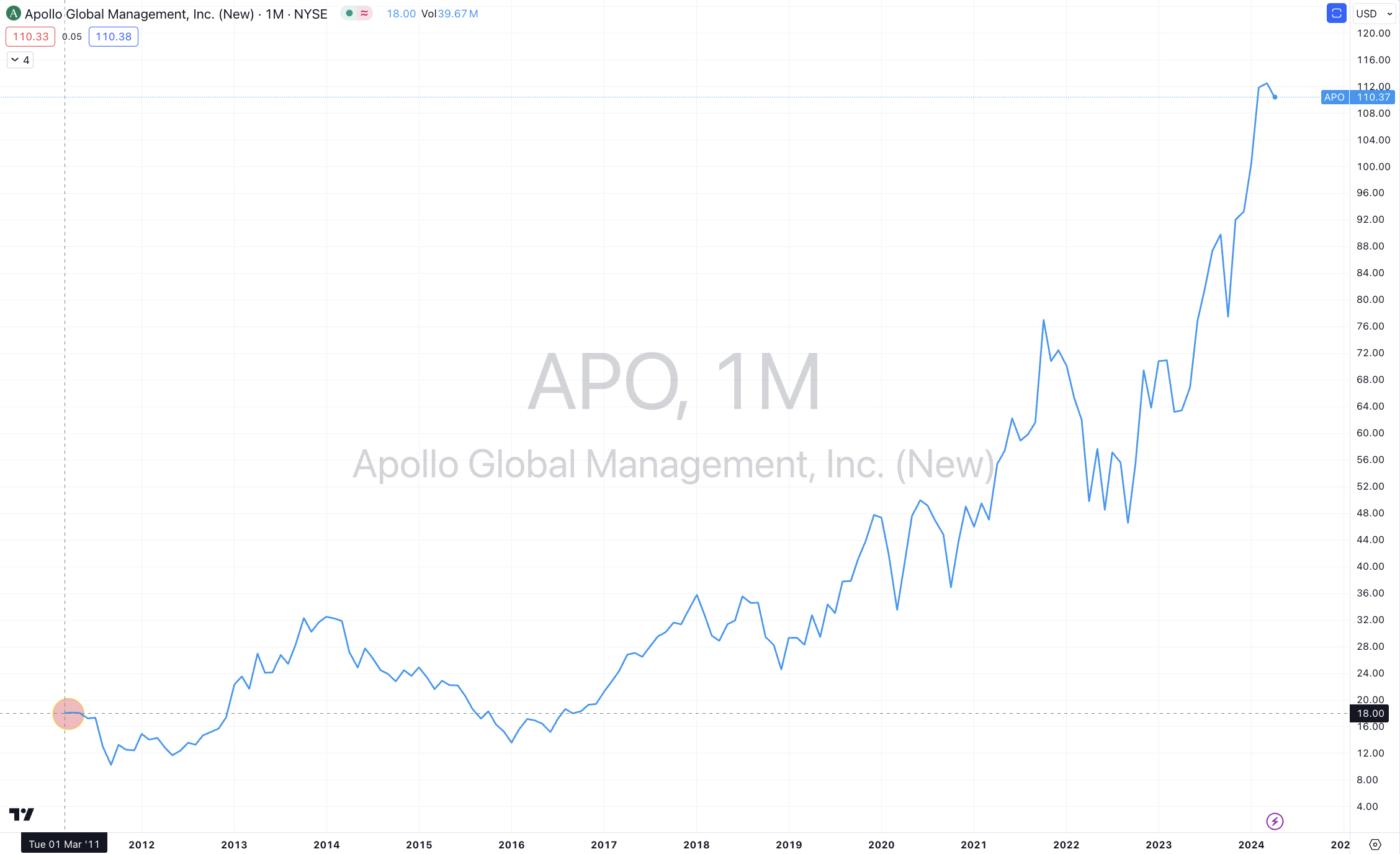
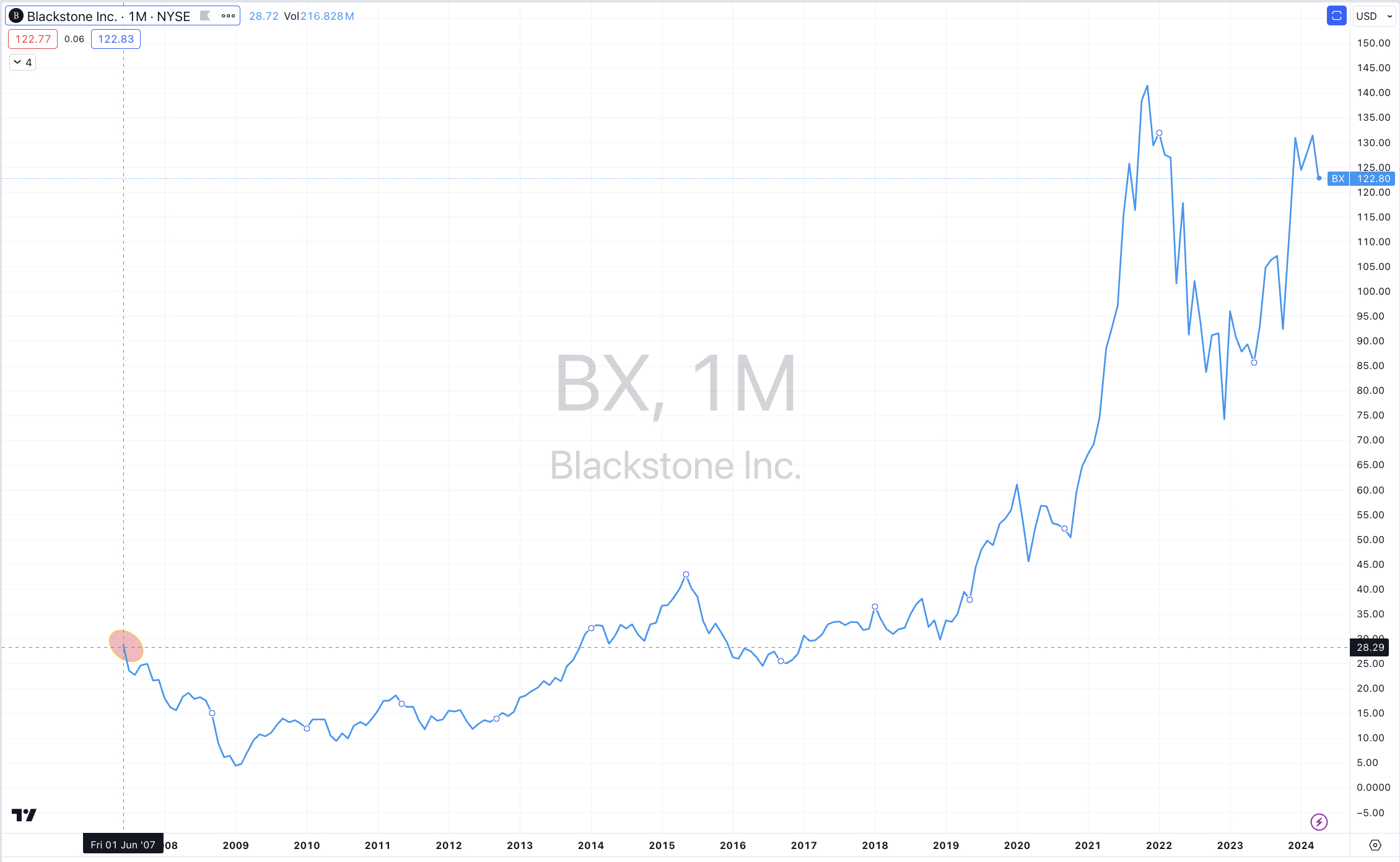
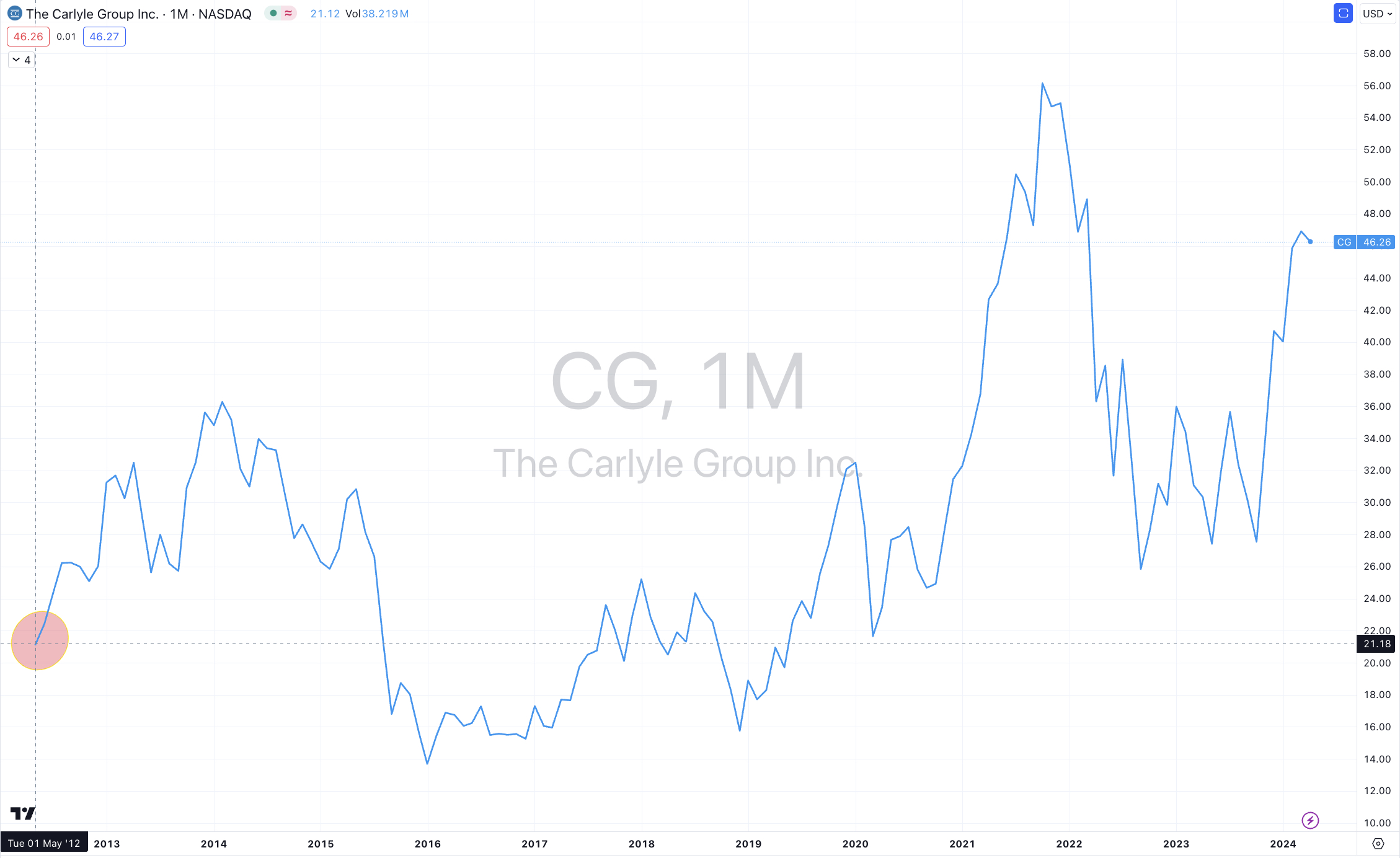
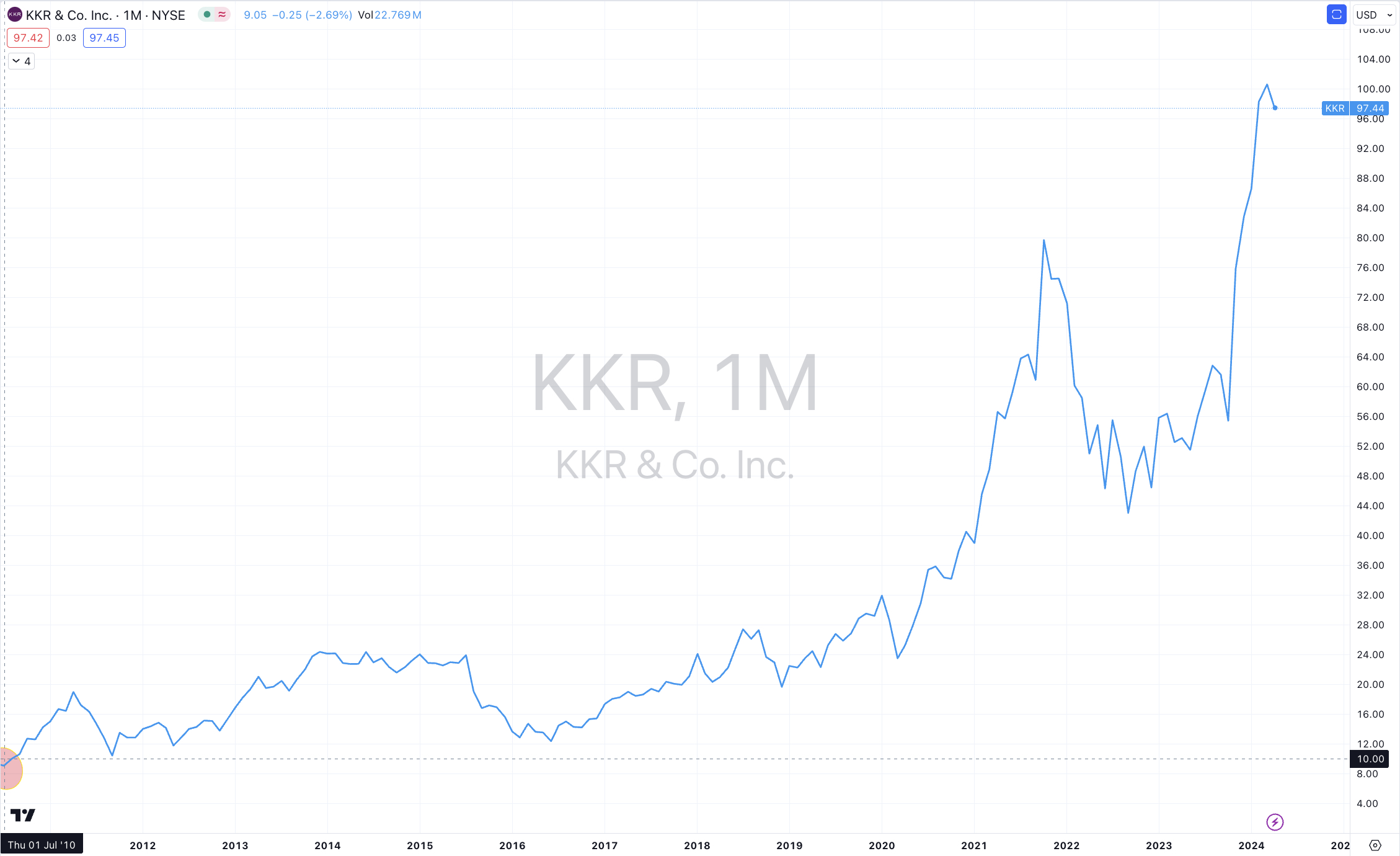
It all started when Fortress Investment Group went public on February 9, 2007, and the IPO was priced at $18.50 per share.

Next, Blackstone went public in June 2007 when its IPO was priced at $31.

KKR priced its IPO at $10 in July 2010.

At the time of KKR going public, shares in Blackstone Group (BX) and Fortress Investment Group (FIG) had fallen by 71% and 87% respectively since their market debuts in 2007.

Apollo Global Management was next to list their shares, when on March 30, 2011 their IPO was priced at $19

The Carlyle Group went public on May 3, 2012, and the IPO was priced at $22 per unit.

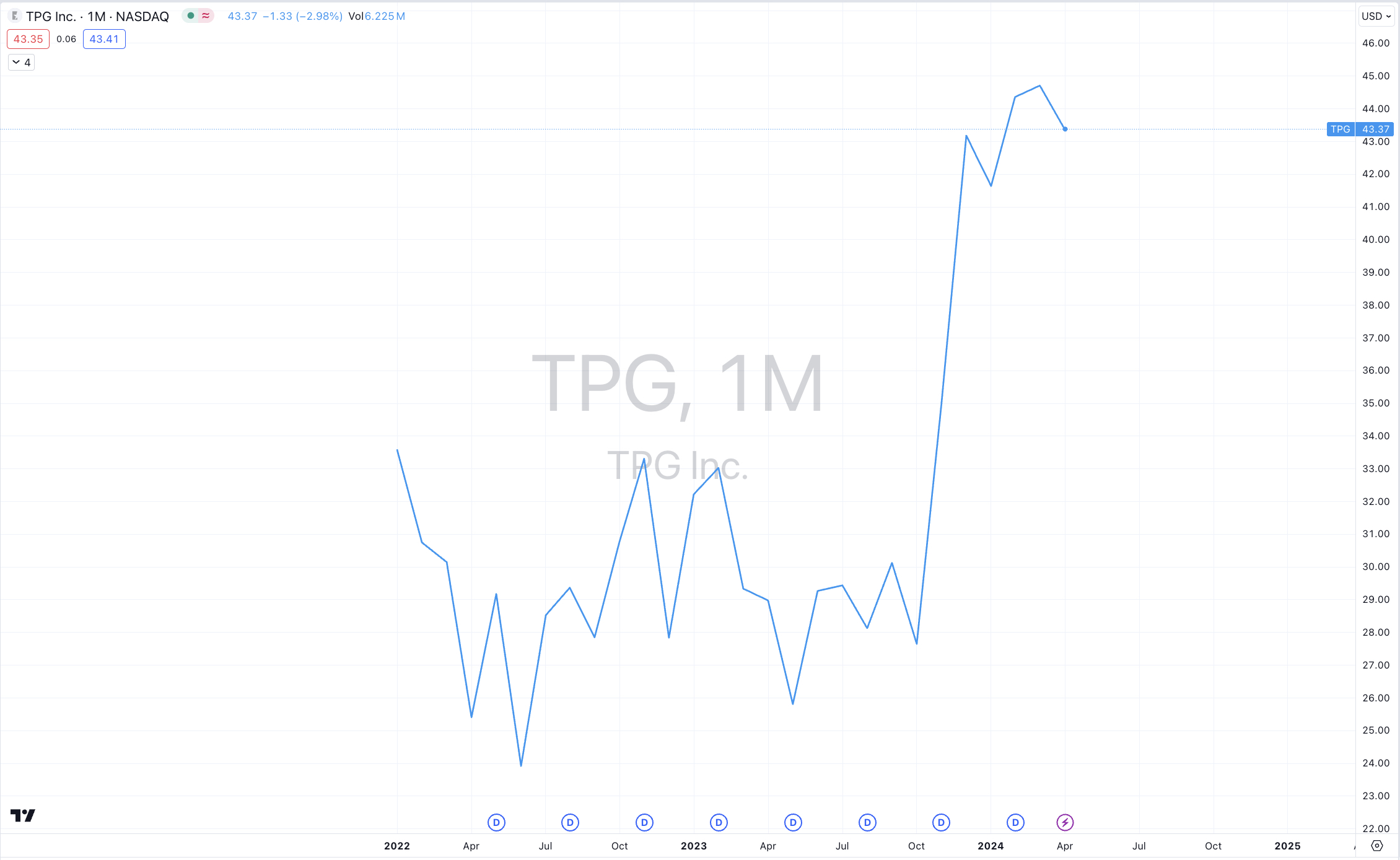
More recently, TPG went public on January 13, 2022, and the IPO was priced at $29.50 per share.

Everyone’s charts are below except for Fortress (FIG) because in Q1 of 2017, Softbank acquired them for $8.08 per share.

Today, CVC announced their interest in going public.

Over a 10-15 year timeframe, it’s not clear cut whether there is merit backing the ‘sponsor’ in every case.

April 15, 2024

by Rob Zdravevski

rob@karriasset.com.au
Screenshot
Screenshot
Screenshot
Screenshot
Screenshot

Macro Extremes (week ending April 5, 2024)

A weekly Macro, Cross Asset review of prices trading at extremes which may generate future investment ideas and opportunities.

The following assets (on a weekly timeframe) either registered an Overbought or Oversold reading and/or have traded more than 2.5 standard deviations above or below its rolling mean.

Extremes “above” the Mean (at least 2.5 standard deviations

U.S. 10 year yield minus German 10 year yield

U.S. 10 year yield 

Aluminium

Bloomberg Commodity Index

WTI Crude Oil

Copper

S&P GSCI 

Brent Crude Oil

Silver in USD

AUD/JPY

AUD/THB

USD/IDR

USD/SEK

USD/PHP

USD/BRL

MXN/USD

COP/USD

And Britain’s FTSE 100 Index

Overbought (RSI > 70)

Russian 10 year bond yield 

Cocoa

Coffee (Robusta)

AEX

KBW Bank Index

Budapest

DAX

Pakistan’s KSE

Italy’s MIB

Nifty 50

TAIEX

Toronto’s TSX

BIST 100

And the S&P 500 Index

The Overbought Quinella – Both Overbought and Traded at > 2.5 standard deviations above the weekly mean)

Coffee (Arabica)

Biodiesel

CRB Index

Silver in AUD

Gold in AUD, CAD, CHF, EUR, GBP, USD and ZAR

Extremes “below” the Mean (at least 2.5 standard deviations)

Australia 10 year yield minus U.S. 10 year yield

North European Hot Rolled Coil Steel (HRC)

Lumber 

Oats

Rice

CHF/AUD

Oversold (RSI < 30)

Chinese 10 year government bond yields

Lithium Hydroxide

Iron Ore

Shanghai Rebar

The Oversold Quinella – Both Oversold and Traded at < 2.5 standard deviations below the weekly mean)

Australian Coking Coal

Chinese Coking Coal 

Notes & Ideas:

For the week, government bond yields rose.

While Chinese and Russian 10 year yields appearing either end of their pendulums, many yields are showing signs of breaking north of their recent sideways pattern.

The Japanese 2’s are amongst the nearest other bond yield to approach an extreme.

And we see some yield spreads appear in this week’s list.

Equities mainly fell for the week, across the world.

Regular readers wouldn’t be surprised about this weeks declines, considering the implied probability that rises when we saw the the long list of overbought equity indices appearing over the past few weeks editions.

The following equity indices dropped out of overbought territory;

KBW Bank Index, CAC 30, IBEX, Dow Jones Industrial Average, Nasdaq Composite, S&P MidCap 400, Vietnam,  Nasdaq Transports & the Philadelphia SOX and the Nikkei 225.

The latter fell 3.4% of the week.

Oslo is in a 6 week winning streak, while Mexico’s main index has put together 4 weeks of consecutive higher prices. 

Toronto’s TSX extends its winning streak to 8 weeks.

The DAX broke 8 week winning streak and Italy’s MIB broke its 9 week rising run. Both these indices joined the Nasdaq 100, SMI, ASX 200 and SOX in performing an bearish outside reversal week. 

Commodities were generally higher and it is where most of the week’s action was.

The major commodity indices have returned to overbought status, mainly driven by the energy and the industrial and precious metals.

Gold prices across various currencies remains overbought, with their weekly performances listed below.

Renewed media noise about the rise in oil and copper prices coincides with them trading at overbought extremes.

Coffee prices were there largest gainers for the week. Arabica played catch up to Robusta Coffee, the latter having risen 22% over the past 6 weeks.

Prices related to steel production such as coking coal, iron ore, rebar, are all in oversold territory.

The “coking coals” have fallen for 7 straight weeks, with Australian Coking Coal prices falling 32% over that time.

The Baltic Dry Index has slumped 35% over the past 3 weeks.

While U.S. Midwest Hot Rolled Coil Steel is approaching oversold territory, the North European price did so, this past week.

Crude Oil, Copper, Tin and Silver moved out of overbought territory.

Rice has fallen for 6 consecutive weeks and its price has declined 15% over that time.

Oats are oversold and have produced a 35% decline from their overbought extreme seen in August 2023.

Cocoa has been overbought for 24 weeks.

Aluminium has risen for 6 straight weeks.

And Lithium Hydroxide has now spent 39 consecutive weeks in weekly oversold territory.

Currencies saw a bit more activity this week, with a few more currencies return to the ‘extremes’ list.

The AUD rose.

The CAD was weaker as was the Yen. 

The Euro was mainly firmer, reversing last week’s weakness.

The British Pound was mixed for the week.

The USD was also mixed as we see it exhibit ‘extreme’ strength versus the  Indian Rupee, Swedish Krona, Philippine Peso and Brazilian Real yet it is trading at ‘extreme’ weakness against the Colombian and Mexican Peso’s.

In fact, the USD has risen for 5 straight weeks against the BRL.

And the Kiwi has declined for 6 consecutive weeks versus the Aussie.

The larger advancers over the past week comprised of;

Aluminium 4.9%, Bloomberg Commodity Index 3.4%, WTI Crude 4.5%, Lean Hogs 3.1%, Copper 5.7%, Heating Oil 5.7%, Coffee 12.5%, Nickel 6.4%, Platinum 2.1%, Gasoline 2.5%, Biodiesel 5%, Robusta Coffee 8.3%, Raw Sugar 2.2%, S&P GSCI 3.3%, CRB Index 2.5%, Brent Crude Oil 4.5%, Gasoil 6.5%, Silver in AUD 9.1%, Silver in USD 10.1%, Gold in AUD 3.3%, Gold in CAD 4.7%, Gold in CHF 4.4%, Gold in EUR 3.9%, Gold in GBP 4.2%, Gold in USD 4.3%, Budapest 1.8%, Egypt 3.4%, MOEX 1.9%, Oslo 1.8% and Turkiye’s BIST 100 climbed 5.2%.

The group of largest decliners from the week included;

Australian Coking Coal (7.7%), Baltic Dry Index (10.6%), Cocoa in London (3.4%), China Coking Coal (3.6%), Cotton (5.6%), North Europe HRC (3.7%), Lumber (2.4%), Cattle (3.7%), JKM LNG in Yen (2%), Lithium (9%), Newcastle Coal (2.1%), Palladium (1.4%), Sugar (2.3%), Dutch TTF Gas (2.7%), Urea U.S. Gulf (2%), Corn (1.8%), Oats (7.2%), All World Developed ex-USA (1.3%), KBW Banking Index (2.8%), CAC (1.8%), DAX (1.7%), DJ Industrials (2.2%), DJ Transports (1.8%), MIB (2.1%), IBEX (1.4%), Indonesia (2.6%), S&P SmallCap 600 (2.6%), Russell 2000 (2.8%), KRE Banking Index (4.1%), S&P MidCap 400 (1.9%), Nasdaq Biotech (3.5%), Nasdaq 100 (0.8%), Nikkei 225 (3.4%), Phillipines PSE (2.3%), SMI (2%), SOX (1.8%), Chile (2%), S&P 500 (1%), Nasdaq Transports (1.6%), Vietnam (2.3%), ASX Small Caps (1.7%) and the ASX 200 fell 1.6%.

April 7, 2024

by Rob Zdravevski

rob@karriasset.com.au
Macro Extremes (week ending March 22, 2024)

A weekly Macro, Cross Asset review of prices trading at extremes which may generate future investment ideas and opportunities.

The following assets (on a weekly timeframe) either registered an Overbought or Oversold reading and/or have traded more than 2.5 standard deviations above or below its rolling mean.

Extremes “above” the Mean (at least 2.5 standard deviations

US10 year minus Australian 10 year yield spread

US10 year divided by Australian 10 year yield spread

WTI Crude Oil

Copper

Tin

S&P GSCI

Brent Crude Oil

Silver in AUD, USD & EUR

Gold in USD

AUD/JPY

AUD/THB

FTSE 100

Overbought (RSI > 70)

Biodiesel

Robusta Coffee 

AEX

Budapest

CAC 30

DAX

Dow Jones Industrial Average

Italy’s MIB

Nasdaq Composite

Nikkei 225

Stockholm

Philadelphia SOX

TAIEX

Nasdaq Transports

Toronto’s TSX

Vietnam

And the S&P 500 Index

The Overbought Quinella – Both Overbought and Traded at > 2.5 standard deviations above the weekly mean)

Russian 10 year bond yield 

Gold in AUD, CAD, EUR, GBP & CHF

Cocoa

IBEX

Extremes “below” the Mean (at least 2.5 standard deviations)

AU10Y – US10Y yield

Australian Coking Coal

CHF/AUD

Chinese RMB

INR/USD

Oversold (RSI < 30)

Chinese 10 year government bond yields

Lithium Hydroxide

The Oversold Quinella – Both Oversold and Traded at < 2.5 standard deviations below the weekly mean)

None

Notes & Ideas:

Government bond yields mostly fell except for the Japanese 2’s and 5’s.

The Japanese 5’s winning streak extends to 7 weeks.

Russian 10 year yields have risen for 8 consecutive weeks.

The Chinese 10’s are the notable oversold extreme in this week’s list.

Equities were higher.

Shanghai is in a 6 week winning streak while the CSI 300 broke its 5 week advance.

Toronto’s has sneakily put together 6 straight rising weeks. 

The DAX is in a 7 week winning streak, the MIB advance extends to 8 consecutive weeks.

The Nasdaq is 34% above its 2090 week moving average while the S&P 500 is 27% above the same measure.

Egypt’s 30 Index isn’t overbought anymore.

Spain’s IBEX has registered an overbought quinella as it trades at its highest point since June 2017.

The FTSE 100 returns to the overbought territory.

The CAC and DAX are still making new all-time highs.

The Dow Jones Industrial Average re-enters overbought territory.

And Italy’s MIB has traded to its highest point since May 2008.

Commodities were generally higher.

While Rotterdam Coal is in a 5 week winning streak, Most coal prices had a terrible week.

Crude Oil makes a return to overbought land, while Copper and Tin extend their stay there.

Rubber isn’t overbought this week.

Gold prices across various currencies remains overbought.

Cocoa has now spent 22 weeks in overbought land.

Nickel broke its 5 weeks winning streak.

Uranium and the Baltic Dry Index broke their 6 week losing streaks.

And Lithium Hydroxide has now spent 37 consecutive weeks in weekly oversold territory.

Currencies saw a firmer CAD again as was the USD.

The AUD was firmer against all except versus the Yen.

The Euro was mixed.

The Yen as did the Kiwi.

The latter is in a 4 week losing streak again the AUD.

The larger advancers over the past week comprised of;

Aluminium 2.8%, Cocoa 11.5%, LNG JKM in Yen 4%, Dutch TTF Gas 2.8%, Uranium 4%, Gold in CHF 2%, Wheat 5%, All World Developed ex USA 1.2%, AEX 2.9%, Austria 2.6%, KBW Bank 3.7%, DAX 1.5%, DJ Industrials 2%, DJ Transports 3.3%, IBEX 3.3%, Nasdaq Composite 2.9%, KOSPI 3.3%, S&P MidCap 400 2.2%, Nasdaq 100 3%, Nikkei 225 5.6%, Russell 2000 1.5%, SOX 3.2%, S&P 400 2.3%, TAIEX 2.8%, Nasdaq Transports 2.9%, FTSE 100 2.6%, ASX 200 1.3%, BIST 3.2% and the ASX Materials rose 2.4%

The group of largest decliners from the week included;

Australian Coking Coal (2.8%), China Coking Coal (2.8%), Rotterdam Coal (2%), Baltic Dry Index (5.5%), Cotton (2.6%), Lean Hogs (2.6%), Copper (3%), Heating Oil (2.4%), Tin (2.3%), Newcastle Coal (4.3%), Nickel (2%), Palladium (8.4%), Platinum (4.8%), Gasoil (1.8%), Silver (2%), Oats (2.1%), Rice (2.7%) and Egypt’s 30 equity index tanked 7.2%.

March 24, 2024

by Rob Zdravevski

rob@karriasset.com.au
Macro Extremes (week ending March 15, 2024)

A weekly Macro, Cross Asset review of prices trading at extremes which may generate future investment ideas and opportunities.

The following assets (on a weekly timeframe) either registered an Overbought or Oversold reading and/or have traded more than 2.5 standard deviations above or below its rolling mean.

Extremes “above” the Mean (at least 2.5 standard deviations

U.S. 3 month bill yield

Copper

Gasoline

Silver in AUD, EUR, JPY and CHF

Gold in USD, GBP , ZAR, CAD and EUR 

Overbought (RSI > 70)

Biodiesel

Robusta Coffee 

AEX

Budapest

CAC 30

DAX

Italy’s MIB

KLSE

Stockholm

And the S&P 500 Index

The Overbought Quinella – Both Overbought and Traded at > 2.5 standard deviations above the weekly mean)

Russian 10 year bond yield 

Gold in AUD, CHF & JPY

Cocoa

Rubber

Egypt 30 Index

TAIEX

Extremes “below” the Mean (at least 2.5 standard deviations)

Australian Coking Coal

Iron Ore

Oversold (RSI < 30)

Chinese 10 year government bond yields

Lithium Hydroxide

The Oversold Quinella – Both Oversold and Traded at < 2.5 standard deviations below the weekly mean)

None

Notes & Ideas:

Government bond yields were mostly higher while many remain trendless.

All yields were lower, except for the Japanese, again.

Japanese 2’s eased away from overbought territory and broke its 8 week rising streak.

The Japanese 5’s winning streak extends to 6 weeks.

Russian 10 year yields have risen for 7 consecutive weeks.

The Chinese 10’s are the notable oversold extreme in this week’s list.

Equities were mixed. Most finished the week 1% of either of side of last weeks close.

Some European bourses continue their winning ways such as Spain, France and Italy as do the recently shunned Chinese indices.

While U.S. indices eased lower and some have commenced something resembling a retracement some weeks ago.

Australian indices were amongst the largest decliners.

The Shanghai Composite and the CSI 300 have put together a 5 week winning streak, the DAX is at 6 weeks, while the Philippines main index broke its 7 week winning streak and the S&P Midcaps snapped its 9 weeks run of advances.

As a result, the MidCap 400 isn’t overbought this week.

Copenhagen isn’t overbought either, nor the Nikkei 225, the NIFTY 50, the FTSE All World (developed ex-USA) index, SENSEX, the SOX and the Nasdaq Transports.

The Nasdaq Composite and Nasdaq 100 aren’t overbought anymore either.

Toronto’s TSX is in a 5 week winning streak.

Vietnam’s main index is nearing overbought territory.

Mexico broke its 5 week losing streak.

Brazil’s BOVESPA has bucked the direction of most global bourses by falling 5.2% since its Christmas overbought reading.

Intra-week, Russia’s MOEX 10 made another all-time high but didn’t close there.

The S&P 500 is still overbought. This week’s decline of 0.1% means it has only declined for 4 weeks of the past 20 weeks.

The CAC and DAX are still making new all-time highs.

Spain’s IBEX is at its highest point since January 2018 and is nearing an interesting overbought scenario.

The Dow Jones Industrial Average took a vacation from its 13 week stay in overbought territory.

And Italy’s MIB has traded to its highest point since May 2008.

Commodities were generally higher.

Oils, distillates and most gases (except for Henry Hub Natural Gas) had a good week, which weigh heavily on the performance of the broader commodity tracking indices.

As a result, JKM LNG isn’t oversold this week.

Inversely, Henry Hub Natural Gas prices fell 8%  to close at an all-time low. This is another example of a parabolic price move being thumped. I’m watching closely for developing strength in this downward trend. Should it gather steam, a visit to $1.20 wouldn’t be out of the question. That’s quite move from $11 from only 20 months ago.

While Gold prices took a breather, its price remains in overbought territory across various currencies.

AUD Gold remains 23% above its 200 week moving average.

Other precious metals had a good week too, with Palladium outpacing Silver.

Cocoa went super parabolic rising 25% for the week and has now spent 21 weeks in overbought land.

Coal was a loser again.

Raw Cane Sugar recovered all of last weeks decline. 

Grains, Precious Metals and Industrial Metals were firmer.

Corn and Soybeans are not oversold anymore. In fact, Soybeans have risen for the past 3 weeks after snapping their recent 10 week losing streak.

Wheat is very close to an oversold reading.

Since its recent oversold reading, Nickel has risen for the past 5 weeks.

Uranium and the Baltic Dry Index are in 6 week losing streaks.

The former has fallen 22% during that streak.

Rotterdam Coal is in a 4 week winning streak.

I see a change in trend approaching for Urea prices.

And Lithium Hydroxide has now spent 36 consecutive weeks in weekly oversold territory.

Currencies saw a firmer CAD, EUR and USD.

The USD rose against everyone unless it was a Peso.

The Japanese Yen was weaker perhaps as capital markets continue to embrace risk, or is this some sort of divergence?

The Aussie fell against everyone except the Yen and Baht.

The DXY Index recovered more than half of last weeks decline.

And the USD broke its 5 week losing streak against the SEK.

The larger advancers over the past week comprised of;

Rotterdam Coal 2.2%, WTI Crude 4.1%, Lean Hogs 2.4%, Copper 5.9%, Heating Oil 3.6%, JKM LNG 3.8%, LNG in Yen 3.6%, Tin 3.4%, Cocoa 25.4%, Orange Juice 2.6%, Palladium 6.3%, Platinum 3.1%, Gasoline 7.5%, Biodiesel 2.4%, Sugar 4.6%, Cane Sugar 4.5%, SPGSCI 2.8%, CRB 2.9%, Dutch TTF Gas 2.4%, Brent Crude 4.2%, Gasoil 4%, CAC 1.7%, China A50 2.1%, MIB 1.6%, HSCEI 2.9%, Hang Seng 2.9%, IBEX 2.8%, Mexico 2.4%, Stockholm 1.9%, Chile 1.9%, Silver in AUD 4.6% and Silver in USD rose 3.6%.

The group of largest decliners from the week included;

Australian Coking Coal (5.3%), China Coking Coal (5.3%), Hot Rolled Coil Steel (2.7%), Lumber (2%), Newcastle Coal (4.7%), Natural Gas (8.3%), China Iron Ore (6.4%), S&P SmallCap 600 (1.8%), Russell 2000 (2.1%), Nasdaq Composite (0.7%), KRE Regional Banks (3.5%), S&P MidCap 400 (1%), Nasdaq Biotechs (1.2%), Nikkei 225 (2.5%), Nifty (2.1%), PSE (1.7%), SENSEX (2%), SOX (4%), ASX 200 (2.3%), ASX Materials (3.4%), ASX Industrials (2.7%), BIST (3.6%) and Uranium fell 5.9%.

March 17, 2024

by Rob Zdravevski

rob@karriasset.com.au

Macro Extremes (week ending February 16th, 2024)

A weekly Macro, Cross Asset review of prices trading at extremes which may generate future investment ideas and opportunities.

The following assets (on a weekly timeframe) either registered an Overbought or Oversold reading and/or have traded more than 2.5 standard deviations above or below its rolling mean.

Extremes “above” the Mean (at least 2.5 standard deviations

10 year Russian government bond yields

Lean Hogs

Tin

Overbought (RSI > 70)

Cotton 

Cocoa

Rubber

Uranium

Robusta Coffee

AEX

Italy’s MIB

KLSE

Dow Jones Industrial Average

NIFTY 50

Nasdaq Transportation Index

Egypt 30 Index

Philadelphia Semiconductor Index (SOX)

TAIEX

Budapest

And the S&P 500 Index

The Overbought Quinella – Both Overbought and Traded at > 2.5 standard deviations above the weekly mean)

Nikkei 225

Russia’s MOEX Index

Turkiye’s BIST 100 Index

Extremes “below” the Mean (at least 2.5 standard deviations)

Shanghai Composite

Oslo’s OBX Index

Wheat

Oversold (RSI < 30)

JKM LNG

Lithium Hydroxide

Nickel on India’s MCX Exchange

Corn 

Soybean

The Oversold Quinella – Both Oversold and Traded at < 2.5 standard deviations below the weekly mean)

China 10 year government bond yield

Notes & Ideas:

Government bond yields were higher for week, again.

As mentioned in last week’s edition, many yields continue to move higher back towards the middle of their recent ranges.

German 10’s closed at their highest weekly close since November 20, 2023.

The Australian 10 year minus U.S. 10 year bond yield spread is in a 4 week losing streak.

The British 5 year’s are in a 5 week winning streak as are the Japanese 2’s. The latter have moved from 0.00% to 0.14% in that time.

Equities were stronger, however there were some losers too.

The Nasdaq 100, Composite and Transports aren’t overbought anymore, breaking wither their 4th or 5th consecutive weeks of advance.

The S&P 500 is still overbought but it did break its 5 week winning streak. It has risen for 14 of its past 16 weeks.

The CAC made a new all-time high.

The DAX performed a weekly outside bullish reversal which can be interpreted as a continuation of its rising trend.

Inversely, the Dow Jones Transports ‘did’ an outside bearish reversal, as ‘did’ the Nasdaq 100.

The Dow Jones Industrial Average broke its 5 week winning streak while it has now spent the past 10 weeks in overbought territory.

The S&P 500 is also in a 5 week winning streak and has risen for 14 of its past 15 weeks.

Amsterdam’s AEX continues to make new all-time highs.

Last week’s report that the Russell 2000 and the S&P MidCap 400 both performed a bullish outside reversal week has resulted in those indices bucking the declines seen in the other major U.S. indices.

Turkiye’s BIST has risen for 7 consecutive weeks making for a 22% (in TRY terms) return.

And the HSCEI has risen 6.5% over the past weeks……in amongst all of that pessimism.

Commodities were mixed with the notable advancers and decliners listed below. 

Cocoa and Sugar broke their respective 5 and 6 week winning streaks.

Precious metals had a good week. 

Softs and Grains were clearly weaker.

Energy was mostly weak, with Natural Gas tanking again.

WTI Crude outperformed Brent Crude.

Lithium Hydroxide prices was unchanged for the week, once again. 

Is this called consolidation or digestion?

Lithium Hydroxide has now spent 32 consecutive weeks in weekly oversold territory.

Cattle is in a 7 week winning streak and has closed higher in 9 of the past 10 weeks.

Heating Oil continues its roller coaster. This week it fell 5%, the prior week it rose 11%, the week before that it fell 6% and the week before that saw it rise 7%. Mamma Mia !

Cotton is in a 6 week winning streak.

Soybeans and Corn are registering oversold extremes. 

Soybeans are in a 9 week losing streak and have fallen 13 of the past 14 weeks.

Henry Hub Natural Gas prices made an new all-time lows, having fallen 28% ion the past 3 weeks while JKM LNG are trading at their lowest close since December 20, 2020.

And Rice performed a weekly outside bearish reversal.

Amongst currencies, the collective U.S. Dollar (DXY) Index is in a 7 week winning streak.

The U.S. Dollar has risen for 7 consecutive weeks against the Chilean Peso which perhaps correlates with the tempered commodity prices of late.

The AUD rose for the week across its pairs, the CAD was slightly lower.

While against specific pairs, the U.S. Dollar has risen for the past 5 or 6 weeks.

The AUD has slight gains, thus putting an end to its consecutive losing streaks against many pairs such as the 6 week losing streak for the AUD/SGD.

The Yen was weaker, again which dances well with the risk-on temperament seen in equities.

The larger advancers over the past week comprised of;

Baltic Dry Index 4.2%, WTI Crude 2.5%, Cotton 2.9%, Lean Hogs 4.9%, Copper 4.3%, Lumber 2.1%, Tin 6.3%, Nickel 2.7%, Palladium 9.6%, Platinum 4%, Silver in AUD 3.5%, Oats 2.1%, Shanghai 5%, CSI 300 5.8%, KBW Bank Index 1.9%, China A50 2.8%, MIB 1.9%, HSCEI 4%, Hang Seng 3.8%, Indonesia 2.5%, KRE Regional Bank Index 1.8%, Nikkei 225 4.3%, Helsinki 1.8%, Stockholm 2.4%, S&P 600 Value 2%, SMI 2%, Chile 4.9%, STI 2.7%, TAEIX 2.8%, FTSE 100 1.8%, BIST 2.3% and the ASX Industrials rose 1.8%.

The group of largest decliners from the week included;

Rotterdam Coal (1.6%), Cocoa (4.6%), Heating Oil (5.3%), Hot Rolled Coil Steel (1.7%0, Coffee (2.5%), Newcastle Coal (2.3%), Natural Gas (12.9%), Sugar (3.9%), Dutch TTF Gas (8.5%), Gasoil (3.9%), Corn (2.9%), Rice (3.2%), Wheat (5.9%), Cocoa (2.7%), Robusta Coffee (2.4%), DJ Transports (3.6%), Nasdaq Composite (1.3%), Nasdaq 100 (1.5%), Oslo (1.9%), S&P 500 (0.4%) and Pakistan’s Karachi KSE 30 fell 5.6%.

February 18, 2024

by Rob Zdravevski

rob@karriasset.com.au

Macro Extremes (week ending February 2, 2024)

A weekly Macro, Cross Asset review of prices trading at extremes which may generate future investment ideas and opportunities.

The following assets (on a weekly timeframe) either registered an Overbought or Oversold reading and/or have traded more than 2.5 standard deviations above or below its rolling mean.

Extremes “above” the Mean (at least 2.5 standard deviations

Lean Hogs

Overbought (RSI > 70)

SHY 

Cocoa

Rubber

Uranium

AEX

Dow Jones Industrial Average

Nasdaq 100

Nasdaq Composite

NIFTY

And the S&P 500 Index

The Overbought Quinella – Both Overbought and Traded at > 2.5 standard deviations above the weekly mean)

KLSE – the Kuala Lumper Stock Exchange

Turkiye’s BIST 100 Index

Extremes “below” the Mean (at least 2.5 standard deviations)

None

Oversold (RSI < 30)

Chile 2 year government bond yield

JKM LNG

Lithium Hydroxide

Nickel on India’s MCX Exchange

Corn 

Soybean

CSI 300 

The Oversold Quinella – Both Oversold and Traded at < 2.5 standard deviations below the weekly mean)

China 10 year government bond yield

Shanghai Composite Index

Notes & Ideas:

Government bond yields were mostly lower for the week, again, even with jump in yields seen in Friday’s session.

The British 2’s, 3’s and 5’s were the exception, wth rising yields for the 2nd consecutive week).

The Japanese 2’s rose in stunning fashion. They have climbed from 0.00% to 0.10% over the past 3 weeks.

Equities were mixed, with a slight weaker bias, although many more are appearing in the overbought column.

Indonesia rose 3.5% reclaiming all of last week’s decline.

The Dow Jones Industrial Average has pout together a 4 week winning streak and has spent the past 8 weeks in overbought territory.

The S&P 500 is also in a 4 week winning streak and has risen for 13 of its past 14 weeks.

The Shanghai Composite has now registered an oversold quinella.

Amsterdam’s AEX and the Nasdaq Composite are yet to reach a new all-time high but the former did close at its highest weekly close.

The Nasdaq Transportation Index finished at its highest weekly close but yet it to break its previous all-time high. It has risen 7% in the past 3 weeks.

And Turkiye’s BIST has risen for 5 consecutive weeks making for 15% (in TRY terms) return.

Commodities were weaker with energy contracts.

To accompany that weakness in energy, WTI Crude, Brent Crude and Gasoline prices posted bearish outside reversal weeks.

Cattle is in a 5 week winning streak and has gained in 7 of the past 8 weeks. Furthermore, Cattle is still trading at extended percentages (39%) above its 200 week moving average.

Newcastle Coal broke its 7 week losing streak.

Heating Oil fell 5.5% giving up most of last week’s 6.8% rise.

Sugar is in a 5 week winning streak.

Soybeans and Corn are registering oversold extremes. 

Soybeans are in a 7 week losing streak and have fallen 11 of the past 12 weeks.

JKM LNG is at its lowest close since December 20, 2020.

And Lithium Hydroxide has now spent 31 consecutive weeks in weekly oversold territory.

Amongst currencies, the AUD has seen its 5th and 6th consecutive week of declines against many pairs, which sits proportionally within my published note on December 29, 2023 that the AUD was ‘full’.

The U.S. Dollar has risen for the past 5 weeks against most pairs.

The Yen was also firmer.

The AUD/CAD, AUD/USD and AUD/INR have declined for 5 consecutive weeks. The CAD/USD has done the same.

The AUD/GBP and the AUD/SGD has fallen for 6 weeks in a row.

The EUR/GBP has eased lower for its 6th straight week.

The larger advancers over the past week comprised of;

Rotterdam Coal 5%, Cocoa 7.2%, Cotton 3.3%, JKM LNG 1.8%, Newcastle Coal 2.4%, Orange Juice 20.3%, Dutch TTF Gas 4%, Uranium 6%, Gold AUD 2.1%, Oats 2.2%, Rice 2.5%, DJ Industrials 1.4%, Indonesia 3.5%, KOSPI 5.5%, Mexico 2.4%, NIFTY 2.4%, Sensex 2%, Nasdaq Transports 2.3%, BIST 100 3.8%, ASX 200 1.9% and the ASX Small Caps rose 2.5%.

For some reference, the Nasdaq Composite and the S&P 500 rose 1.1% and 1.4% respectively.

The group of largest decliners from the week included;

Australian Coking Coal (5%), Bloomberg Commodity Index (2.1%), Baltic Dry Index (7.3%), China Coking Coal (5%), WTI Crude (7.4%), Iron Ore (5.4%), Heating Oil (5.5%), Lumber (3.4%), Lithium (12.4%), Natural Gas (4.4%), Nickel (3.4%), Platinum (2.1%), Gasoline (7.7%), S&P GSCI (3.8%), Brent Crude (6.9%), Gasoil (2.6%), Soybean (1.7%), Shanghai (6.2%), CSI 300 (4.6%), KBW Banking Index (1.7%), China A50 (4.4%), HSCEI (2.6%), Hang Seng (2.6%), KRE Regional Bank Index (7.2%), Oslo (1.7%), Helsinki (2.3%), S&P SmallCap Value (2%) and Switzerland’s fell 1.3%.

For some reference, the S&P Small Cap 600 fell 1.2%, the Russell 2000 declined 1%, the SOX closed 0.1% lower and Toronto’s TSX eased 0.2% for the week.

February 4, 2024

by Rob Zdravevski

rob@karriasset.com.au

Macro Extremes (week ending January 19, 2024)

A weekly Macro, Cross Asset review of prices trading at extremes which may generate future investment ideas and opportunities.

The following assets (on a weekly timeframe) either registered an Overbought or Oversold reading and/or have traded more than 2.5 standard deviations above or below its rolling mean.

Extremes “above” the Mean (at least 2.5 standard deviations

KLSE – the Kuala Lumper Stock Exchange

Nikkei 225

Overbought (RSI > 70)

Cocoa

Uranium

Dow Jones Industrial Average

Nasdaq 100

Philadelphia’s Semiconductor Index

And India’s NIFTY equity index

The Overbought Quinella – Both Overbought and Traded at > 2.5 standard deviations above the weekly mean)

None

Extremes “below” the Mean (at least 2.5 standard deviations)

USD/INR

Hang Seng China Enterprises Index (HSCEI)

Hang Seng (HSI)

Oversold (RSI < 30)

China 10 year government bond yields

Nickel on India’s MCX Exchange

Nickel on LME

Lithium Hydroxide

JKM LNG

CSI 300

The Oversold Quinella – Both Oversold and Traded at < 2.5 standard deviations below the weekly mean)

Soybeans

Corn

Shanghai Composite equity index

Notes & Ideas:

Government bond yields rose for the week, in back and forth weekly action over the past month, although yields are painting a picture of either consolidating the decline in yields seen since October 2023 or recovering part of the fade.

They have all bounced from their oversold extremes seen 4-6 weeks ago.

The only bond market to see yields fall was China’s 10 year paper.

Equities saw a 2-speed environment.

Most global equity indices saw weakness while the ‘larger’ U.S. indices continued their rise.

For example, the Nasdaq has risen 5.5% over the past 2 weeks, although it did fall 3.1% in the week prior to the most immediate fortnight. 

The smaller U.S indices didn’t see the aforementioned strength. The banking and small cap indices were flat while the Russell 2000 was down 0.4% and the MidCaps were up 0.4%.

However, some indices are now trading at stretched levels above their 200 week moving average.

The SOX (closed at its all-time high) is 46% above it, while the Nasdaq 100, the Nikkei 225 and the Nasdaq Composite are 31%, 29.5% and 21% respectively above that measure.

Incidentally, the S&P 500 is trading at 20% above its 200 week moving average and we may start to see money shifting and broadening to the Small and Mid Caps, the further that percentage spread rises.

Taiwan’s TAEIX rose 1% following an election return of the incumbent political party.

On the other side of the ledger, most European markets fell, lead by the Nordics but also including the 1% declines in the DAX and the CAC.

This week saw the Hang Seng and the HSCEI close at their lowest levels since October 24, 2022, while some mainland China markets were mute.

The CSI 300 fell 0.4% while the China A50 rose 0.6%.

India’s SENSEX fell 1.2% and isn’t overbought this week.

Copenhagen snaps its 10 week winning streak and the Nasdaq Biotechnology Index has broken its run of 9 consecutive weekly gains.

The Dow Jones Index had a bullish outside reversal week while Indonesia (snapping its 5 week winning streak) and India’s NIFTY performed outside bearish reversals.

Chile’s main index has fallen 5.3% over the past 3 weeks, yet still remains 21% above its 200 week moving average suggesting a reasonable probability that mean reversion (convergence) lays ahead.

The ASX Materials Index has sunk 9% in the past fortnight and the Hang Seng China Enterprises Index (HSCEI) has tanked 11.5% over the same time. The latter now appears in this week’s oversold category.

And Brazil’s BOVESPA has declined 5% over the past 3 weeks. 4 weeks ago, it was overbought.

Commodities were mixed.

The notable movers either side of the ledger broadly offset the week ending results for the various commodity indices.

Large advances were seen in Sugar, Cocoa & Cotton which saw advances compound to 11.5%, 9%, 4.5% respectively over the past fortnight.

For trend followers, Heating Oil is giving good bullish signals, while Palladium has sunk 25% over the past 4 weeks.

Natural Gas broke its 4 week winning streak as it collapsed 24% over the past week in wicked price action. It rose 30% in the prior 2 weeks.

Other gas contracts such as Dutch TTF and JKM LNG also saw weakness.

Gold (as priced in Australian Dollars) is in a 5 week winning streak.

Soybeans and Corn are registering oversold extremes. 

Soybeans are in a 5 week losing streak and have fallen 9 of the past 10 weeks.

While Corn is also nearing a major mean reversion. Some may recall my warnings of not chasing parabolic moves in grain prices at the commencement of the Ukraine invasion.

Cattle is still trading at extended percentages (35%) above its 200 week moving average.

And Lithium Hydroxide has now spent 29 consecutive weeks in weekly oversold territory.

Amongst currencies, the AUD has seen its 4th consecutive week of declines against many pairs (except against the Yen), which sits proportionally within my published note on December 29, 2023 that the AUD was ‘full’.

The U.S. Dollar has risen for the past 3 weeks against most pairs.

The only currency pair trading at an extreme this week is the overbought Indian Rupee versus the U.S. Dollar. Although this occurrence shouldn’t be taken at face value for there are some nuances about it. 

I see a dichotomy in the direction of the rising CHF/AUD and the ‘risk-on’ sentiment or more particularly, the strengthening Nasdaq.

This requires more work and some rationalising because the weaker Yen is emphasising ‘risk-on’ in equities.

The Euro was mixed.

The British Pound was firmer.

And the SEK/USD has fallen for 4 consecutive weeks resulting in a tumble of 5%.

This January 7th, 2024 note mentioned something about that.

The larger advancers over the past week comprised of;

Baltic Dry Index 3%, Cocoa 6%, Cotton 3.3%, Cattle 1.8%, Tin 3.6%, Gasoline 1.9%, Sugar 9.1%, Urea Middle East 2.3%, Uranium 1.9%, Oats 3%, Nasdaq Composite 2.3%, Nasdaq 100 2.3% and the Philadelphia Semiconductor (SOX) Index soared 8%.

The group of largest decliners from the week included;

Aluminium (1.9%), Rotterdam Coal (2.6%), Bloomberg Commodity Index (1.2%), JKM LNG (10.1%), Lumber (1.9%), JKM LNG in Yen (4.7%), Newcastle Coal (4.8%), Natural Gas (24%), Nickel (1.6%), Palladium (3.1%), Silver (2.5%), Dutch TTF Gas (11%), Shanghai Composite (1.7%), HSCEI (6.5%), HSI (5.8%), IBEX (2.3%), BOVESPA (2.6%), KOSPI (2.1%), FTSE 250 (1.7%), Nasdaq Biotech’s (1.7%), Oslo (1.6%), Copenhagen (3.1%), Helsinki (3.8%), Stockholm (2.5%), SET (2.2%), Chile (2.1%), FTSE (2.1%), ASX Materials (3.7%), ASX Industrials (1.6%), Austria’s ATX (1.6%) and the Developed All World Index ex USA fell 2.1%. 

January 21, 2024

by Rob Zdravevski

rob@karriasset.com.au

Reviewing last quarter’s Macro Extremes moments

Each Sunday I publish a note titled ‘Macro Extremes’ which observes and notes prices of various assets or markets trading at the extended part of their ‘pendulum’ for the week that just ended.

Here is a review of some selected price action of those appearing in the publication over the past couple months.

On December 19, 2023, the British 10 year bond yields were at their lowest since May 2023. They have since moved from 3.50% to 3.92%.

The October 22, 2023 edition saw Mexico’s IPC equity index register a ‘quinella’ of oversold readings when it was at 47,800 points. By December 20th, it rallied (21%) to 58,000 points when it reached an overbought quinella.

That same edition mentioned the extreme oversold of the Nasdaq Biotech Index when it was trading around the 3,650 point mark. 3 weeks ago, its was overbought when it hit 4,430 points, which is a stupendous 21% run within 9 weeks.

A week later, the ASX Industrials Index triggered its own oversold quinella at 6,150 points. it soon lifted (12%) to 6,900 points by New Years Day.

And the October 6, 2023 edition warned to not chase the overbought Orange Juice price which was then trading at $3.90. Its current price is $3.08.

The next edition of Macro Extremes is published tomorrow.

January 20, 2024

by Rob Zdravevski

rob@karriasset.com.au