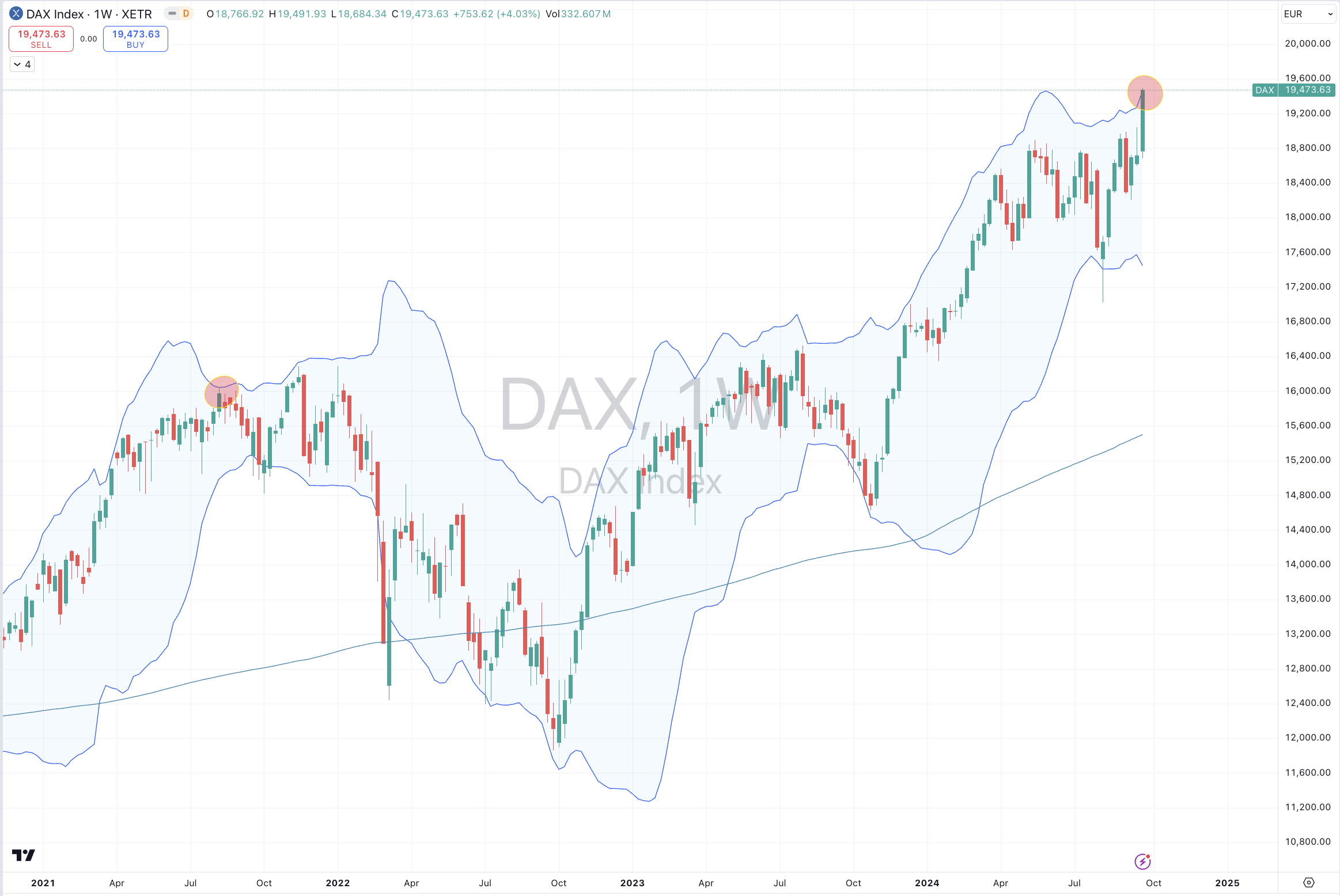
It’s time to trim German equity exposure

Here at the moments when Germany’s #DAX Index has registered a monthly overbought reading.

While there is more behind my analysis, this simple study suggests that those who allocate capital into #German equities might be dummkopf or perhaps foolish, if they haven’t got one foot out of the door.

January 23, 2025

rob@karriasset.com.au

What are you trying to squeeze ?

It was 3 years ago when the DAX Index last traded at such extremes.

Mean reversion (or convergence) beckons.

Institutional Asset Allocators…..if you were advised to ‘go long’ and deploy more capital this week, ask why?

I hope the answer isn’t because German (EU) 2’s are yielding the lowest in 2 years?

More ‘extremes’ will be listed in tomorrows edition of Macro Extremes.

September 28, 2024

by Rob Zdravevski

rob@karriasset.com.au

Peaking bond yields…..

I’m watching how the German 2 year bond yield tracks the Nasdaq 100 (or vice versa)

June 4, 2024

Screenshot

Germany – from stinky to overloved

For the 8th time in the past 12 years, #Germany‘s DAX Index is registering a weekly overbought reading.

While there is more behind my analysis, this simple study shows that probabilities of a further advance change at this juncture.

Following such an occurrence, we mostly see the #DAX trade sideways, if not lower, for up to 24 months hence.

It’s not a time to chase.

That country #allocation trade began about 20 months in mid-2022.

50% ago.

This note listed that observation.

While the DAX is currently within its 7th consecutive week of higher prices and myopically, it looks like having a little more upside, the ‘fat part of the trade’ has been seen.

March 20, 2024

by Rob Zdravevski

Karri Asset Advisors

rob@karriasset.com.au

Screenshot

Germany isn’t de-industrialising

Germany’s main stockmarket has risen about 13% over the past few months, it has climbed about 60% over the last few years and soared 580% over the past 20 years.

Over 20 years, Australia’s ASX 200 has risen 170%.

In 1999, The Economist magazine called Germany the ‘sick man of Europe’…….and every year since, some other financial media pundit or publication has done the same.

January 29, 2024

by Rob Zdravevski

rob@karriasset.com.au

Fat part of the SAP trade is done

The fat part of the trade in SAP shares has been seen.

My probabilities and the risk/reward ratio suggest so.

Although the stock price is making new higher high’s, a trifecta of weekly ‘extremes’ combined with the stock price completing a 7 week winning streak, it’s time to take the money and run.

8 consecutively rising weeks are rarely seen.

Furthermore, its valuations make it challenging to add to the position, let alone continue holding it.

I’ll wait for EUR 92.50 before being interested again.

This is much like my similar thoughts about Microsoft’s stock price as I wrote 2 weeks ago.

December 4, 2023

by Rob Zdravevski

rob@karriasset.com.au

Everybody Hurts (R.E.M.)

I don’t think the market is about to break but many money managers may.

Peers are speculating whether there are big funds unwinded losing and problem positions.

Perhaps so but that often coincides with the ‘straw which broke the camel’s back’.

Many thought buying government bonds yielding 0.60% for 10 years to be a good bet.

In fact, many thought buying German bonds for a NEGATIVE 0.60% (as shown in orange in the chart below) was somewhat appropriate.

And their reward is………..a 20% loss of capital (with no interest coupon paid), as shown by the blue line of a German Bond (SDEU) ETF.

When you consider that “balanced” funds including those in the pension or insurance business may typically follow a model of allocating 60% of monies to equities and 40% to bonds, they may be double hurting as Germany’s DAX equities Index has fallen 24% from its peak.

That’s the reporting of what happened bit.

Now, many think this is ‘forever’. Many think trends and streaks don’t end, wane or reverse.

Consider the contrarian view to the extremes we are seeing?

September 27, 2022

by Rob Zdravevski

rob@karriasset.com.au

Embracing German pessimism

The pessimism in Europe is not unwarranted, however the stock market is discounting much.

Around February 26 – March 8, 2022, the DAX equity index triggered a ‘trifecta oversold’ buy signal which bodes well for the longer term investor.

Around the price of 13,200 (similar to today’s level), the DAX registered an Oversold RSI level below 30, traded 2.5 standard deviations below its weekly mean and was below its 200 week moving average.

August 23, 2022

by Rob Zdravevski

rob@karriasset.com.au

Are German bonds all that?

North Rhein Westphalia (NRW) goes to the polls this weekend.

The political tension surrounding the elections is about many seats Angela Merkel’s party may lose.

NRW is Germany’s most populous state and it’s GDP equals 22% of Germany’s total and if it were a country, it’s economy would be the world’s 14th largest. With a GDP estimated to be in the range of $550 billion and it carries a debt of approx. $230 billion, which is quite a debt for a state with a population of 18 million.

Actually, its Debt to GDP ratio is quite conservative when compared to the whole of Germany’s which runs at around 85%.

While Germany’s GDP to Debt ratio is below the 105%+ marks that Greece, Italy, Portugal, Ireland and the U.S. carry, it is worth exploring why German debt is more revered than France’s.

France’s Debt to GDP ratio is close to Germany’s, yet their 10 year bond has a yield of 2.80% while Germany’s commands a “safe haven” status of 1.52%.

Why do German 10 year bonds trade at 1.52% and why did investors recently accept a negative yield for their short-term deposits?

Is it because Germany’s debt obligations are perceived to be safer than France’s?

For some background, it’s important to note that European countries gave up their right to control their monetary base when they adopted the Euro. It is the European Central Bank that establishes interest rate and monetary policy.

Yet the Bundesbank has said that “it won’t allow inflation to rise”. Hmm, so if inflation rises in Germany (currently at 2% p.a) and the Bundesbank can’t set interest rate policy – how does it propose to control inflation? Perhaps it can influence it’s government to decrease government spending. I don’t think this would help it’s safe haven bond perception.

A German 10 year bond yield 1.52% seems to be close to the low end of its logical range. If inflation rises, German federal and leading state government debt rises and its GDP purchasing power weakens, I can see these bond yields tripling before they halve.