Macro Extremes (week ending February 16th, 2024)

A weekly Macro, Cross Asset review of prices trading at extremes which may generate future investment ideas and opportunities.

The following assets (on a weekly timeframe) either registered an Overbought or Oversold reading and/or have traded more than 2.5 standard deviations above or below its rolling mean.

Extremes “above” the Mean (at least 2.5 standard deviations

10 year Russian government bond yields

Lean Hogs

Tin

Overbought (RSI > 70)

Cotton 

Cocoa

Rubber

Uranium

Robusta Coffee

AEX

Italy’s MIB

KLSE

Dow Jones Industrial Average

NIFTY 50

Nasdaq Transportation Index

Egypt 30 Index

Philadelphia Semiconductor Index (SOX)

TAIEX

Budapest

And the S&P 500 Index

The Overbought Quinella – Both Overbought and Traded at > 2.5 standard deviations above the weekly mean)

Nikkei 225

Russia’s MOEX Index

Turkiye’s BIST 100 Index

Extremes “below” the Mean (at least 2.5 standard deviations)

Shanghai Composite

Oslo’s OBX Index

Wheat

Oversold (RSI < 30)

JKM LNG

Lithium Hydroxide

Nickel on India’s MCX Exchange

Corn 

Soybean

The Oversold Quinella – Both Oversold and Traded at < 2.5 standard deviations below the weekly mean)

China 10 year government bond yield

Notes & Ideas:

Government bond yields were higher for week, again.

As mentioned in last week’s edition, many yields continue to move higher back towards the middle of their recent ranges.

German 10’s closed at their highest weekly close since November 20, 2023.

The Australian 10 year minus U.S. 10 year bond yield spread is in a 4 week losing streak.

The British 5 year’s are in a 5 week winning streak as are the Japanese 2’s. The latter have moved from 0.00% to 0.14% in that time.

Equities were stronger, however there were some losers too.

The Nasdaq 100, Composite and Transports aren’t overbought anymore, breaking wither their 4th or 5th consecutive weeks of advance.

The S&P 500 is still overbought but it did break its 5 week winning streak. It has risen for 14 of its past 16 weeks.

The CAC made a new all-time high.

The DAX performed a weekly outside bullish reversal which can be interpreted as a continuation of its rising trend.

Inversely, the Dow Jones Transports ‘did’ an outside bearish reversal, as ‘did’ the Nasdaq 100.

The Dow Jones Industrial Average broke its 5 week winning streak while it has now spent the past 10 weeks in overbought territory.

The S&P 500 is also in a 5 week winning streak and has risen for 14 of its past 15 weeks.

Amsterdam’s AEX continues to make new all-time highs.

Last week’s report that the Russell 2000 and the S&P MidCap 400 both performed a bullish outside reversal week has resulted in those indices bucking the declines seen in the other major U.S. indices.

Turkiye’s BIST has risen for 7 consecutive weeks making for a 22% (in TRY terms) return.

And the HSCEI has risen 6.5% over the past weeks……in amongst all of that pessimism.

Commodities were mixed with the notable advancers and decliners listed below. 

Cocoa and Sugar broke their respective 5 and 6 week winning streaks.

Precious metals had a good week. 

Softs and Grains were clearly weaker.

Energy was mostly weak, with Natural Gas tanking again.

WTI Crude outperformed Brent Crude.

Lithium Hydroxide prices was unchanged for the week, once again. 

Is this called consolidation or digestion?

Lithium Hydroxide has now spent 32 consecutive weeks in weekly oversold territory.

Cattle is in a 7 week winning streak and has closed higher in 9 of the past 10 weeks.

Heating Oil continues its roller coaster. This week it fell 5%, the prior week it rose 11%, the week before that it fell 6% and the week before that saw it rise 7%. Mamma Mia !

Cotton is in a 6 week winning streak.

Soybeans and Corn are registering oversold extremes. 

Soybeans are in a 9 week losing streak and have fallen 13 of the past 14 weeks.

Henry Hub Natural Gas prices made an new all-time lows, having fallen 28% ion the past 3 weeks while JKM LNG are trading at their lowest close since December 20, 2020.

And Rice performed a weekly outside bearish reversal.

Amongst currencies, the collective U.S. Dollar (DXY) Index is in a 7 week winning streak.

The U.S. Dollar has risen for 7 consecutive weeks against the Chilean Peso which perhaps correlates with the tempered commodity prices of late.

The AUD rose for the week across its pairs, the CAD was slightly lower.

While against specific pairs, the U.S. Dollar has risen for the past 5 or 6 weeks.

The AUD has slight gains, thus putting an end to its consecutive losing streaks against many pairs such as the 6 week losing streak for the AUD/SGD.

The Yen was weaker, again which dances well with the risk-on temperament seen in equities.

The larger advancers over the past week comprised of;

Baltic Dry Index 4.2%, WTI Crude 2.5%, Cotton 2.9%, Lean Hogs 4.9%, Copper 4.3%, Lumber 2.1%, Tin 6.3%, Nickel 2.7%, Palladium 9.6%, Platinum 4%, Silver in AUD 3.5%, Oats 2.1%, Shanghai 5%, CSI 300 5.8%, KBW Bank Index 1.9%, China A50 2.8%, MIB 1.9%, HSCEI 4%, Hang Seng 3.8%, Indonesia 2.5%, KRE Regional Bank Index 1.8%, Nikkei 225 4.3%, Helsinki 1.8%, Stockholm 2.4%, S&P 600 Value 2%, SMI 2%, Chile 4.9%, STI 2.7%, TAEIX 2.8%, FTSE 100 1.8%, BIST 2.3% and the ASX Industrials rose 1.8%.

The group of largest decliners from the week included;

Rotterdam Coal (1.6%), Cocoa (4.6%), Heating Oil (5.3%), Hot Rolled Coil Steel (1.7%0, Coffee (2.5%), Newcastle Coal (2.3%), Natural Gas (12.9%), Sugar (3.9%), Dutch TTF Gas (8.5%), Gasoil (3.9%), Corn (2.9%), Rice (3.2%), Wheat (5.9%), Cocoa (2.7%), Robusta Coffee (2.4%), DJ Transports (3.6%), Nasdaq Composite (1.3%), Nasdaq 100 (1.5%), Oslo (1.9%), S&P 500 (0.4%) and Pakistan’s Karachi KSE 30 fell 5.6%.

February 18, 2024

by Rob Zdravevski

rob@karriasset.com.au
Macro Extremes (week ending February 9, 2024)

A weekly Macro, Cross Asset review of prices trading at extremes which may generate future investment ideas and opportunities.

The following assets (on a weekly timeframe) either registered an Overbought or Oversold reading and/or have traded more than 2.5 standard deviations above or below its rolling mean.

Extremes “above” the Mean (at least 2.5 standard deviations

Cotton

Gasoil

NZD/AUD

Overbought (RSI > 70)

Uranium

Rice

Robusta Coffee

AEX

Italy’s MIB

Nikkei 225

Dow Jones Industrial Average

Nasdaq 100

Nasdaq Composite

Nasdaq Transportation Index

Egypt 30 Index

Philadelphia Semiconductor Index (SOX)

And the S&P 500 Index

The Overbought Quinella – Both Overbought and Traded at > 2.5 standard deviations above the weekly mean)

Cocoa

Russia’s MOEX Index

Turkiye’s BIST 100 Index

Extremes “below” the Mean (at least 2.5 standard deviations)

Shanghai Composite

Oslo’s OBX Index

Oversold (RSI < 30)

Chile 2 year government bond yield

JKM LNG

Lithium Hydroxide

Nickel on India’s MCX Exchange

Corn 

Soybean

The Oversold Quinella – Both Oversold and Traded at < 2.5 standard deviations below the weekly mean)

China 10 year government bond yield

Notes & Ideas:

Government bond yields were higher for week.

Many of them are on the move higher back towards the middle of their recent ranges.

German 10’s closed at their highest weekly close since November 30, 2023.

Equities were stronger, however there were some losers too.

The Dow Jones Industrial Average has put together a 5 week winning streak and has spent the past 9 weeks in overbought territory.

The S&P 500 is also in a 5 week winning streak and has risen for 14 of its past 15 weeks.

Amsterdam’s AEX made a new all-time high.

The Nasdaq Composite are yet to reach a new all-time high but it did close at its highest weekly close while stretching a 5 week winning streak.

The Nasdaq Transportation Index made an all-time high and weekly close. It has risen 10% in the past 4 weeks.

The Russell 2000 and the S&P MidCap 400 both performed a bullish outside reversal week.

And Turkiye’s BIST has risen for 5 consecutive weeks making for a 19% (in TRY terms) return.

Commodities were generally stronger with the notable advancers and decliners listed below. 

The big news was that Lithium Hydroxide prices were unchanged for the week.

Does being ‘unchanged” qualify to end its 13 week consecutive losing streak?

Lean Hogs aren’t overbought but Cotton and Gasoil (Diesel) is.

Cattle is in a 6 week winning streak and has closed higher in 8 of the past 9 weeks. Furthermore, Cattle is trading at extended percentages (41%) above its 200 week moving average.

Heating Oil continues its roller coaster. This week it rose 10%, last week it fell 6% and the week before that saw it rise 7%. Mamma Mia !

Sugar is in a 6 week winning streak.

Soybeans and Corn are registering oversold extremes. 

Soybeans are in a 8 week losing streak and have fallen 12 of the past 13 weeks.

It’s worth to note that Henry Hub Natural Gas prices are a whisker away from making new all-time lows while JKM LNG are trading at their lowest close since December 20, 2020.

And Lithium Hydroxide has now spent 32 consecutive weeks in weekly oversold territory.

Amongst currencies, the collective U.S. Dollar (DXY) Index is in a 4 week winning streak.

While against specific pairs, the U.S. Dollar has risen for the past 5 or 6 weeks.

The AUD has slight gains, thus putting an end to its consecutive losing streaks against many pairs such as the 6 week losing streak for the AUD/SGD.

The Yen was weaker.

And the GBP/USD is in a 4 week losing streak.

The larger advancers over the past week comprised of;

Baltic Dry Index 9.8%, Cocoa 11.8%, WTI Crude Oil 5.8%, Cotton 5.4%, Heating Oil 10.3%, Cattle 2.3%, Newcastle Coal 4.8%, Gasoline 8.9%, S&P GSCI 3.5%, CRB Index 2.5%, Brent Crude Oil 5.8%, Gasoil 12.9%, Rice 2.6%, Robusta Coffee 3.2%, Shanghai Composite 5%, CSI 300 5.8%, AEX 3.6%, China A50 5.3%, DJ Transports 2.6%, HSCEI 1.7%, Russell 2000 2.5%, Nasdaq Composite 2.3%, S&P MidCap 400 1.6%, Nasdaq 100 1.8%, Nikkei 225 2%, Copenhagen 1.6%, SOX 5.3%, Nasdaq Transports 2.8%, BIST 4.4% and the S&P 500 rose 1.4%

The group of largest decliners from the week included;

Rotterdam Coal (2.8%), Lean Hogs (2.2%), Copper (3.5%), Hot Rolled Coil Steel (2.9%), Natural Gas (11.2%), Nickel (2.1%), Orange Juice (2.1%), Palladium (8.4%), Platinum (2.6%), Dutch TTF Gas (7.5%), Uranium (4.1%), Corn (3.1%), Austria (2.4%), IBEX (1.7%), Oslo (2.5%), Helsinki (2%), SMI (1.3%), ASX Materials (3%) and the ASX 200 Index fell 0.7%.

February 11, 2024

by Rob Zdravevski

rob@karriasset.com.au

Macro Extremes (week ending February 2, 2024)

A weekly Macro, Cross Asset review of prices trading at extremes which may generate future investment ideas and opportunities.

The following assets (on a weekly timeframe) either registered an Overbought or Oversold reading and/or have traded more than 2.5 standard deviations above or below its rolling mean.

Extremes “above” the Mean (at least 2.5 standard deviations

Lean Hogs

Overbought (RSI > 70)

SHY 

Cocoa

Rubber

Uranium

AEX

Dow Jones Industrial Average

Nasdaq 100

Nasdaq Composite

NIFTY

And the S&P 500 Index

The Overbought Quinella – Both Overbought and Traded at > 2.5 standard deviations above the weekly mean)

KLSE – the Kuala Lumper Stock Exchange

Turkiye’s BIST 100 Index

Extremes “below” the Mean (at least 2.5 standard deviations)

None

Oversold (RSI < 30)

Chile 2 year government bond yield

JKM LNG

Lithium Hydroxide

Nickel on India’s MCX Exchange

Corn 

Soybean

CSI 300 

The Oversold Quinella – Both Oversold and Traded at < 2.5 standard deviations below the weekly mean)

China 10 year government bond yield

Shanghai Composite Index

Notes & Ideas:

Government bond yields were mostly lower for the week, again, even with jump in yields seen in Friday’s session.

The British 2’s, 3’s and 5’s were the exception, wth rising yields for the 2nd consecutive week).

The Japanese 2’s rose in stunning fashion. They have climbed from 0.00% to 0.10% over the past 3 weeks.

Equities were mixed, with a slight weaker bias, although many more are appearing in the overbought column.

Indonesia rose 3.5% reclaiming all of last week’s decline.

The Dow Jones Industrial Average has pout together a 4 week winning streak and has spent the past 8 weeks in overbought territory.

The S&P 500 is also in a 4 week winning streak and has risen for 13 of its past 14 weeks.

The Shanghai Composite has now registered an oversold quinella.

Amsterdam’s AEX and the Nasdaq Composite are yet to reach a new all-time high but the former did close at its highest weekly close.

The Nasdaq Transportation Index finished at its highest weekly close but yet it to break its previous all-time high. It has risen 7% in the past 3 weeks.

And Turkiye’s BIST has risen for 5 consecutive weeks making for 15% (in TRY terms) return.

Commodities were weaker with energy contracts.

To accompany that weakness in energy, WTI Crude, Brent Crude and Gasoline prices posted bearish outside reversal weeks.

Cattle is in a 5 week winning streak and has gained in 7 of the past 8 weeks. Furthermore, Cattle is still trading at extended percentages (39%) above its 200 week moving average.

Newcastle Coal broke its 7 week losing streak.

Heating Oil fell 5.5% giving up most of last week’s 6.8% rise.

Sugar is in a 5 week winning streak.

Soybeans and Corn are registering oversold extremes. 

Soybeans are in a 7 week losing streak and have fallen 11 of the past 12 weeks.

JKM LNG is at its lowest close since December 20, 2020.

And Lithium Hydroxide has now spent 31 consecutive weeks in weekly oversold territory.

Amongst currencies, the AUD has seen its 5th and 6th consecutive week of declines against many pairs, which sits proportionally within my published note on December 29, 2023 that the AUD was ‘full’.

The U.S. Dollar has risen for the past 5 weeks against most pairs.

The Yen was also firmer.

The AUD/CAD, AUD/USD and AUD/INR have declined for 5 consecutive weeks. The CAD/USD has done the same.

The AUD/GBP and the AUD/SGD has fallen for 6 weeks in a row.

The EUR/GBP has eased lower for its 6th straight week.

The larger advancers over the past week comprised of;

Rotterdam Coal 5%, Cocoa 7.2%, Cotton 3.3%, JKM LNG 1.8%, Newcastle Coal 2.4%, Orange Juice 20.3%, Dutch TTF Gas 4%, Uranium 6%, Gold AUD 2.1%, Oats 2.2%, Rice 2.5%, DJ Industrials 1.4%, Indonesia 3.5%, KOSPI 5.5%, Mexico 2.4%, NIFTY 2.4%, Sensex 2%, Nasdaq Transports 2.3%, BIST 100 3.8%, ASX 200 1.9% and the ASX Small Caps rose 2.5%.

For some reference, the Nasdaq Composite and the S&P 500 rose 1.1% and 1.4% respectively.

The group of largest decliners from the week included;

Australian Coking Coal (5%), Bloomberg Commodity Index (2.1%), Baltic Dry Index (7.3%), China Coking Coal (5%), WTI Crude (7.4%), Iron Ore (5.4%), Heating Oil (5.5%), Lumber (3.4%), Lithium (12.4%), Natural Gas (4.4%), Nickel (3.4%), Platinum (2.1%), Gasoline (7.7%), S&P GSCI (3.8%), Brent Crude (6.9%), Gasoil (2.6%), Soybean (1.7%), Shanghai (6.2%), CSI 300 (4.6%), KBW Banking Index (1.7%), China A50 (4.4%), HSCEI (2.6%), Hang Seng (2.6%), KRE Regional Bank Index (7.2%), Oslo (1.7%), Helsinki (2.3%), S&P SmallCap Value (2%) and Switzerland’s fell 1.3%.

For some reference, the S&P Small Cap 600 fell 1.2%, the Russell 2000 declined 1%, the SOX closed 0.1% lower and Toronto’s TSX eased 0.2% for the week.

February 4, 2024

by Rob Zdravevski

rob@karriasset.com.au

A little more lower for Crude Oil prices

WTI Crude is ‘looseley’ trading 15% below the price it saw on the first trading day following Hamas’ attack on Israel.

And Brent Crude is doing a similar thing.

While my previous writings have re-iterated the peril of ‘trading the headlines’, for those euphoric and momentum buyers of Crude Oil are wearing some pain.

An announced OPEC+ production cut has provided oil price with any interim support. Possibly another headline traded by many.

I’m looking for a WTI Crude price to visit the $70 mark before possible buy orders are placed.

While that is 5% below the current $73.70 price, it could see that level within the next 10 days.

December 4, 2023

by Rob Zdravevski

rob@karriasset.com.au

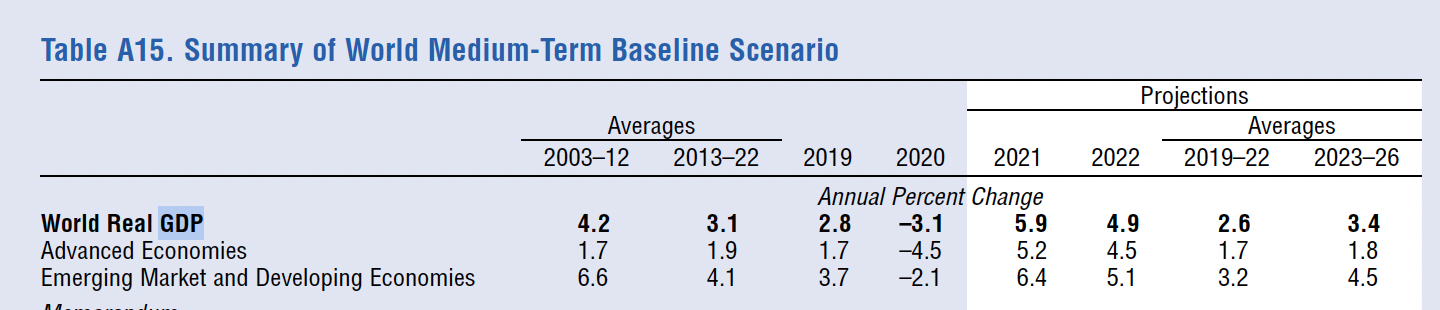
Rising GDP means higher inflation and interest rates

Below is an extract from this week’s IMF economic forecast report showing World GDP is set to rise 21% over the next 5 years.

This is an average of 4.2%, which is a good 35% higher than the post GFC GDP growth average from 2013-17.

So, how can the world’s economy grow by one-fifth in short period of time, without any material inflationary pressures when companies are telling us they see rising costs, constraint in capacity and the need to increase selling prices?

We will see a huge amount demand for production output constrained by production supply.

3 into 1, just won’t fit.

I think central banks in the ‘developed world’ are behind the curve.

Russia, Mexico, Brazil are commodity producing and commodity sensitive economies. Their central banks have been raising rates citing reasons to curb the rising cost of living.

Inflation is a tax that the ‘poor’ can’t afford to pay.

Their citizens are amongst the least indebted in terms of personal debt to GDP, so rising interest rates doesn’t threaten the value of their real estate and financial asset values unlike the sky-high indebted citizens of Australia, Canada, the U.S. and the U.K.

(see the other image below)

Interestingly, South Korea, Norway and New Zealand are the first of the developed world economies to raise interest rates. Their central bank reasons were to curb their respective country’s soaring household debt and home prices. Not the cost of living……

October 13, 2021

by Rob Zdravevski

rob@karriasset.com.au

#economy #interestrates #growth #realestate

Health Check – the Copper/Gold Ratio

The watching the direction (not necessarily its value) of the Copper/Gold Ratio helps me reading the health of the economy.

And it has been healthy….

It’s particularly correlated with the direction of the U.S. Government 10 Year Bond Yield. More on that in the next post.

The chart below shows us the 6 moments when the Copper/Gold Ratio has registered an Overbought reading over the past 20 years.

Such occurrences correlate to and increase the probability of lower prices in the S&P 500 Index or at the very least see it trade sideways for the coming months. This also coincides with my thesis in my recent newsletter.

https://mailchi.mp/karriasset/quadrupling-yields-increases-equities-risk-2

What this chart tells you is that probability does not suggest ‘going long’ or making any meaningful capital deployment into equities at this juncture.

May 2, 2021

by Rob Zdravevski

rob@karriasset.com.au