Crude Oil still consolidating

WTI Crude Oil is in a 6 week losing streak and it’s just commencing a medium term down trend.

It needs to hold $64.75, otherwise I’ll look for a visit to $62.

February 27, 2025

rob@karriasset.com.au

Screenshot

Buy on the sound of cannons

#Israel‘s Tel Aviv 25 equity index has risen 36% since warring began last October.

The circle in the chart below highlights that oversold moment.

The old investment adage of “Buy to the sound of cannons and Sell to the sound of trumpets” comes to mind.

In this weeks edition of Macro Extremes, the Tel Aviv 25 features in the overbought territory.

Hint: could a truce be close?

I also noted that it is registering all-time highs.

Adding to what may seem odd, the price of Crude #Oil has fallen 17% since the start of this particular conflict.

October 22, 2024

by Rob Zdravevski

rob@karriasset.com.au

#contrarian

Screenshot

Watching Oil prices

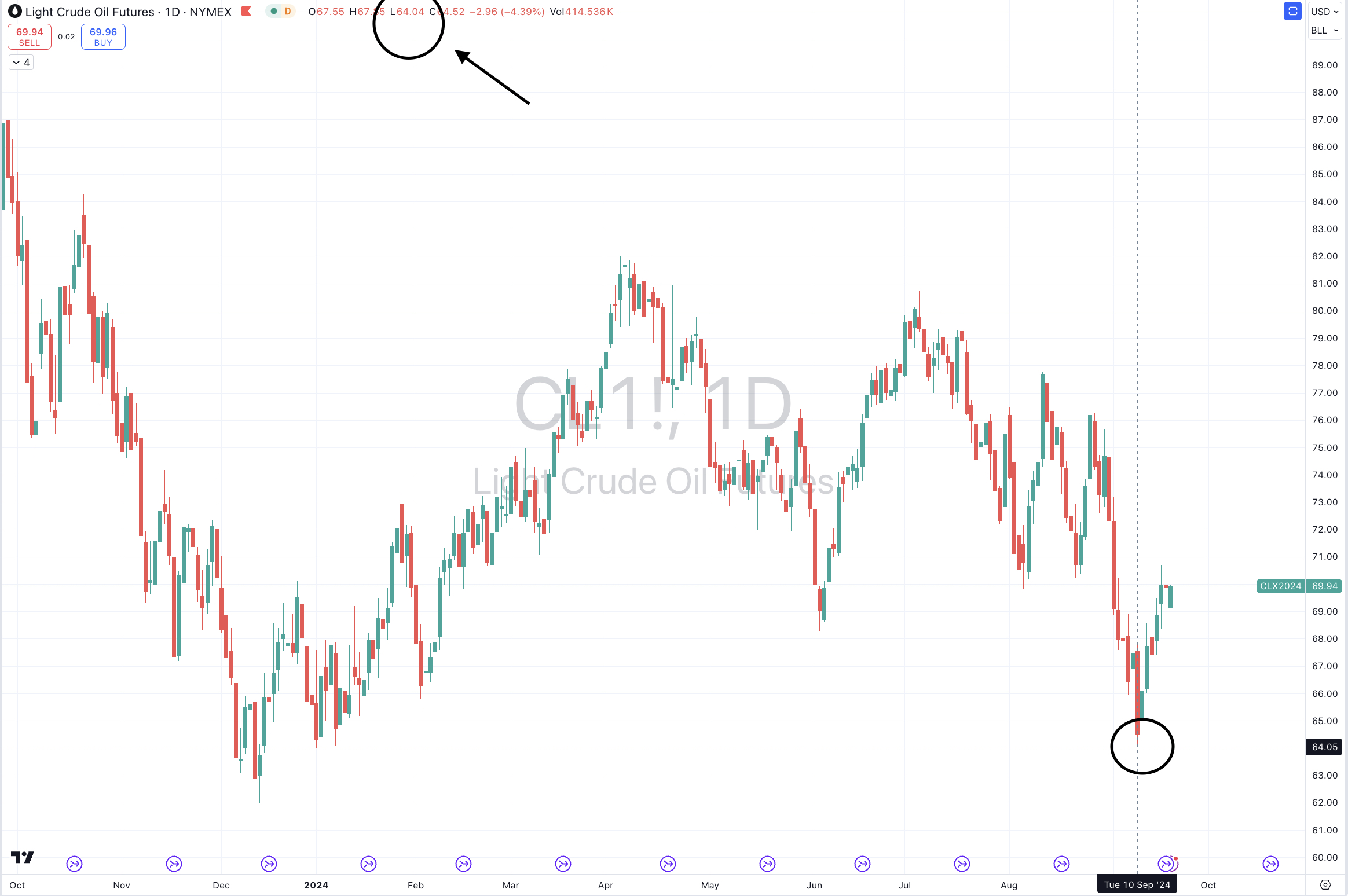
Last week WTI Crude #Oil traded down to $64.04.

I’ve been calling $64 for sometime as its first stop.

While its downtrend needs to be respected for now, it is not yet exhibiting the required strength to send it lower.

No action for now.

Pause and Watching before I call $46.

September 19, 2024

by Rob Zdravevski

rob@karriasset.com.au

Screenshot

Trendless Oil, looking for much lower prices

I haven’t seen any compelling investment opportunity in Crude Oil (or any related equites) over the past 2 years.

I’ve been comfortable with that view as the price of #Oil has mostly traded sideways over that time.

Digestion has been the prevailing trend amongst oil and gas equities.

I’d like to see WTI #CrudeOil trade down to the $64 range before being interested.

At $46, it would become compelling.

This would translate to the share price in Australian energy company, Woodside Energy trading down to $19.65. (it’s currently $28.20)

……and then I ponder the related correlations in currencies etc.

May 14, 2024

by Rob Zdravevski

rob@karriasset.com.au

Shell – wrong call at wrong time

The former #Shell CEO thinks the #SHEL stock price is ‘massively undervalued’.

https://www.ft.com/content/b9d3c147-b74c-470c-b9c7-9cba55efd38a

No it’s not.

See you somewhere around at GBP 21.70, later in the year.

April 15, 2024

by Rob Zdravevski

rob@karriasset.com.au

Screenshot

Crude Oil drop is washing out the ‘longs’

WTI Crude Oil saw the $70 target within 3 days.

This post link alluded to seeing it within “next 10 days”.

The price is now $69.20, at the time of writing.

Now, I’m thinking the next move for WTI Crude Oil is towards $67.80 – $65.90 area, which may be seen quickly, perhaps the end of Monday’s U.S. trading session.

My buying interest is heightened.

Interestingly, WTI Crude Oil prices are in their 7th consecutive week of declines and now I don’t see any geopolitical risk premium.

December 7, 2023

by Rob Zdravevski

rob@karriasset.com.au

A little more lower for Crude Oil prices

WTI Crude is ‘looseley’ trading 15% below the price it saw on the first trading day following Hamas’ attack on Israel.

And Brent Crude is doing a similar thing.

While my previous writings have re-iterated the peril of ‘trading the headlines’, for those euphoric and momentum buyers of Crude Oil are wearing some pain.

An announced OPEC+ production cut has provided oil price with any interim support. Possibly another headline traded by many.

I’m looking for a WTI Crude price to visit the $70 mark before possible buy orders are placed.

While that is 5% below the current $73.70 price, it could see that level within the next 10 days.

December 4, 2023

by Rob Zdravevski

rob@karriasset.com.au

Your Noise Is My Noise

I’ve been advising and managing the equity portfolios for individuals for 20 years. My business is to analyse investment opportunities and the various probabilities of certain things occurring in the future so to position my clients and their money can benefit from my views.

Those views are formulated by me, the investment advisor, using a host of information and sources so it can be dispensed specifically to fit an investors situation.

One problem that I face and I’m sure for many investment professionals who deal directly with their clients do, is to continually diffuse and deflect the opinions and influence that media commentators and “experts” create.

There is often little merit or evidence to their claims that they predicted an event or “saw it coming”. It is equally concerning when the “noise” created about a recent occurrence is structured to suggest that the recent past or the present is now destined to look like the future.

Which brings me to the current flux of the Crude Oil price.

I find it difficult to believe that so many people have suddenly predicted the 50% fall in the oil price. I don’t recall reading or hearing such predictions, yet now these media prophets are receiving adequate air-time for their supposed foresight.

What happens next is that private client investors takes this information as gospel and call their financial professional panting about the analytical revelation they have just heard or read.

Four messages to financial media personalities:

1) Your statements do not help anybody, other than trick people into thinking you are an authority on a subject.

2) Telling me what has happened is useless. It has already happened.

3) The markets have already reacted to the facts.

4)Prices have discounted this news.

My advice to investors is to dismiss this stuff because often the “expert” isn’t a financial professional, nor are they an investor or a participant in the market, let alone licensed or regulated to provide such advice. I’d be interested to ask anyone of them if they have ever put any of their own money at risk behind any of their comments.

It is important to analyse what has occurred in order to educate yourself so to understand history and circumstances which led to an event, but from there on, especially when investing, ice hockey legend, Wayne Gretsky’s quote seems quite relevant, “I skate to where the puck is going to be, not where it has been”.


If you choose to listen or absorb the news and comments about the capital markets, be discerning about who the person is, what their background is, what are their motivations are and whether they have any “skin in the game”.

I think that there is too much energy spent talking about historical facts and masking them as if the preacher had predicted it. Just observe the recent events involving earthquakes, rising property prices, shark attacks, plane crashes and terrorist rampages. Everybody is an expert after the fact and they love telling me how they “told me so”.

The next time that you choose to act on an investment idea or comment that you’ve heard on TV, then I suggest that you periodically and continually call that journalist or “guest expert” and continue to ask them for advice about how the investment is working out and have them explain why its not looking so wonderful at any point in time.

Don’t let other people’s “noise” become part of your investing process.

A Suez Crisis and higher Natural Gas

In Egypt….

two Presidents have been removed from power,
human rights are being violated,
christians are being suppressed and
people are being killed whilst protesting

What if the Muslim Brotherhood (an Iranian proxy) takes power in the world’s most populous Arab nation which borders Israel and straddles the Suez Canal?

Will this make the world nervous?

It’s possible that we see Western intervention to correct matters and protect their billions of dollars spent on military aid over the decades.

Oil prices will probably rise further but I’ll speculate that Natural Gas prices will rise more so.

The price of Natural Gas have been falling for years but I think this will reverse.

When oil becomes more expensive, I think demand for cheaper alternatives such as Natural Gas will be sought and oil won’t be the only fuel source that buyers will settle for.

Furthermore, I expect gas projects (including American shale) will not come on-stream as quickly as expected, due to the rising cost of capital and overall cost overruns.

It is rare that when a commodity is in high demand that it stays cheap for too long.