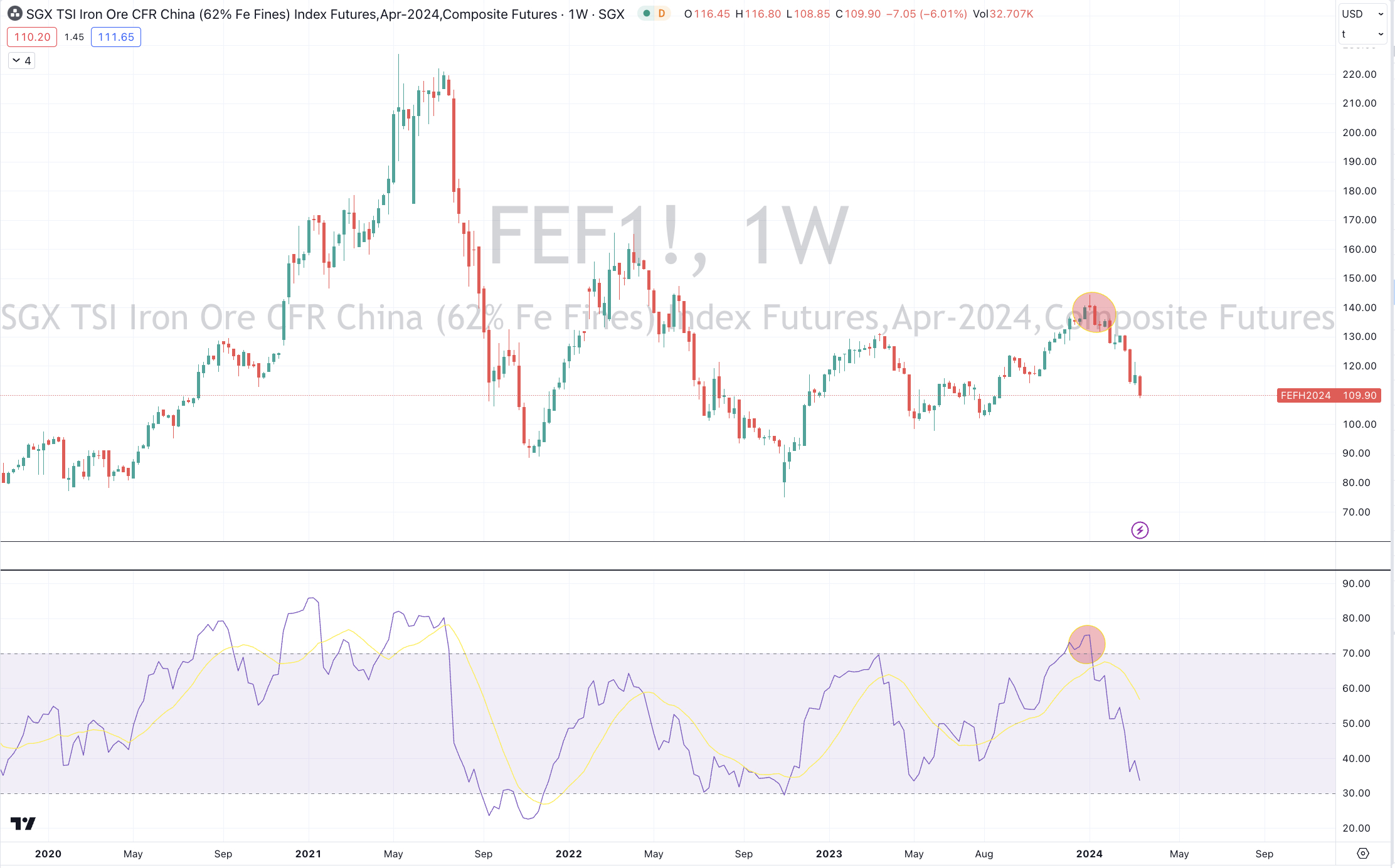
3 months ago, Iron Ore appeared in the overbought category of my corresponding weekly editions of ‘Macro Extremes’.
That observation (along with my other metrics) tells industry participants and traders a) you have little business establishing new long positions and b) sellers should consider selling.
As #ironore prices approach oversold territory, the downward trend has strength.
I’ll look for a lower entry price and that translate into the equity prices of related companies.
p.s. #steel companies will have a better time to buy as well.
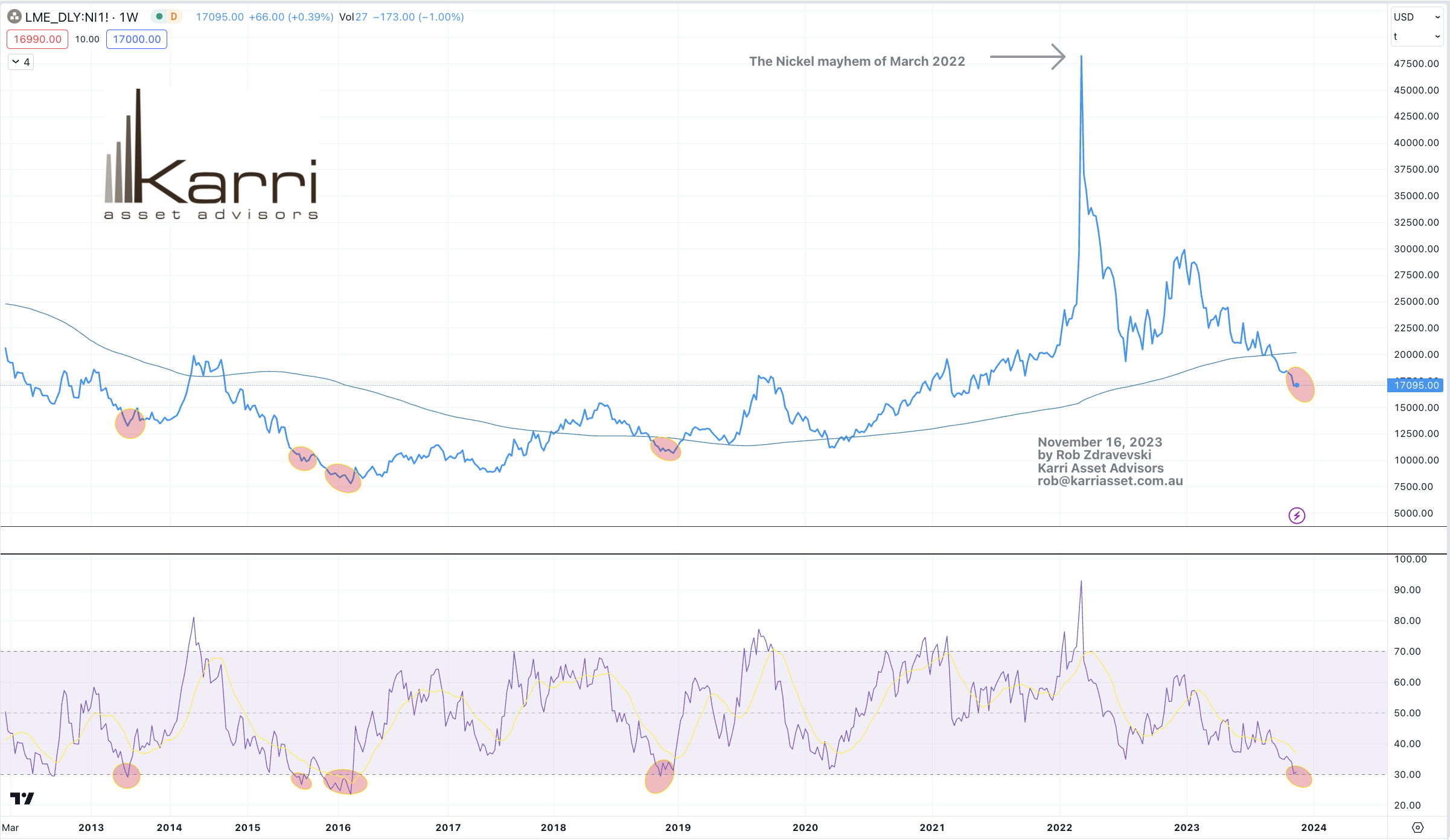
Tuning in to the headline and operational mining pessimism seen amongst Nickel producers (explorers have their own issues)……Nickel prices on the LME are trading at ‘extremes’.
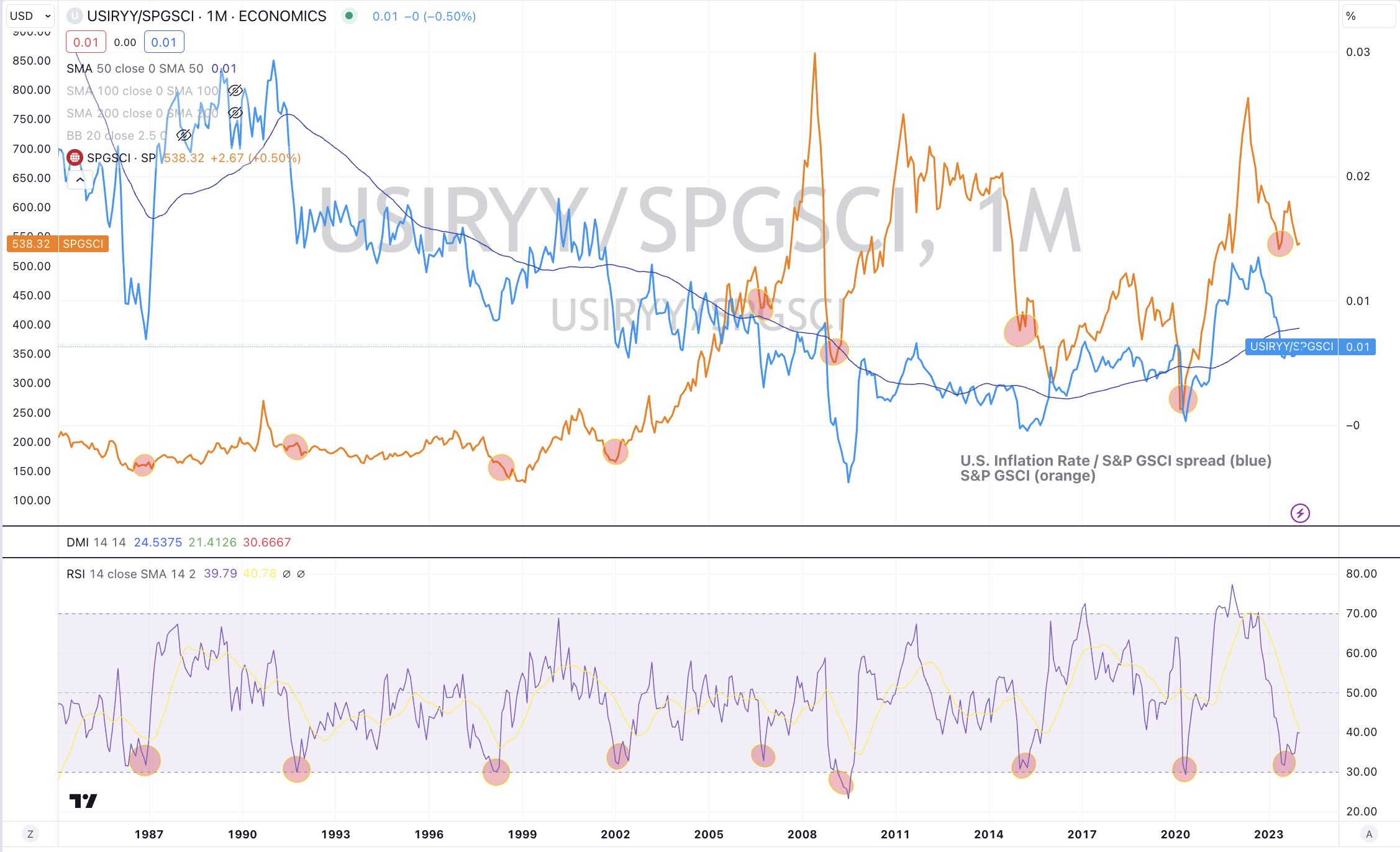
Here are the 9 occurrences over the past 40 years when the U.S. Inflation Rate/S&P GSCI spread was registering a monthly RSI reading of 32 or below.
It coincided with reasonable moments to buy commodities, as illustrated by the orange line which represents the S&P Goldman Sachs Commodity Index (SPGSCI).
I made a similar reference in a note published 2 months ago.
Mexico’s stock market has hit an all-time high, following a recent 6 week winning streak.
In fact, the index has risen 8 of its past 9 weeks.
This week, Mexico’s main index registered a quinella of ‘overbought extremes’ and while momentum can suggest prospects of an extended move higher, my probability is conditioned towards selling, trimming and/or short.
Some may dismiss the importance of Mexico’s equity market but it’s GDP is ranked 15th in the world, which isn’t not too far away from Australia’s position at 13.
In fact, why dig up the stuff if you are losing money on it or your costs are rising and crimping your margins?
but due to this news, the stock price fell 19% last Friday and 6% more in the following 2 days of trade.
Obviously, this would not happen if it was a privately held company.
And so, I think we’ll see a growing trend of listed companies becoming owned by private equity, sovereign and pension funds.
Benefits of such a trend would include allowing executives to move away from ‘short-termism’ and thus freeing up time that they currently spend appeasing public shareholders.
But the best part is not being forced to produce and grow at any expense, pressured by shareholder expectations and you also have most (if not all) of your funding and borrowing covered.
WTI Crude is ‘looseley’ trading 15% below the price it saw on the first trading day following Hamas’ attack on Israel.
And Brent Crude is doing a similar thing.
While my previous writings have re-iterated the peril of ‘trading the headlines’, for those euphoric and momentum buyers of Crude Oil are wearing some pain.
An announced OPEC+ production cut has provided oil price with any interim support. Possibly another headline traded by many.
I’m looking for a WTI Crude price to visit the $70 mark before possible buy orders are placed.
While that is 5% below the current $73.70 price, it could see that level within the next 10 days.
Readers of my weekly Macro Extremes newsletter may have noticed that the Nickel price is appearing in the Oversold category.
It doesn’t happen all that often.
And so how to position for this view may come in the form of owning Nickel mining producers, or those hoarding Nickel reserves, perhaps it’s an opportune for buyers of Nickel (stainless steel) to lower their input costs or just buy Nickel itself.
There is a preface within my latest newsletter ‘Warming To Commodities’, that I have been a bearish on commodities and their related stocks for the past 2 years.
2 years ago, I wrote this note about Australian mining company, Chalice Mining (CHN:ASX) and it was an example of my bearish views.
Following that near-term August 2021 timeframe, the stock price danced between both ends of its ‘extreme pendulum’.
This week, Chalice Mining’s stock price finally mean reverted back to (and below) its 200 week moving average. This satisfies my criteria of an ‘oversold’ extreme where it’s also oversold on a weekly basis and trading 2.5 standard deviations below its weekly mean.
Whilst the downward price trend is strong suggesting further weakness (and there are gaps way below), the lesson is more about observing where the upper end of the ‘extremes’ range was and how the ‘mean’ rolls and morphs over time.
For example, back in August 2021, the 200 week moving average for Chalice sat at $1.49……now that mean is at $4.82.
Now, it’ll be important to watch if the stock price holds $3.37, which was its June 2022 trough.
Interestingly, nearly 15% of the company’s shares outstanding have been traded in the past 4 weeks of weakness.
Providing that ‘nothing is broken’, this is also an example where ‘weaker hands’ are throwing their stock away, into the hands of ‘stronger hands’.