Form a view, reporting it doesn’t help

The Shanghai Composite and CSI 300 Index have risen 10% over the past 2 or 3 weeks.

Media reports simply reporting this adds little value.

https://www.bloomberg.com/news/articles/2024-02-24/enjoy-the-rally-while-it-lasts-is-china-stock-traders-new-mantra?sref=qLOW1ygh

My subjective observation of recent pessimism along with my empirical analysis lead to my weekend publication, “Macro Extremes” listing these indices in the ‘extreme oversold’ category in the few weeks prior to this ‘reported’ news.

While this rebound is encouraging, it should be treated as a ‘trade’ for now. This means I expect a small pullback. Some ‘sideways’ travel and consolidation would also be constructive for China’s equity indices.

A couple weeks ago, I highlighted 7 moments (in a private note) when the CSI 300 provided an entry point which pointed to reasonably probability of a trading bounce.

Today’s situation is also labelled as one of those.

February 25, 2024

by Rob Zdravevski

rob@karriasset.com.au

Screenshot

Can China change from being ‘uninvestible’ ?

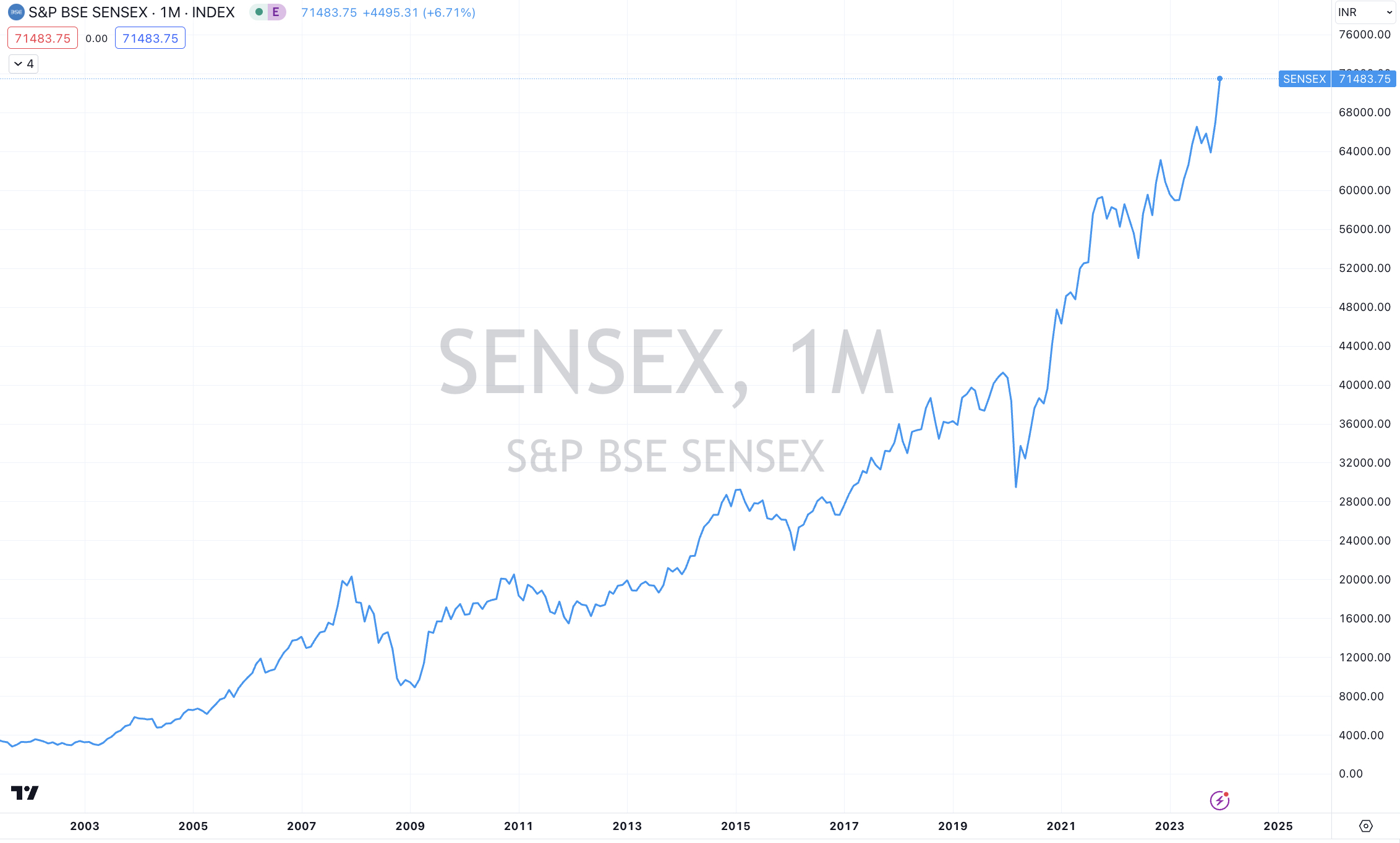
When they say China (equities) is ‘uninvestible’…..the monthly chart covering the past 20 years illustrates the case.

Tradable, sure, although hardly investible….

While the chart of India’s SENSEX Index shows you what an investible equities market looks like.

But uninvestible can change.

December 18, 2023

by Rob Zdravevski

rob@karriasset.com.au

A little more lower for Crude Oil prices

WTI Crude is ‘looseley’ trading 15% below the price it saw on the first trading day following Hamas’ attack on Israel.

And Brent Crude is doing a similar thing.

While my previous writings have re-iterated the peril of ‘trading the headlines’, for those euphoric and momentum buyers of Crude Oil are wearing some pain.

An announced OPEC+ production cut has provided oil price with any interim support. Possibly another headline traded by many.

I’m looking for a WTI Crude price to visit the $70 mark before possible buy orders are placed.

While that is 5% below the current $73.70 price, it could see that level within the next 10 days.

December 4, 2023

by Rob Zdravevski

rob@karriasset.com.au
Iron Ore, China, Australia and the U.S.

What if the U.S. requests (instructs) Australian companies to not sell Iron Ore to China anymore?

After all, it’s being done amongst the semiconductor industry.

Does Australia comply in line with its signed security pacts?

The price of 62% Iron Ore (as traded in Singapore) closed at $81.00.

I’ll look for $76.00 price early next week.

This latent weakness correlates well with the leading weakness seen in the AUD/USD.

And Iron Ore related equities are dancing in tune as well.

The risk (or opportunity) lies in the answer to the question posed at the beginning of this note.

October 28, 2022

by Rob Zdravevski

rob@karriasset.com.au

Iron Ore correlations

The Iron Ore futures (Singapore traded, 62%) price dances nicely along with the stock price of Rio Tinto (RIO.ASX)

September 2, 2022

by Rob Zdravevski

rob@karriasset.com.au
Chinese Industrial Production & Iron Ore

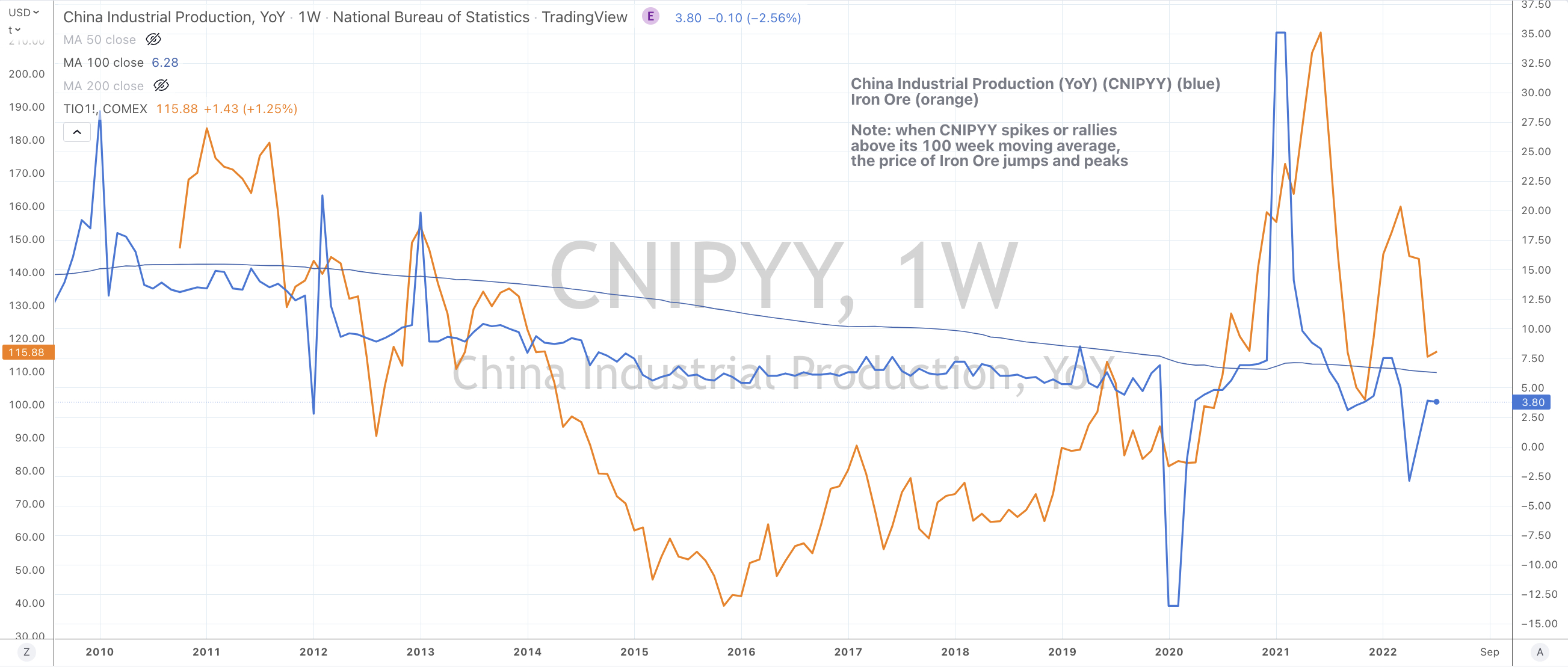
China Industrial Production (CNIPYY) and the price of Iron Ore have a seemingly symbiotic relationship.

I found it interesting (or coincidental) that when CNIPYY spikes or rallies above its 100 week moving average, the price of Iron Ore jumps and peaks.

I think the price of Iron Ore is closer to seeing a low. I’m look for it to touch the $96-$98 mark.

If that occurs, you should see corollaries in Chinese stock indices, the price of Rio Tinto and selected steel companies.

Incidentally, the 10 year average of the CNIPYY has been ~ 11.

August 25, 2022

by Rob Zdravevski

rob@karriasset.com.au

China’s climate policy in disguise

I heard of import tariffs but not export tariffs

Is exporting inflation, China’s new ‘weapon’?

Maybe this is part of China’s net zero emission plan?


Would you like to know why HRC (hot rolled coil steel) prices have quadrupled in the past year?


The world’s largest steel producing nation has been imposing and increasing tariffs on its own steel exports.

I’ll repeat, Chinese companies are required to pay a tariff in order to export their product.

High purity Pig Iron exports attract a 20% tariff while Ferrochrome stands at 40%.
Furthermore, China has removed export tax rebates for 23 steel products including flat and rolled steel)

This is quite incredible. 

It is quite normal for nations to impose a tariff on goods being imported onto their shores and limit ‘product dumping’ but to ‘discourage’ your own corporations from global competition and profits is an extraordinary tactic.

In 2020, total world crude steel production was 1877.5 million tonnes (Mt). The biggest steel producing country is currently China, which accounted for 57% of world steel production in 2020.

The next 6 countries (regions) account for a combined 28.4%. 

They are:
#1 EU  7.4%
#2 India  5.3%
#3  Japan  4.4%
#4 U.S. 3.9%
#5 Russia  3.8%
#6  South Korea  3.6%
.
.
.
.
#29 Australia 0.3%

Australia’s annual steel production is 5.5Mt, ranking behind the production of Bangladesh, Austria, Malaysia and Belgium.

One-third of Australia’s steel needs (nearly 2Mt) are imported, with most it coming from China. The rest is supplied by local manufacturers such as Bluescope Steel.

So, the news becomes even more alarming when the amount of steel imported from China has fallen by 50% in the past several months.

Can you see how half of 2Mt is a pittance of China’s 1,065Mt worth of annual production yet it has a pronounced effect on Australian business.

But what is China export tariff strategy telling us?

Firstly, China is ‘ring-fencing’ some its industrial production perhaps its seen as a form of ’nationalism’ but more so, I see it as securing or better yet, retaining its supply for its own consumption.

This could also be a measure of protectionism, but this is not new because western economies already do it themselves.

When you have a powerful (and enviable) position such global ‘market share’, you can withhold supply, causing localised prices to rise, thus hurting industry and consumers in far away locales.

Whilst imposing tariffs of steel exports will accentuate output gaps in all those other nations and higher prices may remain, by sacrificing some capitalist profits, this may be one aspect how China will reduce its carbon emissions…….

Have a think about that notion?

In addition, after decades of the global juxtaposition of China exporting deflation (and many enjoying lower prices), China may be now “exporting” inflation. 

It may be the definition of being ‘careful what you wish for’.

With its own currency testing multi-year highs (helping put a lid on its own inflation rate), could China’s new export to the world actually become Stagflation?


Don’t forget to subscribe to my blog to receive other notes, the moment they are published or equally feel free to email with a question or comment.


Until next time,

Warm Regards,
Rob Zdravevski
rob@karriasset.com.au

Europe is concerned about China decoupling

The main message of this report is China ‘channelling’ a macro, trade, political and digital decoupling with Europe.

This theme takes some thinking. Many thought China would find friends or solace amongst Europeans amidst a heated spat with the U.S.

Silk Road rhetoric aside, China is taking a binary road instead. Either they are embracing globalisation or nationalistic protectionism. The latter seems to be the current path.

“It is this blend of China’s conditional coupling, a vast state-aid apparatus and protectionism extended to national

champions, and Beijing’s new-found self-confidence in its non-convergence with Organisation for Economic Cooperation

and Development (OECD) norms and principles that is driving the current ‘crisis of interdependence’ with China.”

October 13, 2021

by Rob Zdravevski

rob@karriasset.com.au

#china #oecd #decoupling

Perspective and Hypocrisy

What is the big deal with the Chinese government’s recent directives stymying technology or education firms?

During the 2010’s, the U.S. Department of Education either forced the closure or change of ownership, sued or ended accreditation or recognition of ‘education providers’ such as DeVry Education Group (now Adtalem Global Education), ITT Educational Services, Corinthian Colleges and Apollo Education (which was taken private at $10 per share, compared to its high of $89/share in 2009).

For example, then Californian attorney-general, Kamala Harris led the charge in suing Corinthian (leading to their demise in 2016 when she won her judgement) for predatory practices of mounting and leaving students in crippling debt……much like China’s concerns today.

In addition, didn’t the U.S. government force the break-up of AT&T and Microsoft?

And I wonder……aren’t Google, Facebook, Microsoft, Apple etc, some type of pseudo-government agencies ?

or at least, at their behest or influence?

Between all the congressional hearings and testimonies and the ‘cloud’ of anti-trust undertakings, a little perspective is required to the current Chinese news.

After all, it is not a far-fetched idea that Amazon is forced to ‘spin-off’ its AWS division.

The hypocrisy of western governments doesn’t seemed to be recognised by their own selves. They apply a host of restrictions, rules and bans too.

Perhaps China is entering its own Progressive Era and the U.S. may have its own 2.0 version?

https://www.bloomberg.com/news/articles/2021-07-27/china-tech-crackdown-xi-charts-new-model-after-emulating-silicon-valley?sref=qLOW1ygh

July 30, 2021

by Rob Zdravevski

rob@karriasset.com.au

Take your pick – Thorium or Uranium

While I have hinted that I am bullish on nuclear energy and uranium……I have been an avid watcher of thorium which has been seen as a nascent alternative but in truth it has existed for some time. Its evolution has been retarded for a host of political and capitalist reasons.

An extract from this article says, “China has some of the world’s largest reserves of thorium, a silvery metal with weak radioactivity. By some calculations it has enough to meet the country’s energy needs for at least 20,000 years. By contrast, China has some of the lowest uranium reserves of any nuclear-capable country”.

https://www.neimagazine.com/news/newschina-moves-forward-with-thorium-molten-salt-reactor-8919220