Macro Extremes (week ending January 2, 2026)

A weekly Macro, Cross Asset review of prices trading at extremes which may generate future investment ideas and opportunities

The following assets (on a weekly timeframe) either registered an Overbought or Oversold reading and/or have traded more than 2.5 standard deviations above or below its rolling mean. 

n.b. pricing of (commodity) futures contracts is only considering the immediate front month. 

denotes multiple week inclusion 

Extremes above the Mean (at least 2.5 standard deviations) 

Austrian 10 year bond yields

U.S. 10 year minus U.S. 2 year bond yield spread

Overbought (RSI > 70)  

Australian 2, 3 and 5 year bond yield

Australian 10 year minus U.S. 10 year bond yield spread *

Danish & Korean 10 year government bond yields *

European 20 and 30 year bond yields

The Japanese bond yield curve

Silver in AUD & USD *

CHF/JPY *

EUR/JPY *

GBP/JPY *

MYR/USD *

All World Developed ex USA index

Austria’s ATX Index

U.S. KBW Bank Index *

Hungary’s BUX Index *

Indonesia’s IDX Composite Index

Egypt’s EGX Index *

Spain’s IBEX *

Taiwan’s TAEIX

Malaysia’s KLSE Index

Pakistan’s KSE Index

South Korea’s KOSPI Index

Nasdaq Biotech Index *

OMX Helsinki Index *

Czechia’s PX Index *

South Africa’s SA40 equity index *

Chile’s IGPA *

Singapore’s Strait Times *

Israel’s TA35 *

Nasdaq Transports *

Canada’s TSX equity index *

FTSE 100

S&P Biotech Index

The Overbought Quinella (Both Overbought and Traded at > 2.5 standard deviations above the weekly mean) 

Lithium Hydroxide

Nickel

CNH/USD *

ZAR/USD

Poland’s WIG Index

Extremes below the Mean (at least 2.5 standard deviations) 

None

Oversold (RSI < 30) 

U.S. 10 year minus the Australian 10 year bond yield spread *

U.S. 10 year bond yield divided by Australian 10 year yield spread *

Richards Bay Coal *

Lumber *

Sugar #16 *

Rice *

JPY/AUD *

JPY/CAD

NZD/AUD *

The Oversold Quinella (Both Oversold and Traded at < 2.5 standard deviations below the weekly mean) 

USD/CNH

USD/ZAR

Notes & Ideas: 

Government bond yields generally rose.

U.S. 2 year bond yields have fallen for 4 weeks.

Danish 10 year yields have climbed for 5 weeks.

Brazilian 10 year yields fell and snapped a 4 week rise.

Japanese 2 and 5 year bond yields have risen for 7 weeks straight.

Indonesian 10 year yields have fallen for 5 weeks.

Turkish 10’s have sunken for 7 weeks.

Equities were mixed to mostly higher.

Malaysia’s KLSE fell and broke a 4 week winning streak.

Poland’s WIG has risen for 4 weeks.

The Russell 2000 and South Africa 40 have climbed for 4 weeks.

The All World Developed Index, Austria’s ATX, Spain’s IBEX, Norway’s OBX, Czechia’s PX, South Africa’s SA40, Israel’s TA-35, and the ASX Financials are in 6 week winning streaks.

KBW Bank Index, ASX Financials and DJ Transports fell and broke a 5 week winning streak.

Pakistan’s KSE has climbed for 8 consecutive weeks.

Commodities were also mixed.

Coffee, Cattle, Lithium Hydroxide, Nickel, and Orange Juice were the notable gainers. 

Palladium, Platinum, Gold, Corn, oats, Rice and Tin were the notable decliners.

None of the precious metals are overbought, this week.

Orange Juice has advanced for 4 weeks, climbing 44% over that time.

Uranium’s winning streak extends to 6 weeks.

Gasoline has slumped for 4 weeks.

Lithium Hydroxide has moved into overbought territory.

Silver in AUD broke its 7 week winning streak.

Rice has fallen for 7 straight weeks.

Currencies were quieter.

The Aussie was mostly weaker.

AUD/JPY, MYR/USD and GBP/USD fell and broke their 5 week winning streaks.

CAD was lower.

CAD/JPY and GBP/JPY fell and broke a 7 week advance.

EUR/CHF has declined for the past 4 weeks.

THB/USD fell and broke its 6 week climb.

Inversely, the USD has fallen against the South African Rand for 6 weeks.

And the USD/Chinese Yuan is oversold.

The larger advancers over the past week comprised of; 

Copper/Gold Ratio 2.5%, Arabica Coffee 2%, Cattle 2.8%, Lithium Hydroxide 15.4%, Aluminium 1.9%, Nickel 6.5%, Orange Juice 4.3%, Robusta Coffee 2.5%, Dutch TTF Gas 3.9%, AEX 2.8%, ATX 2%, IDX 2.5%, FCATC 3.4%, MIB 1.7%, HSCEI 2.9%, Hang Seng 2%, IBEX 1.9%, TAEIX 2.8%, KSE 3.9%, KOSPI 4.4%, OBX 1.8%, OMX-H 2%, SOX 2.2%, TA35 2.6%, VN Index 3.2%, WIG 3.5% and BIST rose 1.8%.

The group of largest decliners from the week included; 

Bloomberg Commodity Index (2.6%), Palm Oil (2.4%), Copper (2.5%), Lumber (3.4%), Lithium Carbonate (9.3%), Tin (5.2%), Newcastle Coal (2.8%), Natural Gas (6.7%), Palladium (16.4%), Platinum (14.2%), Sugar (3.8%), Silver in AUD (7.9%), Silver in USD (8.2%), Gold in AUD (4.2%), Gold in CAD (4%), Gold in CHF (4.1%), Gold in EUR (4%), Gold in GBP (4.2%), Gold in USD (4.4%), Gold in ZAR (5.3%), Corn (2.8%), Oats (3.3%), Rice (4.2%), Soybean (2.5%), Wheat (2.4%), IBB (1.8%), S&P SmallCap 600 (1.4%), Nasdaq Composite (1.5%), KRE (1.9%), Mexico (2.3%), NBI (1.8%), S&P 600 (1.4%) and XBI fell 2.8%.

January 4, 2026

By Rob Zdravevski 

rob@karriasset.com.au 
Silver – Short, not Long

As I write, the price of Silver is trading at US$71.33.

My work suggests that it trades down to ~US$47, at which point I’ll assess if US$38-US$40 is on the cards.

I have similar directional views for Gold.

December 31, 2025

rob@karriasset.com.au

Perspective about Silver

Over the 3 years, the share price of Ralph Lauren has outperformed the price of Silver.

Over the past 6 months, the share price of U.S. healthcare company, Grail Inc. have considerably outperformed the price of Silver.

And the price of Platinum has mimicked that of Silver.

For those busy reporting the news…….could Ralph Lauren stock be a store of value?

Macro Extremes (week ending December 26, 2025)

A weekly Macro, Cross Asset review of prices trading at extremes which may generate future investment ideas and opportunities

The following assets (on a weekly timeframe) either registered an Overbought or Oversold reading and/or have traded more than 2.5 standard deviations above or below its rolling mean. 

n.b. pricing of (commodity) futures contracts is only considering the immediate front month. 

denotes multiple week inclusion 

Extremes above the Mean (at least 2.5 standard deviations) 

Belgian and Indian 10 year bond yields

U.S. 5 year bond yield minus U.S. 5 year inflation breakeven spread *

Australian Coking Coal *

Copper

Lithium Hydroxide

Nickel

AUD/USD

CHF/USD

ZAR/USD *

Malaysia’s KLSE Index *

Vietnam’s VN Index

Overbought (RSI > 70)  

Australian 2 year bond yield

Korean 10 year government bond yields

Japanese 30 year bond yields

Australian 10 year minus U.S. 10 year bond yield spread

Tin *

Aluminium (LME price) *

Gold in AUD, CAD, CHF, EUR, GBP, USD & ZAR *

AUD/JPY *

CAD/JPY *

CHF/JPY *

CNH/USD *

EUR/JPY *

GBP/JPY *

Austria’s ATX equity index *

U.S. KBW Bank Index *

Hungary’s BUX Index *

Egypt’s EGX Index *

IBB biotech ETF *

Spain’s IBEX *

Brazil’s Bovespa

Nasdaq Biotech Index *

OMX Helsinki Index *

Czechia’s PX Index *

South Africa’s SA40 equity index *

Chile’s IGPA *

Singapore’s Strait Times

Israel’s TA35 *

Nasdaq Transports *

Canada’s TSX equity index *

The Overbought Quinella (Both Overbought and Traded at > 2.5 standard deviations above the weekly mean) 

Danish 10 year government bond yield *

Japanese 2, 5 & 10 year government bond yields *

Palladium

Platinum

Silver in AUD & USD

AUD/IDR

CNH/USD *

MYR/USD *

THB/USD

Extremes below the Mean (at least 2.5 standard deviations) 

AUD/THB *

BRL/USD *

USD/MXN

USD/SEK

Oversold (RSI < 30) 

U.S. 10 year minus the Australian 10 year bond yield spread *

U.S. 10 year bond yield divided by Australian 10 year yield spread

Richards Bay Coal *

Lumber *

Sugar #16 *

Rice *

JPY/AUD

NZD/AUD

The Oversold Quinella (Both Oversold and Traded at < 2.5 standard deviations below the weekly mean) 

USD/CNH

Notes & Ideas: 

Government bond yields generally eased except for Japan’s.

The Australian and Euro yield curve fell and broke 4 weeks of advance.

Brazilian and Danish 10 year yields have climbed for 4 weeks.

Japanese 2 and 5 year bond yields have risen for 6 weeks straight.

Indonesian 10 year yields have fallen for 4 weeks.

Turkish 10’s have sunken for 6 weeks.

The U.S. 10Y minus U.S. 2Y spread eased and is no longer overbought.

While the U.S. 5 year breakeven inflation rate is nearly oversold.

We have also seen some reversals.

The U.S. 10 year minus Australian 10 year bond yield spread rose and broke a 8 weeks losing streak.

Chilean 2 year bond yields rose to break 4 weeks of decline.

And U.S 3 month bill yields rose to snap a 5 week losing streak.

Equities traded higher.

Malaysia’s KLSE was climbed higher for 4 weeks.

The All World Developed Index, Austria’s ATX, KBW Bank Index, Dow Jones Transports, Spain’s IBEX, Norway’s OBX, Czechia’s PX, South Africa’s SA40, Israel’s TA-35, and the ASX Financials are in 5 week winning streaks.

Italy’s MIB fell for the first time in 4 weeks.

U.S. Regional Bank Index fell and snapped a 5 week winning streak.

Pakistan’s KSE has climbed for 7 consecutive weeks.

Commodities were firmer.

Palm Oil, Lithium, Natural Gas, Nickel, Silver, Platinum, Palladium, Coffee and Gold were the notable gainers. 

Shipping Rates was the sole notable decliner.

Platinum has soared 42% in the past 3 weeks.

Orange Juice has climbed 40% in the past 3 weeks.

While the Baltic Dry Index has given up 35% over the same time.

Lithium Hydroxide has moved into overbought territory.

Cattle fell and broke a 4 week winning streak.

Silver as priced in AUD is in a 7 week winning streak.

The USD version has climbed for 5 weeks.

Newcastle Coal and Gasoil rose and broke 5 weeks of decline.

Heating Oil mean reverted.

JKM LNG rose and broke 4 weeks of loss.

Arabica coffee looks like changing direction of trend.

Lithium Carbonate is nearing overbought territory.

Uranium has climbed for 5 weeks.

Rice has fallen for 6 straight weeks.

And Wheat is in a 7 week slump.

Currencies were active.

The Aussie rose.

AUD/JPY, MYR/USD and GBP/USD have risen for 5 consecutive weeks.

The Loonie was mixed to firmer.

CAD/JPY an the GBP/JPY have climbed for 7 weeks.

The Euro was mostly weaker.

THB/USD has climbed for 6 weeks.

Inversely, the USD has fallen against the South African Rand for 5 weeks.

And the USD/Chinese Yuan is oversold.

The larger advancers over the past week comprised of; 

Aluminium 2.4%, Bloomberg Commodity Index 3.4%, Cocoa 1.9%, Palm Oil 4.7%, Copper 6%, Arabica Coffee 2.8%, JKM LNG in Yen 2.4%, Lithium Carbonate 3.9%, Lithium Hydroxide 3.5%, Newcastle Coal 2.2%, Natural Gas 9.6%, Nickel 6.8%, Orange Juice 2.9%, Palladium 13.2%, Platinum 22.4%, Robusta Coffee 6.2%, Sugar 2.4%, Gasoil 2%, S&P GSCI 1.5%, CRB Index 1.*%, Silver in AUD 16.3%, Gold in AUD 2.9%, Gold in CAD 3.5%, Gold in CHF 3.7%, Gold in EUR 3.9%, Gold in GBP 3.5%, Gold in USD 4.5%, Gold in ZAR 3.8%, Corn 1.4%, Oats 3.4% Wheat 1.8%, Shanghai Composite 1.9%, CSI 300 2%, All World Developed 1.5%, KBW Bank Index 1.8%, China A50 1.6%, FCATC 2%, Bovespa 1.5%, TAIEX 3.1%, KOSPI 2.7%, Mexico 2.6%, Nikkei 225 2.5%, PSE 2.5%, SOX 2%, IGPA 1.7%, S&P 500 1.4%, STI 1.5%, XFJ 1.4%, XJO 1.6%, XMJ 3.4% and ASX Small Caps fell 2.2%.

The group of largest decliners from the week included; 

Baltic Dry Index (7.2%), Israel’s TA35 (1.6%).

December 28, 2025 

By Rob Zdravevski 

rob@karriasset.com.au 
A relationship with Gold

The attached study depicts the relationship between the price of Gold and the Gold Volatility Index

Macro Extremes (week ending December 19, 2025)

A weekly Macro, Cross Asset review of prices trading at extremes which may generate future investment ideas and opportunities

The following assets (on a weekly timeframe) either registered an Overbought or Oversold reading and/or have traded more than 2.5 standard deviations above or below its rolling mean. 

n.b. pricing of (commodity) futures contracts is only considering the immediate front month. 

denotes multiple week inclusion 

Extremes above the Mean (at least 2.5 standard deviations) 

Chilean 10 year minus 2 year bond yield spread

European 5 and 10 year bond yields

U.S. 5 year bond yield minus U.S. 5 year inflation breakeven spread

U.S. 10 year minus U.S. 2 year bond yield spread

Australian Coking Coal

ZAR/USD

Italy’s MIB Index

Malaysia’s KLSE Index

Nasdaq Transports *

Overbought (RSI > 70)  

Australian 10 year minus U.S. 10 year bond yield spread *

Japanese 2, 5 and 30 year bond yields

Aluminium (LME price)

Palladium

Silver in AUD & USD

Gold in AUD, CAD, CHF, EUR, GBP & USD *

AUD/JPY *

CAD/JPY *

CHF/JPY *

CNH/USD *

EUR/JPY *

MYR/USD *

Hungary’s BUX Index *

Egypt’s EGX Index *

IBB biotech ETF *

Spain’s IBEX *

Nasdaq Biotech Index *

OMX Helsinki Index

South Africa’s SA40 equity index *

Chile’s IGPA *

Israel’s TA35 *

Canada’s TSX equity index *

FTSE 100 Index

And the S&P Biotech ETF *

The Overbought Quinella (Both Overbought and Traded at > 2.5 standard deviations above the weekly mean) 

Danish 10 year government bond yield

Euro 20 and 30 year bond yields

Japanese 10 year government bond yields *

Tin

Platinum

GBP/JPY *

Austria’s ATX equity index *

U.S. KBW Bank Index *

Czechia’s PX Index *

Extremes below the Mean (at least 2.5 standard deviations) 

Brent Crude Oil

JKM LNG in Yen

Wheat

AUD/THB

BRL/USD

Oversold (RSI < 30) 

U.S. 10 year minus the Australian 10 year bond yield spread *

U.S. 10 year minus the European 10 year bond yield spread *

U.S. 10 year bond yield divided by Australian 10 year yield spread

Richards Bay Coal *

Lumber *

Sugar #16 *

Rice *

JPY/USD

The Oversold Quinella (Both Oversold and Traded at < 2.5 standard deviations below the weekly mean) 

None

Notes & Ideas: 

Government bond yields rose, again, again.

The Australian yield curve has climbed for 4 weeks.

Japanese 2 and 5 year bond yields have risen for 5 weeks straight.

Kiwi 10 year yields fell and broke 8 weeks of advance.

The U.S. 10 year minus Australian 10 year bond yield spread has fallen for 8 weeks.

And Chilean 2 year bond yields have fallen for 4 weeks.

Equities were mixed.

Many indices appearing in last week’s overbought list, are no longer so.

The All World Developed Index, Austria’s ATX, Dow Jones Transports, Italy’s MIB, Spain’s IBEX, Norway’s OBX, Czechia’s PX, South Africa’s SA40, Israel’s TA-35, and the ASX Financials are in 4 week winning streaks.

U.S. Regional Bank Index has risen for 5 weeks.

Pakistan’s KSE has climbed for 6 consecutive weeks.

The Nasdaq Transportation Index fell and broke its 4 week winning streak.

Chile’s IGPA fell and broke a 9 week winning streak.

Commodities were mixed, again.

Orange Juice, Silver, Platinum, Palladium, Uranium, Nickel and Lithium were the notable gainers. 

Shipping Rates, Coffee, Gases, Distillates, Soybeans and Cocoa dominated the losers category.

Platinum has soared 30% in the past week.

Orange Juice has climbed 33% in the past fortnight.

Heating Oil has fallen 10% over the last 2 weeks,

While the Baltic Dry Index has given up 27% over the same time.

Lithium Hydroxide is no longer oversold.

Cattle, Tin and Silver (in USD) have risen for 4 weeks.

While Silver as priced in AUD is in a 7 week winning streak.

Newcastle Coal, Gasoil and Rice has fallen for 5 straight weeks.

Wheat is in a 7 week slump.

Currencies were active.

The Yen’s weakness continues and is seen in various pairs such as against the CAD & GBP across a 6 week losing streak.

The Aussie mostly fell and as a result, all of last weeks overbought readings are no longer so.

AUD/JPY and MYR/USD have risen for 4 consecutive weeks.

CAD/JPY has climbed for 6 weeks.

The British Pound was higher.

The USD firmed enough to move certain pairs out of oversold territory.

And the USD/Chinese Yuan is oversold.

The larger advancers over the past week comprised of; 

Australian Coking Coal 2.4%, Aluminium 3%, Copper 2.8%, Lithium Carbonate 7.4%, Lithium Hydroxide 4.1%, Tin 2.7%, Nickel 3.8%, Orange Juice 21.4%, Palladium 15.8%, Platinum 14.5%, Dutch TTF Gas 1.7%, Urea U.S. Gulf prices 1.6%, Uranium 3.8%, Silver in AUD 9.2%, Oats 4.2%, Gold in AUD 1.6%, ATX 2.6%, MIB 2.9%, IBEX 1.9%, KLSE 1.7%, FTSE 250 2%, PX 3.3%, SMI 2.2%, FTSE 100 2.6% and Vietnam rose 3.5%.

The group of largest decliners from the week included; 

Baltic Dry Index (8.3%), Cocoa (6.9%), WTI Crude Oil (1.4%), Palm Oil (2.9%), Heating Oil (3.3%), JKM LNG (1.7%), Arabica Coffee (7.8%), Natural Gas (3.1%), Gasoline (2.4%), Robusta Coffee (8.4%), Sugar (1.4%), Gasoil (3.5%), Soybeans (2.4%), EGX (2.6%), FCATC (2.3%), HSCEI (2%), S&P SmallCap 600 (1.4%), TAIEX (1.8%), KOSPI (3.5%), Nikkei 225 (2.6%), PSE (1.9%) and the ASX Material Index fell 1.8%.

December 21, 2025 

By Rob Zdravevski 

rob@karriasset.com.au 
Markets, currency, and expectations — a few observations.

📈 Calendar year-to-date (1 Jan–20 Dec 2025):
• S&P 500: +16.2% (USD, ex-dividends)
• S&P 500: +9.3% (AUD)
• ASX 200: +5.7% (AUD)

📆 Australian financial year to date (since 1 July 2025):
• S&P 500: +8.8% (AUD)
• ASX 200 (price): +0.9%

Across either timeframe, clients should be pleased with the outperformance delivered at the portfolio level, particularly given the broader market backdrop.

November is a good example.
While major indices were broadly flat, most client portfolios rose ~2%. At the same time, several widely followed “super-star” hedge funds reportedly fell ~2%.

Relative outcomes matter — especially when markets aren’t doing much.

A few broader points worth noting:

1) Currency matters — a lot.
The currency you invest in, measure in, or convert back to can materially change outcomes. I expect far more action in currency markets over the coming years, and currency selection will remain a deliberate part of my global strategy.

2) The herd delivers herd results.
Moving with the crowd usually produces the same outcome as the crowd.
Diversification helps you lose less than someone else — it is not designed to produce above-average returns.

3) A different kind of bubble is forming.
Not in prices — but in expectations.

When a potential 20% return is met with, “Is that all?”, it’s worth remembering that the ASX 200 has risen only ~5% over the past 12 months.

Perspective still matters.

December 20, 2025

rob@karriasset.com.au

What Now? – December 2025 Newsletter

It has been some time since my July 17, 2025 newsletter.
I haven’t had anything new to say.
 
In that edition, along with the June and April 2025 versions, my main message was;

“I don’t (didn’t) see any structural problems in the global equity market”.
 
Those newsletters contained a host of analysis illustrating that the currency and bond markets told me that the “prospects for equities is OK” and we were not experiencing any peaks nor bubbles.

Since and during, I have been accumulating various equities and building portfolios for clients with the focus on “making money in any type of market conditions”.

I also wrote about the opportunities observed in the healthcare and transport industries, along with Chinese equities and commodities such as Palladium.

They have all performed well.

The latter has soared 70% since it was mentioned in my June 20, 2025 newsletter which is notably more than the 27% rise seen in the Gold price, over the same time.

And the markets have been very kind.

 
You may want to read the April 1, 2025 and April 10, 2025 newsletters where I was stating the case for “buying” rather than running and selling.

Since my April 10, 2025 newsletter, the MSCI All Country World Index (ACWI) and the S&P 500 have risen 23%, while the ASX 200 climbed 16%. Those returns should temper and place the giddiness of Gold’s advance within perspective.

While the price of various (and many other) stocks have doubled or more.

Those returns were achieved amidst the cited ‘noise’ and ‘concern’.

That’s why its important to ignore the noise or narrative and rely on the data, mathematics and signals.

This reminder remains intact.
 
 
Between April 2025 and now, I have taken profits in selected stocks and started positioning portfolios is a new series of stocks which seem to be unwanted and trading at much cheaper valuations than I’ve seen at any time over the past few years.
 

  • Today, I am discovering many investing ideas across the equity markets.
  • One doesn’t find such a range of opportunities when the market is forming a peak.
  • Inversely, when equity markets are at or near a peak, I can’t usually find anything worthy of investment.

 
Furthermore, there are so many high-quality companies which are attractively priced that investors don’t need to trawl through the gutters of speculation.  
 
My current areas of interest include a range of companies in software, online marketplaces, data and verification providers, brand name chemical companies, cloud accounting and some selected biotech’s.

Coming soon, I anticipate including energy and building materials companies to that list.
 
And I still don’t see any structural problems in the global equity markets.
 
 
Thank you for being a reader of my various opinions and views and I hope you find a nugget of value within them.

Also, thanks to those who forward to and share my newsletter with others.
 
Season’s Greetings to all and wishing you a prosperous and healthy 2026.
 

Until next time,

Rob Zdravevski
rob@karriasset.com.au
.
In between newsletters, you can read my varied commentary across a range of markets and asset classes on my blog or Linkedin page.

Feel free to pass this onto your friends and professional associates. They are also welcome to contact me on +61 438 921 403 or send an email to rob@karriasset.com.au


“I think diversification and all the stuff they’re teaching at business school today is probably the most misguided concept everywhere” – Stanley Druckenmiller

“If you can’t accept volatility in the value of your assets, allow me to introduce you to a bank term deposit” – Me

Not getting torched is only the half of it

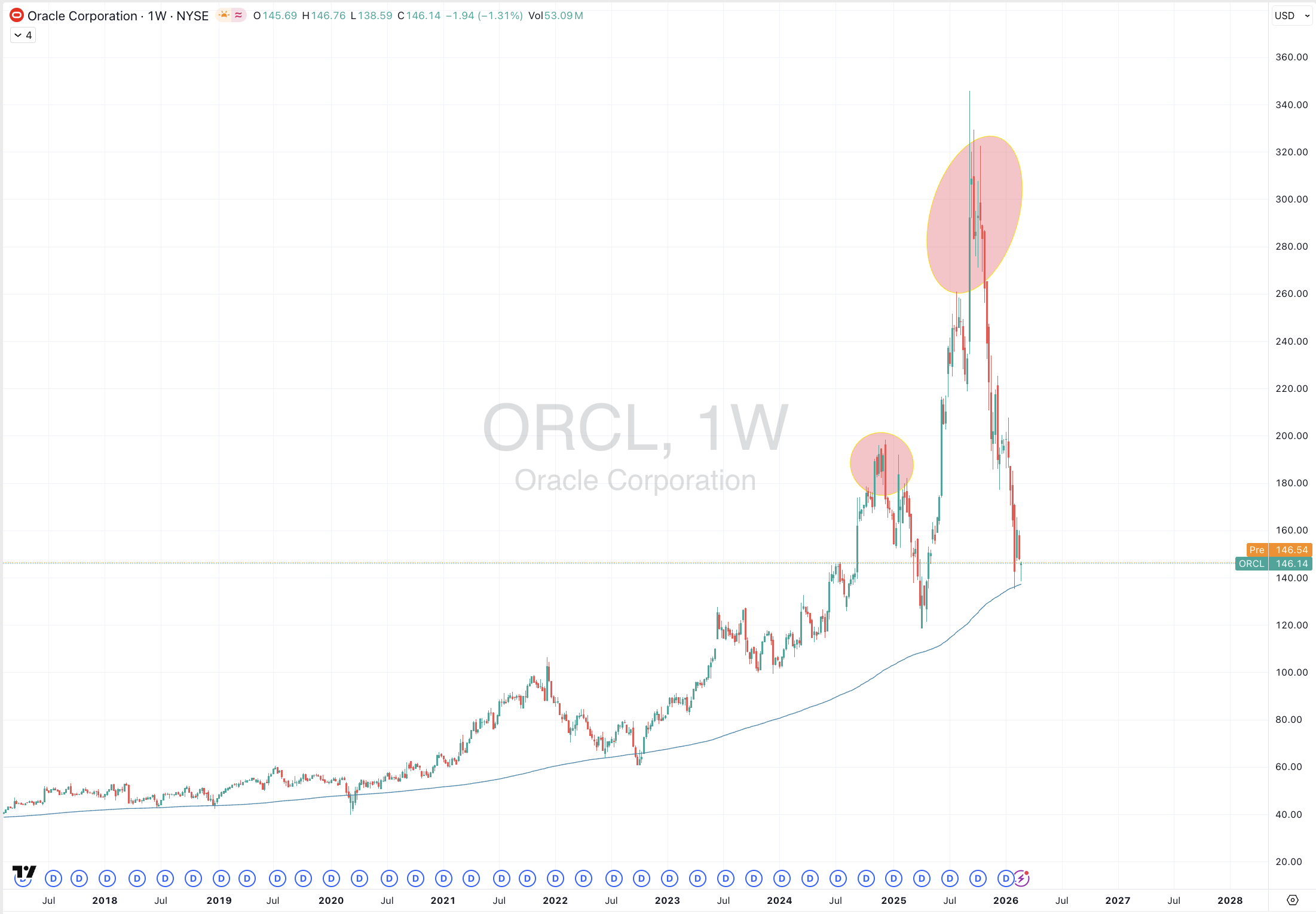
Q: What was the reason ‘you’ bought Oracle stock at $320 in September 2025?

A: Because that was the day when ORCL reported its Q1 earnings and announced a massive contract with OpenAI.

Today, the stock price is $178.46 and within 4 months, those buyers have nearly halved their money.

The circles in the study below tell you have you have no ’empirical’ reason to have been a buyer of Oracle shares.

For the disciplined, you may get to buy it at $138 (for a trade) or the bargain hunters may wait for their pitch in the $105 – $98 zone.

December 18, 2025

rob@karriasset.com.au

How Bitcoin and Equities dance together

Here is a look at the correlation between Bitcoin and Equities (S&P 500)