What the 10’s-2’s spread may tell us
June 22, 2021 Leave a comment
My story about watching interest rates spreads and how the S&P 500 equity index may act.
June 22, 2021
by Rob Zdravevski
rob@karriasset.com.au

Trying to hear what's not being said
June 22, 2021 Leave a comment
My story about watching interest rates spreads and how the S&P 500 equity index may act.
June 22, 2021
by Rob Zdravevski
rob@karriasset.com.au
June 22, 2021 Leave a comment
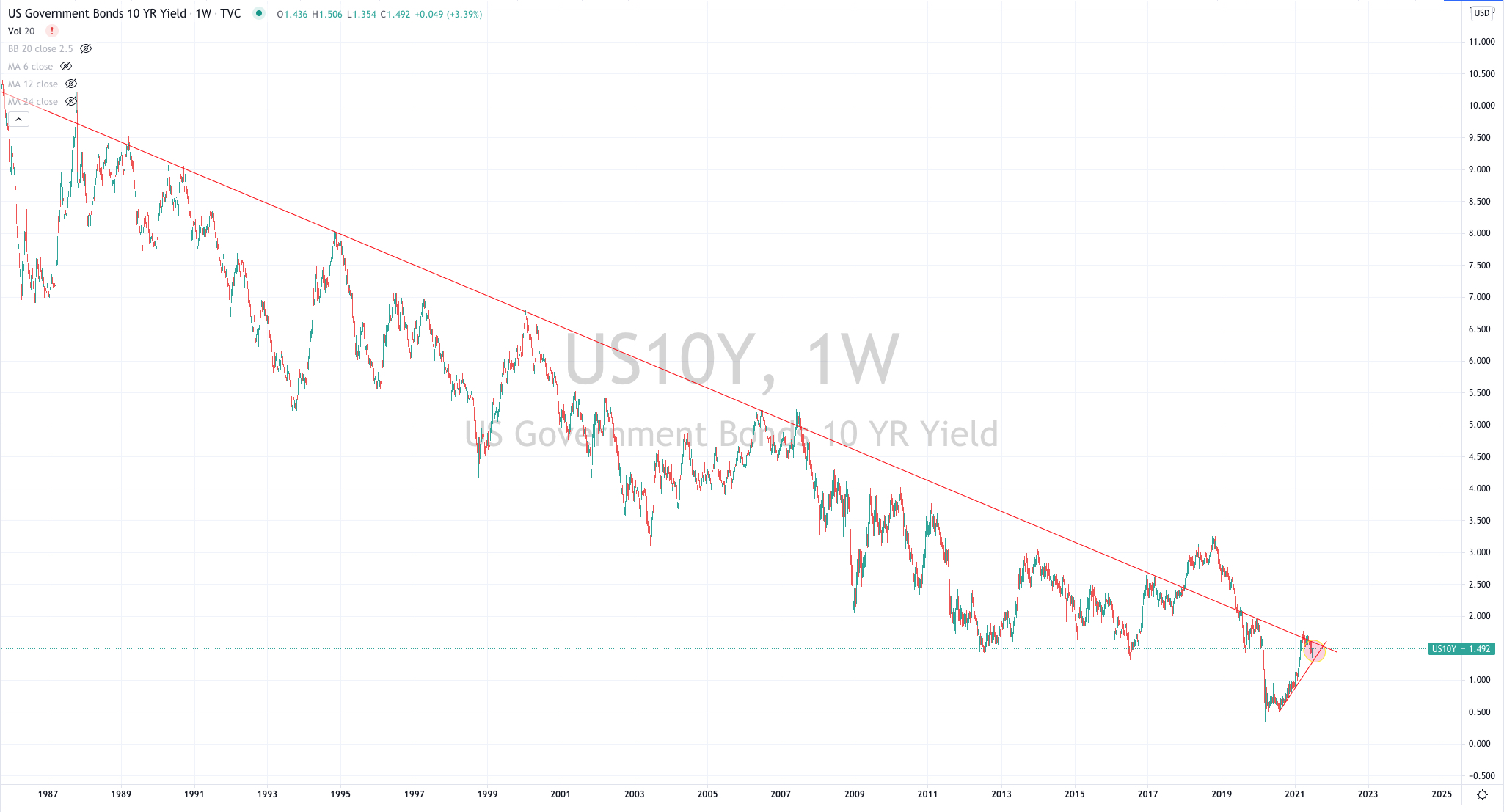
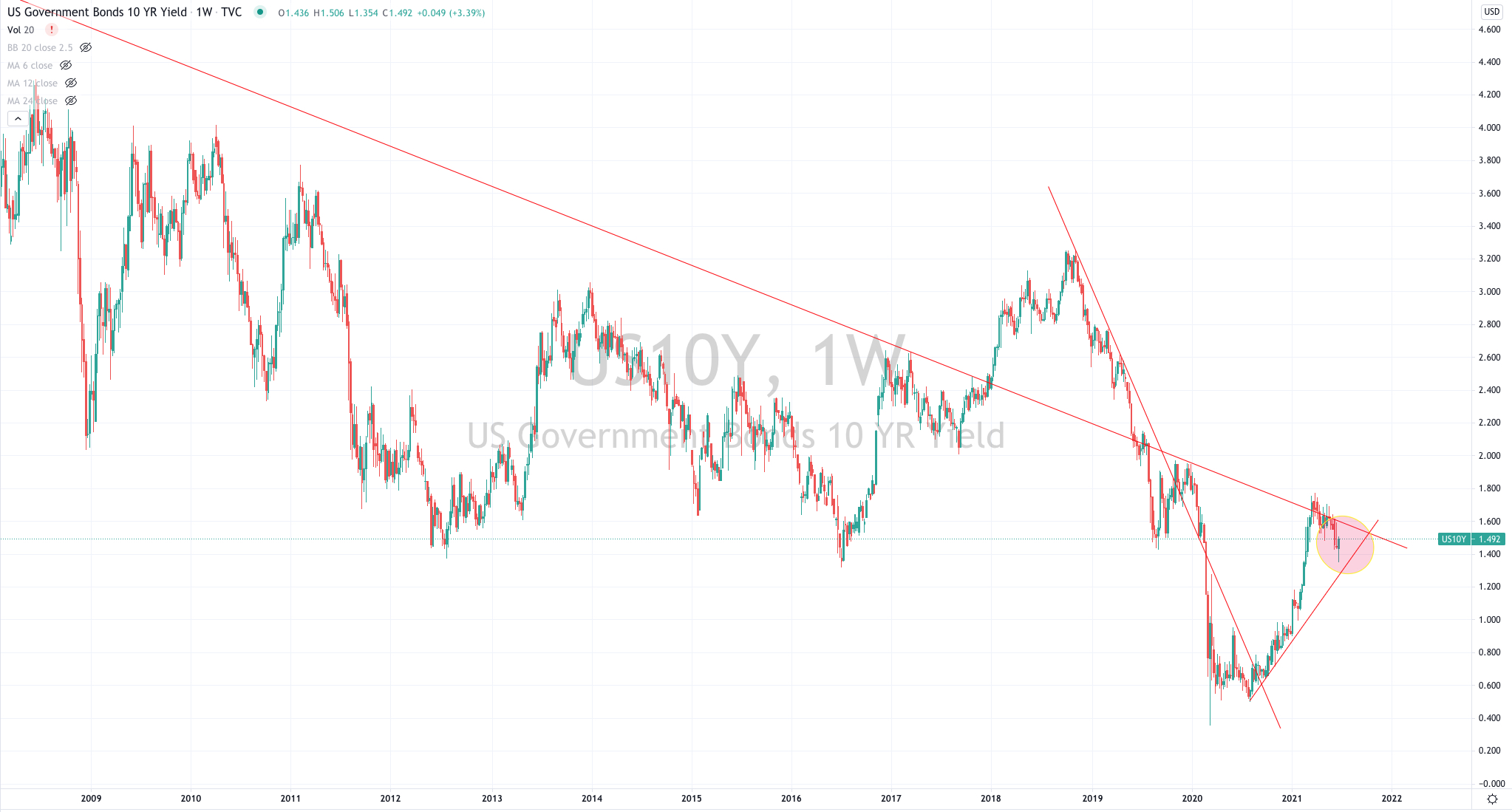
I was watching whether the U.S. 10 year government bond yield broke above 1.75%……I am now revising this…the number is now 1.62%.
It’s currently trading at 1.49%.
If it breaks and closes ‘solidly’ above 1.62%…..’all hell could break loose’.
The charts below show a 30 year trend line and a close-up of the current timeframe.
Well, more plausibly, the S&P 500 suffers corrections and trades sideways for ~ 18 months (as written in my March 2021 newsletter below).
https://mailchi.mp/karriasset/quadrupling-yields-increases-equities-risk-2
The accompanying metric to watch is the spread between the 10 and 2 year yield. Today, that differential is 1.24%.
If that shoots higher (past 1.45%, then 1.65% and up to 2.00%) then the S&P 500 will experience a more meaningful downdraft.
Keep in mind that the S&P 500 is still trading at 38% above its 200 week moving average, which is at the upper end of its historical range.
Mean reversion of the index is not a preposterous suggestion.
but the real message is that passive index (ETF) investing should work out to be a poor strategy.
In fact, the S&P 500 may be little changed over the next 2 years.
For example, what if the (six) FAANGM stocks underperform, decline of travel sideways ? After all, these 6 stocks make up 23% of the S&P 500’s market capitalisation.
My focus is to find specific company stocks (globally) offering an attractive risk/reward equation which will benefit from strong demand, tightening supply, reasonable market share perhaps giving them improving pricing power in an industry which may have capacity constraints.
June 22, 2021
by Rob Zdravevski
rob@karriasset.com.au
June 20, 2021 Leave a comment
The following assets (on a weekly timeframe) registered an Overbought reading or traded more than 2.5 standard deviations above its rolling mean.
Extremes “above” the Mean (at least 2.5 standard deviations)
Natural Gas
Live Cattle
India’s Nifty 50 equity index
Chinese 10 year bond yields
Overbought (RSI > 70)
Tin (for the 8th week)
Gasoil
Heating Oil
WTI Crude Oil
Brent Crude Oil
France’s CAC-40 equity index (for the 10th consecutive week)
Korea’s KOSPI Index
and Australia’s ASX 200 (in its 3rd week and at its most weekly overbought since late July 2019)
The Overbought Quinella – Both Overbought and Traded at > 2.5 standard deviations above the weekly mean)
Switzerland’s SMI equity index
Assets (securities) within my immediate universe which touched the other side of the extreme, being Oversold (where the RSI is < 30) or were at least 2.5 standard deviations below its mean are;
Extremes “below” the Mean (at least 2.5 standard deviations)
Japanese 10 Year Government Bond Yields (the granddaddy of risk indicators)
Soybeans
AUD/USD
NZD/USD
Oversold (RSI < 30)
Nil
The Oversold Quinella – Both Oversold and Traded at < 2.5 standard deviations above the weekly mean)
Nil
Notes & Ideas:
A diminishing list of extreme readings continues as trend change direction and mean reversions take place.
The massive moves in global markets over the past week were seen in the commodity markets.
After weeks of overbought extremes (which is what I write about in this weekly missive), e saw the following declines;
Iron Ore (5%)
Gold (6%)
Leans Hogs fell 11% and broke a 16 week ‘extreme’ streak
Copper (8%)
Coffee (5%)
Lumber (20%)
Platinum (10%)
Sugar (6%)
Silver (8%)
the CRB Commodity index (3%)
Corn (8%)
Soybean (11%)
Other overbought extreme streak-makers included;
the KBW Banking Index fell 8% (I now see buying opportunities in selected U.S. banking stocks),
the Dow Jones Industrial Index (3.5%)
DJ Transports Index (4.6%)
the Russell 2000 (4%) and
the MidCap 400 (5%)
There is merit in referencing past weekly editions of ‘Macro Extremes’ to check the assets which were ‘peaking’ before the current mean reversion has commenced.
We also saw strength in the U.S. Dollar (against consensus thinking) with 3% declines for the week seen in the AUD and CAD against the greenback.
The U.S. 10 year bond yield it yet to break above 1.75%. Yields eased further this past week from last weeks 1.46% to close at 1.44%.
Other notable moves included the Baltic Dry (shipping) index climbed a further 12% following last week’s 17% advance.
Cryptocurrencies has a negative week across the board (and especially during today’s Sunday session).
During the week, Bitcoin fell 14%, Ethereum tanked 18%, Litecoin slumped 15% and Ripple declined 20%.
Incidentally, no cryptocurrencies are Oversold yet.
And lastly, Bitcoin had a benign week. It is trading 158% above its 200 Week Moving Average, which is lower from last week’s 172% reading and certainly lower when compared to its 466% peak in mid-April 2021.
June 20, 2021
by Rob Zdravevski
rob@karriasset.com.au
June 18, 2021 Leave a comment
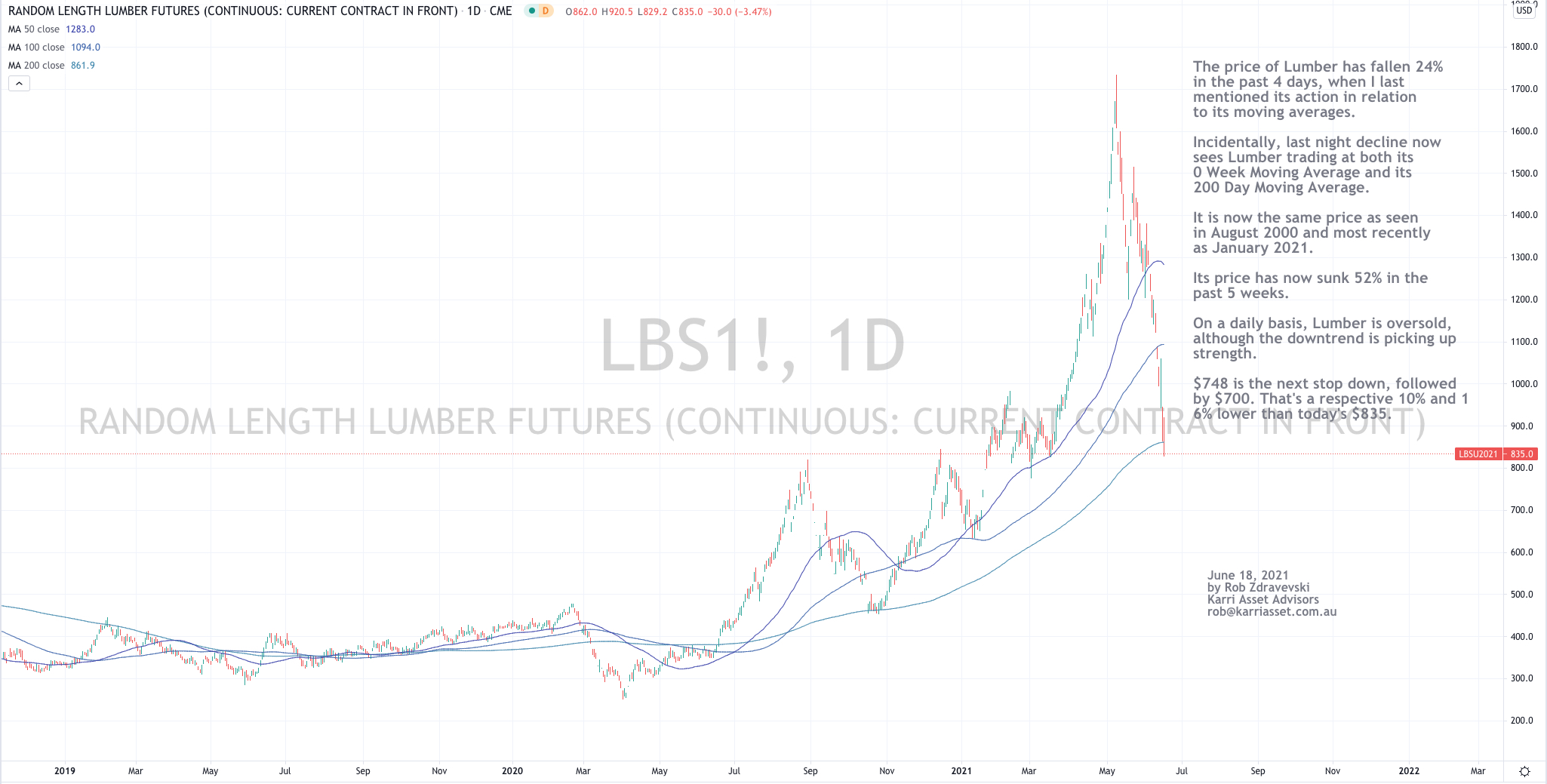
The price of Lumber has fallen 24% in the past 4 days, when I last mentioned its action in a topic relating to its moving averages.
Incidentally, last night decline now sees Lumber trading simultaneously at both its 50 Week Moving Average and its 200 Day Moving Average.
It is now the same price as seen in August 2000 and most recently as January 2021.
Its price has now sunk 52% in the past 5 weeks.
June 18, 2021
by Rob Zdravevski
rob@karriasset.com.au
June 15, 2021 Leave a comment
There’s a slight increase in rigs being utilised although still notably lower than pre-pandemic numbers, let alone to the heydays of 2011-2014
June 15, 2021 Leave a comment
It’s nice to be quoted in a recent S&P Global Market Intelligence article.
https://www.spglobal.com/marketintelligence/en/news-insights/latest-news-headlines/experts-caution-on-copper-after-decarbonization-stimulus-driven-price-boost-64381465
June 15, 2021 Leave a comment
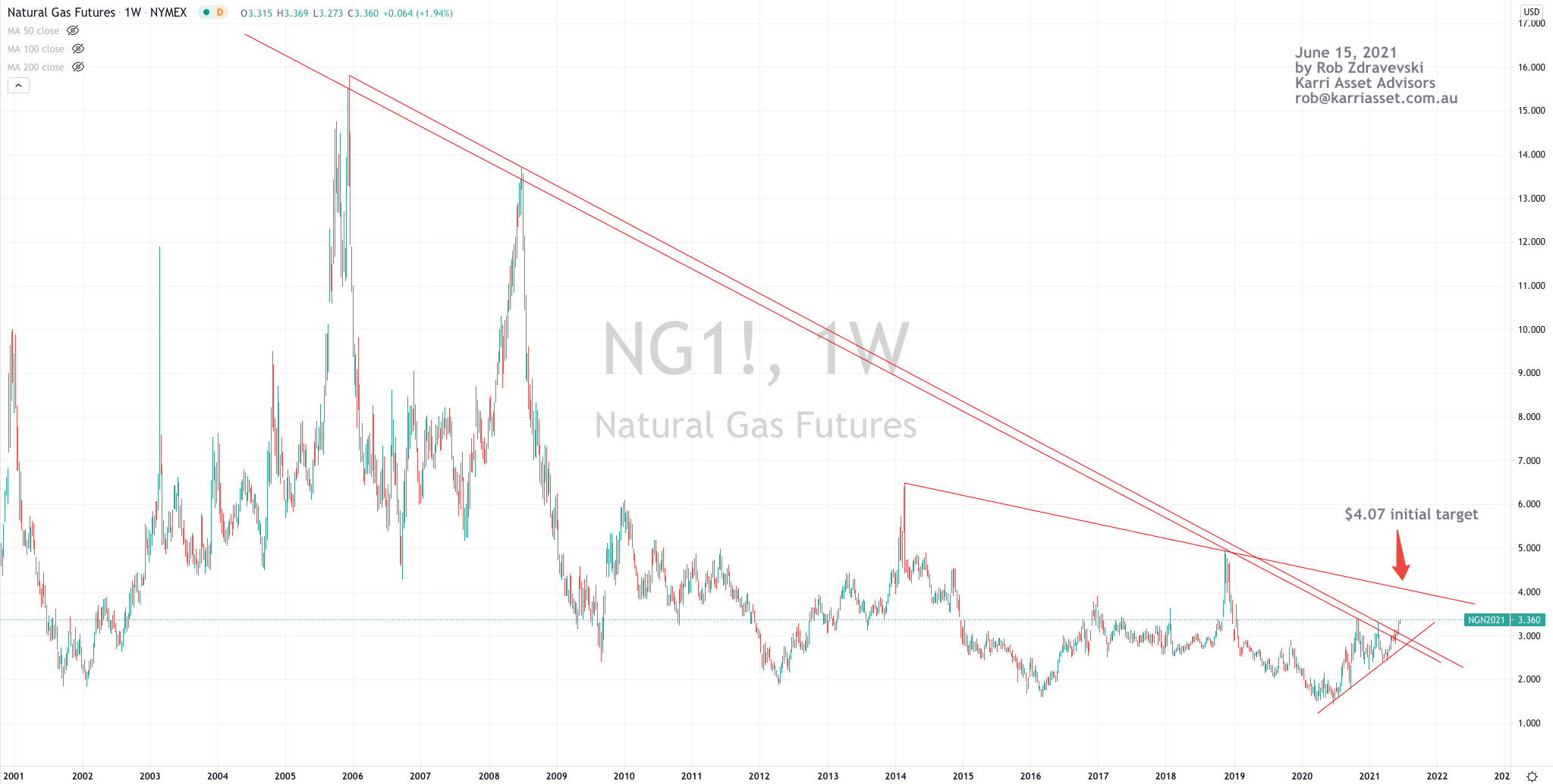
6 week ago, I wrote about a pending breakout in the price of Natural Gas. (see my original post link below)
2 weeks ago, it made that break higher and has risen 10% since.
June 15, 2021
by Rob Zdravevski
rob@karriasset.com.au
June 15, 2021 Leave a comment
Since May 10, 2021, the price of Lumber has fallen 42%.
The daily chart below shows the price falling past its 50 and 100 day moving averages and it seems to be on its way to the 200 dma, which is only 14% away.
I’ve been reminding readers about mean reversion especially following extreme parabolic upward moves as we have seen in Lumber, Hot Coil Rolled Steel, Corn, Soybeans, Bitcoin, Tesla etc etc

June 13, 2021 Leave a comment
The following assets (on a weekly timeframe) registered an Overbought reading or traded more than 2.5 standard deviations above its rolling mean.
Extremes “above” the Mean (at least 2.5 standard deviations)
Natural Gas
Orange Juice
Brazil’s Bovespa equity index
Overbought (RSI > 70)
The Commodities Indices (the CRB and Bloomberg’s)
Tin (for the 7th week)
Iron Ore (for 7 consecutive weeks)
Gasoil
Heating Oil
WTI Crude Oil
Brent Crude Oil
Lean Hogs (for the 16th consecutive week and its highest price since July 2014)
Corn (a return to the list)
the S&P 500 index
S&P 400 Mid Cap equity index
Amsterdam’s AEX equity index
France’s CAC-40 equity index (for the 9th consecutive week)
Germany’s DAX equity index
Italy’s MIB equity index (both for the 2nd week)
the Oslo, Helsinki and Stockholm equity indices (for the 3rd consecutive week)
and Australia’s ASX 200 (in its 2nd week and at its most weekly overbought since late July 2019)
The Overbought Quinella – Both Overbought and Traded at > 2.5 standard deviations above the weekly mean)
Nil
Assets (securities) within my immediate universe which touched the other side of the extreme, being Oversold (where the RSI is < 30) or were at least 2.5 standard deviations below its mean are;
Extremes “below” the Mean (at least 2.5 standard deviations)
Japanese 10 Year Government Bond Yields (the granddaddy of risk indicators)
Oversold (RSI < 30)
Nil
The Oversold Quinella – Both Oversold and Traded at < 2.5 standard deviations above the weekly mean)
Nil
Notes & Ideas:
The most notable moves have mainly involved the bond market, where yields across the board have eased (meaning ‘risk is back on’ and bonds were being bought more aggressively).
This week, there are no bond yields in Overbought territory across any government debt.
We are also seeing the ‘energy complex’ continue their time in Overbought territory.
Gold moved lower after touching 2 (not 2.5) standard deviations above the mean in recent weeks, as it consolidates for now.
Other notable departures from the Overbought list are currencies and selected equity indices such as the Dow Jones Industrial Average and the KBW Banking Index, which ended a 14 week overbought streak.
So…as the ‘extremes’ list thins out, I look to identify assets which are ‘trending’ or about to develop one….before new extremes are posted.
Aside from entries in this week’s list, the global equity indices which were nearing extreme Overbought readings are South Korea’s KOSPI and India’s NIFTY.
The U.S. 10 year bond yield it yet to break above 1.75%. Yields eased further this past week from last weeks 1.55% to close at 1.46%.
Weekly movers in recently overbought commodities includes Lumber falling 18% and Soybean declined 5%, while the Baltic Dry (shipping) index rebounded 17%
And following up last week’s comments, we have seen a break higher in the Russell 2000 as it rose 2%. Small caps rising at the tail end of a large cap advance may be sign of a trap if you are chasing the riskier tail of the market.
In crypto land, Ethereum fell 13% negating the previous week’s 13% advance and still half the price from it May 10th high.
No cryptocurrencies are Oversold yet.
And lastly, Bitcoin had a benign week. It is trading 172% above its 200 Week Moving Average, which is lower from last week’s 181% reading and certainly lower when compared to its 466% peak in mid-April 2021.
June 13, 2021
by Rob Zdravevski
rob@karriasset.com.au
June 11, 2021 Leave a comment
Notable price action in overnight markets saw Bonds being bought across the duration.
U.S. Year bond yield have fallen to 1.43% (from recent 1.65%)
Japanese 10’s are 0.05%, tightening from their recent 0.08%
and a large number of U.S. banking stocks traded down for the day
and in a range which is called an outside bearish reversal day.
This is where today’s high was higher than yesterday’s and today’s low was also lower than yesterday’s and importantly today’s closing price was below yesterday’s and in fact, many closed at their lowest point of the day.
This suggests some lower prices in the nearer-term.
It seems the market said that they aren’t buying the inflation story.
It also says that equities are deemed risker today than they were last week.
My view is that bond yields will soon rise again (i.e. bonds will be sold) and use dips in the bank stocks to accumulate.
Why ??
Because inflation is evident. You don’t need to listen to the media or the politicians.
All you need to do is read the quarterly earnings transcript of major corporations. They are telling you what is happening at the coalface.
June 11, 2021
by Rob Zdravevski
rob@karriasset.com.au
 rob zdravevski's blog