Water finds its own level
February 4, 2022 Leave a comment
In the absence of value, using the word ‘blue chip’ as your margin of safety when buying shares is perilous, as Facebook’s 25% one day decline clearly illustrates.
Trying to hear what's not being said
February 4, 2022 Leave a comment
In the absence of value, using the word ‘blue chip’ as your margin of safety when buying shares is perilous, as Facebook’s 25% one day decline clearly illustrates.
February 3, 2022 Leave a comment
I’ve been banging on recently about pending mean reversions in the price of many assets.
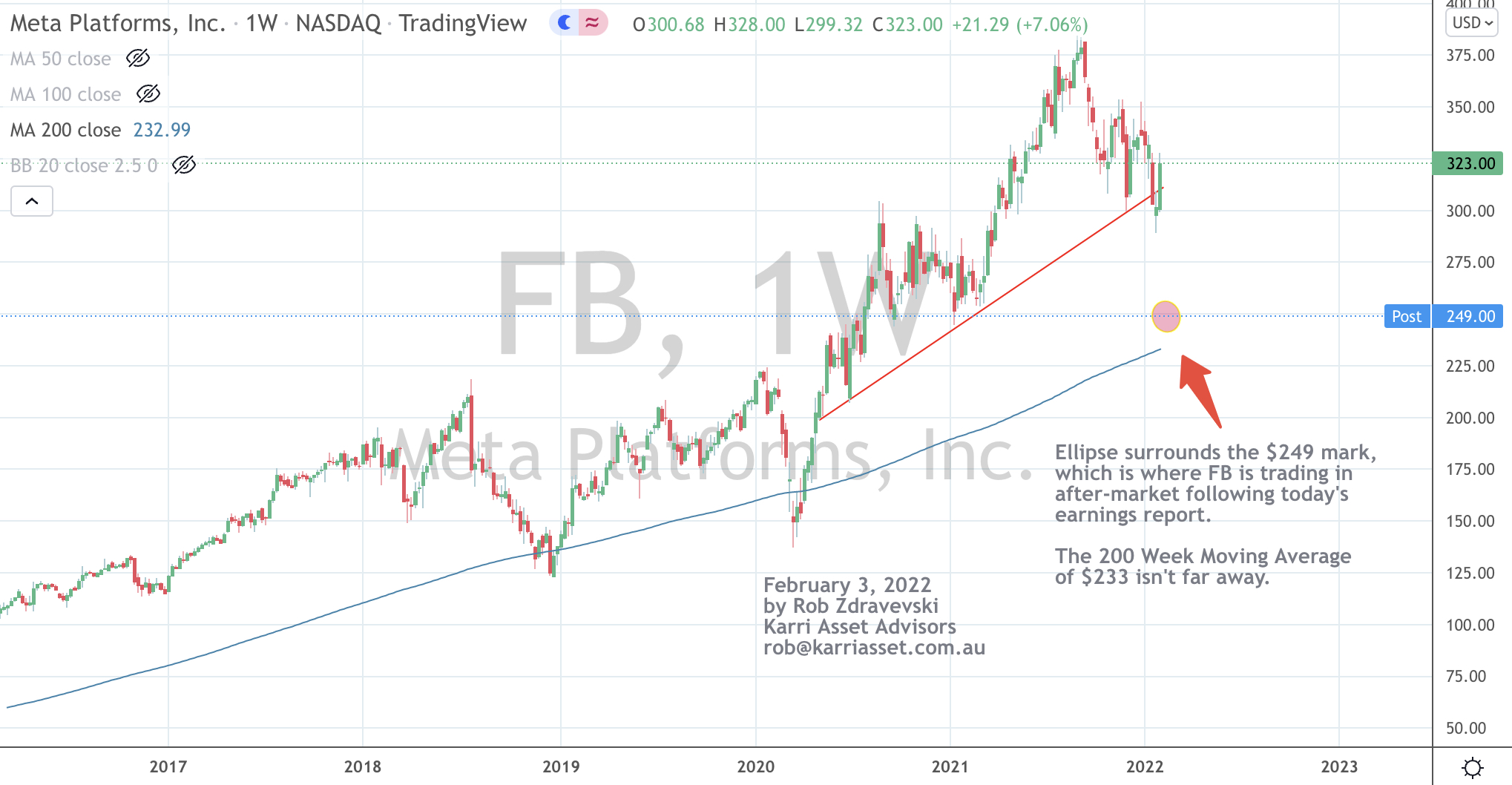
In today’s news, it’s Facebook’s (Meta) turn.
They reported poor quarterly earnings and the stock has fallen 23% in after-market trading.It’s going to erase some serious market capitalisation.
It’ll be wiping out the same amount as the combined sharemarket value of ANZ Bank, National Australia Bank, Westpac Bank, Wesfarmers and Telstra.
Facebook’s stock price is well on its way to a long term mean reversion.
In my charts (see below), I use a 200 week moving average. I want to reiterate, this is a 4 year rolling mean.
I’m not rejoicing the decline but I’m highlighting that when managing investment portfolios, ‘alpha’ can be strangely achieved by not owning assets which are overpriced or perilously stretched.
As I don’t short stocks, telling people when to stay away doesn’t show up in any performance reports.
Some of my reminders and prompts have included;
My January 21 newsletter showed many charts of stocks who have already been crunched.
The December 28 newsletter highlighted the distortion the FAANGM stocks are creating within the S&P 500.
On January 26, 2022, an extract from this note,
said, “Meanwhile, the other three of the “FAANGM’s gang, being Netflix, Amazon and Facebook have already broken below their corresponding (or sympathetic) support lines.”
February 3, 2022
by Rob Zdravevski
rob@karriasset.com.au
February 3, 2022 Leave a comment
The Thomson Reuters (core commodity) CRB Index hits its highest level since November 2014.
Weightings are particularly heavy towards energy and agricultural contracts.
The CRB is a whisker away from the target mentioned in this story written a few days ago, while the AUDUSD has hit my target of 0.7135.
This is part of my call of a peak for broader commodity prices.
Just take a look around the prices of Oil, Gasoline, Heating Oil, Corn, Wheat, Coffee, Cattle, Oats etc etc.
Also, the price action in Crude Oil is suggesting the recent run is waning.
#meanreversion
In turn, I am not owning any related equities across Oil & Gas, Bulk producers of grains and even miners of raw industrial/base metals.
It’s as good as it’s going to get for in this current wave.
So, what else to do…..
Well, I’ll wait…..
then I’ll watch the stock prices of companies who buy these raw commodities such as Kellogg, Starbucks, Kraft Heinz, Nestle, Nucor or Nippon Steel, as their input costs will fall, thus improving their margins.
…….also, the unloved precious metals are worthy of some attention, while the AUD/USD isn’t acting very constructively.
To many, it might seem perverse to Buy USD (and sell your AUD 0.7130) but that is what the market is telling me.
I’m also seeing divergences in currency correlations.
Take a look at the chart below showing the AUDUSD laid over the CRB Index and then the other is the price of BHP over the same currency cross.
I believe currency before I believe the equity.
For extra kicks, I’ve thrown a chart showing the price of Woodside Energy mimicking the CRB Index.
February 3, 2022
by Rob Zdravevski
rob@karriasset.com.au


February 2, 2022 Leave a comment
Geopolitics and machinations of war are the smokescreen for the real M&A play, being Economic.
Much like Ukraine having certain assets or businesses of interest to Russia (Ukraine is the world’s 4th or 5th largest exporter of Iron Ore, Wheat and Corn)……China would like to control Taiwan Semiconductor.
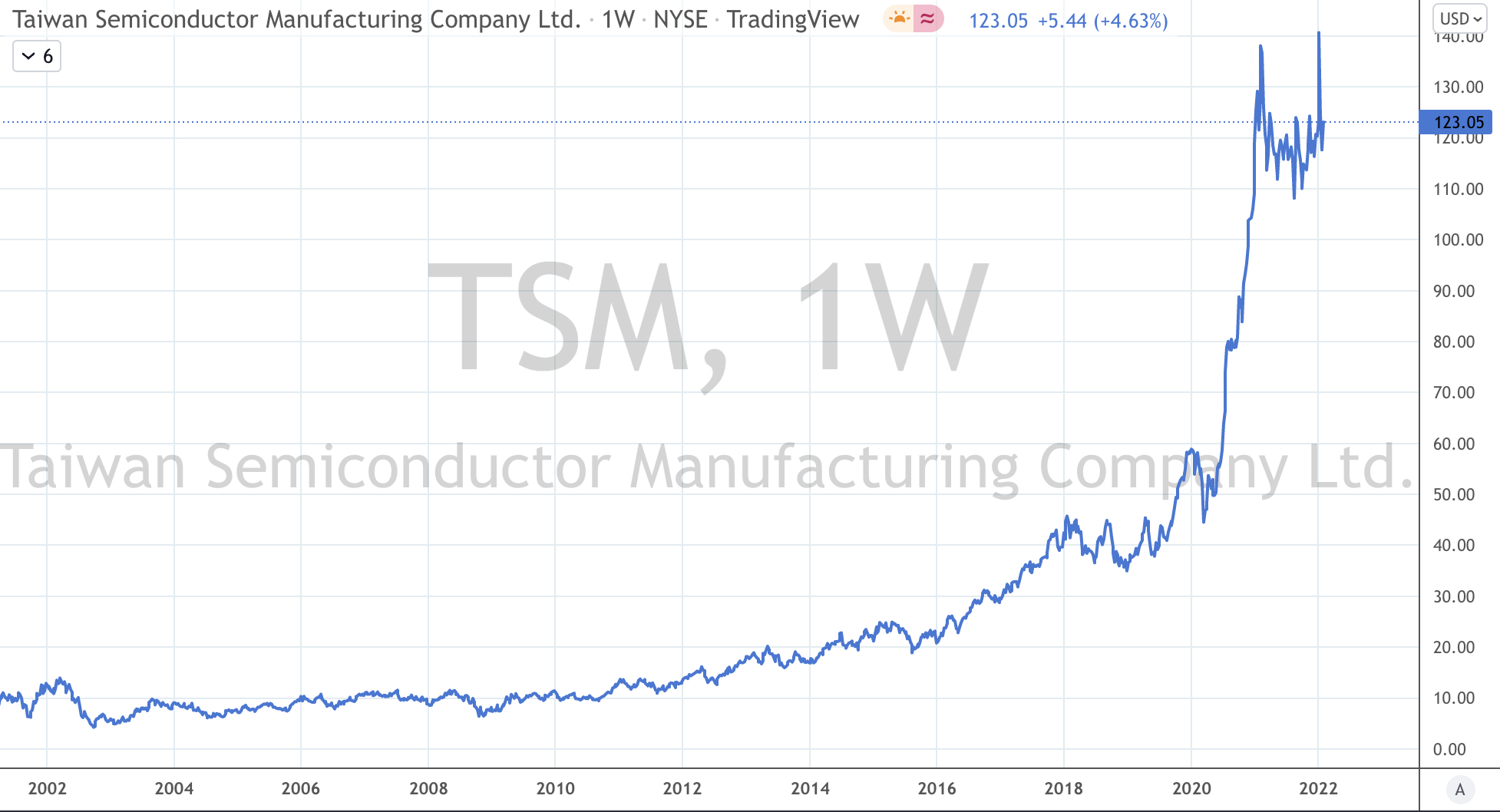
There is no company of meaningful national interest as Taiwan’s……Taiwan Semiconductor Manufacturing Company (TSMC)
TSMC is a giant. Its capital expenditure plans for 2022 alone will be $44 billion.
Japan is courting them to open up facilities or move more of their operations there.
Certain states in the U.S. have offered TSMC incentives to move there, with a new plant being built in Arizona.
With 54% global market share of the semiconductor foundry market, it’s no wonder.
These guys build and design a bucket load of the world’s semiconductor chips.
Furthermore, they make 92% share of the world’s most sophisticated and advanced chips found in phones, cars etc.
They are the exclusive provider of chips in Apple’s iPhones and most Mac computers.
In fact, Apple accounts for 25% of TSMC’s annual revenue of $57 billion.
Qualcomm, Broadcom, AMD and Nvidia are also major customers. Or put another way, they rely heavily on TSMC.
TSMC is also an important company for the United States.
And TSMC knows it.
Under the category of self-interest, this is why the world is either trying to either lure them towards their shores or help protect them (and their self-interest) out of fear that TSMC falls under Chinese control.
To illustrate the level of TSMC’s national importance, if we look at the $21 trillion GDP of the United States, its largest company, Apple has a market cap of $2.9 trillion. Then Microsoft is at $2.3 trillion, followed by Google at $2 trillion while Amazon is $1.55 trillion.
Germany has a GDP of $3.8 trillion.
Its largest company market caps are SAP at $165 billion, Siemens and Volkswagen are $130 billion, Allianz is $105 billion while Merck, Daimler and Deutsche Telekom are all around $90 billion each.
While Japan’s GDP is $5 trillion, Toyota’s market cap is $248 billion and Sony is $148 billion
and within Australia’s GDP of $1.3 trillion, the listed market caps of its national goliath’s include BHP at $169 billion, Commonwealth Bank is $168 billion and CSL comes in at $130 billion.
In Taiwan, its GDP is $760 billion.
Taiwan Semiconductor has a market capitalisation of $613 billion.
No other company globally comes close to having a market cap as large as the whole of its ‘home’ nations entire annual GDP.
February 2, 2022
by Rob Zdravevski
rob@karriasset.com.au
#TSMC #taiwan
February 2, 2022 Leave a comment
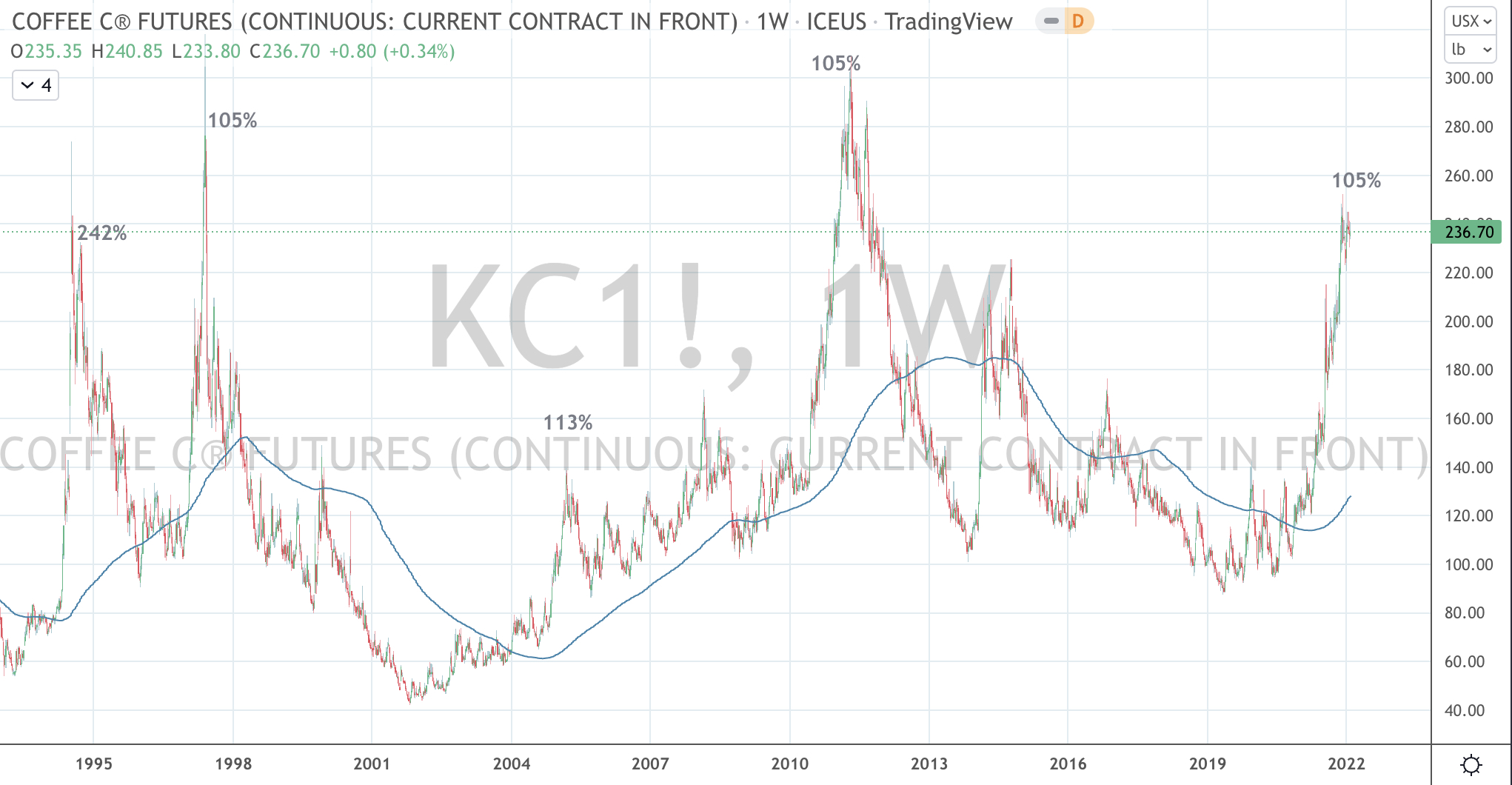
Coffee prices are at historically high extremes.
Across various measures, Coffee is overbought and stretched.
In the chart below, the month of December 2021 shows the contract price of Arabica coffee at 105% above its 200 weekly moving average.
It’s quite uncanny that “105%” has been seen at previous peak moments.
And remember, parabolic moves are often met with a sharp retracement. The price should eventually come back and kiss that 200 week average.
A falling coffee price bodes well for companies such as Nestle and Starbucks. These companies can acquire beans at cheaper levels but not necessarily reduce their retail prices.
They can justify any backlash by citing rising labour or wage costs.
By the way, just like the price of beer, I’ve never seen the price of coffee decline at the retail and premium level.
So, in other words, the price of coffee beans may halve but the price of your coffee beverage will firm.
February 2, 2022
by Rob Zdravevski
rob@karriasset.com.au
February 2, 2022 Leave a comment
The bellwether says it’s going to be OK !
In this note 6 days ago, I mentioned my focus around Alphabet’s (Google’s) quarterly earnings report.
The earnings are good, GOOGL is trading up 8.6% in the after-market and in the past week, GOOGL held its support level shown on the chart below.
February 2, 2022
by Rob Zdravevski
rob@karriasset.com.au

February 1, 2022 Leave a comment
I think this is the basis that the Reserve Bank of Australia (RBA) is using for not following the rest of the world’s hawkish stance on interest rates.
“As the Board has stated previously, it will not increase the cash rate until actual inflation is sustainably within the 2 to 3 per cent target range. While inflation has picked up, it is too early to conclude that it is sustainably within the target band.”
https://www.rba.gov.au/media-releases/2022/mr-22-02.html
While inflation has risen into its target range, the RBA’s articulation of it needing to sustainably remain in that band, aids my case that inflation will moderate into the year.
So much, that I think the U.S. Federal Reserve will CUT rates after it initially hikes twice.
Earlier this week, I wrote that I think the 5-7 Fed hikes predicted by some investment banks is ridiculous.
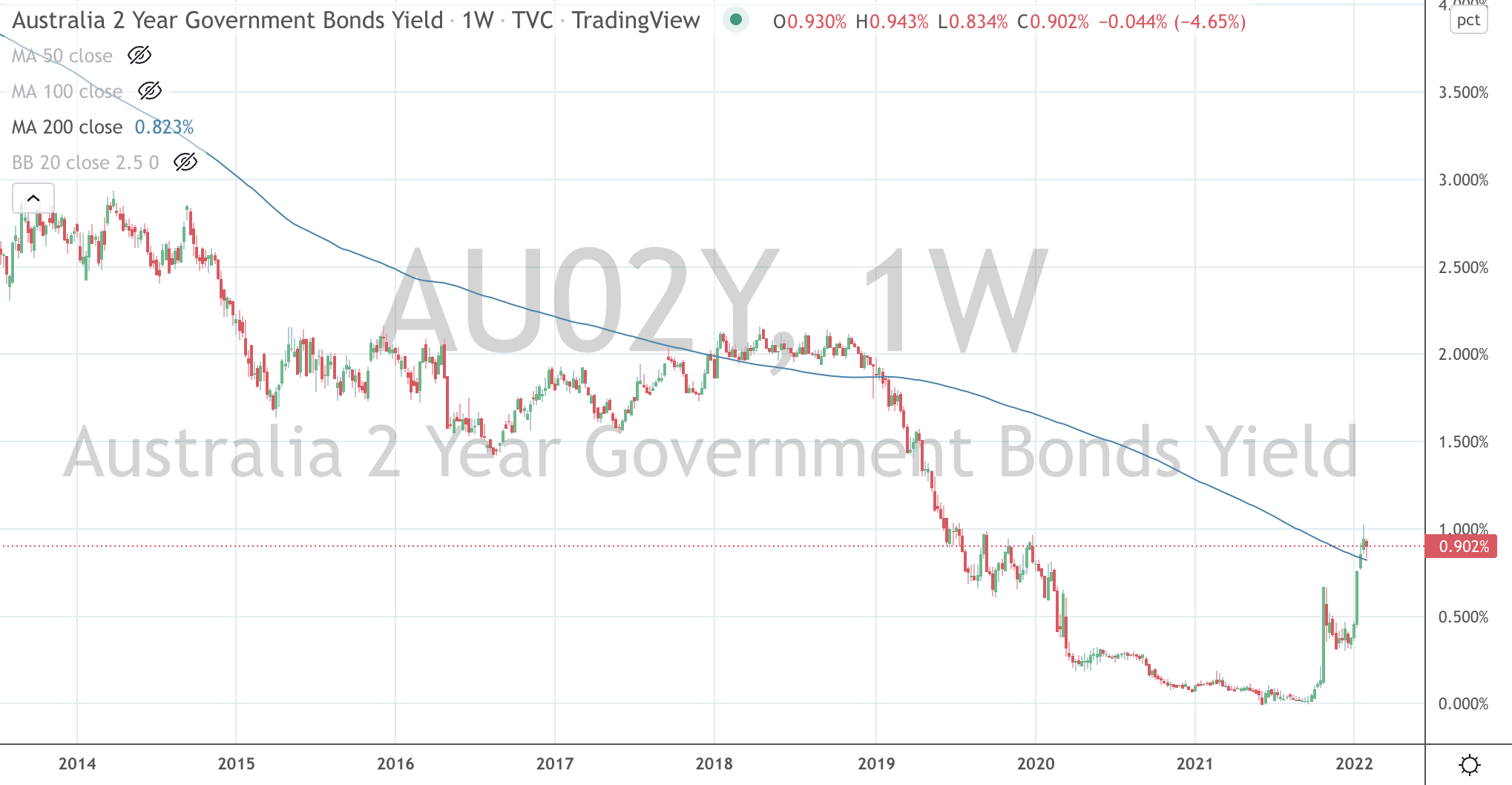
It increasingly seems the RBA is behind the curve (keeping cash rates at 0.10%) while the Australian 2 year note has risen (8-fold since October) to 0.90%, yet they seem to be the outlier bet in the rate hiking stakes, especially amongst the commodity exporting nations.
February 1, 2022
by Rob Zdravevski
rob@karriasset.com.au
February 1, 2022 Leave a comment
Ahhhh, the beauty, cruelty, anguish and wickedness of the stockmarket.
Don’t ya just love it?
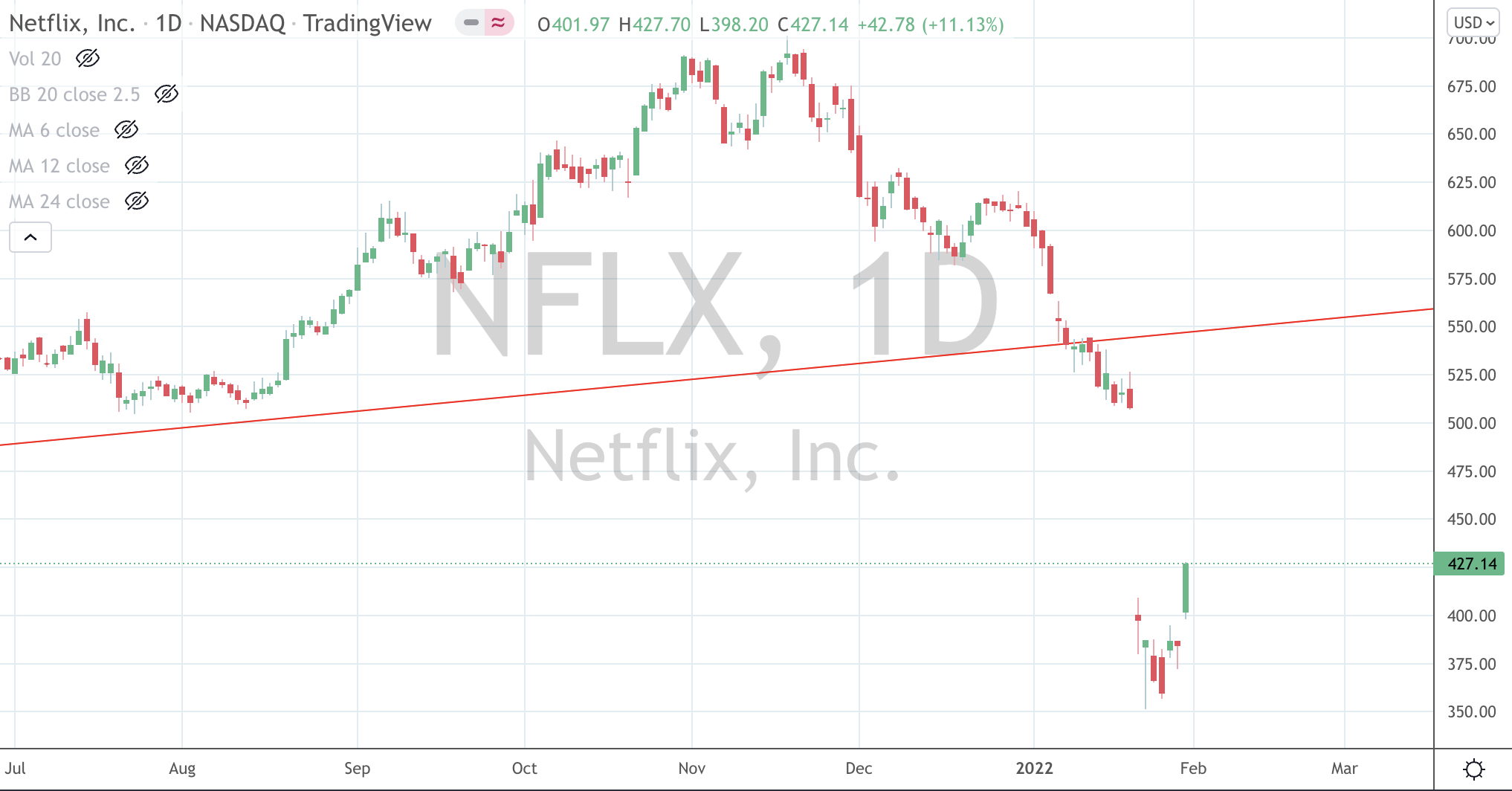
I was comfortable acquiring Netflix stock a couple days ago.
And then, Netflix stock rose 11% in today’s trading and its up 20% from its intra-day low only 4 days ago.
Just think about that. Cash earns you 1% for the year.
Netflix is up 11% in a day.
And so the conundrum’s continue.
Tomorrow we’ll see those who are buying, because they are missing out.
Others may see it as a second chance to sell, if they got spooked by January’s decline.
Or what about the buyers in the last 2 days who are salivating over (or nervous about) a 11%-15% return, in such quick time. Keeping in mind, there tax to pay.
And then those who bought at today’s high of $427 prices will watch the stock fall 9% as it ‘backs and fills the ‘gap’ in the stock chart to $387.
Stocks often move to where they can do the most damage and much of it is psychological.
February 1, 2022
by Rob Zdravevski
rob@karriasset.com.au
January 31, 2022 Leave a comment
AUDUSD is making a new lower low.
It could trade up to 0.7082 – 0.7135 in next days, however I’m preparing for a next lower leg where 0.6780 is the next stop.
In turn, following a little pop to 260.50, the Thomson Reuters CRB Index should also turn lower.
This scenario bodes poorly for the broader commodity complex, with energy, agricultural’s and industrial metals at greatest risk to declines.
Beyond this, ponder your exposure to producers/miners/drillers/growers of such commodities.
Inversely, lower input prices will benefit those end product ‘manufacturers’.
And I’ll look to sell USD/buy AUD at lower levels.
January 31, 2022
by Rob Zdravevski
rob@karriasset.com.au
January 31, 2022 Leave a comment
Last week, the Baltic Dry Index dropped below 1,340 thus satisfying an Oversold as written in this note dated January 22, 2022.
 rob zdravevski's blog