Macro Extremes (week ending June 3, 2022)

The following assets (on a weekly timeframe) registered an Overbought or Oversold reading and/or have traded more than 2.5 standard deviations above or below its rolling mean.

Extremes “above” the Mean (at least 2.5 standard deviations)

None

Overbought (RSI > 70)

Australian 2, 3, 5 & 10 year government bond yields

Canadian, Swiss, German, Spanish, French, Greek, Italian, South Korean, New Zealand and Portuguese 10 year government bond yields

U.S. 2 & 5 year government bond year yields

U.S. Dollar (DXY) Index

Natural Gas

Gasoline

CRB Index

Bloomberg Commodity Index

WTI Crude Oil (September ’22 and December ’22 contracts)

USD/JPY

The Overbought Quinella – Both Overbought and Traded at > 2.5 standard deviations above the weekly mean)

None

Extremes “below” the Mean (at least 2.5 standard deviations)

None


Oversold (RSI < 30)

NZD/AUD

JPY/USD

TLT

The Oversold Quinella – Both Overbought and Traded at > 2.5 standard deviations above the weekly mean)

None

Notes & Ideas:

The big news for the week was the rise in global government bond yields. Following a couple down weeks, 10 year bond yields rose. Some examples include Spain moving from 2.09% to 2.47%, Germany’s yield increased from 0.98% to 1.26%, UK Gilts rose from 1.92% to 2.15% and the American 10’s climbed from 2.74% to 2.94%.

Many of these yields made new, recent highs…except for the U.S. Its high remains 3.20%.

While the Japanese 10’s tell us that things aren’t that bad as they idle around the 24 basis points mark.

Also notice there are only currency crosses in this weeks list. After weeks of telling you they are trading at extremes many are now making their way towards their weekly mean, or at the very least away from their ‘extremes’.

So much so, the U.S. Dollar (DXY) Index is no longer overbought.

I’m also reminding readers of the pertinency when assets and securities appear in each weeks list.

Most recent examples, include the Oversold lows seen in Chinese and Hong Kong stocks, the Oversold lows in U.S. indices such as S&P 500 and the Russell 2000 and South Korea’s Kospi’s which has risen 4.7% from its Oversold low of 2,550 on May 9th to its current 2,670 level.

These are not oversold any longer.

The CRB (commodities) Index remains overbought, for the 20th consecutive week.

The energy complex continued its strength, while subjectively its nearing stretched levels.

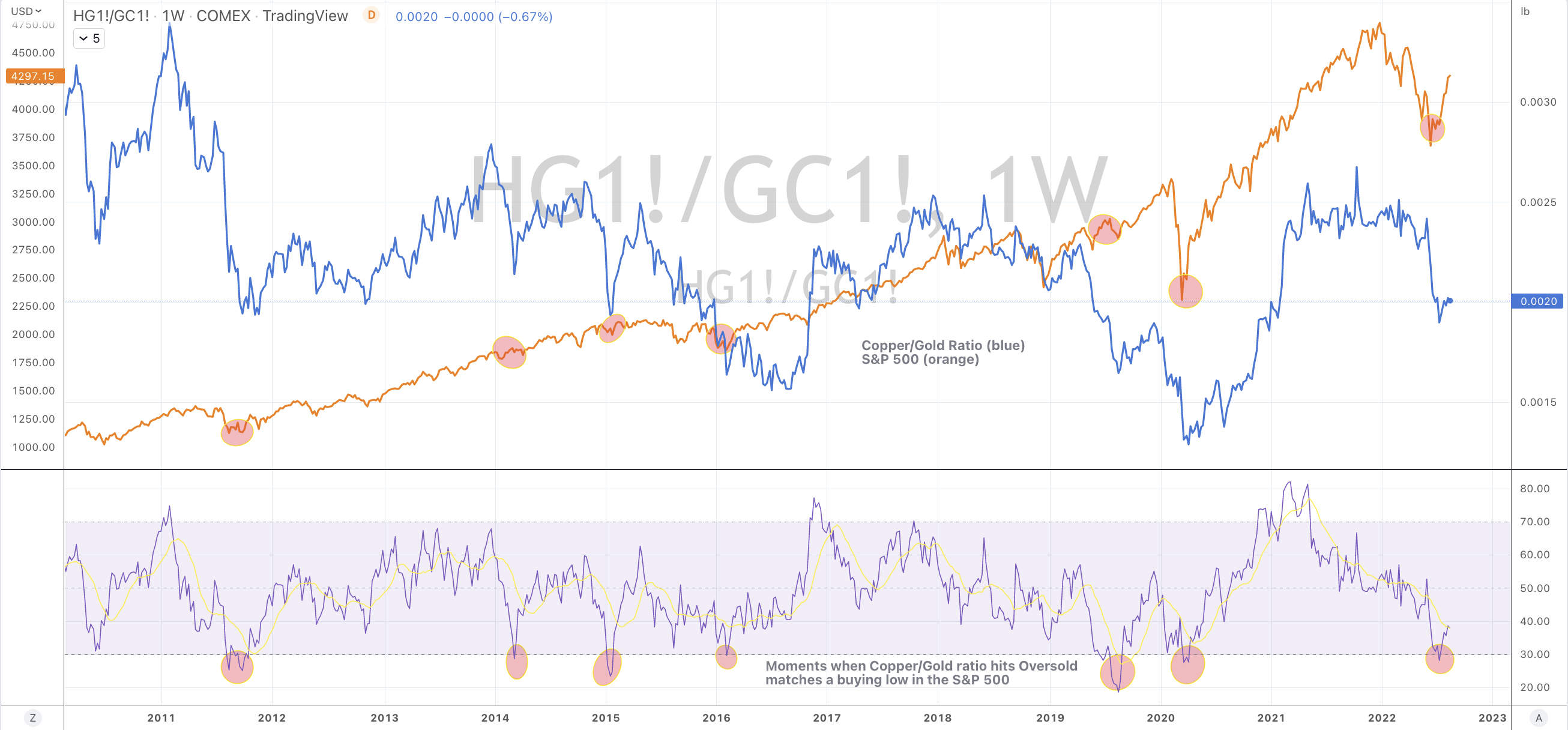
Copper rose for the week as did the Copper/Gold ratio. The latter hit and didn’t break resistance.

Lumber fell notably for the week and has halved since March. It closed the week at $623. The $500 – $560 range may prove an attractive entry point.

Cryptocurrencies were quiet, while one of the 6 or so darlings, Cardano rose 17%. I heard about Cardano from ‘retail’ investors when it was $3. I don’t hear about when it’s 56 cents.

In other news, grains were lower with Wheat leading the decline with a drop of 10%. As the ‘long’ soft’s is crowded and the probability of mean reversion is increasing, its a warning for farmers to lock in prices.

I’ll watch if Gold (in AUD) holds the A$2,500 level.

And perversely, the Shanghai Composite Index has risen 6.2% in 4 weeks, albeit in the face of Covid lockdowns, it’s a reminder of how markets factor in the news quicker than many expect.

The larger advancers over the past week comprised of; 

Rotterdam Coal 12.4%, WTI Crude 3.3%, Gasoil 12.8%, Copper 3.8%, Heating Oil 6.9%, JKM 6.1%, Nickel 8.5%, Platinum 7.8%, Gasoline 8.7%, Brent Crude 1.7%, Uranium 5.7%, Shanghai Composite 2.1%, AUD/JPY 3.6%, CSI300 2.2%, HSCEI 2.6%, Hang Seng 1.9%, Nikkei 3.7%, Copenhagen 2.5% and Taiwan’s TAEIX 1.8%.

The group of decliners included;

Australian Coal (18.4%), Aluminium (5.5%), China Coal (1.9%), Hot Rolled Coil Steel (3.4%), Lumber (10.3%), Natural Gas (2.3%), Palladium (2.9%), Rubber (2%), Dutch TTF Gas (9.3%), Corn (6.5%), Oats (1.9%), Rice (3.9%), Soybeans (2%), Wheat (10.2%), KBW Banking Index (1.7%), Italy’s MIB (1.9%), IBEX (2.3%) and the SOX fell 1.7%.  

June 5, 2022

by Rob Zdravevski

rob@karriasset.com.au  

Energy stocks – Heed the siren’s call

The oil and gas (energy) stocks are overcrowded.

As an illustration of only one measure which I use, the annotations on the chart below show the percentage that Hess Corp is trading above its 200 week moving average.

As you can see, the elastic band is looking a little stretched.

Go take a look at a bunch of stock prices of similar companies from Marathon, Occidental to Exxon and check if they are trading at similar extremes.

The call for ‘stronger and longer’ for energy stocks is fraught. This may be a good script for those who are ‘long’ at much lower prices, but if this ‘stay overweight energy’ news is reaching you now and with your ‘new money’ perhaps buying at these current prices…..

be aware of the siren’s call.

The contrarian was buying Brent Crude at $40, not $125.

Buying oil or energy related stocks at current prices, doesn’t provide you with an attractive risk/reward metric, let alone an adequate margin of safety.

In Hess’ case, what are looking at?

$30 up or $30 down…..this is hardly compelling, let alone tantalising.

June 3, 2022

by Rob Zdravevski

rob@karriasset.com.au

When government tries to frame the central bank

Don’t simply believe that central banks cause or can solve inflation.

The rhetoric, economic policy and legislation of government cause, create and add to rising prices.

Whether they allow energy exploration or development, subsidise housing with taxation free of capital gains, not encouraging longer term residential rental tenancies, not securing internal production supply of key commodities or food stuffs or placing tariffs on imports, government

Don’t be fooled by Joe Biden’s framing of remarks that he ‘respects an independent Fed’ etc etc…..should inflation not decline prior to the November 2022 mid-term elections, he is trying to set them up as the ‘fall guy’, when in turn he could have (as can Australian politicians) changed policies to help abate inflation.

Yet, it’s too late for Biden’s vote prospects to do that, so instead, they’ll work on a plan to blame the central bank for any short-comings.

In Germany, where you can lease a house for longer periods of time and where more than half the population rent, they are not seeing notable inflation in the cost of housing. (see graphic below)

It’s understandable that their price of energy is rising sharply, due to another policy error of relying too heavily on a key supplier.

Australia and the United States have energy resources.

Why are these locally sourced costs rising ?

It’s governmental economic policy to blame, not central bank monetary policy.

Graphic source: https://www.destatis.de/EN/Press/2022/05/PE22_221_611.html#:~:text=WIESBADEN%20%E2%80%93%20The%20inflation%20rate%20in,rate%20had%20been%20%2B7.4%25.

June 3, 2022

by Rob Zdravevski

rob@karriasset.com.au

Some price action notes on Wesfarmers (WES.AX)

The text in the chart below says….

$45.30 in Wesfarmers would signify
and coincide with the stock price;


1) touching 2.5 standard deviations below its weekly mean,

2) meeting its 200 week moving average and

3) registering a Weekly Oversold reading in the Relative Strength Index (RSI).

June 1, 2022

by Rob Zdravevski

rob@karriasset.com.au

Aussie/Yen leads the SPX in risk

The Aussie/yen is in blue,

The S&P 500 is the orange line,

the have a symbiotic relationship,

AUD/JPY leads the S&P 500 in directional moves,

as my ‘circles’ highlight.

June 1, 2022

by Rob Zdravevski

rob@karriasset.com.au

Macro Extremes (week ending May 27, 2022)

The following assets (on a weekly timeframe) registered an Overbought or Oversold reading and/or have traded more than 2.5 standard deviations above or below its rolling mean.

Extremes “above” the Mean (at least 2.5 standard deviations)

EUR/GBP

Overbought (RSI > 70)

Australian 2, 3, 5 & 10 year government bond yields

German, Spanish, French, Greek, Italian and Portuguese 10 year government bond yields

U.S. 2 government bond year yields

U.S. Dollar (DXY) Index

Natural Gas

Gasoline

CRB Index

Bloomberg Commodity Index

WTI Crude Oil (September ’22 and December ’22 contracts)

USD/JPY

The Overbought Quinella – Both Overbought and Traded at > 2.5 standard deviations above the weekly mean)

None

Extremes “below” the Mean (at least 2.5 standard deviations)

HKD/USD

CNH/USD

Dow Jones Transports

S&P 400 Mid Cap index

Nasdaq Transports

S&P 600 Small Caps


Oversold (RSI < 30)

JPY/USD

The Oversold Quinella – Both Overbought and Traded at > 2.5 standard deviations above the weekly mean)

None

Notes & Ideas:

The big news for the week was the stunning bounce in global equity indices especially in the United States. 

Musings in recent edition of ‘Macro Extremes’ about Oversold moments and a 7th consecutive weekly decline in some indices portended a change of direction.

Calling such a low was highlighted in my newsletter released earlier in the week 

https://mailchi.mp/karriasset/buy-signals-appearing

And in other posts such as;

https://robzdravevski.com/2022/05/21/a-different-way-looking-at-the-nasdaq/

https://robzdravevski.com/2022/05/20/a-rare-oversold-moment-for-the-sp-500/

https://robzdravevski.com/2022/05/12/mean-reversion-is-a-happening-thing/

Keep in mind that it doesn’t mean a change of trend, but merely a break of a streak.

Incidentally, there is little news in the financial media reporting that last week’s advance added a certain amount of trillions in market capitalisation, while we only hear of the trillions ‘wiped’ or ‘lost’…….and never about the trillions which are ‘found’.

In other news, the 5 and 10 year U.S. government bond yields are not Overbought. 

While the CRB (commodities) Index remains overbought, for the 19th consecutive week….the U.S. Dollar Index (DXY) ended 6 consecutive week of ‘overboughtness’.

The chart below shows the recent divergence of the AUD/USD and broader commodity prices.

Probability is increasing of a weaker US dollar as a means of simply retracing the recent bullish move, although there isn’t much talk about commodity prices easing, let alone reverting to any chosen mean.

The Baltic Dry Index (shipping costs) took a break and fell 20% following a 51% advance in the previous 6 weeks.

Bitcoin fell again (another 5%) and has declined 50% over the past 9 weeks. 

The larger advancers over the past week comprised of; 

Bloomberg Commodity Index 2.5%, China Coal 2.6%, WTI Crude 4.3%, Gasoil 9.4%,  Heating Oil 7.1%, JKM LNG 3.7%, Coffee 6.3%, Lumber 4.2%, LNG 3.1%, Tin 3.3%, Natural Gas 8%, Orange Juice 6.2%, Palladium 5.4%, Gasoline 2%, Silver 2%, CRB Index 2.5%, Dutch TTF Gas 4.2%, Brent Crude 5.9%, Oats 14.9%, AEX 2.8%, KBW Banking Index 9.2%, French CAC 3.7%, German DAX 3.4%, Dow Jones Industrials 6.3%, DJ Transports 7.1%, Italy’s MIB 2.3%, Spain’s IBEX 5.3%, Bovespa 3.2%, S&P MidCap 400 6.5%, Nasdaq 100 7.2%, Osloa 3.1%, Helsinki 3.9%, Stockholm 3.2%, Russell 2000 6.5%, Swiss SMI 3%, Philadelphia Semiconductor (SOX) Index 8.1%, S&P 500 6.6%, U.K.’s FTSE 2.7%, Canada’s TSX 2.7%, S&P SmallCap 600 6.7%, Nasdaq Biotech Index 2.8% and Australia’s ASX 200 rose 0.5%.

The group of decliners included;

Baltic Dry Index (19.8%), Australian Coal (2%), Aluminium (2.6%), Rotterdam Coal (13.5%), Hot Rolled Coiled Steel (13.7%), Nickel (2.6%), Cotton (2%), Urea (5.1%), Bitcoin (4.6%), Ethereum (13.5%), Cardano (15.1%), CSI 300 (1.9%).

May 29, 2022

by Rob Zdravevski

rob@karriasset.com.au  

Rate hikes are built in

The current Fed Target Rate is 1%,

the minutes released overnight hint at 2 rate hikes of 0.5% each in the next consecutive meetings,

the chart below is the U.S. 1 year Treasury Note,

it’s already at 2%,

2 more rate hikes bring the Fed Rate up to 2%,

See how the markets factor in the future………?

My call remains intact, the Fed hikes 3 times and could possibly cut once within 9-18 months.

When you couple hawkish Fed speak with talk amongst the population of recession and slowdowns will, by design, also help simmer inflation.

It’s even more simple…..western central banks can’t hike rates too much because they would derail the great overvalued, leveraged home ownership trade.

While the public financial markets correct and adjust, it’s not as great of consequence compared to central bank policy affecting the retention of your job and being able to service mortgage repayments adequately,

The uncrowded trade is to see inflation peak and abate and same goes for government bond yields.

May 26, 2022

by Rob Zdravevski

rob@karriasset.com.au

2nd chance to buy the uranium theme

While the structural imbalances in the uranium industry remains intact and the investment theme has years to run, spot prices and animal spirits get ahead of themselves sometimes.

So, as markets wash-out late comers and ‘unnatural’ participants, I’ll look for a pullback in the uranium spot price to around the $35-$36 level and I’ll correlate that into my preferred equity exposures as my next moment to accumulate.

May 25, 2022

by Rob Zdravevski

rob@karriasset.com.au

Latest newsletter – “Buy Signals Appearing”

https://mailchi.mp/karriasset/buy-signals-appearing

May 25, 2022

by Rob Zdravevski

rob@karriasset.com.au

Lumber prices barreling lower again

I enjoy watching the price of Lumber. It’s tells a good story.

Currently, it is barrelling towards a $570 support. The trend has been negative as it continues to make ‘lower low’.

Lumber’s price action has also been a good study in mean reversions and fibonacci retracements.

It also tends to lead the S&P 500 in near-term peaks and troughs.

I also think it has been a handy barometer of inflation or at least scarcity of supply.

For those watching inflation, it’ll be interesting to watch how the higher prices of the past several months will affect lumber yards, timber truss manufacturers and homebuilders as they try to pass on higher ‘finished’ prices compared to the more competitive prices buyers of lumber can achieve today?

May 23, 2022

by Rob Zdravevski

rob@karriasset.com.au