When bonds and stocks both fall

When bonds and equities both fall, it’s a sign of indiscriminate selling.

Big Tech has been an obvious victim and the watchlist below shows that it doesn’t matter what you own.

In fact, during yesterday’s trading, there weren’t many places to hide.

There have been some reports citing that this past day mimics those seen on October 9, 2008 and March 18, 2020.

All this tells us is that some parties are in some type of forced liquidation. There is no use in speculating who and why.

However, such an occurrence isn’t reliable in calling a bottom in the S&P 500 as other indicators such as long-term RSI’s, Standard Deviations and VIX (to name a few) do not marry up with the plunges seen in 2008 and 2020.

May 6, 2022

by Rob Zdravevski

rob@karriasset.com.au
Trying to hear what is not being said – May 5, 2022

I recall Goldman Sachs calling for $200 oil when it was trading at $130. It soon dropped to $90.

It’s a little bit funny that I’m not hearing that prediction being repeated anytime over the past 6 weeks.

In the meantime, Goldman Sachs did $100 million in trading revenue on 32 separate business days in the 1st quarter. Their trading division accounted for 61% of its quarterly revenue. 

As far as profits are concerned, I wonder how much the proprietary trading division made during the quarter?

Do people ever think it is possible that while an investment house is promoting its market calls to ‘buy’ something, that the same investment house may be the seller of their own stock or inventory?

May 5, 2022

by Rob Zdravevski

rob@karriasset.com.au
Trying to hear what’s not being said – May 5, 2022

Readers of my weekly ‘Macro Extremes’ note may deduce that the following are Overbought and ’Stretched”

Cotton (up 50% in 4 months)

Rice (up 22% in 4 months)

Corn (up 36% in 4 months)

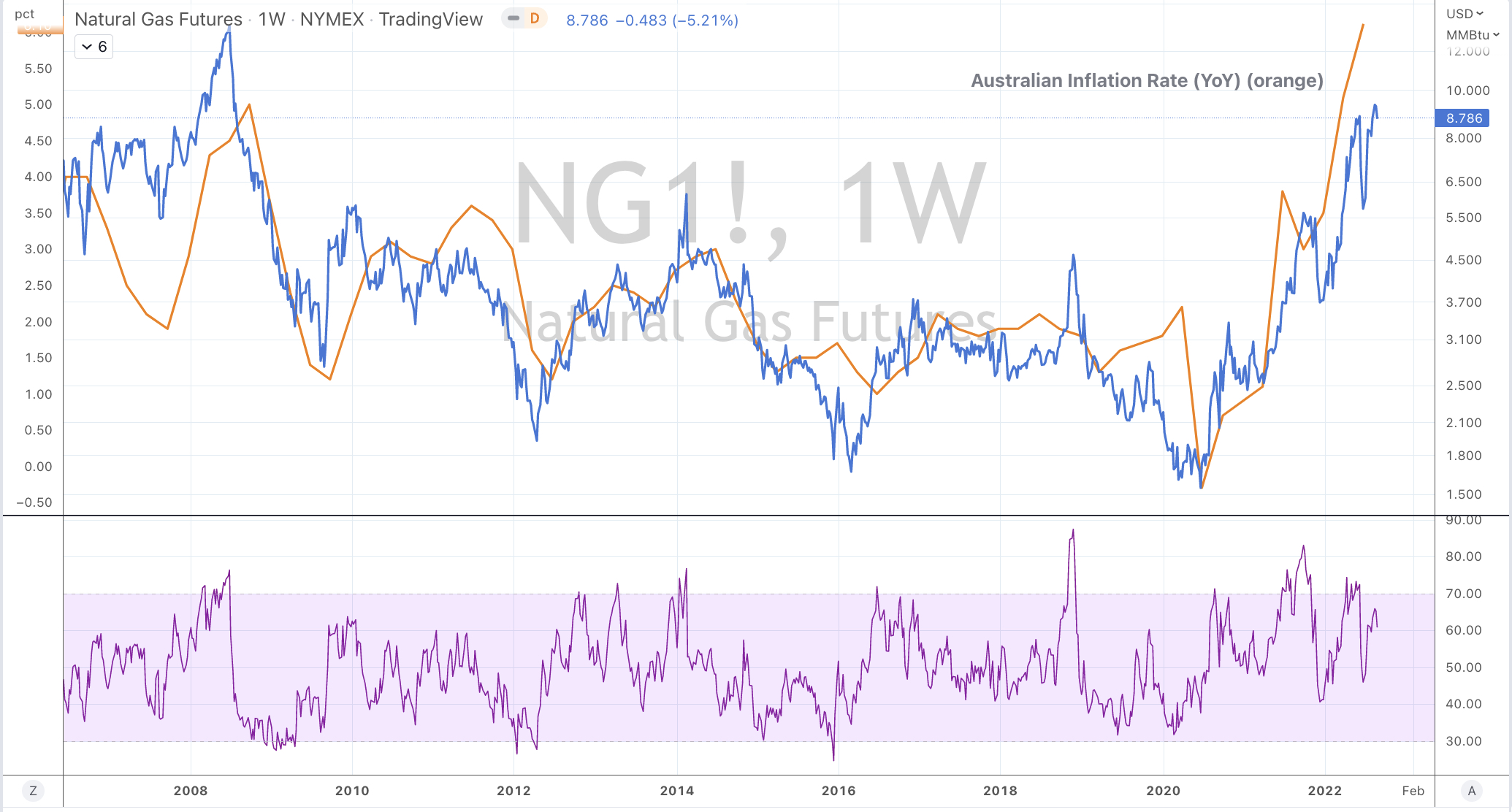
Natural Gas (Henry Hub price) has soared 117% in 3 months

These higher prices are good for the producers and onerous for the buyers of the raw material.

However, the contrarian thinks about what the story looks like when things change and move in the opposite direction.

For those who chased the news and fearfully bought something at the wrong end of the pendulum, you may be surprised to know that since the week surrounding February 28th – March 7th, 2022 (Ukrainian invasion)……

Wheat is 25% lower (remember how the lack of Ukrainian wheat was going to send prices higher ‘forever’?)

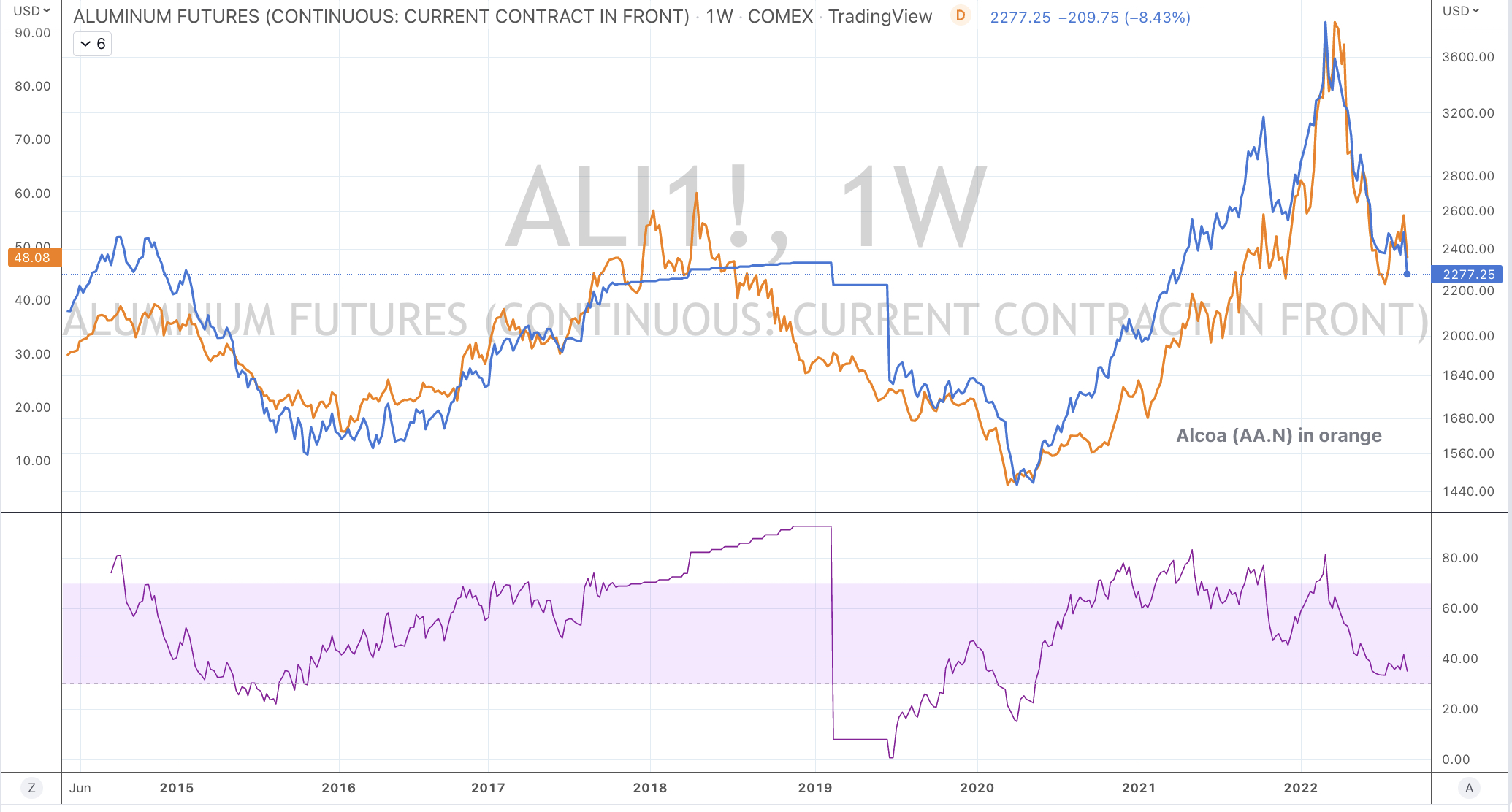
Aluminium is 24% lower

European delivered (Dutch TTF) Natural Gas has slumped 55%

Palladium has declined (Russia has 40% of the global reserves)

Crude Oil is 18% weaker

the Japanese Korean LNG Marker has fallen 54%

Lumber has swooned 34%

Nickel has tanked 50% from its March intraday high

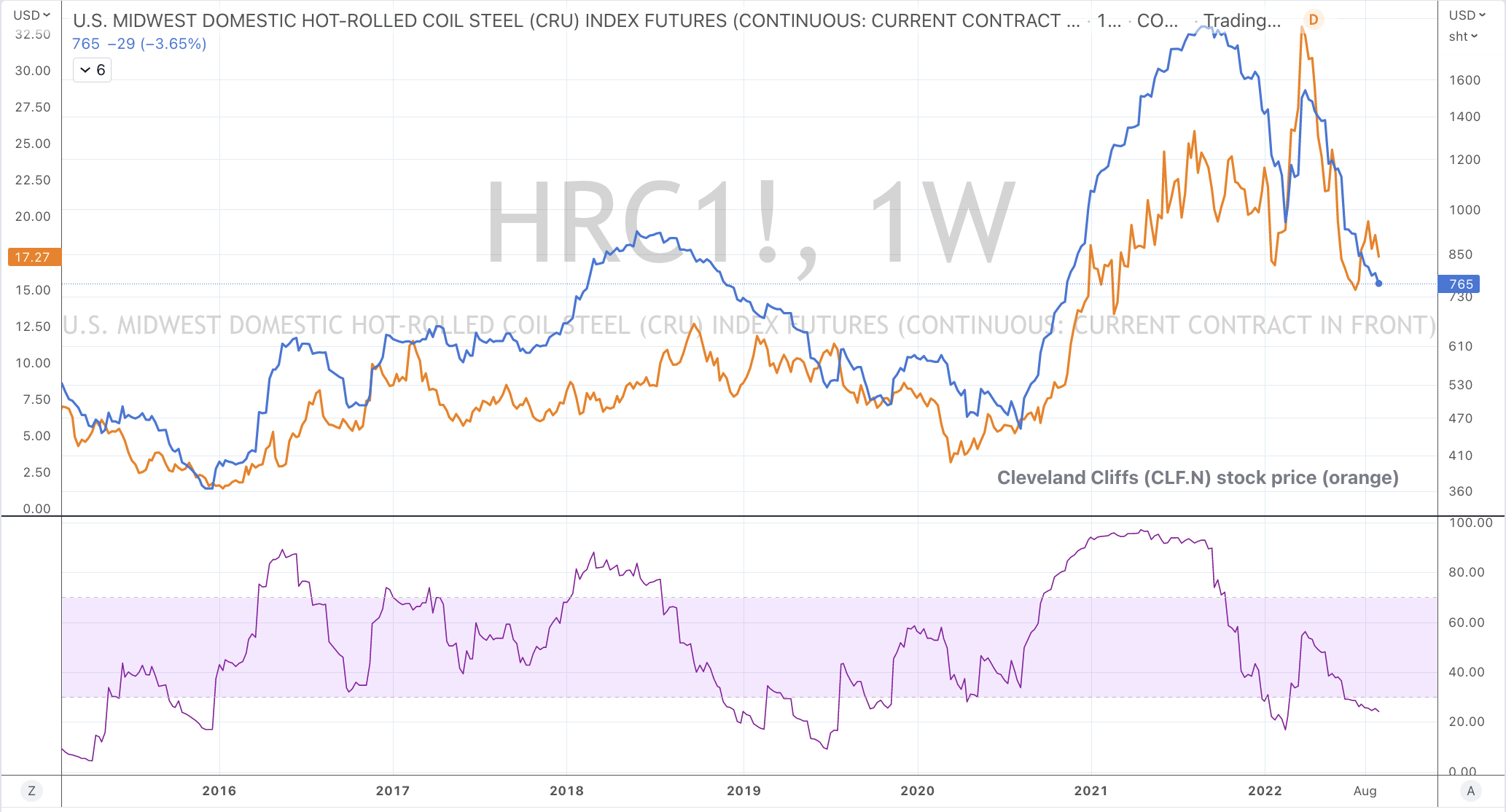
and Hot Rolled Coiled Steel is 20% lower than its September 2021 high.

Interestingly, the Baltic Dry Index has ‘only’ risen 20% since the early March news of supply disruptions and port chaos in Shanghai arose.

May 5, 2022

by Rob Zdravevski

rob@karriasset.com.au

Rate hikes are hardly a ‘surprise’

Be careful subscribing to financial media framing recent central bank hikes as being a ‘surprise’.

As the charts below illustrates, the 2 year bond yields have already factored in a rise in interest rates.

I expect these government yields to fall in the coming months as they converge towards the central banks respective cash or benchmark rates.

May 5, 2022
by Rob Zdravevski
rob@karriasset.com.au
Macro Extremes (week ending April 29, 2022)

The following assets (on a weekly timeframe) registered an Overbought or Oversold reading and/or have traded more than 2.5 standard deviations above or below its rolling mean.

Extremes “above” the Mean (at least 2.5 standard deviations)

Istanbul’s BIST Index

Overbought (RSI > 70)

Australian 2, 3, 5 & 10 year government bond yields

Canadian, Spanish, French, Greek, British, Italian, Korean, Swedish, Portuguese, New Zealand & Swiss 10 year government bond yields

German 2, 5 and 10 year yields

U.S. 2, 5 & 10 year yields

TBX & TBT

CRB (Commodities) Index

Corn

Rice

Cotton

Orange Juice

AUD/JPY

The Overbought Quinella – Both Overbought and Traded at > 2.5 standard deviations above the weekly mean)

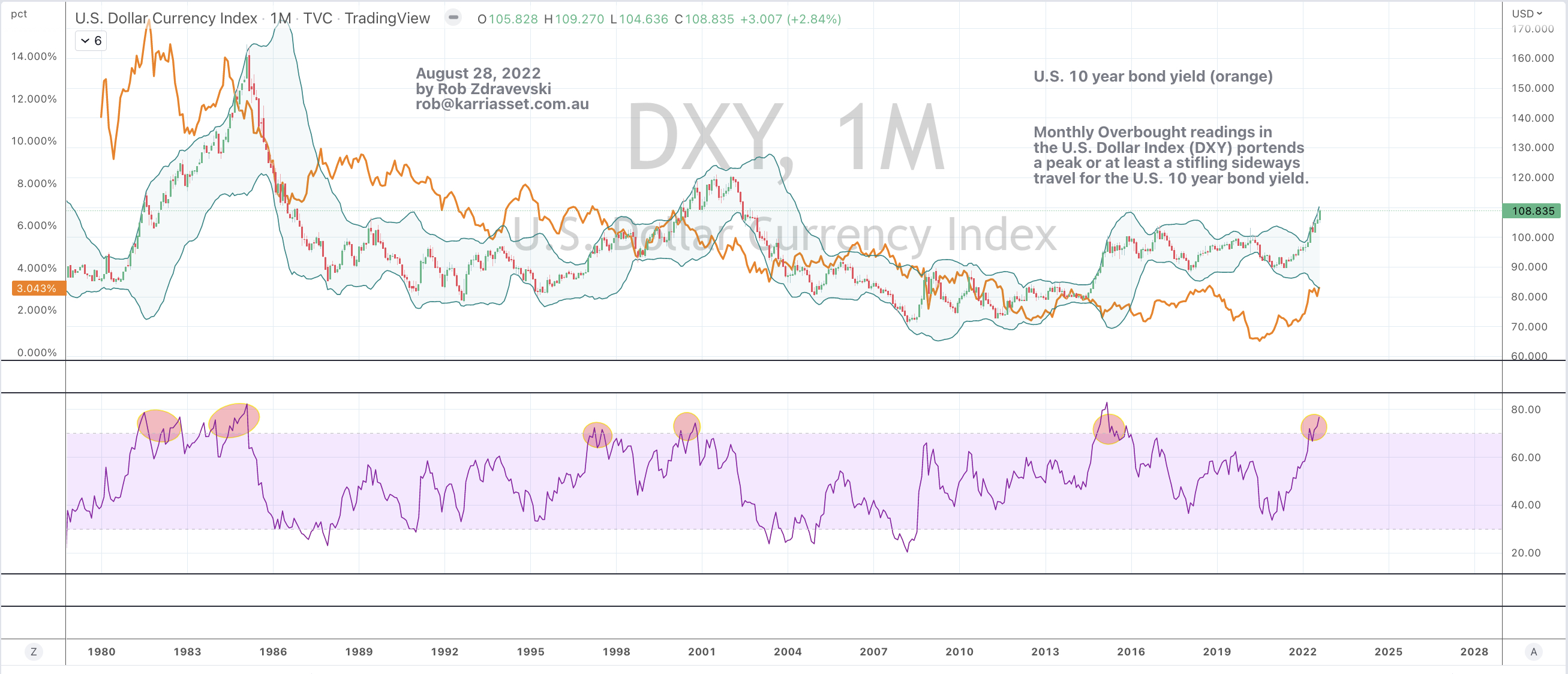
U.S. Dollar Index (DXY)

Heating Oil

USD/JPY

Extremes “below” the Mean (at least 2.5 standard deviations)

Cattle

NZD/USD

SGD/USD

Taiwan’s Taiex index


Oversold (RSI < 30)

TLT

IEF

China’s CSI 300

JPY/AUD

HKD/USD

The Oversold Quinella – Both Overbought and Traded at > 2.5 standard deviations above the weekly mean)

FXE

GBP/USD

EUR/USD

CNH/USD

KRW/USD

Shanghai Composite


Notes & Ideas:

This past week’s big news remains the same. Bonds and Currencies.

Other observations include;

UK Gilts aren’t overbought anymore,

Bitcoin has broken a support line,

The Copper/Gold Ratio closed the week (it’s lowest weekly close since January 24th) at an important support line. (In Monday’s trade, it has broken below this),

The Japan/Korean LNG Marker is at its lowest price since February 14th,

We saw a bearish outside reversal week in the AUD/GBP,

The Euro has reached its most oversold level (on a monthly basis, not my usual weekly timeframe) since 2015,

The AUD/JPY is not overbought anymore,

while the AUD/USD flaunting is support line,

The mean reversion of those FAANGM’s has reached halftime.

There are places to hide, the CAC only fell 0.7% for the week, Italy’s MIB and Singapore’s Strait Times Index declined a mere 0.1%, the Nikkei was down 0.9% and the ASX 200 barely eased 0.5%,

A 13.3% swoon in the Nasdaq 100 over the past 4 weeks and it’s still not oversold.

Natural Gas recovered last week’s decline of 11%, 

the price of Urea slumped 19%

and Precious Metals fell while major equities indices did the same. Last week’s edition of ‘Macro Extremes’ signalled this citing their bearish outside reversal price action.

The larger advancers over the past week comprised of; 

Baltic Dry Index 4.2% (adding to last week’s 8% rise), Heating Oil 21.4%, Australian Coal 11.4%, WTI Crude Oil 2.6%, U.S. Dollar Index 2.1%, Gasoil 9.7%, Gold Volatility Index 4.5%, Natural Gas 10.9%, Orange Juice 2.5%, Gasoline 4.2%, Cotton 7.2%, Dutch TTF Gas 4.8%, Corn 2.6%, Rice 5.6%, HSCEI 4.7%, Hang Seng 9.5%, Russia’s MOEX 9.5%.

The group of decliners included;

Aluminium (4.8%), Rotterdam Coal (20.4%), Lean Hogs (9.8%), Copper (3.8%), Hot Rolled Coil Steel (4.4%), JKM (3.8%), Coffee (2.2%), Lumber (2.2%), Cattle (6.9%), Tin (6.3%), Palladium (2.9%), Silver (4.9%), Urea (19.1%), Uranium (2.1%), Gold in USD (1.8%), Oats (9.5%), Wheat (1.8%), Bitcoin (3.8%), KBW Banking Index (5.2%), Dow Jones Industrials (2.5%), Bovespa (2.9%), S&P Midcap 400 (3.2%), Nasdaq (3.8%), Oslo (1.9%), Russell 2000 (4%), SOX (2.3%), S&P 500 (3.3%) and the Taiex fell 2.5%.

May 2, 2022

(written 2 days later than usual, better late than never)

by Rob Zdravevski

rob@karriasset.com.au  

Newmont nears target buying range

I wasn’t expecting anything resembling a 17% decline in Newmont Mining in only 6 trading days following the writing of this note below.

NEM stock is now $72.60.

and that target I mentioned of $64-$68 (within ~ 9 months) may be seen sooner that I thought.

In fact, if a few more people throw away their stock in the coming week, then $68.50 makes for an interesting entry price, for a trade.

A bounce from $68.50 will also give those wishing to sell, a second chance.

If NEM breaks above $86.40, then the $90 mark should be an interim ‘lid’ on the stock.

Longer term mean reversion mentioned in the original post, still counts.

April 26, 2022

by Rob Zdravevski

rob@karriasset.com.au

Macro Extremes (week ending April 22, 2022)

The following assets (on a weekly timeframe) registered an Overbought or Oversold reading and/or have traded more than 2.5 standard deviations above or below its rolling mean.

Extremes “above” the Mean (at least 2.5 standard deviations)

China Coal

Rice

Natural Gas

Orange Juice

Overbought (RSI > 70)

Australian 2, 3, 5 & 10 year government bond yields

Canadian, Spanish, French, Greek, British, Italian, Korean, Swedish, Portuguese, New Zealand & Swiss 10 year government bond yields

German 2, 5 and 10 year yields

U.S. 2, 5 & 10 year yields

U.S. Dollar Index (DXY)

TBX

CRB (Commodities) Index

Corn

AUD/JPY

The Overbought Quinella – Both Overbought and Traded at > 2.5 standard deviations above the weekly mean)

TBT

Istanbul’s BIST equity index

USD/JPY

Extremes “below” the Mean (at least 2.5 standard deviations)

None


Oversold (RSI < 30)

TLT

IEF

China’s CSI 300

Shanghai Composite

JPY/AUD

HKD/USD

The Oversold Quinella – Both Overbought and Traded at > 2.5 standard deviations above the weekly mean)

JPY/USD (for the 7th week)


Notes & Ideas:

This pst week’s big news is the same as the last 3 or 4 weeks: the bond market and their overbought status.

Moreover, we saw yields lurch 15-20 basis points higher in many 10 year bonds. Some example include Portugal’s 10’s moving from 1.85% to 2.00% or the U.S. 10’s moving from 2.82% to an intra-week high of 2.98%.

JGB’s made a new high, perhaps suggesting the ‘risk-on’ world is OK.

Precious Metals saw weakness and featured amongst the bearish reversals listed below.

Some currencies moved 2% which isn’t a range normally seen in a weekly term.

In other news, last week’s 26% rise in Natural Gas saw it give up 11% this week and commensurately, the JKM tanked 23%. Other energy commodities also fell while the price of Uranium took a break from its recently reported Overbought Extremes by falling 14%.

We saw constructive price action in the Copenhagen, Oslo & Helsinki equity indices, while the S&P 500 has fallen 6.2% and the Nasdaq 100 has declined 10.5% over the past 3 weeks.

And lastly, we saw bearish outside reversal week in Gold, Silver, Copper, Orange Juice, Platinum, the S&P 500, the Dow Jones Industrials, SOX, MIB, KBW Bank Index, Nasdaq, Russell 2000 and the SOX.

The larger advancers over the past week comprised of; 

Baltic Dry Index 8%, Heating Oil 2.2%, Lumber 14.4%, Rice 2.2%, EURAUD 2% and Dow Jones Transports rose 1.5%

The group of decliners included;

Australian Coal (3%), Bloomberg Commodity Index (2.6%), Cocoa (3.1%), China Coal (10.6%), WTI Crude Oil (4.6%), Gold (2.1%), Copper (3%), Japan Korean ‘LNG” Marker (22.6%), Natural gas (10.5%), Orange Juice (2.8%), Platinum (6.7%), Gasoline (2.2%), Rubber (1.6%), Sugar (4.1%), Silver (5.6%), Cotton (4.3%), CRB Index (2.5%), Brent Crude (4.5%), Uranium (13.7%), Oat (5.1%), Wheat (2%), AUDUSD (2%), NZDUSD (1.9%), CNHUSD (2.3%), JPYUSD (1.7%), ZARUSD (6.9%) and Australia’s ASX 200 fell 0.7%.

April 24, 2022

by Rob Zdravevski

rob@karriasset.com.au  

Newmont price to ease

In a continuation of my Alcoa post earlier today, Newmont Mining’s stock price is now dancing at ‘extremes’ not seen for some time.

The first chart below is an illustration of the various times that Newmont’s stock price has traded at high levels of percentage above its 200 weekly moving average.

Other than the shocks of the respective 1981 interest rate hikes and the 1987 stockmarket crash, Newmont Mining’s stock price doesn’t necessarily spend time up in this stratosphere.

My case is not a one-way street.

Note the highlighted ellipse in the chart surrounding 2003 and 2005.

Newmont trades at 101% above its 200 WMA in the last part of 2003, then attempts a mean reversion to then rise back to the same stock price, YET the percentage reading is ‘only’ 57%.

This is because the 200 WMA ‘rolls up’ quickly to catch up with the parabolic move seen through 2003.

The 200 WMA will move higher, while NEM stock price declines.

This is the convergence that I mention in the previous Alcoa post.

So, I’l look for Newmont’s stock to work its way back to the $64-$68 mark in the coming 9-13 months.

The second chart compares Newmont to the Gold price (in USD).

Similar to Alcoa, it’s plausible that Newmont uses its well priced equity to make some acquisitions or raise some capital itself.

April 20, 2022

by Rob Zdravevski

rob@karriasset.com.au

Earnings season once again, let’s watch Google

On the eve of last quarter’s earnings season (on January 26th, 2022) I wrote a newsletter citing Alphabet (Google’s) earnings as being important and setting the course for technology stock price action.

https://mailchi.mp/karriasset/googles-earnings-will-set-the-course

The charts contained within that newsletter featured some support lines that some of the FAANGM stocks were still holding above.

Google has now broken below that support line as has Microsoft, while Apple remains barely above its.

My previous quips have mentioned the weighted importance that these stocks have in the Nasdaq 100 and S&P 500. The recent pullback of these goliaths (following their dead cat bounce) explains the 7% decline in the Nasdaq 100 over the past 3 weeks.

Alphabet (Google) reports earnings April 26th.

Apple reports on April 28th.

There is good probability that these stocks fall further, much like other high-flyers have and some of their FAANGM brethren.

April 20, 2022

by Rob Zdravevski

rob@karriasset.com.au

Alcoa is amongst many

Mean Reversion is a big theme of mine and it is a warning to heed in a market (and world) which thinks prices only travel in a one-way direction.

Whilst valuation and fundamentals matter and the pricing of an asset already takes that into account, the price action of the asset is something else to observe when ‘animal spirits’ sends it to the edges of its normal trading range or price distribution.

So, in Alcoa’s case, it is difficult to convince one self to buy the shares at this level.

And if you do, at least recognise that you may be the marginal buyer.

In the chart below, you’ll see Alcoa is stretched above a significant long term measure that I use, being the 200 Week Moving Average.

This is one study I use to illustrate moments of ‘extremes’.

Alcoa has never traded at 220% above its 200 week moving average.

In fact, a price which is 60% above (or below) its 200 week moving average is about the extent of the equity price ‘elastic’.

So, what’s next;

Although the current 200 week moving average is currently at $31, its not so clear to expect the price of Alcoa shares to simply fall and mean revert to that level.

The recent parabolic price move means that this mean will “roll higher” at a reasonably faster pace than normal.

We should see the price of Alcoa and its 200WMA converge to somewhere near the $55 mark.

This also suggests holders of Alcoa stock manage their risk (i.e. selling, hedging) 

From a corporate perspective, it’s prudent for Alcoa to use its ‘inflated’ currency (being its shares) to either raise capital, restructure debt or to make acquisitions.

April 20, 2022

by Rob Zdravevski

rob@karriasset.com.au