3% more in the S&P 500

I think the S&P 500 rally should stall around 4,115 and not break the high of 4,118 seen on Sept 12, 2022.

4,155 (an extension of 1%) carries some probability, although it should be a head fake.

And keep in mind that daily ‘gap ups’ are ‘backed and filled’ at some time.

At 4,155 the S&P 500 would only be 14% below its all time high, while it will have seen a 19% advance from its October 13, 2022 low.

While such a bounce from 3,491 can be understood, being within 14% of the all-time high is a little difficult to comprehend in light of the 2 most notable headwinds not seen for 40 years…..a substantial change in inflation and the sizeable increase in the cost of capital.

So, whether it’s a further 3% or 4%, it’s a rally to rent rather than own.

November 12, 2022

by Rob Zdravevski

rob@karriasset.com.au
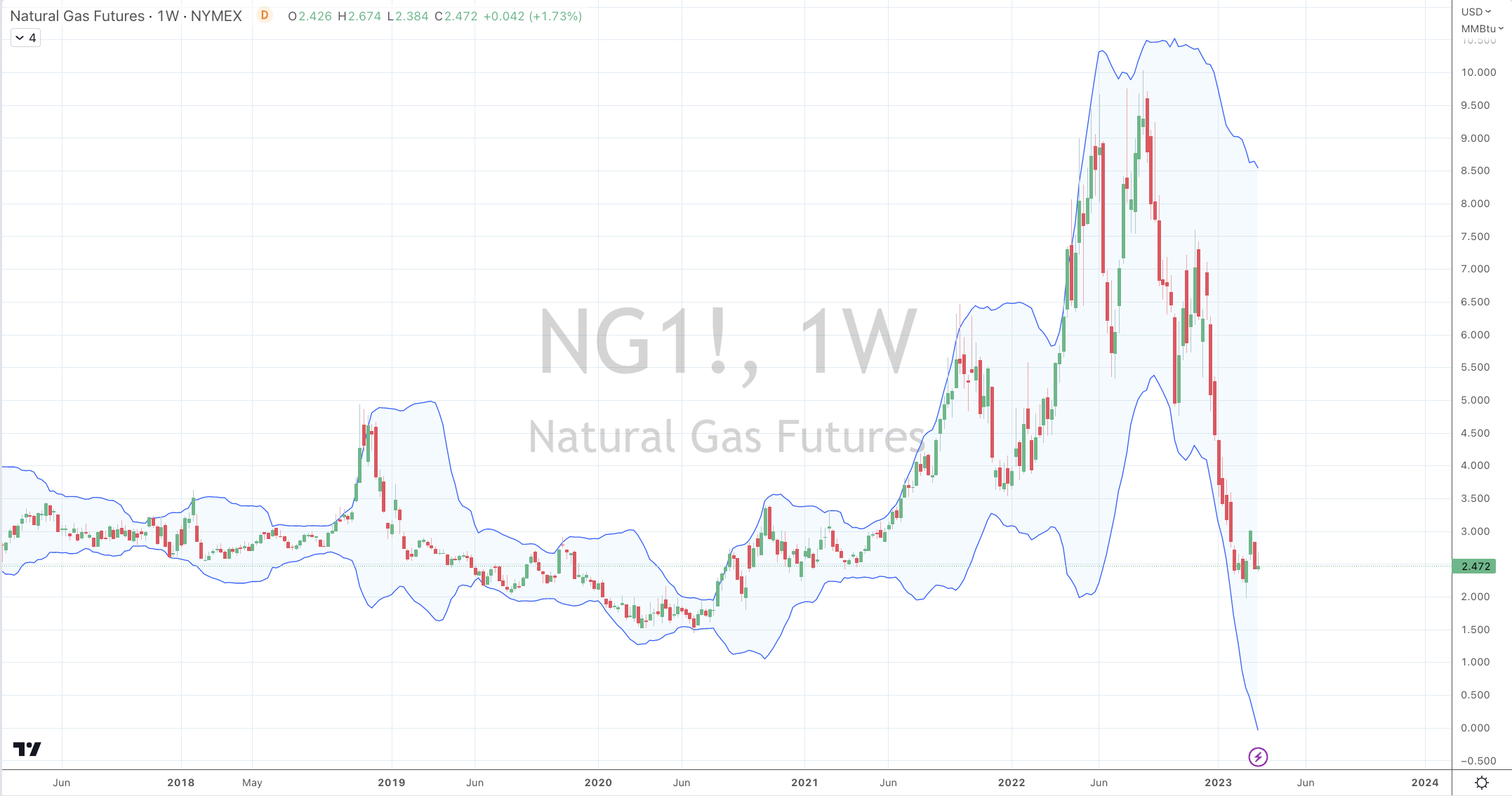
Alcoa’s volatility is worth watching

In 30 trading trading days since September 30, 2022…..

Alcoa shares have seen 23 trading days where the price moved up or down more than 2%.

Furthermore, 16 of the last 30 trading days saw the stock close higher or lower by more than 4%.

Although this prolific rate of change has existed for months prior.

Surely, nothing too exciting can happen about the fortunes of an aluminium producer which warrants such volatility?

Has Alcoa got the makings of becoming a ‘meme’ stock?

November 11, 2022

by Rob Zdravevski

rob@karriasset.com.au

Looking for ‘higher highs’

Something to compliment your trend continuation/exhaustion analysis or your general ‘reading of the tape’ is to watch whether equities prices which have recently made a ‘lower low’ are able to trade to a ‘higher high’ than their immediately previous high.

Here is an example I’m watching in the shares of Macquarie Bank (MQG.AX) and whether it can break above $184.18 which was its recent high on Sept 13th, 2022

November 11, 2022

by Rob Zdravevski

rob@karriasset.com.au

Mind The Gaps

Today’s stockmarket action isn’t constructive.

Whether traders/investors are celebrating inflation being ‘less’ bad or speculating on a change of interest rate policy……

These sharp moves create gaps in the price charts.

‘Gap-ups’ are often honoured (at some time) that prices trade back down to fill that gap between the previous day’s high and the low seen in the exuberance of the following day.

The chart below of Amazon is one example but you will find this littered globally across a range of stocks.

This a case of caveat emptor.

While rallies can pop a little higher be sure to assess your risk/reward skew amongst the current price action.

I think this is another rally to ‘rent and not own’.

November 11, 2022

by Rob Zdravevski

rob@karriasset.com.au
Happy Remembrance Day

Lest We Forget

When are commodities cheap?

Commodities are cheap when the CRB Index trades below its 200 week moving average and registers a weekly Oversold reading.

Presently, the heavy weighting of the energy complex is keeping commodity indices at elevated levels.

In fact, todays pricing is at levels exhibiting similar stretched moments prior to the CRB Index converging towards its 200 week moving average.

Keep in mind, that this is a study of the CRB Index, for selected commodities are in their own ‘cheap’ territory such as Copper and Iron Ore.

November 10, 2022

by Rob Zdravevski

rob@karriasset.com.au
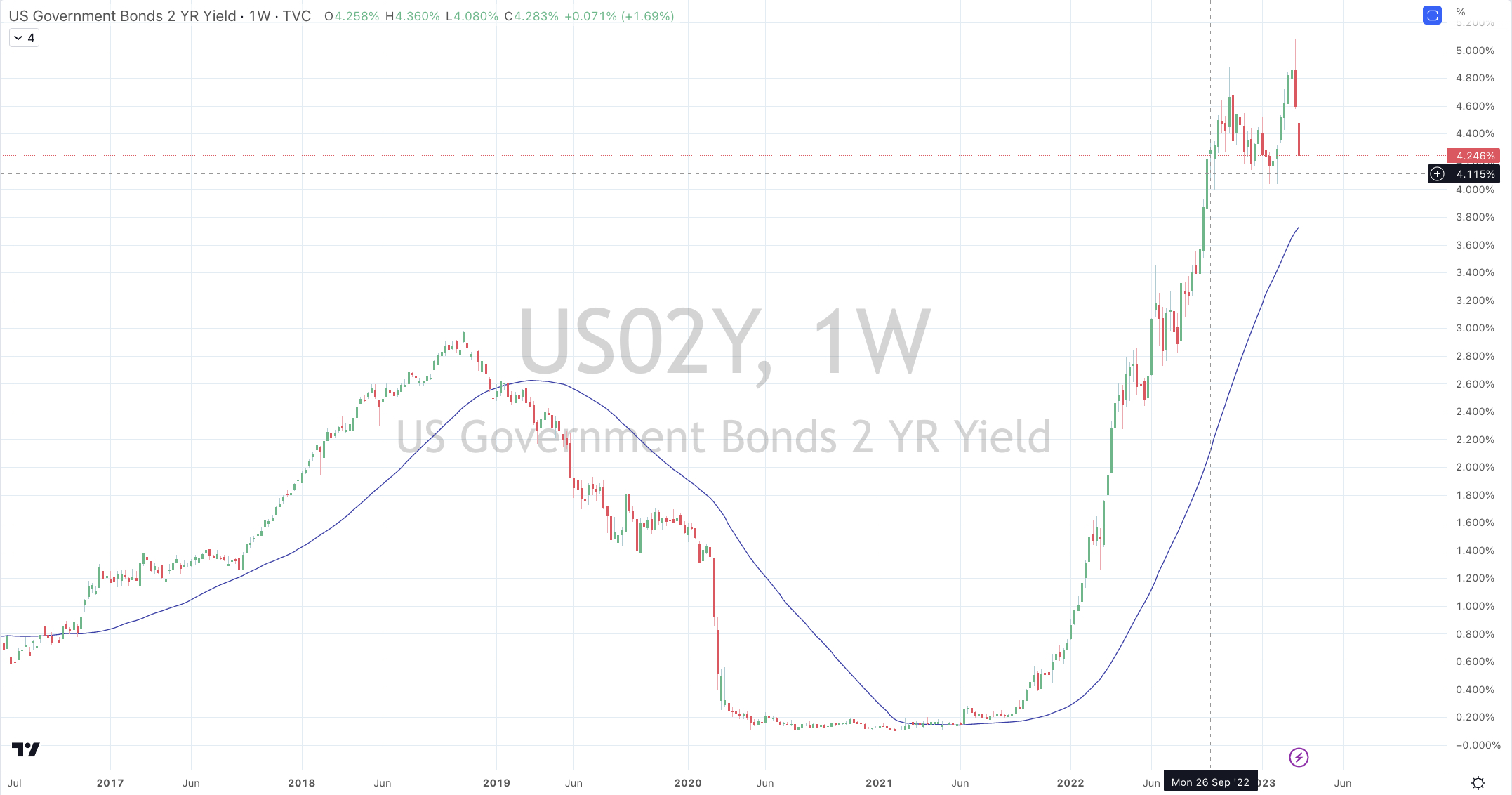
Oil & Gas rigs are still climbing

Globally, we may be 6 months away from reaching the same oil rig count as seen in March 2020, for the number of rigs in action tend to decline through November – February.

The lag in deployed rigs appears in the Middle East, Africa and ESG ‘shamed’ Europe.

I don’t know why Biden is so angry at his American Oil & Gas E&P companies, for their rig count is nearly back to where they once came from.

I think that threat of his to impose a super tax of their ‘super’ profits was a mid-term election rhetorical ploy.

November 10, 2022

by Rob Zdravevski

rob@karriasset.com.au
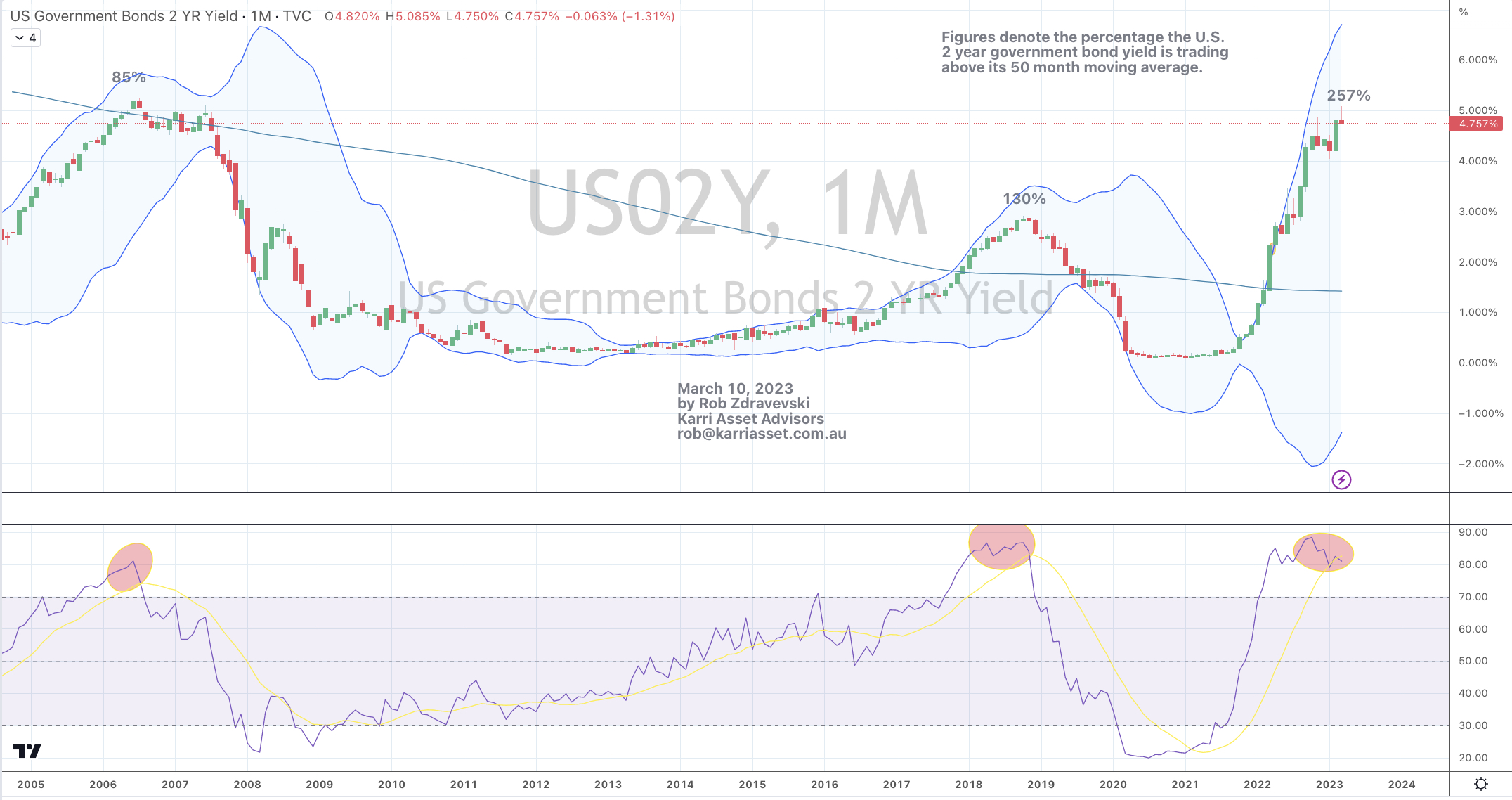
A declining Revenue to Employee ratio equals job layoffs

Too many employees and not enough revenue?

Perhaps your revenue to employee ratio isn’t what you are hoping for?

Decades ago, I figured good businesses tend to generate $300,000 of revenue for each employee on the books. That number was and is still considered quite good.

See if that works out close amongst some local businesses that you may know.

Back in original tech boom, Cisco Systems was amongst the gold standard in this category.

In 1998 Cisco had revenues of $8.5 billion and 145,000 employees thus the revenue to employee (Rev/Emp) figure was $586,000

In 2016, their revenue was $49.2 billion versus 73,700 for $668,000 revenue per employee.

In 2021, revenue was relatively steady at $49.8 billion against 79,500 employees for a Rev/Emp of $626,000.

The better gold standard back in 1998 was Apple.

A year after Steve Jobs returned to the company and launched the iMac to replace the ‘Macintoshes’, they were doing $6 billion revenue with 6,700 employees for a Rev/Emp of $895,000

In 2016, revenue of $216 billion using the employ of 116,000 people made that figure jump to $1.86 million

and in 2021, $366 billion revenue with 154,000 employees equals $2.38 million revenue for each employee.

So, when we look at the job layoffs occurring in Silicon Valley this year, perhaps the companies are running with too much fat.

Facebook (Meta) at $1.64 million Rev/Emp and Spotify’s $1.73 million seem to be looking OK, while Twitter’s $667,000, Tesla’s $757,000, Shopify’s $520,000 and Oracle’s $302,000 may help explain labour redundancies.

In comparison, companies such as Coca Cola has a Rev/Emp ratio of $535,000, Boeing is at $430,000, Citigroup is $343,000 and Starbucks does $182,000 based on its $25 billion of revenue compared to their headcount of 138,000 people.

November 10, 2022

by Rob Zdravevski

rob@karriasset.com.au

Macro Extremes (week ending November 4, 2022)

The following assets (on a weekly timeframe) registered an Overbought or Oversold reading and/or have traded more than 2.5 standard deviations above or below its rolling mean.

Extremes “above” the Mean (at least 2.5 standard deviations)

Copper/Gold Ratio

Overbought (RSI > 70)

Cattle

Orange Juice

TBT and TBX bond ETF’s

U.S. 2, 5, 10, 20 and 30 year government bond yields

German 2 and 5 year government bond yields

U.S. 5-7 year corporate bond yields

U.S. 10 year minus Australian 10 year bond yields

Divide the difference between the yield of the U.S. 10’s and Australian 10’s

U.S. 5 year bond yield minus U.S. 5 year breakeven inflation rate

U.S.10 yer bond yield minus U.S. 10 year breakeven inflation rate

The Overbought Quinella – Both Overbought and Traded at > 2.5 standard deviations above the weekly mean)

None

Extremes “below” the Mean (at least 2.5 standard deviations)

Coffee

Oversold (RSI < 30)

Tin

Hot Rolled Coil Steel (HRC)

IEI, IEF & TLT bond ETF’s

Taiwan’s TAIEX index

INR/USD

IDR/USD

JPY/USD

The Oversold Quinella – Both Overbought and Traded at > 2.5 standard deviations above the weekly mean)

None

Notes & Ideas:

This past week’s big news is bonds were mainly bid higher causing many yields to fall, even after the Bank of England, Australia’s Reserve Bank and the U.S. Federal Reserve all lifted interest rates.

It was a case of ‘sell the rumour and buy the fact’.

In this week’s list ‘extremes’ above, I have added some stranger bond yield relationships to create some curiosity.

Commodity indices had a strong week.

Many more currencies aren’t showing ‘extreme’ weakness against the U.S. Dollar.

Iron Ore, Cotton and Hong Kong/Chinese equities are no longer at ‘extremes’. They bounced from their recent oversold levels. The Hang Seng index rose 9% for the week.

Other examples of prices bouncing off their recent extreme lows include the KOSPI rising 8.5% over the past 5 weeks and the U.K.’s FTSE 100 is up 6.7% in 3 weeks.

If you made 7% in a month, would you be tempted to close the books and take the next 11 months off?

The U.S. equity markets seemed to give off a feeling that they had a positive week, when the opposite occurred.

In addition to this week’s list of notable movers, over the past fortnight, Natural Gas has soared 27%, Silver is up 14% and WTI Crude has risen 9%.

On the downside over the last fortnight, Hot Rolled Coil Steel has eased 11%, Rotterdam Coal has fallen 21% and the Baltic Dry Index has tanked 29%.

And don’t let the news headlines fool you. Even with wheat being blockaded from leaving Ukraine, the price of Wheat is flat over the past 2 weeks. 

The larger advancers over the past week comprised of;

Aluminium 7.7%, Bloomberg Commodity Index 5.1%, Cocoa 5.7%,  WTI Crude 5.4%, Copper 7.5%, Copper/Gold Ratio 5.5%, Coffee 3.5%, Natural Gas 12.6%, Nickel 6%, Orange Juice 6.3%, Gasoline 6.7%, Sugar 3.4%, Silver 8.3%, CRB Index 5.5%, Cotton 20.6%, Brent Crude 4.7%, Urea Middle East 6.8%, Silver in AUD 7.3%, Gold 2.2%, Oats 6.6%, Rice 7.2%, Soybeans 4.4%, Wheat 2.2%, S&P GSCI 4.6%, Shanghai Composite 5.3%, KBW Banking Index 0.7%, CAC 2.3%, CSI 300 6.4%, DAX 1.6%, MIB 3.3%, HSCEI 9%, Hang Seng Index 8.7%,  BOVESPA 3.2%, KOSPI 3.5%, Oslo 3%, Helsinki 2.5%, Sensex 1.7%, Straits Times 2.3%, TAIEX 1.9%, FTSE 4.1%, Istanbul 8% and Australia’s ASX 200 rose 1.6%, for the 2nd consecutive week.

The group of decliners included;

Rotterdam Coal (10%), Baltic Dry Index (13.8%), China Coal (5.7%), Lean Hogs (3.6%), Hot Rolled Coil Steel (HRC) (4.5%), Heating Oil (14%), JKM LNG Gas (4.1%), Lumber (4.4%), Tin (3.4%), Palladium (3%), Dutch TTF Gas (17.6%), Uranium (3.2%), DJ Industrials (1.4%), DJ Transports  (0.7%), S&P MidCap 400 (1.2%), Nasdaq 100 (6%), Russell 2000 (2.6%), SOX (1.5%), S&P 500 (3.4%), S&P SmallCap 600 (2.1%) and the Nasdaq Composite fell 5.7% 

November 6, 2022

by Rob Zdravevski

rob@karriasset.com.au

Another tale of being in the last decile

This chart revisits the percentages which the Nasdaq 100 was trading below its 200 day moving average.

Today, that percentage is at 17%.

It’s kinda towards the bottom end of recent history.

I find this study useful when I combine it with other contrarian data to decide my weighting allocation towards equities.

The most extreme percentages seen during 2022, 2008 and 2009 were between 31% & 40% below the Nasdaq 100’s 200 day moving average.

Is the current market environment today different to those times?

Well, it is because the cost of capital is rising at a larger quantum than ever seen.

In 2001/2002 it was a re-adjustment of frothy valuations.

In 2009/2009, it was a systemic banking crisis.

November 4, 2022

by Rob Zdravevski

rob@karriasset.com.au

Where has the labour gone?

3 million people are Door Dashers.

They average earning $26 per hour.

Depending which U.S. state you may work in, that is much better than the $10-$14 minimum wage.

I learned (in today’s quarterly earnings call) that 90% of Door Dashers work less than 10 hours per week.

This adds up to a lot of people if I extrapolate that across those who ‘host’ or clean AirBnB properties, drive for ride sharing companies, life coaches or any type of freelancer, who are not in ‘traditional’ work force.

After all, why would you work 40 hours per week doing a job that you don’t like and are required to answer to a boss or superior, when you can earn 60% of what you normally would, while working 70% less hours than your ‘previous’ life.

One example is where a local yoga teacher conducts an hour long session at a nearby park, charging $15 and 30 people show up.

$450 on Saturday and $450 on Sunday.

2 hours work

Cash.

Why would you want to wipe down restaurant tables and deal with customers?

Listening to the quarterly calls or reading the transcripts) of the ‘gig’ related companies may provide clues to when the labour market eases.

I think a good recession will fix the tight labour market.

Perhaps people working in the “gig’ economy may then start to reconsider flexibility and lumpy income for steadier climes and company health insurance?

Especially, if mortgage repayment stress rears its head.

November 4, 2022

by Rob Zdravevski

rob@karriasset.com.au