The tax man seizes cryptocurrencies
November 19, 2021 Leave a comment
But I thought crypto currencies were decentralised, anonymously owned/transacted and many steps removed from ‘the man’?
Trying to hear what's not being said
November 19, 2021 Leave a comment
But I thought crypto currencies were decentralised, anonymously owned/transacted and many steps removed from ‘the man’?
November 18, 2021 Leave a comment
$700 million for 20 years.
That’s a bit more than the $100 million / 30 years deal Enron had for Astro Field naming rights.
I wish we could read the Force Majeure clause
Is this a harbinger for the crypto industry?
History doesn’t suggest immediately and not within the next 2 years.
But it’s certainly a shift from having a naming rights sponsor who sells paperclips to one involved in the burgeoning industry of ‘crypto’.
November 17, 2021
by Rob Zdravevski
rob@karriasset.com.au
November 17, 2021 Leave a comment
Globally, the number of active rigs deployed in the petroleum industry continues to rise.
50% more rigs are in operation from the pandemic low.
November 14, 2021 Leave a comment
The following assets (on a weekly timeframe) registered an Overbought reading or traded more than 2.5 standard deviations above its rolling mean.
Extremes “above” the Mean (at least 2.5 standard deviations)
U.S. Dollar (DXY) Index
Gold in AUD and USD
Russell 2000 Small Cap Index
S&P Midcap 400 Index
Dow Jones Industrial Average
Nasdaq Transports
U.K.’s FTSE 100
Overbought (RSI > 70)
Australian 5 year government bond yields
New Zealand 10 year government bond yields
U.S. 5 year government bond yields
the JKM “Japan/Korea (LNG) Marker”
Coffee
Tin
The CRB (commodities) Index
Australian Coal
Urea
Italy’s MIB equity index
The S&P 500
And Oslo’s equity index
The Overbought Quinella – Both Overbought and Traded at > 2.5 standard deviations above the weekly mean)
U.S. 2 year government bond yields
France’s CAC-40 equity index
Dow Jones Transports
Nasdaq 100
Philadelphia Semiconductor Index
And Instanbul’s BIST equity index
Assets (securities) which touched the other side of the extreme, being Oversold (where the RSI is < 30) or were at least 2.5 standard deviations below its mean are;
Extremes “below” the Mean (at least 2.5 standard deviations)
GBP/USD – suggesting a weaker British Pound
Oversold (RSI < 30)
Iron Ore
The Oversold Quinella – Both Overbought and Traded at > 2.5 standard deviations above the weekly mean.
None
Notes & Ideas:
The past week was the mildest in terms of volatile price swings in some months.
While the list of extreme readings narrowed as many assets meander between such as Brazil’s Bovespa no longer being oversold.
The larger advancers over the past week comprised of Baltic Dry Index 3.4%, HSCEI 3.3%, Hang Seng 1.8%, Copenhagen 3.4%, Aluminium 1.9%, Cocoa 5.3%, Copper 2.5%, Gold in USD 2.9%, Coffee 9%, Tin 2.8%, Dutch TTF Gas 2.2%, Nickel 3.2%, Orange Juice 9.7%, Platinum 5.2%, Silver 4.9%, Gold in AUD 3.5%, Corn 4.4%, Rice 4.2%, Soybeans 3.2%, West 6.6%, Uranium 5.8% and Urea 2%
The group of decliners included Gasoil (3.1%), Heating Oil (2.1%), Lumber (6.1%), Natural Gas (13.1%), Rotterdam Coal (6.2%) and China Coal (4.5%)
November 14, 2021
by Rob Zdravevski
rob@karriasset.com.au
November 8, 2021 Leave a comment
It’s been quite some time since I’ve seen a bunch of my indicators all poised on the verge of suggesting a decline in equities, commodities, their sympathetic currencies (the AUD & CAD) and government bond yields.
The relevant word is ‘poised’. A few prices need to hold, alternatively…..if not……prices move to test recent lows and it will be telling if they make ‘lower lows’.
While my focus within client portfolios remains on individual companies, their metrics, valuations and prospects……
there seems to be a ‘growing’ consensus (how’s that for tautology?) that equity markets may move higher resembling a ‘melt-up’.
My instincts may have agreed with this consensus but I need to honour mathematics instead, which are signalling weakness.
It’s also wise to keep in mind that the herd often walks into a trap.
I think a bet on a melt-up is a poorly laid wager in terms of probability and risk versus reward.
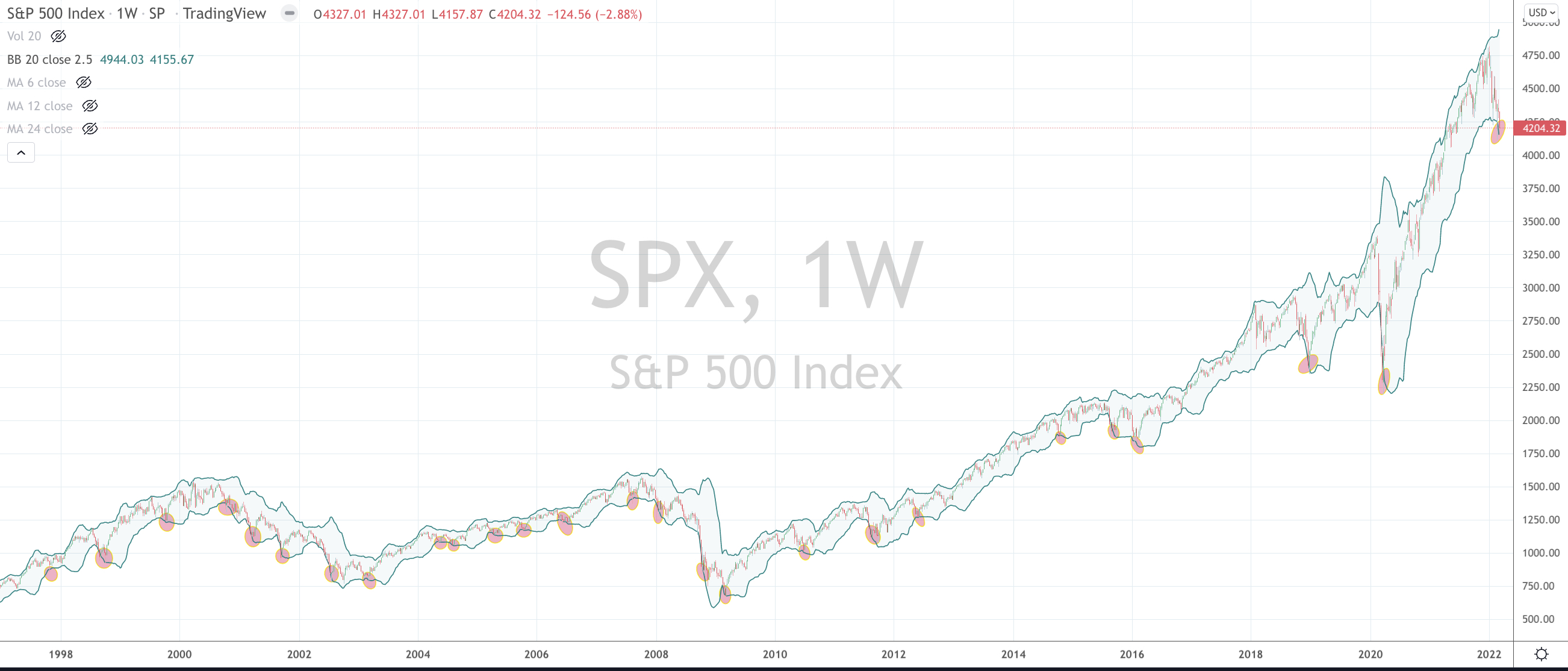
More so, as my indicators are marrying up to various ‘extremes’ including the percentage which the S&P 500 is trading above its 200 week moving average. This extreme hasn’t been seen for more than 20 years.
This is not a call for a crash. I don’t spend time on that type of stuff.
I’m raising more cash, protecting capital and putting on some hedges.
My message for fully invested, diversified ‘index huggers, is to at least consider that the ‘fat part of the trade’ may have been had.
or put it another, what risk are you taking to squeeze out an extra 10% of index return?
November 8, 2021
by Rob Zdravevski
rob@karriasset.com.au
November 7, 2021 Leave a comment
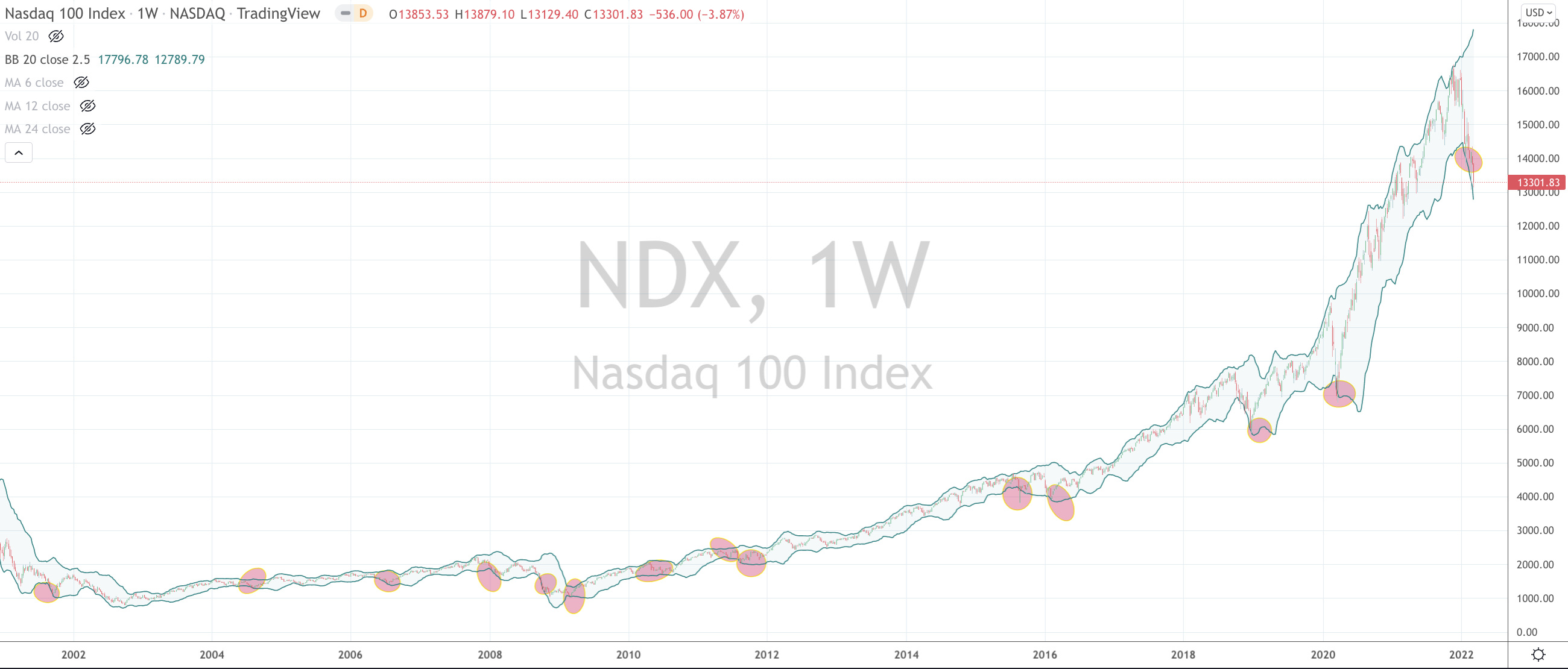
The following assets (on a weekly timeframe) registered an Overbought reading or traded more than 2.5 standard deviations above its rolling mean.
Extremes “above” the Mean (at least 2.5 standard deviations)
Australian 2, 5 & 10 year government bond yields
Spanish, Greek & Italian 10’s
Dow Jones Industrial Average
S&P Midcap 400 Index
Russell 2000 Small Cap Index
Nasdaq Transports
Overbought (RSI > 70)
WTI Crude Oil (the March 2022 contract)
Gasoil
the JKM “Japan/Korea (LNG) Marker”
Natural Gas
Australian coal
Urea
Cattle
Amsterdam’s AEX equity index
Dow Jones Transports index
And the USD/TRY (setting a new all-time low in a weakening Turkish Lira)
The Overbought Quinella – Both Overbought and Traded at > 2.5 standard deviations above the weekly mean)
France’s CAC-40 equity index
Dow Jones Transports
Italy’s MIB equity index
Nasdaq 100
Oslo Bors equity index
Philadelphia Semiconductor Index
S&P 500
And Instanbul’s BIST equity index
Assets (securities) which touched the other side of the extreme, being Oversold (where the RSI is < 30) or were at least 2.5 standard deviations below its mean are;
Extremes “below” the Mean (at least 2.5 standard deviations)
GBP/USD – suggesting a weaker British Pound
Rice
Oversold (RSI < 30)
Iron Ore
The Oversold Quinella – Both Overbought and Traded at > 2.5 standard deviations above the weekly mean.
None
Notes & Ideas:
The two notable asset class moves this week were dominated by the reversal in bond yields which saw them fall sharply (meaning the buying of bonds was quite aggressive) along with a host of +2% advances amongst various equity indices.
In fact, the decline in government yields isn’t a surprise. Past editions of ‘Extremes’ contained examples of where the Aussie 10’s moved from 1.77% to 1.95%. In this past week, they retraced the previous week’s move, to close back at 1.74%.
The yield in the Aussie 5’s fell from 1.46% to 1.27% .
It was actually uncanny that yields seemed to fall 20 basis points in many countries irrespective of their actual yield percentage.
However, countries who have recently raised rates where the interesting exceptions. New Zealand saw their 10’s only decline from 2.60% to 2.55%, Norway fell from 1.70% to 1.56% while Poland’s 10’s rose from 2.88% to 2.91%.
In last week’s edition, I highlighted the contrast in Greek 10 year bonds which were yielding 1.33%.
I find it interesting that this yield seems to imply a similar risk/return to the U.S 10’s yield of 1.45%. Does that make Italian, Spanish and Portuguese 10 year government bond yields more creditworthy than the United States? They yield 0.88%, 0.41% & 0.33% respectively.
And when compared to the aforementioned Norway, it’s equally difficult to reconcile their pricing.
Incidentally, the investors fancied Greek 10 year bonds, seeing its yield firm from 1.33% to 1.09% this week.
In other happenings, the Baltic Dry Index continues its mean reversion (the cost of bulk shipping) falling 23%, making for a 64% decline in 4 weeks.
Aluminium fell 5.4% giving it a 18% decline in the past 3 weeks and Chinese Coal prices have sunk 26% over the same time.
On the topic of mean reversion, many assets/securities/commodities continue their decline or meander lower, especially as some revert from euphoric media emphasising peaks.
Last week, I wrote that I was watching the AUD/USD test 0.7520. Alas, it didn’t break that level and we now see it at 0.7399.
The larger advancers over the past week comprised of JKM LNG 5.4%, Lumber 4.3%, Iron Ore 2.3%, Cattle 2%, Sugar 3.5%, Gold (in AUD) 3.6%, Gold (in USD) 2%, Rotterdam Coal 3.7%, Dutch TTF Gas 14.1%, Urea 6.6%, CAC 40 3.1%, DAX 2.3%, DJ Transports 5.9%, FTSE MIB 3.4%, Midcap 400 4%, Nikkei 2.5%, Oslo 3.3%, Helsinki 2.2%, Russell 2000 6.1%, SOX 8.9%, S&P 500 2%, Taiwan TAEIX 1.9%, Nasdaq Transports 2.4%, ASX 200 1.8% and Istanbul 5.7%.
The group of decliners included Aluminium (5.9%), Baltic Dry Index (23%), Cocoa (5.8%), WTI Crude (2.8%), Nickel (2%), Orange Juice (3.8%), Gasoline (2.1%), Corn (2.7%), Soybean (3.5%), China Coal (5.7%), Uranium (7.7%) and the Hang Seng Index fell 2%.
November 7, 2021
by Rob Zdravevski
rob@karriasset.com.au
November 5, 2021 Leave a comment
In a business of billions, it can be a game of pennies.
Last week, Brent Crude failed making a higher high’ (breaking its October 2018 peak) by 3 cents.
Last week’s peak also coincided with other overbought readings which I list in my weekend ‘Macro Extremes’ post.
Brent needs to hold $64.76 in order to not make a ‘lower low’ in a near timeline.
Brent’s 200 week moving average is $62. The gravitational pull of mean reversion should be honoured.
My bias is for lower oil (and other energy) prices, at least towards the $66 mark and we’ll assess the next move later.
November 5, 2021
by Rob Zdravevski
rob@karriasset.com.au
#brent
#oil
#crude

November 5, 2021 Leave a comment
Here is an example in the peril of placing ‘market orders’…..
especially at the open of the trading day or following a substantial announcement or event.
Overnight, Google announces a $1 billion equity investment in nonvoting convertible preferred CME Group stock.
As the 15 minute intraday chart below illustrates, CME closed the previous days trading at $220.
The news was announced after the close.
The next day, trading in CME common stock opens at $230, which is 4.5% higher from the previous days closing price…….to only see it steadily decline through the day and close at the same price as it did yesterday.
I’m quite sure there were many people who entered a ‘market order’ to find out they paid 4.5% more than yesterdays price without understanding that this could actually happen.
I hope the stock goes up (for their sake) and hope that it doesn’t fall further, but after all hope is not a strategy.
November 5, 2021
by Rob Zdravevski
rob@karriasset.com.au

November 5, 2021 Leave a comment
I’m always entertained by these stories.
https://www.bloomberg.com/news/articles/2021-11-03/opec-heads-for-geopolitical-showdown-as-biden-demands-more-oil?sref=qLOW1ygh
Firstly, the United States isn’t part of OPEC.
When you’re not a member of a member based organisation, how can you expect to have your requests (demands) actioned?
Secondly, the irony of Biden asking OPEC to pump more oil (so to ease U.S. domestic gasoline prices) while he is attending COP26 in Glasgow is comical.
Thirdly, he seems to be targeting blame at the Saudi’s for not increasing their output. There are other nations which make up OPEC and OPEC+.
Biden is proving to be a poor manager of geopolitical nuances.
But there any many more angles to this story;
Imagine if the U.S. was still a net exporter of oil?
A lower oil price may make their shale market uneconomical?
The U.S. can always lift sanctions on Iranian oil, allowing it to hit the market?
p.s. In my view, the decline in Crude was expected once OPEC said they won’t be increasing output. Why? Because, we will be closer to output being increased at the next meeting……Markets price in the probability of next move quickly.
#oil
November 5, 2021
by Rob Zdravevski
rob@karriasset.com.au
November 5, 2021 Leave a comment
Over the past 7 days, the Canadian, Australian and British central banks kept interest rates on hold.
The Bank of England’s decision to stand pat appears to be a surprise.
It’s not.
Central bankers in the countries listed above are at risk of losing control of the long end of the interest rate curve.
I’ll reiterate that these central banks are loathed to raise interest rates because it will affect their heavily indebted citizens (who are carrying too much personal debt) and are relying on soaring property prices to boost their wealth, which I’ve pointed out in the article links below.
Increasing interest rates puts all of that wealth creation at risk.
Their reasonings for keeping rates low will be to not stifle economic growth.
No central banker ever got in trouble for NOT putting up rates.
Inversely, New Zealand and Norway are raising rates to put a lid on extraordinary asset growth, while their citizens also rank amongst the most indebted.
The bankers in the rising rate camp are citing the need to keep a lid on runaway real estate prices and the cost of living.
November 5, 2021
by Rob Zdravevski
rob@karriasset.com.au