Waiting for cheaper Oracle price
March 17, 2025 Leave a comment
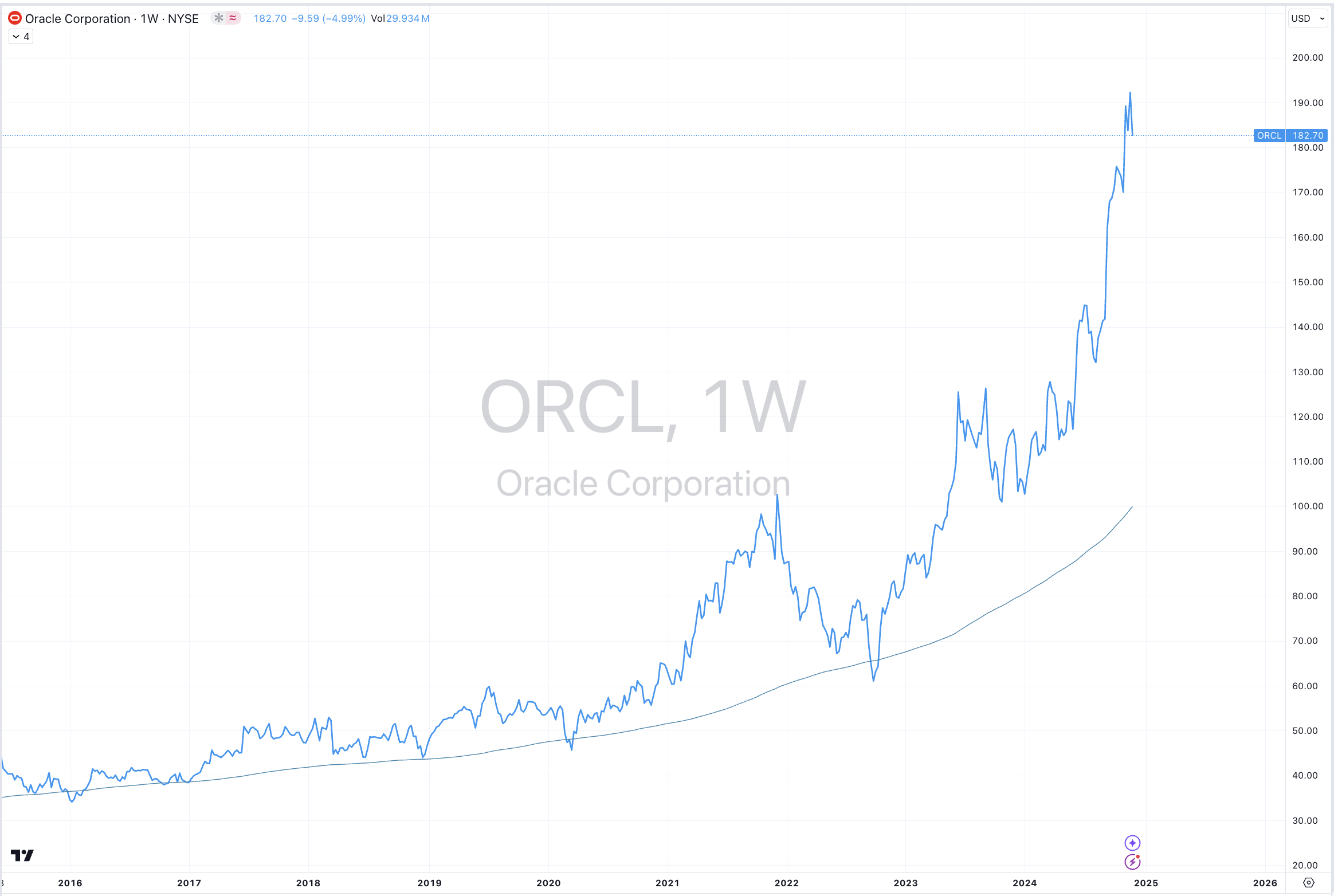
In late November 2024, I ‘implied’ lower travel for the price of Oracle (ORCL.US) stock.
I’ll wait for $108.50.
March 17, 2025
rob@karriasset.com.au

Trying to hear what's not being said
March 17, 2025 Leave a comment
In late November 2024, I ‘implied’ lower travel for the price of Oracle (ORCL.US) stock.
I’ll wait for $108.50.
March 17, 2025
rob@karriasset.com.au
November 28, 2024 Leave a comment
While Oracle Corp (ORCL:US) isn’t part of the Mag-7, it mimics a similar 10x EV/Sales multiple and is probably trading at a greater extreme.
A decline in its stock price to $128 or below would help in halving that EV/Sales figure.
November 28, 2024
rob@karriasset.com.au
September 15, 2022 Leave a comment
This week’s note highlighted USD currency headwind risk.
So, Oracle’s ‘currency headwind’ equated to nearly 15% of its quarter’s earnings.
No small change and it is a factual effect that the U.S. Dollar’s strength is having on American corporate earnings.
An extract from Oracle’s Q1 Fiscal 2023 earnings transcript is,
“The currency headwind this quarter was much higher than the 3% headwind that was present when we gave guidance. It was actually 6 points, even though due to rounding, it may look like 5%, and that’s a currency headwind to total revenue. It was, in fact, 6 points. And yet, we still exceeded our forecast on a reported basis, and we beat our constant currency revenue forecast by $200 million. We saw similar currency headwinds in EPS, which had an $0.08 negative effect, much worse than the $0.05 headwind present at the time of guidance in June.”
But with present USD strength being extended and stretched, in the spirit of positioning for ‘where the puck is going to be’, I’ll look for the contrarian effect to company earnings in the coming quarters.
In the meantime, well run Japanese companies should be ‘minting’ profits from their increasing competitive position of having a monumental weaker Yen.
September 15, 2022
by Rob Zdravevski
rob@karriasset.com.au
January 24, 2013 Leave a comment
Singularly, you may not have noticed various U.S. companies either re-finance existing debt or importantly issue new debt, over the past year or so.
Collectively, it is a monumental amount of debt.
Cleverly, these companies have taken advantage of the almost perpetual low yields of the government benchmarks, upon which they can base their spreads against.
Companies such as Oracle, Amazon & Goldman Sachs have issued bonds either secured or unsecured against their equity at historically low yields; which is brilliant financial strategy for these companies.
With interest rates at such low levels, probability and cycles suggest that rates will rise in the coming 6 years or so.
When 10 year benchmark rates are 6% and not 2%, I can’t see a 10 year 2.5% coupon Oracle Corp. bond being redeemed early, meaning bond holders will probably suffer capital losses unless held until maturity. Just imagine holding a bond that yields 2.5% into the latter half of this decade while others are earning twice or three times that amount?
Although, we are seeing a great bond issuance cycle, capital markets will most likely miss out on the next re-financing cycle.
What happens then?
Perhaps, companies will payout maturing debt by selling their own shares, which incidentally, they accumulated in share buy-backs conducted in 2012/2013 using the cheap money that they obtained from the same investors who bought their bonds?
 rob zdravevski's blog