Iron Ore, China, Australia and the U.S.

What if the U.S. requests (instructs) Australian companies to not sell Iron Ore to China anymore?

After all, it’s being done amongst the semiconductor industry.

Does Australia comply in line with its signed security pacts?

The price of 62% Iron Ore (as traded in Singapore) closed at $81.00.

I’ll look for $76.00 price early next week.

This latent weakness correlates well with the leading weakness seen in the AUD/USD.

And Iron Ore related equities are dancing in tune as well.

The risk (or opportunity) lies in the answer to the question posed at the beginning of this note.

October 28, 2022

by Rob Zdravevski

rob@karriasset.com.au

Mean reversions nearing the end

The big mean reversion back to the 200 week moving average has been underway.

While somewhat ‘smaller’ growth stocks did it much earlier and sharply, I have been highlighting the FAANNGM stocks as the ones to watch due to their hugh weighting and skew in the S&P 500 and Nasdaq indices.

The FAANNGM acronym accounts for the companies Facebook, Amazon, Apple, Netflix, Nvidia, Google and Microsoft.

I also included Tesla in some of my commentary due to its $1.4 trillion market capitalisation also adding to this concentration at the top.

This week, Google (Alphabet) traded back down to its 200 week moving average.

Microsoft is nearly there.

Amazon and Nvidia did it several weeks ago.

Netflix and Facebook (Meta) plunged through that level many months ago.

But Apple and Tesla haven’t done so.

While there isn’t a rule that suggests they need to fall all the way to their mean but the stretched levels which they were trading at told me to either sell or not chase them higher…..because gravity does exist.

Incidentally, the Nasdaq 100, the Philadelphia Semiconductor and S&P 500 indices also reverted back to its 200 week moving average  (WMA) over the past month, as have the Small-Cap, Mid-Caps, Banking, Transportation indices. 

We have seen all the ‘rubbish’ or over priced and zealous technology stocks tank first, followed by many other sectors including the industrials, then notable indices caught up with the decline and the last to follow are the originally identified culprits, being the FAANNGM stocks.

Pundits are all waiting for some indication of a market capitulation.

Could that occur when Apple and Tesla reach their 200 week moving average?

That may only matter if you are owning or trading Apple or Tesla.

Many indices are at higher prices today than when they touched their 200 WMA back in June or September 2022.

This story had a lead up which I began writing about in 2021.  

3 days before the S&P 500 peak, I wrote this note which highlighted the extreme percentages that the indices and in particular the FAANNGM stocks were trading at.

https://mailchi.mp/karriasset/a-distorted-sp-500-amongst-extreme-peaks

In the next newsletter, I illustrated the damage already being done (at that time) amongst the lesser technology starlets and warned of that spreading to the bigger boys. 

This article from January 2022 discussed how recently stratospheric FAANNGM stocks where looking weak and about to break below important support lines.

https://mailchi.mp/karriasset/there-is-gravity-in-the-stratosphere

This article written days later in February 2022, reiterates the story about the 200 week moving average being something to watch in the pending reversion to the mean.

Now that these mean reversions have occurred or are close to doing so, it doesn’t automatically render them a Buy suggestion.

There is more analysis to be done and basis required for such a recommendation

Clients will soon receive commentary with my views about what to consider next. 

October 28, 2022

by Rob Zdravevski

rob@karriasset.com.au

Trimming public company fat

Why is Elon Musk saying that he may/will cut 5,600 of Twitter’s 7,500 (75%) workforce?

It is simple. Save costs because the company is too ‘fat’.

Because in the absence of a major shareholder or founding executive, public companies are often run with some largesse in attempts to increase productivity or roll out products so to increase revenue, in order to satisfy stock analysts and shareholders.

Musk is gonna trim some fat.

When companies are private, they are run leaner.

There are some conundrums though.

I don’t know why Meta (Facebook) has 72,000 employees nor why Spotify and Airbnb each have 6,000.

The former is cutting 15,000 jobs soon. Airbnb cut 25% or 1,900 employees in May 2020.

All three have majority or a founder as CEO, yet they have more employees than what I think is logical.

I bet if they were private companies, they would have a lot less headcount.

October 28, 2022

by Rob Zdravevski

rob@karriasset.com.au

Ship out the Cattle herd

It’s time to lock in the selling price for your cows.

In other words, for sellers of Cattle, prices are now in the territory of being ‘good enough’.

In fact, beef farmers are looking at Cattle prices trading at ‘extremes’ not seen for a while.

The ‘circles’ in the ‘weekly based” chart below show prices coinciding at certain percentages above Cattle’s 200 week moving average, 2.5 standard deviations above a rolling weekly mean and registering a weekly Overbought RSI reading.

It’s advisable to ‘take the fat part of the trade’.

For Aussie, Canadian and Brazilian beef farmers who are receiving proceeds in USD, you’re in a particular purple patch whilst your currencies are trading at reasonable weakness.

Albeit, currency conversion is a seperate trade.

Specifically, for the AUD/USD, I think there is a good probability of seeing the AUD/USD trade below 63 cents again, in the near term.

October 27, 2022

by Rob Zdravevski

rob@karriasset.com.au

The energy dominos are falling one by one

Now that RBOB Gasoline, Natural Gas, Dutch TTF Gas and the JKM LNG Marker prices have halved, I think other commodities in the energy complex are at a critical juncture.

While I remain cautious and specifically bearish on crude oil prices (I expect WTI Crude to move towards $65-$68 from its current $84.50), the larger declines could be seen in Heating Oil and Diesel (Gasoil).

They are currently trading at $3.95 and $10.82 respectively.

Both Heating Oil and Gasoil remain in downtrends across various timeframes and now I am watching a few more indicators to confirm strength and the next leg downwards.

If so, there could be 40% further downside in Heating Oil and Gasoil.

This view all seems quite perverse as the Northern Hemisphere winter approaches.

p.s. the largest use of diesel is in transportation, not electricity generators

I’ll write when/if the probability of this increases.

October 25, 2022
by Rob Zdravevski
rob@karriasset.com.au

Uranium price pondering’s

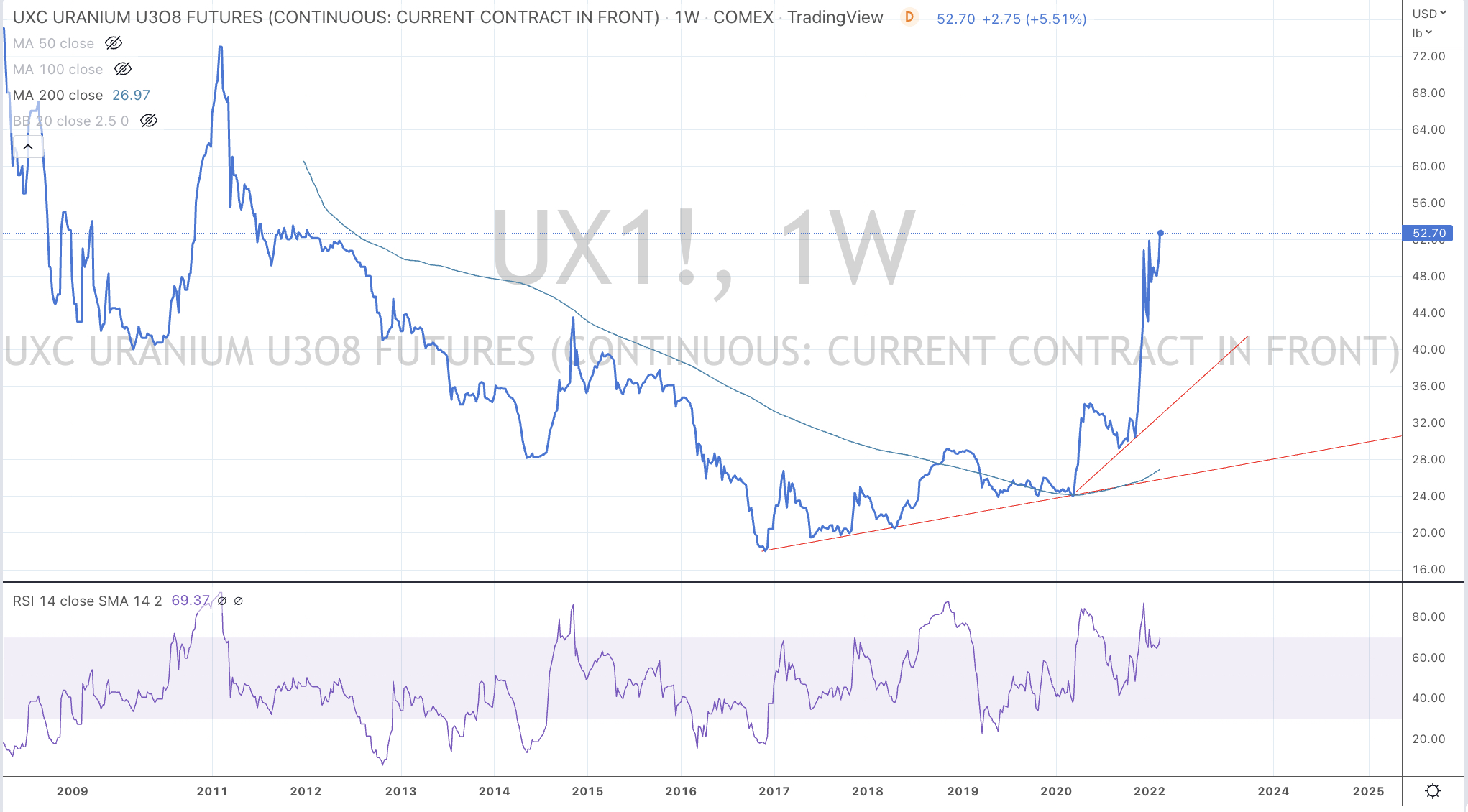
I think that the price of Uranium is currently in a blow-off top.

From today’s price of $52.70, it reaching $61-$64 is plausible.

However, assigning probability to an additional surge is difficult.

In other words, I’m not considering initiating a new long trade in Uranium futures.

It’s current price which is parabolic in shape, is also stratospheric by many measures.

It is Overbought on a weekly basis and on a monthly timeframe. The latter seldom occurs.

Furthermore, Uranium is trading at a stretched percentage (95%) above its 200 week moving average.

Commodity prices start entering rarified air whenever they venture 40% above this measure.

My trend analysis confirms Uranium’s bullish direction and it is garnering some strength. 

This suggests that momentum will send prices higher before it peaks.

To be clear, current ‘longs’ in uranium will get to have a little more of their (yellow) cake, but it is a riskier proposition for those thinking about initiating new positions at $53.

I think the price of uranium is prone for some mean reversion back to the $34 – $38 mark, perhaps occurring into January 2023.

October 24, 2022

by Rob Zdravevski

rob@karriasset.com.au  

Beat the Phillies

Let’s hope that that Philadelphia Phillies don’t win the World Series. 

The global economy cannot afford it.

This from Morning Brew sums it up…..

“Are we about to enter an economic crisis? Could be. But don’t look at unemployment, interest rate hikes, or the housing market for clues. A better indicator is whether the Philadelphia Phillies win the World Series.

As the baseball historians on the Brew’s social media team found, over the past 100 years the surest sign of an economic downturn has been a Philly-based baseball team winning the World Series. It happened in 1929, 1930, 1980, and 2008.”

source: Morning Brew October 5, 2022

I’m not being mean spirited.

I do have a soft spot for the Phillies. I grew up watching Mike Schmidt playing 3rd base.

However, last night the Phillies beat the Yankees for a berth in the World Series where they will meet the Houston Astros.

For the sake of the economy, 

Go Astros !

My current picture of the price of Copper.

Resistance lines are being flirted with.

I expect the new yet weak short term rising daily trend to exhaust itself between $3.56 – $3.61 level.

This should see the S&P 500 and AUD/USD mimic this directional short-term move.

I’m watching out for a ‘bull trap’.

The downward medium term trend in Copper remains intact.

I would need to see Copper trade above $3.79 for that bearish medium term trend to wane.

October 24, 2022

by Rob Zdravevski

rob@karriasset.com.au

Macro Extremes (week ending October 21, 2022)

The following assets (on a weekly timeframe) registered an Overbought or Oversold reading and/or have traded more than 2.5 standard deviations above or below its rolling mean.

Extremes “above” the Mean (at least 2.5 standard deviations)

Orange Juice

GBP/AUD

Overbought (RSI > 70)

Cattle

U.S. 2, 5 and 10 year government bond yields

German 2, 5 & 10 year government bond yields

British 5 year government bond yields

Australian, Spanish, French, British, Greek, Italian, Portuguese and Swedish 10 year government bond yields

The Overbought Quinella – Both Overbought and Traded at > 2.5 standard deviations above the weekly mean)

TBT & TBX

U.S. 20 and 20 year government bond yields

Canadian, Korean and New Zealand 10 year government bond yields

Extremes “below” the Mean (at least 2.5 standard deviations)

AUD/CAD

SGD/AUD

AUD/INR

Straits Times Index

Coffee

Oversold (RSI < 30)

Tin

Hot Rolled Coil Steel (HRC)

Cotton

TLT

IEF & IEI

CSI 300 Index

Hang Seng Index

KRW/USD

The Oversold Quinella – Both Overbought and Traded at > 2.5 standard deviations above the weekly mean)

INR/USD

JPY/USD

IDR/USD

Notes & Ideas:

The news for the week was the benign week for most commodities, the bouncing reverberation for equities and many currencies trading in and away from their recent weeks of extremes.

Other notable changes from last week’s list is that some equity indices moved away from their extremes such as the Shanghai Composite and the TAIEX and we saw some bond yields entering a quinella of overbought extremes.

Whilst we mainly saw a robust bounce amongst the larger U.S. equity indices, the KBW Banking Index and DJ Transports didn’t mimic the moves of their bigger siblings, advancing ‘only’ 0.7% and 1.5% for the week respectively.

In other capital market observations, the Hang Seng has fallen 27% since its rebound rally high on July 4th, 2022. The HSCEI Index has tanked 44% over the same time.

Inversely, from that same day, Brazil’s Bovespa has risen 24%. Interestingly, as Brazil’s central banks had one of the first and most aggressive rate hiking policy.

I’m watching for a change in trend in the price of Copper. Not yet confirmed though.

Gas prices continue to plummet, Coffee has fallen 13% in the past 2 weeks and Diesel (Gasoil) has tanked 17% over the same time.

Brazilian and Swiss 10 year bond yields look like peaking and rolling lower.

Many currencies strengthened against the USD (including the Aussie) and the DXY isn’t overbought this week. Incidentally, something to watch is the DXY had a bearish outside reversal week.

The Indian Rupee (INR) fell an alarming 4.6% on the week sending the currency to its weakest levels in my data. The INR has declined 11% this calendar year.

The Yen also fell to its lowest price (against the USD) on record.

Interestingly, India’s Sensex equity index is up 1.8% for this calendar year compared to the S&P 500 which is 21% that its price on January 1st, 2022 while the DXY has soared 17%.

And lastly, the US 5 year bond yield minus 5 year inflation breakeven rate remains Overbought as does its 10 year peer. These usually signal a peaking process in the Crude Oil price, which relates to other ramifications and correlations.

The larger advancers over the past week comprised of;

Australian Coking Coal 2.4%, Lean Hogs 8.4%, Lumber 8.9%, Cattle 2.4%, Platinum 4.4%, Brent Crude 2%, Uranium 5.5%, Silver in AUD 3.1%, Silver in USD 6.1%, CAC 1.7%, DAX 2.4%, Dow Jones Industrials 4.9%, DJ Transports 1.5%, MIB 3%, IBEX 2.2%, Bovespa 7%, S&P MidCap 400 3%, Nasdaq 100 5.8%, Sensex 2.4%, Stockholm 1.7%, Russell 2000 3.6%, SOX 8.1% (for context, it fell 8.3% last week), S&P 500 4.7% (same closing price as a month ago), FTSE 1.6%, Istanbul 8.9%, TSX 2.9%, S&P SmallCap 600 3.3% and Nasdaq Composite 5.2%.

The group of decliners included;

Aluminium (4.9%), Bloomberg Commodity Index (2.1%), Cocoa (3%), China Coal (2.3%), Gasoil (3.3%), Heating Oil (3.7%), Coffee (3%), Tin (2.9%), Natural Gas (23.2%), Nickel (2%), Sugar (2.4%), Dutch TTG Gas (20%), Florida Gulf Urea (4%), Gold in AUD (2%), Oats (5.4%), CSI 300 (2.6%), Hang Seng (2%), STI (2.3%), TAIEX (2.4%) and Australia’s ASX 200 fell 1.2%

October 23, 2022

By Rob Zdravevski

rob@karriasset.com.au   

Australia is not in recession

My latest newsletter (link below) talks about yield curves in Australia and the United States and how an Oversold yield curve (that’s not the same as inverted) are reasonable signals to buy equities.

https://mailchi.mp/karriasset/australia-is-not-in-recession-7374377