Chinese equities remain a contrarian idea

Readers of my weekly editions of “Macro Extremes” will remember my commentary about unloved Chinese equities when they were wallowing in oversold territory.

Then we had a plethora of “American” analysts and portfolio managers telling us that China 🇨🇳 is ‘uninvestible’.

On Bloomberg Radio today, a pundit expressed disappointment in the Chinese governments lack of interest (unlike American authorities) to intervene in the affairs of indebted property developers who may risk destabilising the economy.

Let me get this straight….the capitalist is advocating socialism?

p.s. over the past 3 weeks, the Hang Seng China Enterprises Index (HSCEI) has risen 10% while Alibaba has climbed 28%.

October 27, 2021
by Rob Zdravevski
rob@karriasset.com.au

Charts with lines on them

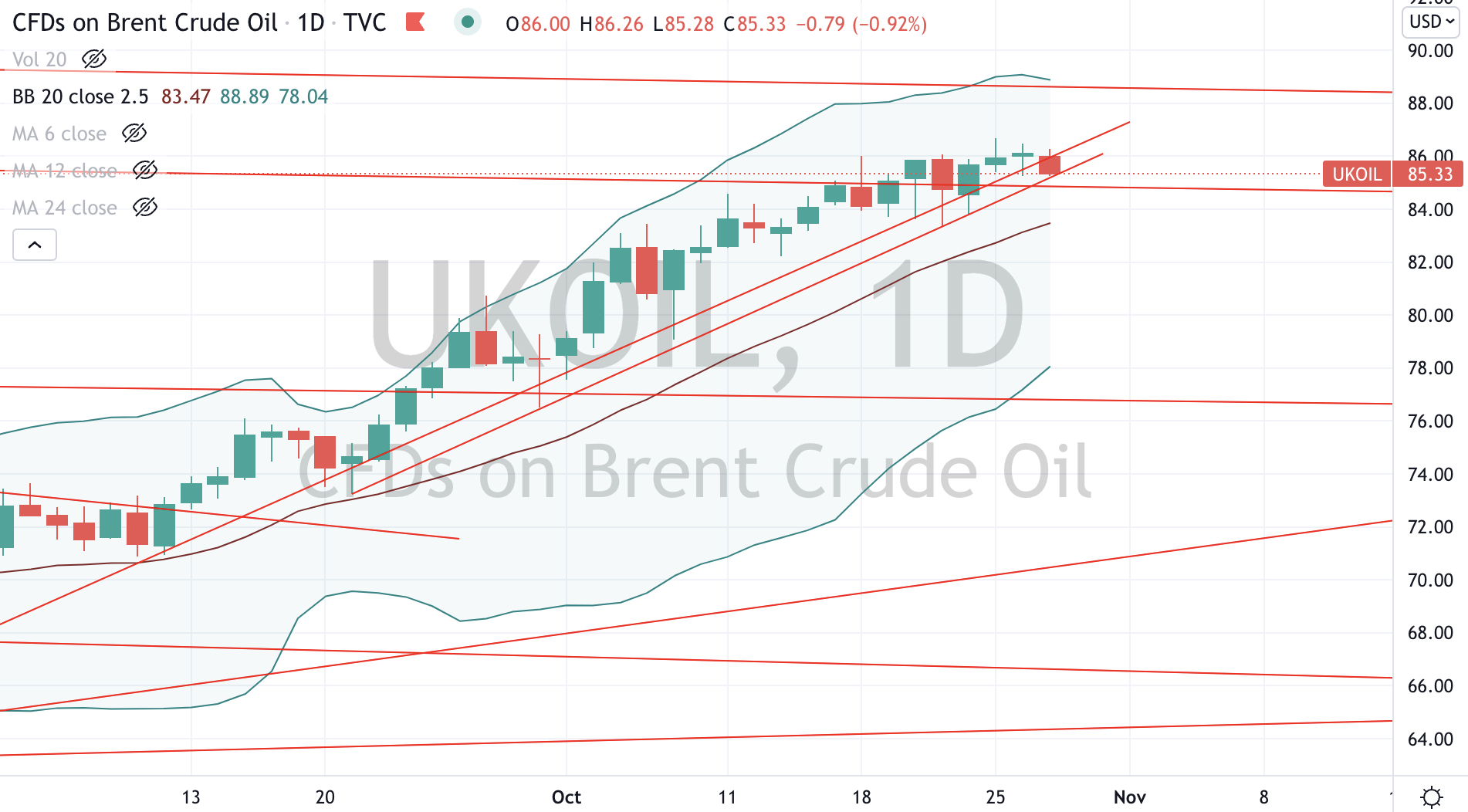
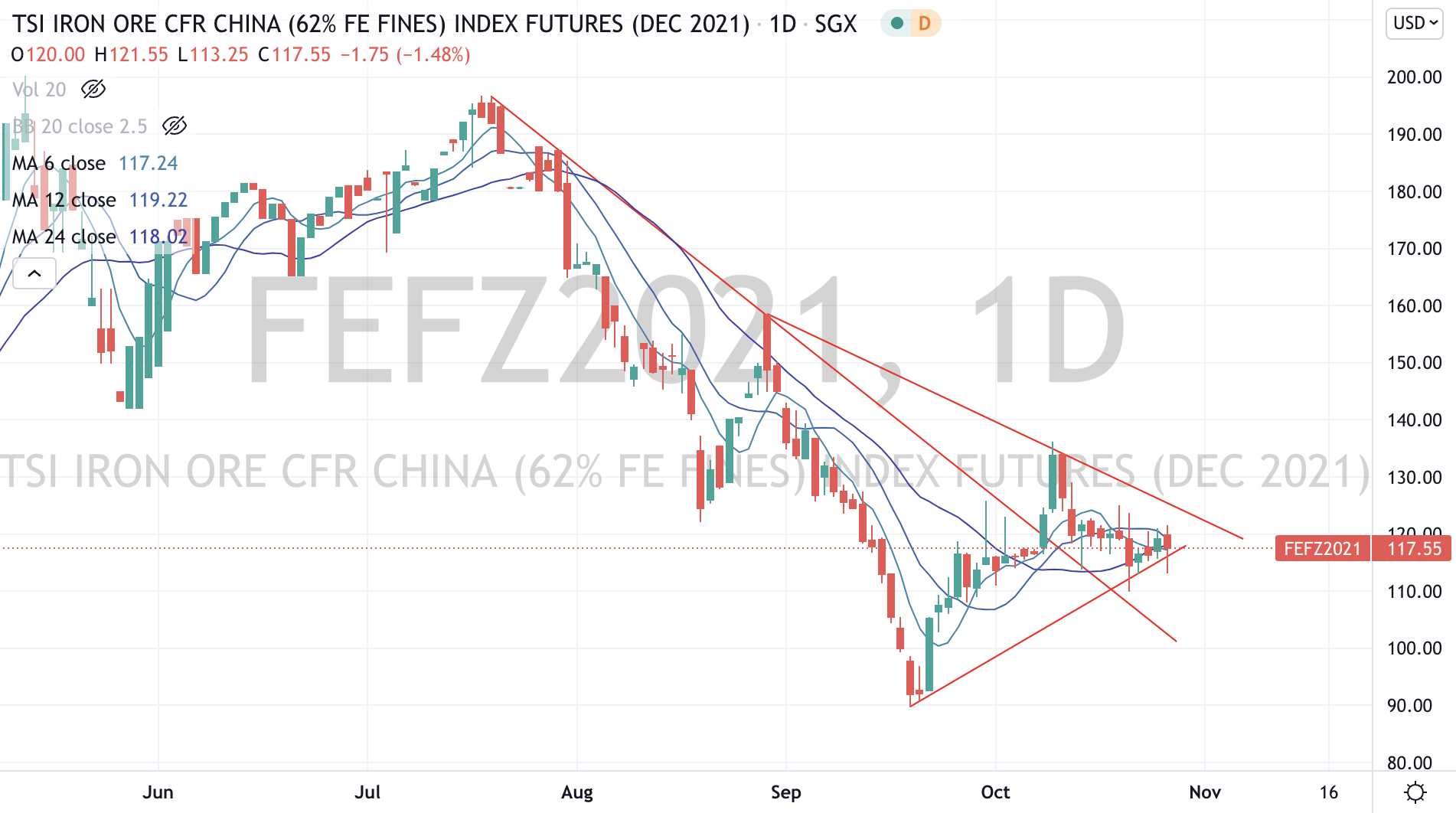
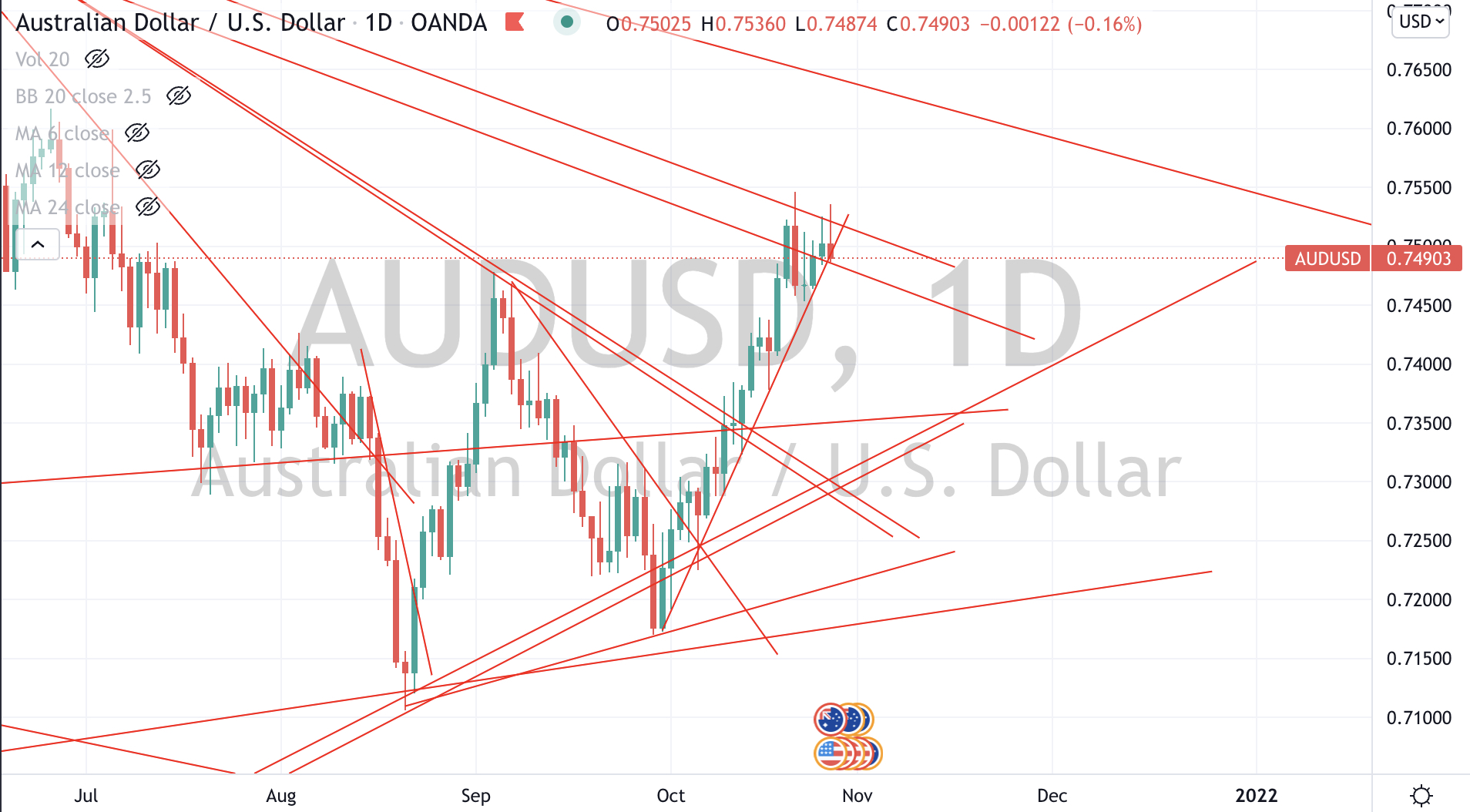
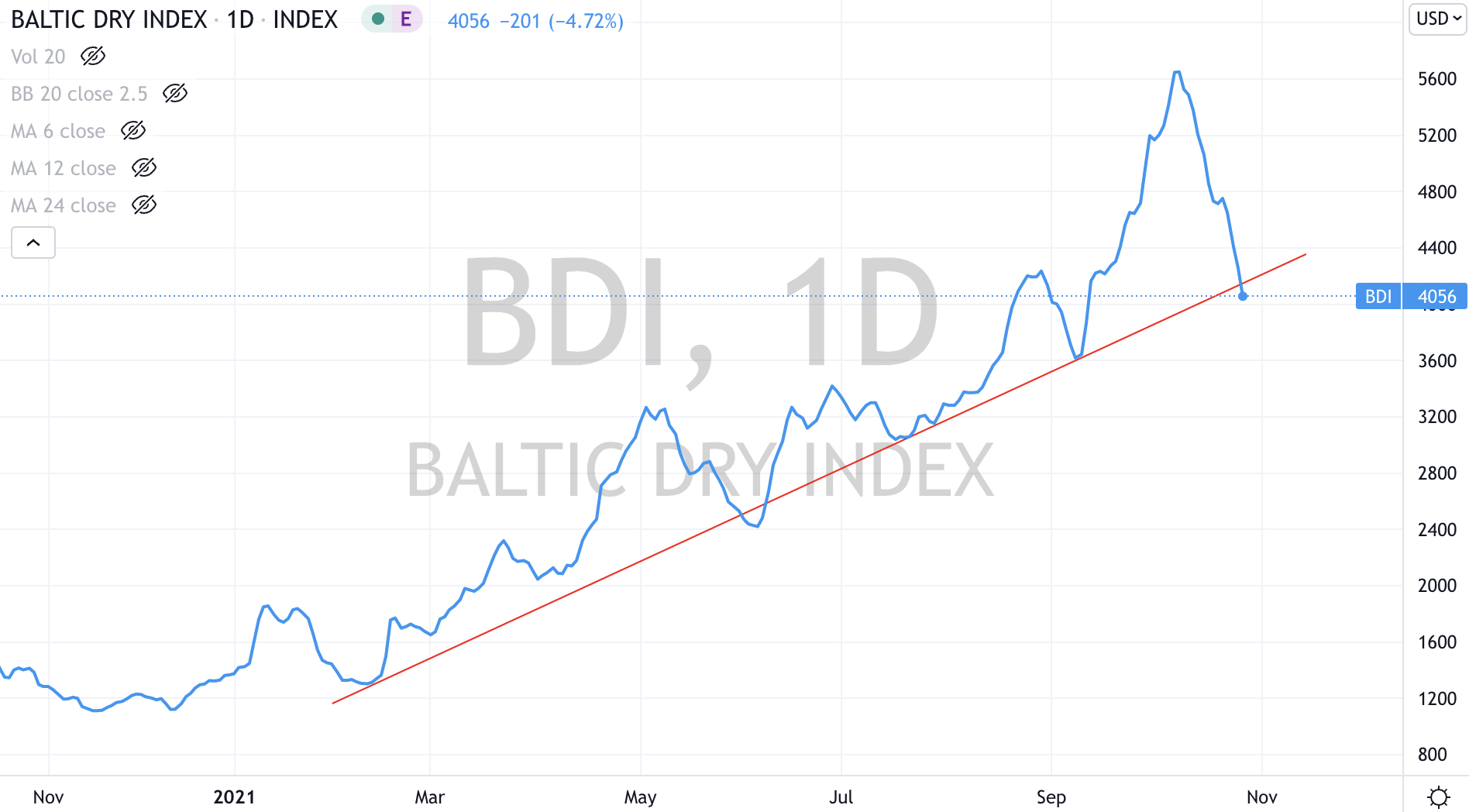
Referencing my previous post, here are price charts of the Baltic Dry Index, Iron Ore, Brent Crude and the AUDUSD.

October 27, 2021

by Rob Zdravevski

rob@karriasset.com.au

Watching Wednesday & Thursday trading

Certain price activity this afternoon is becoming interesting, at least to me.

The bias is for lower prices and in some cases a re-test of recent lows, although probability of lower lows is increasing.

Brent and WTI Crude is pennies from breaking below a support line I’m watching. Gasoline prices are currently being smacked and Hot Rolled Coil Steel was slapped overnight.

Inversely, the AUDUSD is having a 2nd and 3rd attempt of butting its head up against a 0.7520 resistance, though it may be losing steam.

Iron Ore had a bearish reversal day, other Iron Ore related stocks had terrible price action (and are poised at important levels), Coal prices look dubious and the U.S. 10 year bond yields look like moving below its current 1.61%….to mention several.

You may want to sell your Bitcoin.

If a bunch of prices hold, it could be a ‘buy on the dip’, however I shan’t be heroic at this stage. I’ll need to wait and trust my signals.

One of my favourite risk on/off indicators (AUDJPY) needs to stay above 85.12 to foil this ‘lower prices’ call and Copper needs to stay above US$4.38.

Let’s see what we wake up to on Thursday morning.

And the work is (will be) to position for what the effects will be and the opportunities to be ready for.

My next couple posts will have some price charts and a bunch of lines strewn across them.

October 27, 2021

by Rob Zdravevski

rob@karriasset.com.au

Late comers to coal are long & wrong

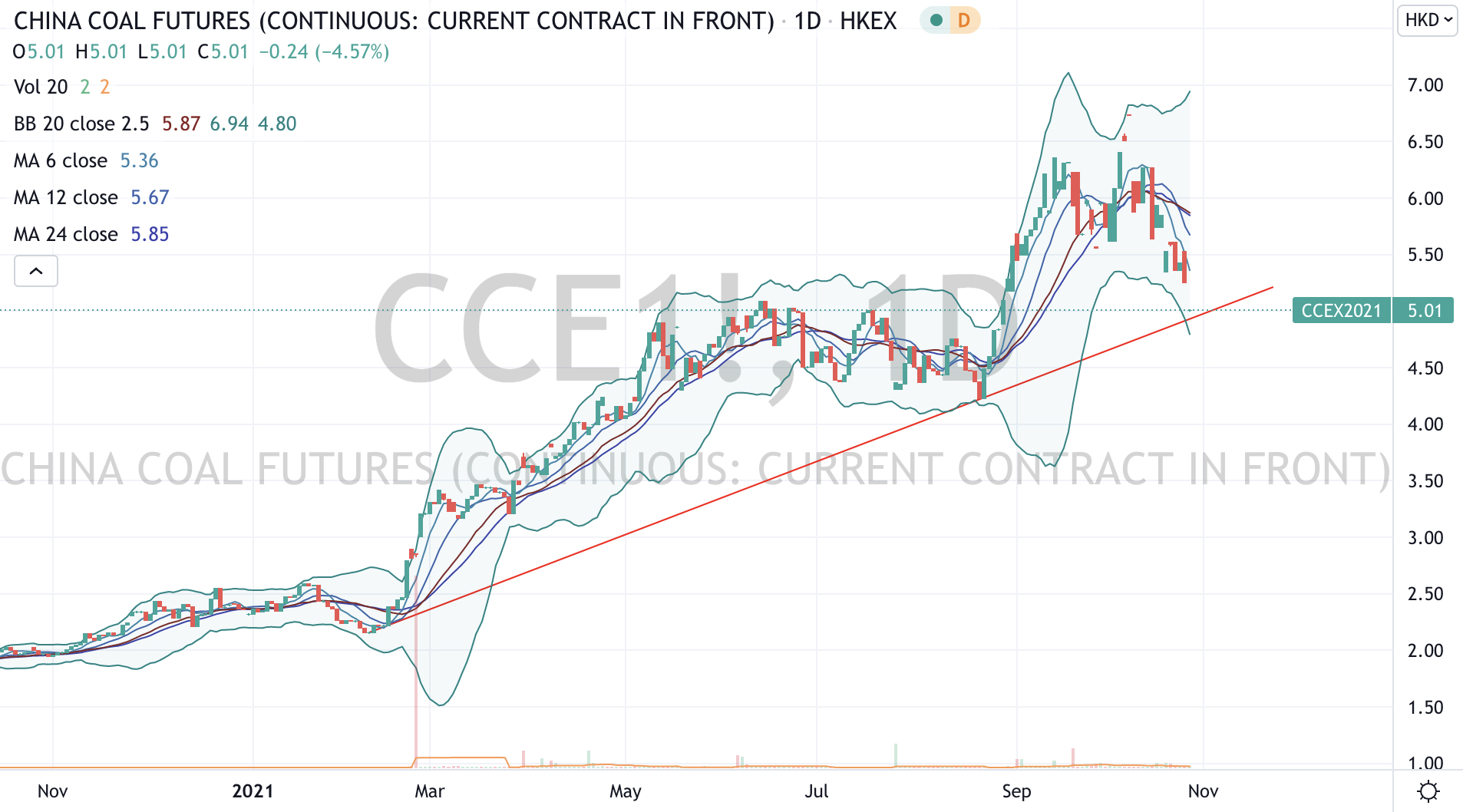
With all the recent hubbub about rising coal prices……behold Chinese Coal futures have declined 25% over the past 3 weeks.

This is another example of whilst news of rising prices is spreading within mainstream media, you’ll often find those very prices peaking around that moment.

A break below HK$4.90 will see this daily downtrend accelerate.

I see it testing HK$4.20.

One shouldn’t have been going long in the recent surge and I wouldn’t be long today.

October 27, 2021

by Rob Zdravevski

rob@karriasset.com.au

Steel yourself

4 days ago, I wrote some stuff about China, export tariffs and steel prices.

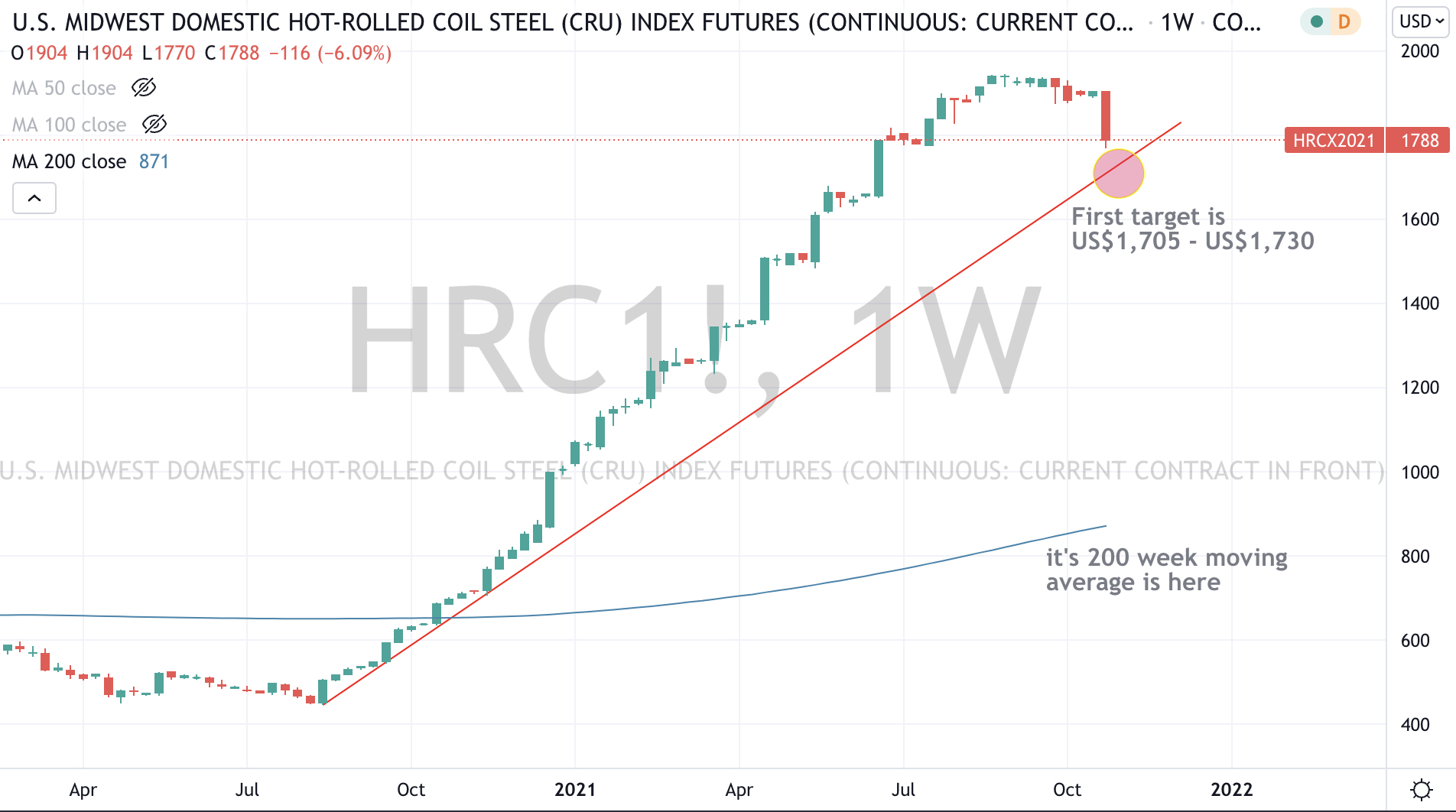
The price of U.S. Midwest Hot-Rolled Coil Steel (HRC) fell 6% last night.

Any decline in HRC prices shouldn’t be a surprise. As it featured near the top of my list in a recent post titled, “It’s a sellers market“, where HRC was trading at 119% above its 200 week moving average. Very stretched indeed.

The chart below shows you an immediate trendline that it should test. From there I’ll watch other factors to determine a change in trend and its strength along with other support and target levels.

Falling steel U.S. steel prices tells me that capacity is increasing slightly and demand may be softening. As prices fall and find some equilibrium, it should lower the input costs for the construction industry but don’t automatically assume it’ll improve their margins though, as labour costs won’t sympathetically decline.

Incidentally, stock prices of U.S. steel companies have performed very well lately.

October 27, 2021

by Rob Zdravevski

rob@karriasset.com.au

Don’t be the lone ranger

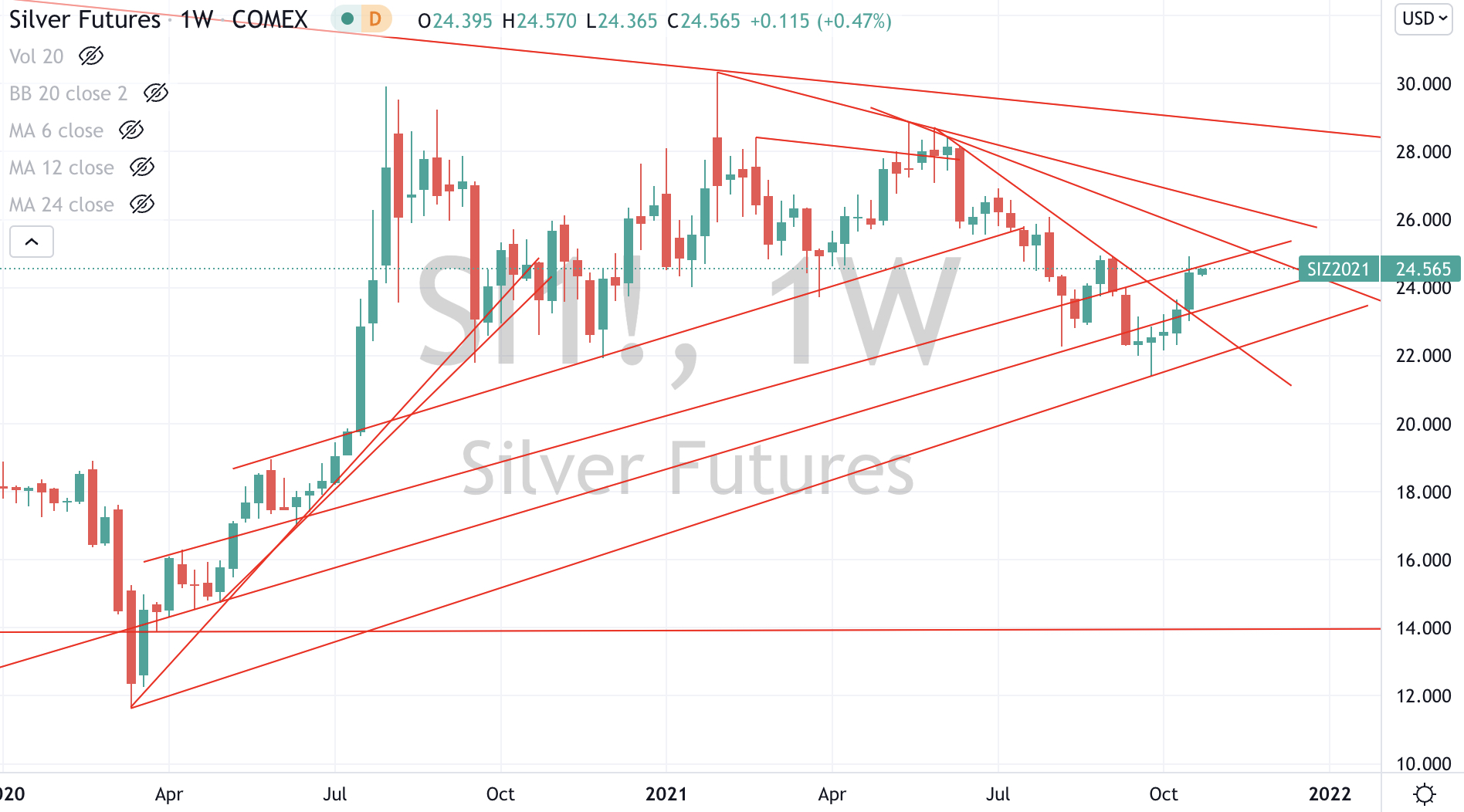
Here are my current squiggles about Silver, as I watch whether it breaks higher.

The call is for higher prices but I need it to close above $25.07 to solidify the bullish trend from a daily to a weekly basis.

New, long money should watch this resistance and it’s prudent to wait for the break.

October 25, 2021

by Rob Zdravevski

rob@karriasset.com.au

Macro Extremes (week ending October 22, 2021)

The following assets (on a weekly timeframe) registered an Overbought reading or traded more than 2.5 standard deviations above its rolling mean.

Extremes “above” the Mean (at least 2.5 standard deviations)

Australian 2 and 10 bond yeilds

Canadian 10 year bond yields

U.S. 10’s

Nickel

AUD/JPY

NZD/USD (the Kiwi is powering higher)

KBW U.S. Banking Index

DJ Transports Index

And Bitcoin


Overbought (RSI > 70)

U.K. 10 year government bond yields (Gilts)

South Korean 10’s

Bloomberg and CRB commodity indices

Hot Rolled Coil Steel (for the 56th consecutive week)

the JKM “Japan/Korea (LNG) Marker”

Natural Gas

Gasoline 

Brent & WTI Crude Oil

Australian coal

Coal, Rotterdam delivery

Dutch TTG Natural Gas

Russia’s MOEX equity index

Amsterdam’s AEX equity index

and India’s Sensex & NIFTY 50 equity indices


The Overbought Quinella – Both Overbought and Traded at > 2.5 standard deviations above the weekly mean)

Australian 5 year government bond yields

German 5 year bond yields

U.S. 2 year and 5 year govn’t bond yields 

New Zealand 10 year bond yields 

Turkish 10’s

Gasoil

Heating Oil

Oslo OBX 25 equity index

USD/JPY (suggesting a strong USD and weak Yen)

It’s the weakest since early 2019, so sell USD and Buy JPY and use it to buy cheap Japanese equities.

USD/TRY (obviously we expect a weak Turkish Lira)


Assets (securities) which touched the other side of the extreme, being Oversold (where the RSI is < 30) or were at least 2.5 standard deviations below its mean are;

Extremes “below” the Mean (at least 2.5 standard deviations)

Brazil’s BOVESPA equity index

USD/CNH – suggesting a strong Chinese Yuan

EUR/AUD – telling us the Euro is weaker and we have a strong Australian Dollar, so sell your AUD and Buy EUR (there are some bargains amongst European equities) 


Oversold (RSI < 30)

Iron Ore


The Oversold Quinella – Both Overbought and Traded at > 2.5 standard deviations above the weekly mean.

None


Notes & Ideas:

A more muted week of price movements registering+/- of 2% than previous editions.

We mainly saw decliners in energy and base metals while advancers were seen in agricultural commodities and selected equity indices. 

Remember how unloved the Chinese equity market was only a month ago?

Other highlights were the continued decline in the Baltic Dry Index and LNG prices along with a smashing of Brazil’s BOVESPA equity index.

Rising government bond yields also continue to rise and seem stretched at this moment and the AUD/USD traded up to 0.7510 as mentioned in last week’s post.

The larger advancers over the past week comprised of; 

Orange Juice 4%, Silver 4.7%, Corn 2.3%, Wheat 3%, Uranium 4%, KBW Banking Index 4.1%, Dow Jones Transports Index 3.8%, HSCEI 4.3%, Hang Seng Index 3.1%, Copenhagen equity index 3.6% (both Maersk and Vestas rose 9%) and BIST Istanbul 3.7% (in light of a 2% central bank rate cut)

The group of decliners included Aluminium (8.3%), Lean Hogs (6.3%), Gasoil (2%), Baltic Dry Index (9.1%), Copper (4.9%), LKM LNG (2.9%), Coffee (2%)_, LNG (6.7%), Natural Gas (2.4%), Sugar (3.6%), China Coal (5%), Rotterdam Coal (3.7%)m, Dutch TTF Gas (6.7%), BOVESPA (7.3%).

Please refer to last weeks edition for key levels which I continue to watch.

October 24, 2021

by Rob Zdravevski

rob@karriasset.com.au  
China’s climate policy in disguise

I heard of import tariffs but not export tariffs

Is exporting inflation, China’s new ‘weapon’?

Maybe this is part of China’s net zero emission plan?


Would you like to know why HRC (hot rolled coil steel) prices have quadrupled in the past year?


The world’s largest steel producing nation has been imposing and increasing tariffs on its own steel exports.

I’ll repeat, Chinese companies are required to pay a tariff in order to export their product.

High purity Pig Iron exports attract a 20% tariff while Ferrochrome stands at 40%.
Furthermore, China has removed export tax rebates for 23 steel products including flat and rolled steel)

This is quite incredible. 

It is quite normal for nations to impose a tariff on goods being imported onto their shores and limit ‘product dumping’ but to ‘discourage’ your own corporations from global competition and profits is an extraordinary tactic.

In 2020, total world crude steel production was 1877.5 million tonnes (Mt). The biggest steel producing country is currently China, which accounted for 57% of world steel production in 2020.

The next 6 countries (regions) account for a combined 28.4%. 

They are:
#1 EU  7.4%
#2 India  5.3%
#3  Japan  4.4%
#4 U.S. 3.9%
#5 Russia  3.8%
#6  South Korea  3.6%
.
.
.
.
#29 Australia 0.3%

Australia’s annual steel production is 5.5Mt, ranking behind the production of Bangladesh, Austria, Malaysia and Belgium.

One-third of Australia’s steel needs (nearly 2Mt) are imported, with most it coming from China. The rest is supplied by local manufacturers such as Bluescope Steel.

So, the news becomes even more alarming when the amount of steel imported from China has fallen by 50% in the past several months.

Can you see how half of 2Mt is a pittance of China’s 1,065Mt worth of annual production yet it has a pronounced effect on Australian business.

But what is China export tariff strategy telling us?

Firstly, China is ‘ring-fencing’ some its industrial production perhaps its seen as a form of ’nationalism’ but more so, I see it as securing or better yet, retaining its supply for its own consumption.

This could also be a measure of protectionism, but this is not new because western economies already do it themselves.

When you have a powerful (and enviable) position such global ‘market share’, you can withhold supply, causing localised prices to rise, thus hurting industry and consumers in far away locales.

Whilst imposing tariffs of steel exports will accentuate output gaps in all those other nations and higher prices may remain, by sacrificing some capitalist profits, this may be one aspect how China will reduce its carbon emissions…….

Have a think about that notion?

In addition, after decades of the global juxtaposition of China exporting deflation (and many enjoying lower prices), China may be now “exporting” inflation. 

It may be the definition of being ‘careful what you wish for’.

With its own currency testing multi-year highs (helping put a lid on its own inflation rate), could China’s new export to the world actually become Stagflation?


Don’t forget to subscribe to my blog to receive other notes, the moment they are published or equally feel free to email with a question or comment.


Until next time,

Warm Regards,
Rob Zdravevski
rob@karriasset.com.au

What came next was absurdly obvious

It was the most unorthodox of monetary policy yet one that you couldn’t place the bet on.

Turkey’s Erdogan fires a bunch of central bank governors because they expressed reluctance towards lowering interest rates.

Lo and behold, a week later, Turkey’s 🇹🇷 central bank cuts rates by 200 basis points. Not 50 or a 100, but 200.

The reaction: Turkish 10 year bonds are unchanged at 19% and Turkish bank stocks little affected.

October 22, 2021
by Rob Zdravevski

rob@karriasset.com.au
It’s a sellers market.

It’s important to know when not to pile in and not follow the crowd.

Locking in high prices is my first thought. The other side of this is to figure out who and what is affected when prices materially revert towards their mean and what scenarios and opportunities arise.

The list below shows the percentage that selected commodities and equity indices are trading above their 200 week moving average.

n.b. 200 weeks is taking a measure over a reasonably long term.

When mainstream media and the broader crowd suddenly becomes an expert in European gas prices and the cost of shipping containers across the world, it is prudent to incorporate probability and mathematics into your decision making.

I don’t spend time trying to call a crash or corrections but rather identify not being the marginal buyer and to observe where the pendulum’s arc is…….and not get caught when it swings the other way.

This is an exercise of watching the exuberance of the crowd as they try to squeeze out the last of the gains, well after the ‘fat part of the trade’ has been seen.

In other words, I’d prefer to ‘buy straw hats in winter’ or perhaps ‘buy natural gas in summer’.

Incidentally, a reading of > 15% can start to signal that prices are starting to become ‘stretched’.

Dutch Natural Gas (TTF) 367%

JKM LNG 338%

Rotterdam Coal 197%

Baltic Dry Index 194%

Urea 147%

Australian Coal 125%

Hot Rolled Coil Steel 119%

Natural Gas 87%

Semiconductor Index 75%

Uranium 71%

Coffee 71%

Nasdaq 100 63%

Nickel 53%

Copper 52%

Tin 52%

Gasoline 48%

WTI Crude 48%

Aluminium 47%

Heating Oil 43%

Lumber 41%

S&P 500 41%

Sugar 40%

Brent Crude 39%

Wheat 37%

Gasoil 37%

CRB (commodities) Index 33%

South Korean KOSPI 25%

Nikkei 225 22%

Iron Ore 17% (was 120%, price has halved in 3 months)

Gold (in USD) 16%

ASX 200 16%

Platinum 14%

Cattle 11%

Lean Hogs 7% (was 79%, prices halved in 4 months)

Cocoa 4%

and the few which are trading below their 200 week moving average

HSCEI (15%)

Hang Seng (5%)

Orange Juice (1%)

October 22, 2021

by Rob Zdravevski

rob@karriasset.com.au