Macro Extremes (week ending July 1, 2022)

The following assets (on a weekly timeframe) registered an Overbought or Oversold reading and/or have traded more than 2.5 standard deviations above or below its rolling mean.

Extremes “above” the Mean (at least 2.5 standard deviations)

Brazil 10 year government bond yields

Overbought (RSI > 70)

U.S. Dollar Index

The Overbought Quinella – Both Overbought and Traded at > 2.5 standard deviations above the weekly mean)

None

Extremes “below” the Mean (at least 2.5 standard deviations)

Copper/Gold Ratio

Corn

Oats

Soybeans 


Oversold (RSI < 30)

Hot Rolled Coil Steel

Bitcoin (incl GBTC)

Ethereum

JPY/USD

GBP/USD

KRW/USD

INR/USD

SEK/USD

IDR/USD

The Oversold Quinella – Both Overbought and Traded at > 2.5 standard deviations above the weekly mean)

South Korea’s KOSPI equity index

Taiwan’s TAEIX equity index

Copper

Tin

Chilean Peso / U.S. Dollar

Notes & Ideas:

This week’s biggest news was that no developed world bond yields appeared in the Overbought extreme section. After some weeks of appearing on this publication, yields eased across the board.

Over the past 2 weeks, we saw German yields fall from 1.92% to 1.23%, Australian 10’s declined from 4.25% to 3.47%, U.K. Gilts eased from 2.74% to 2.10%, JGB’s have nearly halved from 0.42% to 0.21%, Swedish 10’s fell from a yield of 2.18% towards 1.54% and U.S. 2’s moved from 3.45% to 2.84% while the 10’s fell commensurately from 3.50% to 2.89% and the yield curve is yet to invert.

The carnage of bond losses is offering some reprieve to those recent buyers.

The other news is the continued decline in commodity prices.

Silver fell heavily enough that it touched its 200 week moving average.

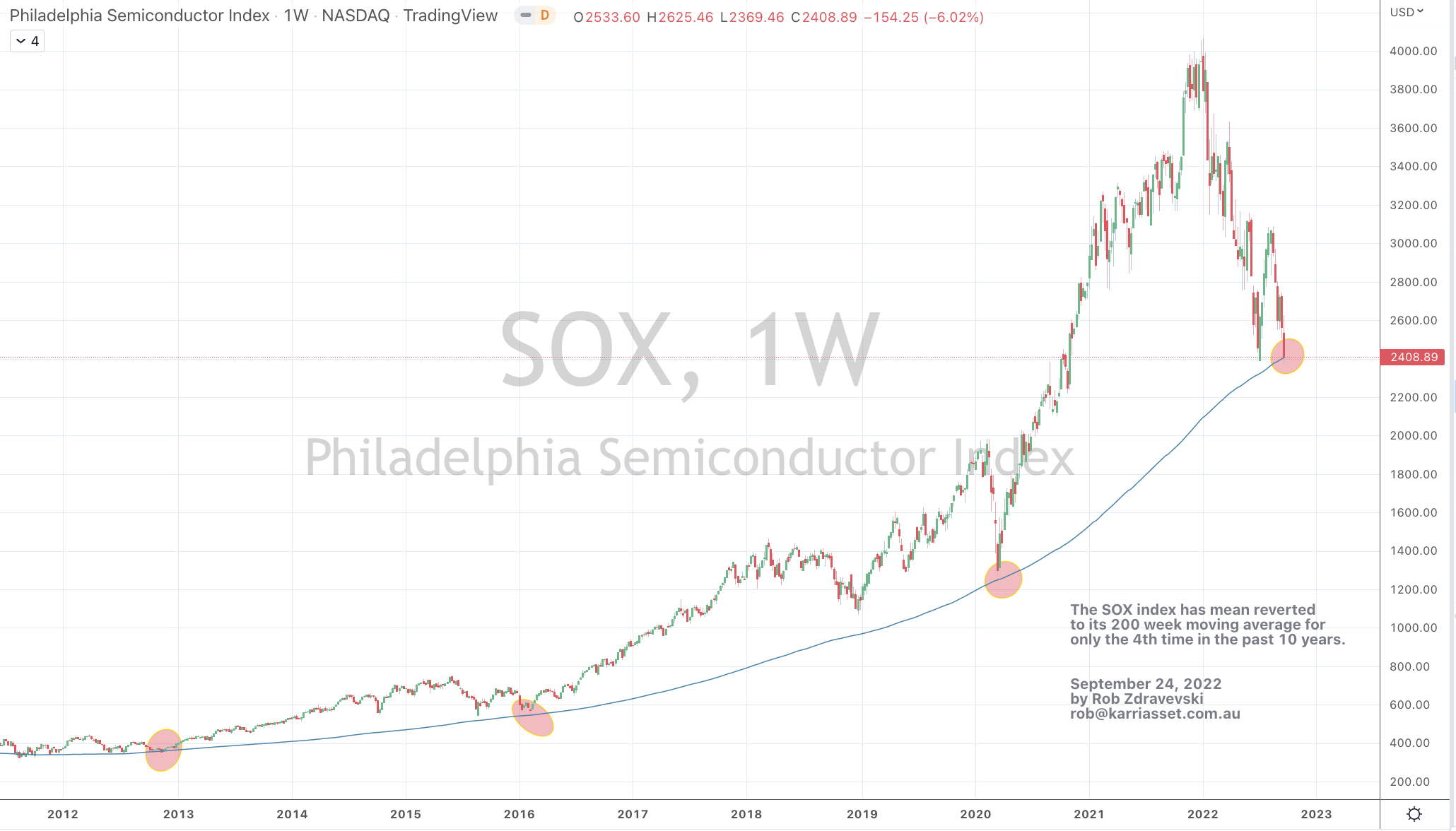
Coal, Aluminium, Cocoa, Iron Ore and Platinum are nearing a ‘buying zone’, as is the Philadelphia Semiconductor Index which has tanked 40% from its New Year Day’s high.

Silver may be an interesting buy at US$18.65, more work to be done.

Some previous posts (published on July 3, 2022) have featured comments about Copper and its correlation to GDP and Interest Rates. Today, Copper has seen its lowest price since February 5, 2021, a 17 month low. 

Some currencies saw larger than normal moves, namely in the AUD/JPY and the AUD/USD, where they shifted 1.8%. The South African Rand dropped 3.4% and the Chilean Peso (vs USD) also weakened. Notice the commodity centric currencies all have softened in unison with lower commodity prices.

Corn is back to late January 2022 prices, which is a month (and lower) prior to the Ukrainian invasion.

I’m pondering that Brent Crude has risk from its current $111 down to $70 and so I wonder what would this say about the inflation readings we may see in Q2 of 2023. Remembering that inflation figures are a lagging indicator.

Natural Gas continues to fall. It fell 8% for the week, even following a 5.6% rebound rise on Friday.  Before the Friday bounce I wrote a seperate note about closing the ‘short trade’ and taking the ‘fat part of the trade’. This cheaper price will now benefit certain company’s inputs. The same cheaper input question applies to those companies in the business of buying Cotton.

While, ‘the other gas’, LNG has soared 52% in 2 weeks. I didn’t see that ‘trading surge’ coming.

Tin is in the Overbought column falling another 6%, which is now sank 30% in the past 3 weeks.

Gold (in AUD) is trading up against some important resistance.

I see a possible 70% long-term decline in the price of Coffee.

And I may write more about the Oversold, contrarian risk indictors that Bitcoin and Ethereum have become.

The larger advancers over the past week comprised of; 

China Coal 6.1%, JKM 4.3%, Lumber 15.3%, LNG 6.4%, Orange Juice 4.8%, Palladium 4.5%, Dutch TTF 15%, Urea (U.S. Gulf) 6.6%, Uranium 2.3% and China’s CSI 300 1.6%.

The group of decliners included;

Australian Coal (22.8%), Aluminium (1.1%), Bloomberg Commodity Index (3.5%), Baltic Dry Index (5%), Cocoa (4.9%), Gasoil (5.8%), Gold (0.9%), Copper (3.7%), Heating Oil (9.7%), Hot Rolled Coil Steel (17.5%), Tin (6.4%), Natural Gas (7.9%), Nickel (2.7%), Platinum (3.6%), Gasoline (5.1%), Silver (6.9%), CRB Index (2.3%), Cotton (1.7%), Urea – Middle East (1.9%), Silver in AUD (4.3%), Corn (17.4%), Oats (5.3%), Wheat (9.7%), Soybean (2%), Bitcoin (8.8%), Ethereum (12.8%), GBTC (11.6%), KBW Banking Index (2.4%), CAC (2.3%), DAX (2.3%), Dow Jones Industrials (1.3%), DJ Transports (1.9%), MIB (3.5%), Kospi (2.6%), S&P Midcap 400 (1.6%), Nasdaq 100 (4.3%), Nikkei (2.1%), Russell 2000 (2.2%), SOX Index (9.6%), S&P 500 2.2%, TAIEX (6.3%) and the Nasdaq Composite slumped 4.1%.

July 3, 2022

by Rob Zdravevski

rob@karriasset.com.au  

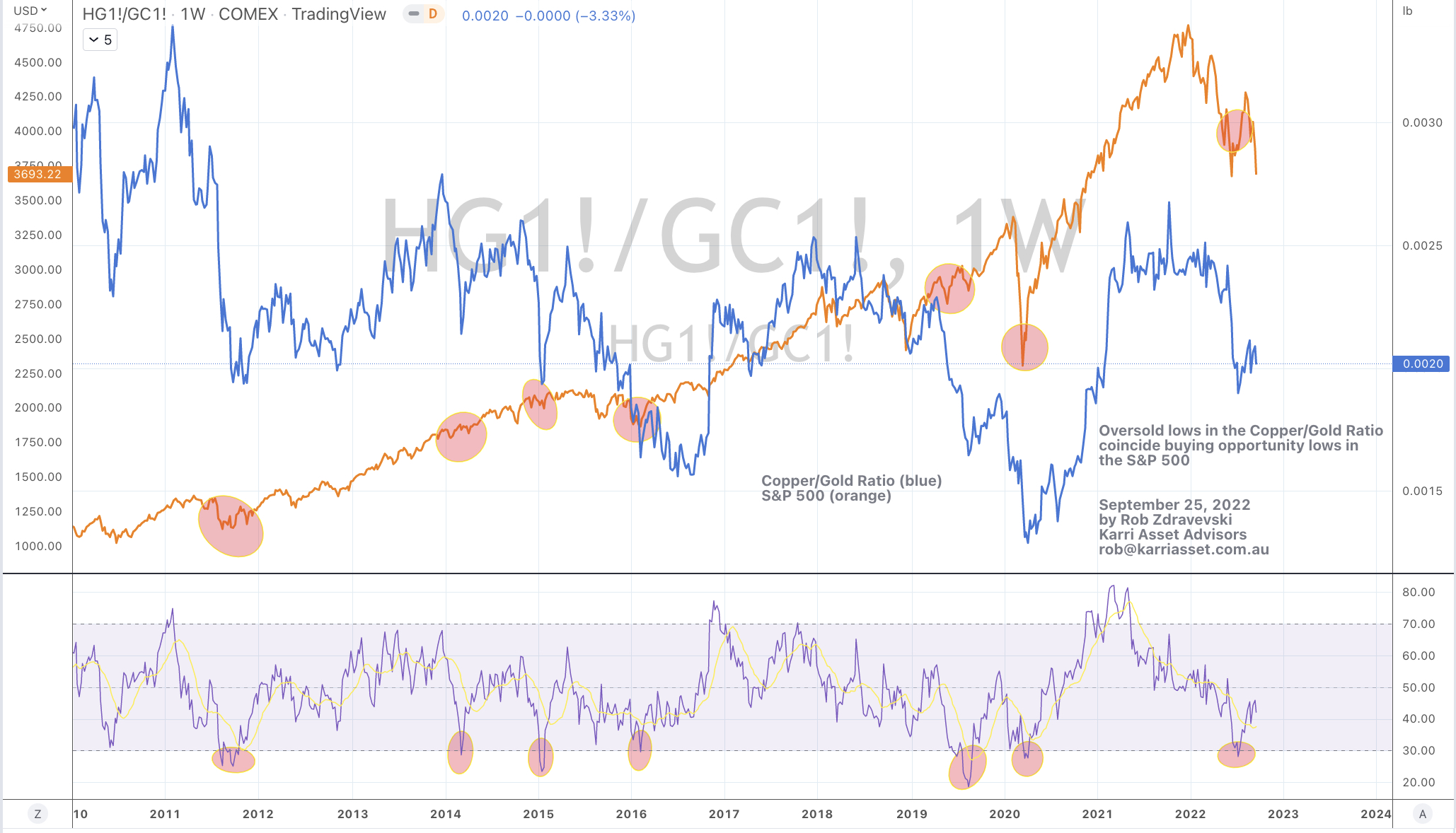
The trusty Copper/Gold Ratio

As I revisit this post about the Copper/Gold Ratio from May 2022,

Today, I write…..

The Copper/Gold Ratio tends to lead changes of direction when relating it to U.S. 10 year interest rates.

This week the Copper/Gold Ratio traded down to 2.5 standard deviations below its weekly mean and touched its 200 weekly moving average.

To boot, the Copper price itself, registered a Weekly Oversold reading and a negative 2.5 standard deviations ‘extreme’. 

Now, I expect the prices on this chart to converge.

Meaning, the Copper price rises and 10 year bond yields decline a little more. There is slightly more emphasis on the latter.

July 3, 2022
by Rob Zdravevski
rob@karriasset.com.au

IPO’s have dramatically decline

In the Americas, during the quarter just completed (Q2, 2022), IPO’s raised only $2.5 billion.

During the same quarter, one year ago, IPO’s raised $49 billion.

That’s a decline of 95%.

The PDF link from EY contains a bunch of data for the statistical nerds.

Ultimately, it’s a reminder that when IPO’s are being offered in abundance (as they were throughout 2021), it’s a reasonably good signal that equity markets are nearing the end of its bull run.

Miraculously, a plethora of IPO’s coincides with above average prices or valuations.

Remember, that investment banks work for the seller (of the asset or the security). It is the seller that pays them to find buyers and in the latest wave of IPO’s the sellers of the shares were the incumbent owners.

Seldom did I see circumstances where new shares were being issued for the purpose of raising capital. Furthermore, many prospectuses showed that little cash was being retained for the corporation for “General Purposes”, instead funds often flowed to founders or private equity firms selling their stake.

Hint: Today, I don’t hear or see of many IPO’s coming to market.

July 3, 2022

by Rob Zdravevski

rob@karriasset.com.au

Coming Soon – Price Discounting Wars

Inventories and Margins.

These are two words I’ll be scanning for in the upcoming U.S. quarterly earnings transcripts.

Amongst a mid-cycle slowdown, I expect companies to engage in ‘price discounting’.

This may last 6 months or so, as companies are now holding too much stock.

This was partly driven by their desire to secure product by any means during a supply chain problems and paying too much for this scarcity.

Those higher ‘produced’ prices are a combination of rising commodity & labour costs.

In this May 2022 post about Lumber, 

I wrote the following;

“For those watching inflation, it’ll be interesting to watch how the higher prices of the past several months will affect lumber yards, timber truss manufacturers and homebuilders as they try to pass on higher ‘finished’ prices compared to the more competitive prices buyers of lumber can achieve today?”

Below are 2 examples of how that same story may be applied to competitors in the Hot Rolled Coil Steel industry.

Example 1

Let’s assume Company ABC bought their steel at prices somewhere within the shadowed areas appearing the chart below, let’s say it was bought at a mid point of $1,400 per ton….

then the steel is worked into an I-Beam as used in the construction industry,

then we add 30% in labour and production costs along with a selling margin,

the price of this ‘produced’ steel is now $1,800.


Example 2

While Company XYZ is buying steel at todays price of $930 per ton and after adding 30%, 

they are able to sell the same produced product for $1,200 per ton.


You can see how Company ABC may be pressured to discount their inventory and thus hurting their margins, let alone encouraging other competitors to increase production and gain market share.


Albeit, their inventory isn’t perishable, the unknown of whether market prices will return to their highs will play on Company ABC’s decision to hold or move their stock. 

This anticipated discounting this will be deflationary.

July 1, 2022

by Rob Zdravevski

rob@karriasset.com.au


Reviewing an Oil call from 12 months ago

In this post from June 28, 2021 (one year ago), I called a high in Brent Crude Oil.

It was real close.

The post then called for a shakeout. Well, it wasn’t quite that but it did fall 15% as the Oversold circles show in the chart below.

Lo and behold, Brent Crude Oil did trade up to $120 – $140 region as predicted

In fact, the high was $138 per barrel.

Now, I watch whether it breaks an important support line around the $108.50 mark.

June 30, 2022

by Rob Zdravevski

rob@karriasset.com.au

Crude Oil is your inflation proxy

Gold hasn’t been a good inflation hedge

Whether you want to call it a hedge or a proxy, the chart below shows the WTI Crude Oil price (in blue) laid over the U.S. Inflation Rate (the orange line).

If you don’t want to get involved in an interest rate trade and you are thinking that inflation will rise, buying long-dated Oil call options have worked a treat.

Be careful, this theory works when inflation is (or about to) rise.

It doesn’t work if inflation stabilises or remains constant.

Today, you’ll need to be aware of where the pendulum is, for both of them.

June 30, 2022

by Rob Zdravevski

rob@karriasset.com.au

Opt to buy on ‘down days’

Jargon Warning Ahead:

A short-term observation in selected equities recommends prudence not to chase momentum and ‘spikes’ when trading days which resemble ‘bounces’ and ‘relief rallies’.

When stocks, indices or commodities ‘gap-up’, there is a high probability that prices trade lower relatively soon to ‘back and fill’ those gaps or spaces in the charts.

My experience suggest that ‘Gap ups’ are often honoured and ‘closed’ in the nearer term when volatility is running above average.

A simple example is that on Friday June 17, 2022, Apple saw an intra-day high of $133.08. The next day (Monday) it opened higher and throughout that day its low was $133.32. There is a 24 cents gap in that price chart.

Then, a few days later (on Wednesday Juen 23rd) its high was $138.59. The following day, the stock price opens higher from the previous days close (gaps-up) and its intra-day low was $139.77.

There is another gap in the chart.

These should be ‘backed and filled’.

In other words, if you are a buyer of Apple stock (this is not a research recommendation), you shouldn’t chase it at today’s $143 high but instead wait for those gaps to be filled and be patient at $133.10.

So, my preference is to accumulate on days when prices are falling, rather than chasing the momentum of the herd.

June 27, 2022

by Rob Zdravevski

rob@karriasset.com.au

Position before it happens

I’ve spent a lot of time telling clients and readers about staying away from certain stocks, commodities or bonds.

But the underlying message is to position yourself before the next move happens.

On June 3rd, 2022, when the share price of Hess Corporation was hitting a high of $131.40, I wrote in the note below that Hess’ stock prospects is either ‘a ‘$30 up or $30 down…..this is hardly compelling’

Hess is down 23% from its high.

The stock is now trading at $101.70, which is awfully close to the $30 variance I mused about.

A few days later, I wrote about the “Mother of all peaks” appearing in Natural Gas.

The downturn started within days and it has now fallen 32% in 2 weeks, since this note.

While the decline in certain energy related securities and commodities is not over.

In the interim, I expect a bounce in these prices for various reasons which translate ‘the sudden drop is overdone’.

From the book of ‘taking the fat part of trade’, by shorting Natural Gas at $9.45 (it’s now trading at $6.22) and now enjoying a 34% gain, it is prudent to close out that position, whether its wholly or partially.

This is an extraordinary result in any asset class over a 12 month period, let alone in 14 days.

It’s important to not confuse genius with being fortuitous.

But that’s the past……

Preparedness (analysis and mathematics) should be valued rather than the reporting of what has already occurred.

You want to be prepared for a trading low in Copper and Tin, which have fallen 26% and 40% respectively and the current trough in South Korea’s KOSPI equity index (currently at 2,367 points), to mention a few.

10 days, I wrote this note about the Buy signals appearing in South Korea.

Weeks ago, I wrote about the lows being seen in the Hang Seng, Shanghai Composite and the Hang Seng China Enterprises Index

The latter has risen 21% in the past 7 weeks.

For some perspective, I think investors need to condition for normalised (or lower) returns as I wrote in this January 3rd, 2022 note.

Today, the trend in those indices may be improving but your margin of safety has diminished if you are now buying those markets at a price which is 20% higher.

June 26, 2022

by Rob Zdravevski

rob@karriasset.com.au

Macro Extremes (week ending June 24, 2022)

The following assets (on a weekly timeframe) registered an Overbought or Oversold reading and/or have traded more than 2.5 standard deviations above or below its rolling mean.

Extremes “above” the Mean (at least 2.5 standard deviations)

None

Overbought (RSI > 70)

Australian 2 & 3 year government bond yields

U.S. 2 and 5 year government bond yields

Canadian, Swiss, German, Spanish, French, Italian, Korean and Portuguese 10 year government bond year yields

TBT & TLT

USD/JPY

The Overbought Quinella – Both Overbought and Traded at > 2.5 standard deviations above the weekly mean)

None

Extremes “below” the Mean (at least 2.5 standard deviations)

Copper

Copper/Gold Ratio

Oats

Soybeans

S&P MidCap 400 and SmallCap 600

SMI

Toronto’s TSX

ASX 200 


Oversold (RSI < 30)

JPY/USD

The Oversold Quinella – Both Overbought and Traded at > 2.5 standard deviations above the weekly mean)

South Korean KOSPI Index

Chilean Peso / U.S. Dollar

Bitcoin and Ethereum (also touching their 200 week moving average) 

Notes & Ideas:

This week’s biggest news was the rally in stocks, the pullback bond yields and all the currencies moved from away from their extremes.

As I reflect on the most recent editions of this periodical, both of these asset classes were and have spent time at the ‘extreme’s.

The crescendo of a surging yield Japanese 10 year yield of 2 weeks ago, peaking at 0.45% seems more pointed now they at 0.22%. This decline aligned with one of many signals of a rally in equities.

Another interest rate and market indictor to watch is the Copper/Gold Ratio, which I’ve written about previously. It also touched its 200 week moving average this past week.

The U.S. Dollar Index isn’t Overbought, nor the Australian 5 and 10 year bond yields, Germany’s 2 & 5’s or the U.S. 10’s.

The US 10 year minus Australian 10 year yield is no longer Oversold, nor is the GBP/USD, the Korean Won or the S&P 500.

Last week we had a hint of a rise in stocks as the Nasdaq rose amongst a list of losers and I wrote “The U.S. biotech index closed up 0.06%. Perhaps some rotational resilience for a bludgeoned sector”.

The Nasdaq Composite rose 7.5% while the Biotech Index soared 9.7%……for the week.

Natural Gas continued is decline (down 32% in 2 weeks) while LNG prices added to the previous weeks gains.

While, the other Gas (LNG) spiked 46% for the week.

Tin declined 10%, adding to last week’s fall of 12.8% and the relevance of this note, its down 40% since its Overbought Quinella on March 7th, 2022 edition of this note

Cotton slipped 25% for the week. Why? Is it speculators realised that’s replenishable?

Perhaps the same realisation occurred in the Oats, Corn, Wheat and Soybean market last week?

Unsurprisingly, the Bloomberg Commodity Index is down 11% in 3 weeks, while Oil didn’t contribute to any of this decline for it only fell 0.6% for the week, following last week’s 10% slump.

Nor did Gold, as it only fell 0.6%, but then again Gold has been acting strangely for many months.

The larger advancers over the past week comprised of; 

JKM 9.3%, Lumber 1.9%, LNG 6.4%, Palladium 3.1%, Gasoline 2.4%, Dutch TTF Gas 9.1%, Uranium 1.4%, AEX 3.9%, KBW Banking Index 4.5%, CAC 3.2%, CSI 300 2%, Dow Jones Industrial 5.5%, DJ Transports 5.3%, MIB 1.6%, HSCEI 3.6%, HSI 3.1%, Midcap 400 4.6%, Nasdaq 100 3.5%, Nikkei 2%, Sensex 2.7%, OMX 5.2%, Russell 2000 6%, SMI 3.6%, SOX 5.4%, S&P 500 6.5%, FTSE 2.7%, S&P SmallCap 600 4.7%, Biotechnology Index 9.7%, Nasdaq Composite 7.5%, ASX 200 1.6% and commodity heavy TSX rose only 0.6%.

The group of decliners included;

Aluminium (1.9%), Bloomberg Commodity Index (4.3%), Australian Coal (2.2%), Baltic Dry Index (9.6%), China Coal (8.7%), Iron Ore (2.2%), Copper (6.8%), Coffee (1.8%), Natural Gas (10.4%), Cattle (2%), Tin (10.4%), Nickel (2.5%), Orange Juice 6.7%, Platinum (2.9%), CRB Index (3.4%), Cotton (25.3%), Silver in AUD (2.6%), Silver (2.5%), Corn (4.4%), Oats (19.8%), Soybeans (6.3%), Wheat (10.5%), KOSPI (3.1%), OBX (2.9%), HEX (2%), STO (1%) and Taiwan’s TAEIX (2.2%).

June 26, 2022

by Rob Zdravevski

rob@karriasset.com.au  

“Go to where the puck will be”

I’ve been cautioning about lower commodity prices with mean reversion being the major undertone.

My writings have broadly warned about not chasing prices that have ‘gone parabolic’ amongst the many basis’ and theorems.

In todays trade, commodities are getting smashed again.

Copper is down 5%, Natural Gas is 8% weaker, Platinum and Nickel are lower, Silver is off 2%, Corn and Soybeans have declined 3%, Oats have slumped 12% while Wheat and Cotton have eased 4%, with the latter down 20% for the week.

Many of these prices are the same or below the February 23, 2022 Ukrainian invasion.

Remember all that palaver about Ukraine being the ‘bread basket of Europe’. Well that may be the case, but it matters if you chase things higher and pay the wrong prices.

Now, I’m not saying ‘short’ a host of commodities as it’s too late (while some of the energy complex has yet to start) or at least the margin of safety has diminished.

You want to position for the lows and what opportunities appear in the 2nd and 3rd derivitive.

I’ve attached charts of Cotton and Urea.

June 23, 2022
by Rob Zdravevski
rob@karriasset.com.au