A little more lower for Crude Oil prices

WTI Crude is ‘looseley’ trading 15% below the price it saw on the first trading day following Hamas’ attack on Israel.

And Brent Crude is doing a similar thing.

While my previous writings have re-iterated the peril of ‘trading the headlines’, for those euphoric and momentum buyers of Crude Oil are wearing some pain.

An announced OPEC+ production cut has provided oil price with any interim support. Possibly another headline traded by many.

I’m looking for a WTI Crude price to visit the $70 mark before possible buy orders are placed.

While that is 5% below the current $73.70 price, it could see that level within the next 10 days.

December 4, 2023

by Rob Zdravevski

rob@karriasset.com.au

Knowing when you’re pushing oil barrels uphill

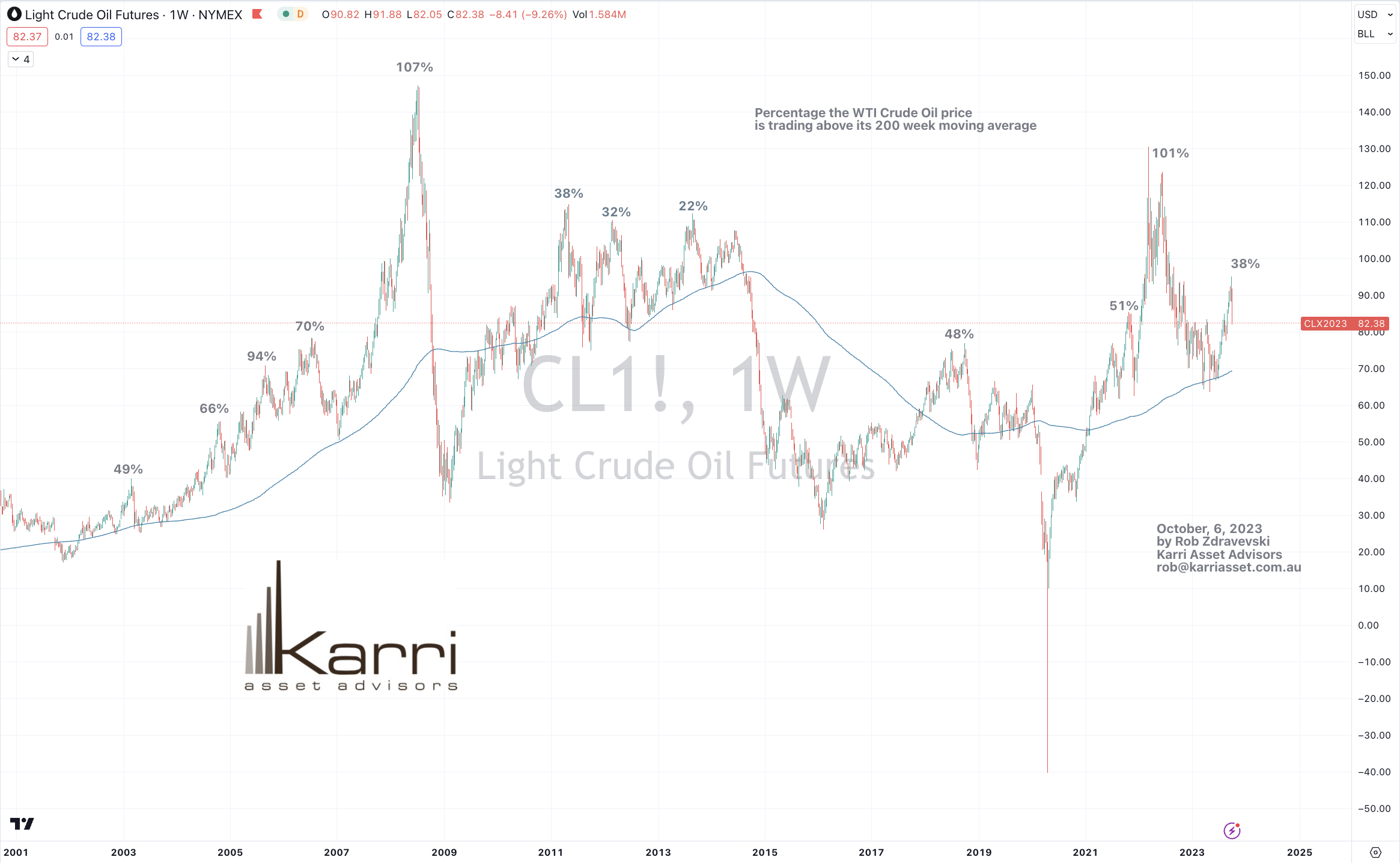
The study below shows the percentage that the WTI Crude Oil price was trading above its 200 week moving average.

When combined with my other studies and metrics, (albeit I couldn’t predict this week’s 10% decline) the probability of the oil price embarking on an extended advance was waning.

More so (subjectively observed), when the financial media noise increased surrounding the various analysts saying $100 was inevitable.

This coincides with my note written 2 weeks earlier.

The high was $95, it is now $82, may see you at $73.10.

Better yet, we may see much cheaper shares in energy companies.

October 6, 2023

by Rob Zdravevski

rob@karriasset.com.au

American inflation rates tells OPEC when to cut production

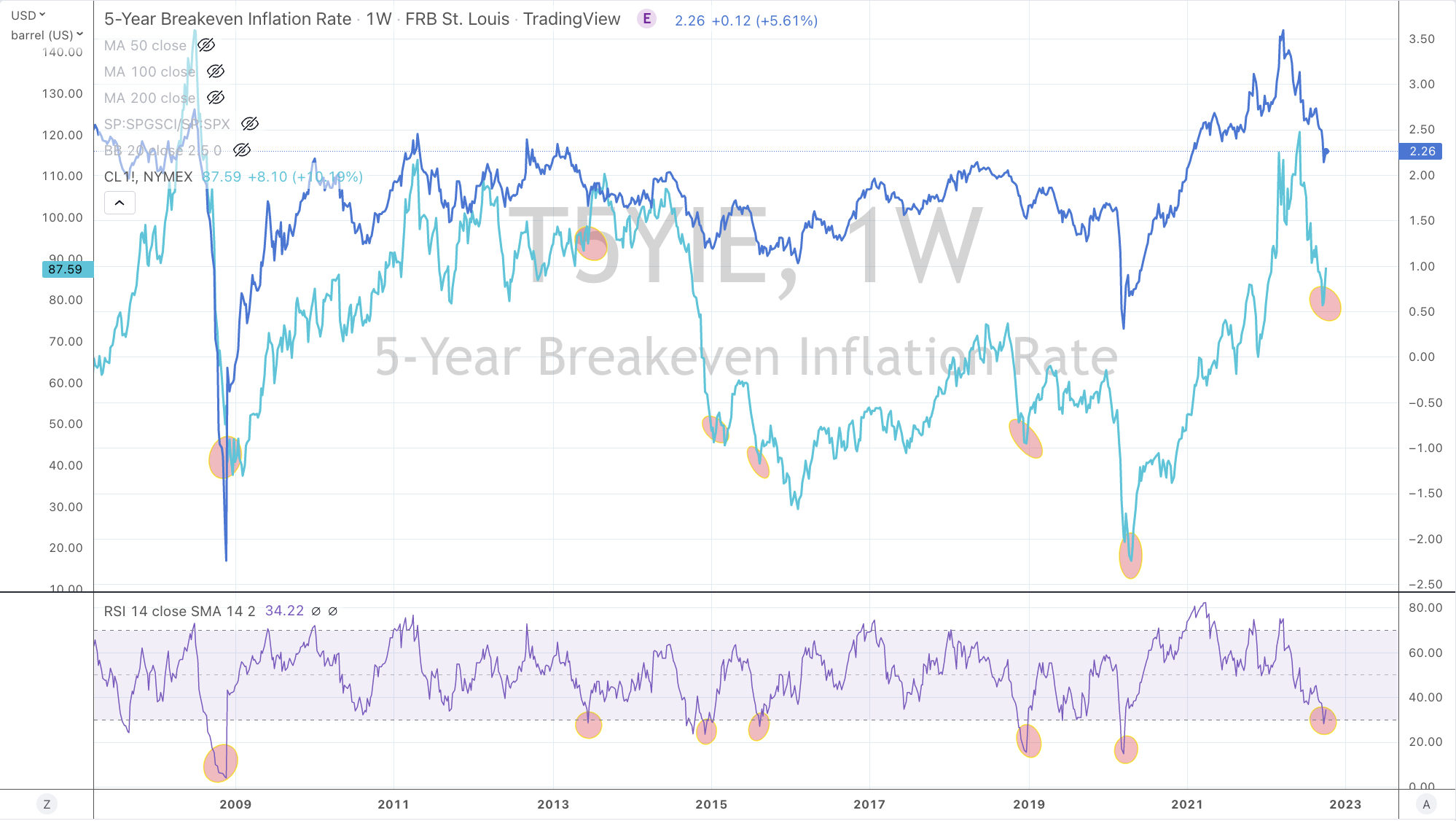
Here is a lovely chart showing the price of WTI Crude compared to U.S. 5 year break-even inflation rate.

To which the St. Louis Fed says about the latter, ‘the value implies what market participants expect inflation to be in the next 5 years, on average.’

Each value dance wonderfully together.

The better part of the chart is the lower bit where the RSI (Overbought/Oversold) indicator appears.

Whenever the 5 year breakeven inflation rate is Oversold (as this weekly chart shows), the WTI Crude Oil price finds a floor from which to advance.

We saw an Oversold 5 year b/e rate last week.

This week’s OPEC production cut announcement wasn’t a surprise because this Oversold moment in the U.S. 5 year break-even inflation rate tends to coincide with OPEC announcing production cuts.

Of course, Biden isn’t happy that OPEC have cut production.

Furthermore, Biden has virtually released all of the nation’s Special Petroleum Reserves. While he probably thinks it was his strategy sending Gasoline prices lower, when it was in fact a combination of other falling commodity prices (which is deflationary), mean reversion in the oil price and rising credit forces at work.

No to mention the importance of Biden needing lower domestic petroleum prices to aide his mid-term election hopes.

OPEC’s production cut may seem to be mathematically synchronised to the United State’s own inflation break-even rates but I think it is equally loaded with a little political payback.

Funnily, the U.S. isn’t pleased with this announcement and have passed on their views but it’s difficult to have a say into a club of which you’re not a member of.

Keep in mind, this study doesn’t assist the decision of when to sell your Oil.

There are other indicators for that.

October 6, 2022

by Rob Zdravevski

rob@karriasset.com.au

Don’t fight OPEC?

We say ‘Don’t fight the Fed’,
Perhaps Biden shouldn’t fight OPEC?
What a terrible politically motivated decision especially when the SPR is normally kept for emergency supply disruptions such as in case of a hurricane etc.

And he asks or even persuades other nations to join him in their own ‘release’.

Such ad-hoc ‘band-aids’ seldom solve and this releases will be soon forgotten.

Alas, the oil price rose 3% today.
Maybe short covering played a part as speculators bet on a larger dumping.

Biden just added supply this hurting his own U.S. drillers. With this type of decision, drillers are hardly about to make capex decisions to drill more.

This story also mentions how the replenishing costs may be detrimental to refiners.

Lo and behold, pending OPEC’s response in the coming months, the reflexivity of this scenario means oil prices make their way lower due to inflationary pressures crimping GDP growth.

Furthermore, Biden becoming worse at international diplomacy. His relationship with Saudi Arabia is dreadful (interesting Saudi and China) are close allies.

His relationship with Russia is awful. (And Russian troops gather around Biden’s mates in the Ukraine)

And China and Russia definantly cooperate.

To understand Oil, it’s worthy to watch how the world works.

November 24, 2021

by Rob Zdravevski

rob@karriasset.com.au

Biden’s juxtoposition

I’m always entertained by these stories.

https://www.bloomberg.com/news/articles/2021-11-03/opec-heads-for-geopolitical-showdown-as-biden-demands-more-oil?sref=qLOW1ygh

Firstly, the United States isn’t part of OPEC.

When you’re not a member of a member based organisation, how can you expect to have your requests (demands) actioned?

Secondly, the irony of Biden asking OPEC to pump more oil (so to ease U.S. domestic gasoline prices) while he is attending COP26 in Glasgow is comical.

Thirdly, he seems to be targeting blame at the Saudi’s for not increasing their output. There are other nations which make up OPEC and OPEC+.

Biden is proving to be a poor manager of geopolitical nuances.

But there any many more angles to this story;

Imagine if the U.S. was still a net exporter of oil?

A lower oil price may make their shale market uneconomical?

The U.S. can always lift sanctions on Iranian oil, allowing it to hit the market?

p.s. In my view, the decline in Crude was expected once OPEC said they won’t be increasing output. Why? Because, we will be closer to output being increased at the next meeting……Markets price in the probability of next move quickly.

#oil

November 5, 2021

by Rob Zdravevski

rob@karriasset.com.au

Reviewing Times Of Oil Excess

I wrote the linked article in September 2012 when Oil was trading at $117, predicting bearish times ahead.

Since the rout in the first half of 2020, I have been an oil bull.

https://robzdravevski.com/2012/09/17/lower-oil-prices-by-2020/

March 5, 2021

by Rob Zdravevski

rob@karriasset.com.au

An Oil Shock in stealth

OPEC are meeting today, it could be a doozy….murmurs of supply cuts.

My question to answer what OPEC may decide is…..

what do the Saudi’s and Russia want or need ??
and what will hurt America the most ??
especially following the recent accusations made by the U.S about MBS and Biden approved missile strikes against Iranian backed militia…….

the answer is higher oil prices.

Logic suggests a nice reversion of Brent back to $53 would be sensible, equitable etc.
but without being a purposeful antagonist and we are a year on from last years March 8th stoush,

although Brent at $75 would remind many who’s in charge….

and I reiterate that inflation (meaning higher interest rates and higher government and corporate debt servicing costs) will likely come from higher prices in the energy complex and definitely not from services and consumer products.

March 4, 2021
by Rob Zdravevski
rob@karriasset.com.au

Who is calling the shots

Putin and MbS are having talks again,
watch the oil price,
timing interesting near the U.S. election,
output cuts are the logical bet,
there is nothing like petro-nations needing petro-dollars.

Lower Oil Prices By 2020?

Venezuela is the largest holder (18%) of the world’s proven oil reserves. If we discount any government inflated figures and the difficulty and costliness of extracting from the Orinoco Belt, let’s agree that they may come in slightly lower than Saudi Arabia.

Although, this comparison is between one country to another. It is worthy to note that Middle Eastern countries collectively hold 48% of these reserves.

Recently, it has been reported that Venezuela may default on its debt sometime in 2013.  I don’t believe they will, but they will create tensions and ransoms surrounding such a possibility.

They will simply produce more oil receipts to service or extinguish their debt. The IEA, OPEC and Saudi’s have also said that they would like to see oil prices lower than their present levels.

Recently, it seems that the oil price has been supported by speculation or anticipation surrounding geopolitical tensions and probabilities.

Israel’s equally hostile reaction to Iran’s previous threats has bid up the oil price of late along with populous Arab uprisings, although geopolitically, it would be wise for Israel to seek counsel from the United States before any pre-emptive missile attacks.

Although Iran would prefer a better scenario, but covertly they would welcome higher oil prices as it would ease the fiscal pain associated with new rounds of sanctions while Venezuela needs higher prices to make their tar, economically viable.

Much of America’s foreign policy is oil based and higher oil prices wouldn’t help America’s economic plight. Look for more diplomatic focus towards South America and  the former Soviet Republics.

The fundamental case for lower oil prices includes a subdued global economy, cheap coal and abundant gas (shale or otherwise) and record levels of oil production capacity will help keep the price of oil low.

Furthermore, there is so much oil in the world, we are not close to a “peak oil” scenario. In fact, the value of the world’s proven reserves amounts to at least $150 trillion, which is more than the combined value of all of the worlds gold, bank deposits, government debt and the market capitalisation of the worlds listed companies.

Yossie Hollander’s TED Talk summarised it well. There is not enough money in the world to buy all of the world’s oil, thus oil is too expensive.

When investing, you should avoid owning an asset where there is excess supply for I would prefer owning an asset that is in demand but in short supply.