AUD – now Overbought at a Weekly Extreme
September 1, 2020 Leave a comment
I feel markets are at another acute point.
It’s not about doom but rather to position for the opportunity.
In this note, I’ll start with the AUD and USD.
Since Buying AUD in the depths of March 2020, I’ve been advising clients to sell AUD against the USD in a tiered fashion at 0.66, 0.69 and 0.71.
With a weaker USD, we have also seen a commensurate advance in commodity prices. Note the link ?
I’ve been banging on about overbought readings recently each time they were registered on the “daily” charts, BUT now, significantly, we are seeing “Weekly” extremes.
Please take a look at the AUD/USD chart below and my annotations within it.
It’s only the 10th time in past 18 years that we have seen this and it’s the first time in 9 years.
I’m not calling a crash and of course and 0.7750 is entirely possible but I want to identify that such extremes are not common. Buying AUD at this end of the pendulums arc warrants thought to the probability of mean reversion.
September 1, 2020
by Rob Zdravevski
rob@karriasset.com.au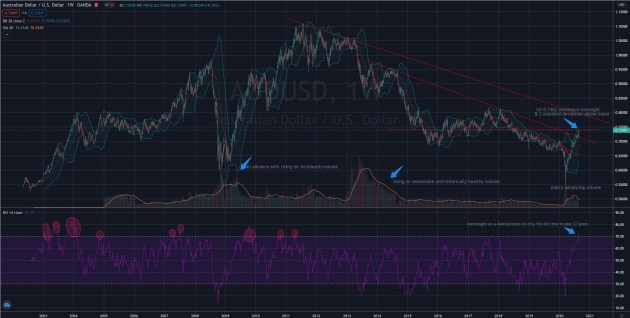
 rob zdravevski's blog