Each Sunday I publish a note titled ‘Macro Extremes’ which observes and notes prices of various assets or markets trading at the extended part of their ‘pendulum’ for the week that just ended.
Here is a review of some selected price action of those appearing in the publication over the past couple months.
On December 19, 2023, the British 10 year bond yields were at their lowest since May 2023. They have since moved from 3.50% to 3.92%.
The October 22, 2023 edition saw Mexico’s IPC equity index register a ‘quinella’ of oversold readings when it was at 47,800 points. By December 20th, it rallied (21%) to 58,000 points when it reached an overbought quinella.
That same edition mentioned the extreme oversold of the Nasdaq Biotech Index when it was trading around the 3,650 point mark. 3 weeks ago, its was overbought when it hit 4,430 points, which is a stupendous 21% run within 9 weeks.
A week later, the ASX Industrials Index triggered its own oversold quinella at 6,150 points. it soon lifted (12%) to 6,900 points by New Years Day.
And the October 6, 2023 edition warned to not chase the overbought Orange Juice price which was then trading at $3.90. Its current price is $3.08.
The next edition of Macro Extremes is published tomorrow.
While I prepare for a capital expenditure led cycle which will aide the case for higher commodity prices, positioning your investments for such a ‘theme’ won’t be as simple as owning equity in any or many mining companies.
The hoo-ha that we heard about the price of #gold hitting new highs through the month of December 2023 seems now muted.
Today is an example of the risks involved with mining production when combined with the market’s (or analysts) expectation of valuation.
Australia’s Evolution Mining and Canada’s Barrick Gold Corporation both reported their quarterly mining production and their stock prices fell 20% and 9% respectively.
We also saw some commensurate declines amongst some peers.
Here are the 9 occurrences over the past 40 years when the U.S. Inflation Rate/S&P GSCI spread was registering a monthly RSI reading of 32 or below.
It coincided with reasonable moments to buy commodities, as illustrated by the orange line which represents the S&P Goldman Sachs Commodity Index (SPGSCI).
I made a similar reference in a note published 2 months ago.
A weekly Macro, Cross Asset review of prices trading at extremes which may generate future investment ideas and opportunities.
The following assets (on a weekly timeframe) either registered an Overbought or Oversold reading and/or have traded more than 2.5 standard deviations above or below its rolling mean.
Extremes “above” the Mean (at least 2.5 standard deviations
KLSE – the Kuala Lumper Stock Exchange
Nikkei 225
Overbought (RSI > 70)
Cocoa
And India’s NIFTY and SENSEX equity indices
The Overbought Quinella – Both Overbought and Traded at > 2.5 standard deviations above the weekly mean)
SHY – U.S. 1-3 year bond ETF
Uranium
Extremes “below” the Mean (at least 2.5 standard deviations)
Soybeans
Oversold (RSI < 30)
Nickel on India’s MCX Exchange
Nickel on LME
CSI 300
Lithium Hydroxide
JKM LNG
The Oversold Quinella – Both Oversold and Traded at < 2.5 standard deviations below the weekly mean)
China 10 year government bond yields
Corn
Notes & Ideas:
Government bond yields fell for the week, giving up some of the previous week’s rise.
Although, it was generally a quiet week, the arrest moves were seen in the tanking of yields amongst the Japanese 2’s and 5’s.
Perhaps lost amongst many was that 2 weeks ago, Brazilian 10’s were at their lowest since August 2021.
And so, even with the recent bounce in yields, the first wave of declines seen since the September/October 2023 highs should be the first past of a larger mean reversion in bond yields.
Equities were mixed with many staying within 1% of last week’s closing prices.
If pressed, there was a slight bias towards weakness. The few that rose appear in this week’s list of movers.
The Nasdaq 100 rose 3.2% recovering the previous week’s 3.1% decline.
Volatile ? Perhaps but certainly we are seeing notable rates of change.
The last few editions listed the list of winning weekly streaks amongst various equity indices. They have all been broken.
The last major intact streak is the 9 consecutive weeks of gains for the Nasdaq Biotechnology Index.
Indonesia’s main bourse has risen for 5 straight weeks.
Inversely, the HSCEI is at its lowest closing price since early November 2022.
The ASX Materials Index has sunk 5% in the past fortnight as has the Hang Seng China Enterprises Index (HSCEI).
Brazil’s BOVESPA and Mexico’s IPC have respectively fallen 2.5% and 3% over the past 2 weeks after being overbought 3 weeks prior.
The SOX rose 3%, recovering half of last week’s 6% slide. It isn’t at a new all-time high which it made a few weeks ago.
And while the S&P 500 continues to ‘act’ constructively, it’s ‘only’ 19% above its 200 week moving average.
Commodities were mostly weaker, albeit slightly.
The big movers were declines seen in shipping rates, metals and grains, again.
The winners included Uranium, Natural Gas, Lean Hogs and Cocoa.
Iron Ore isn’t overbought after falling 4.4% this past week.
The direction of the Copper/Gold Ratio is also back on my radar as this is a good indicator of the economy’s health.
Rotterdam Coal continues its see-saw. The last 3 weeks have seen it fall 8%, then rise 8% to falling 6.5% this past week.
Gold (as priced in Australian Dollars) is in a 4 week wining streak as is Natural Gas.
Natural Gas (Henry Hub) prices have risen 30% in the past 2 weeks, while the Dutch TTG Gas price fell 7% erasing the previous week’s 7% gain.
Soybeans and Corn are registering oversold extremes.
Soybeans is in a 4 week losing real and has fallen 8 of the past 9 weeks.
While Corn is also nearing a major mean reversion. Some may recall my warnings of not chasing parabolic moves in grain prices at the commencement of the Ukraine invasion.
Cattle is still trading at extended percentages (33%) above its 200 week moving average.
Lithium Hydroxide has now spent 28 consecutive weeks in weekly oversold territory.
And Sugar’s rose again, climbing 5% in the past fortnight, following its recent oversold status, which it reached with consecutive weeks of declines.
Amongst currencies, the AUD has seen its 3rd consecutive week of declines against many pairs, which sits proportionally within my published note on December 29, 2023 that the AUD was ‘full’.
The group of largest decliners from the week included;
Aluminium (1.6.%), Rotterdam Coal (6.5%), Baltic Dry Index (30.8%), WTI Crude (1.6%), Iron Ore (4.4%), Copper (1.8%), Coffee (1.6%), Lumber (1.9%), JKM in Yen (11.4%), Tin (4.3%), Newcastle Coal (2.5%), Orange Juice (4.8%), Palladium (5.7%), Platinum (5.2%), Dutch TTF Gas (7.4%), Corn (3%), Soybeans (2.6%), Wheat (3.3%), Shanghai Composite (1.6%), KBW Bank Index (3.1%), HSCEI (2.2%), KRE Regional Bank Index (2.6%), KOSPI (2.1%), Oslo (1.4%), Chile (1.4%) and the ASX Materials. Index fell 1.8%.
Since this post on December 20, 2023, warned readers to not trade (chase) the headlines, Shipping Rates and Oil prices have declined.
Within it, I wrote, “The global powers with economic interests will put a stop to it and the companies with a commercial interests will simply cease putting cargoes at risk.”
Now, 22 days later, we are seeing their “corrective measures”.
The notations in the attached charts point out how prices reacted from October 19, 2023 when the first missiles and drones (bound for Israel) were shot down and when activity escalated around mid-December 2023.
Within the article, I furthermore cited its stretched levels above its 200 week moving average.
Aluminium prices suffered a similar fate.
The chart below shows the time frame that copper fell 33.4% within 13.6 months from the date the article was publishing……..whaddayaknow, it mean reverted down to its 200 week moving average.
At that moment (14 months later) Copper turned into a ‘buy’ opportunity.
This weekend, clients will be receiving my latest view.
A weekly Macro, Cross Asset review of prices trading at extremes which may generate future investment ideas and opportunities.
The following assets (on a weekly timeframe) either registered an Overbought or Oversold reading and/or have traded more than 2.5 standard deviations above or below its rolling mean.
Extremes “above” the Mean (at least 2.5 standard deviations
KLSE – the Kuala Lumper Stock Exchange
Overbought (RSI > 70)
Cocoa
Uranium
Iron Ore
And India’s NIFTY and SENSEX equity indices
The Overbought Quinella – Both Overbought and Traded at > 2.5 standard deviations above the weekly mean)
None
Extremes “below” the Mean (at least 2.5 standard deviations)
Rotterdam Coal
Oversold (RSI < 30)
Nickel on India’s MCX Exchange
Lithium Hydroxide
The Oversold Quinella – Both Oversold and Traded at < 2.5 standard deviations below the weekly mean)
None
Notes & Ideas:
Government bond yields rose except for the Chinese 10’s and the Japanese durations.
Probability implied such a rise when observing the many 5-9 weeks declining streaks in existence.
While you may have not placed a trade to sell any bonds at this juncture, this publication certainly suggested that one shouldn’t buy bonds at the recent ‘extremes’.
Swiss 10’s have strung a 3 week yield rally from 0.61% to 0.83%. The were oversold 4 weeks ago.
The yield in the Aussie 10’s saw its 5 week declining streak come to end.
And the South Korean 10’s broke their 10 week losing streak.
Equities were mostly lower except for there IBEX, Oslo, Helsinki, SMI, SET & Copenhagen.
The latter has put together a 10 week winning streak, while Thailand’s SET is in its 5 consecutive rising week.
The Nasdaq Biotechnology has quietly risen for 8 straight weeks.
Asian and U.S. were amongst the larger declining indices for the week.
In fact, the DJ Industrials, the Nasdaq Composite and the S&P 500 all broke (unsurprisingly, again) their consecutive winning streaks.
As did Mexico, Stockholm & Chile’s main equity indices.
Furthermore, the AEX, CAC, DAX, KOSPI, TAIEX and the ASX 200, all performed weekly outside bearish reversals.
And the SOX did not make a new all-time high this week, instead it fell 6%.
Commodities were mostly weaker, although the commodity indices were flat to slightly higher.
The strength in the energy contracts helped offset the larger declines seen in metals and grains.
Rotterdam Coal rose 8% erasing last week’s 8% decline.
Natural Gas rose significantly while Palladium, Oats and Soybeans tanked.
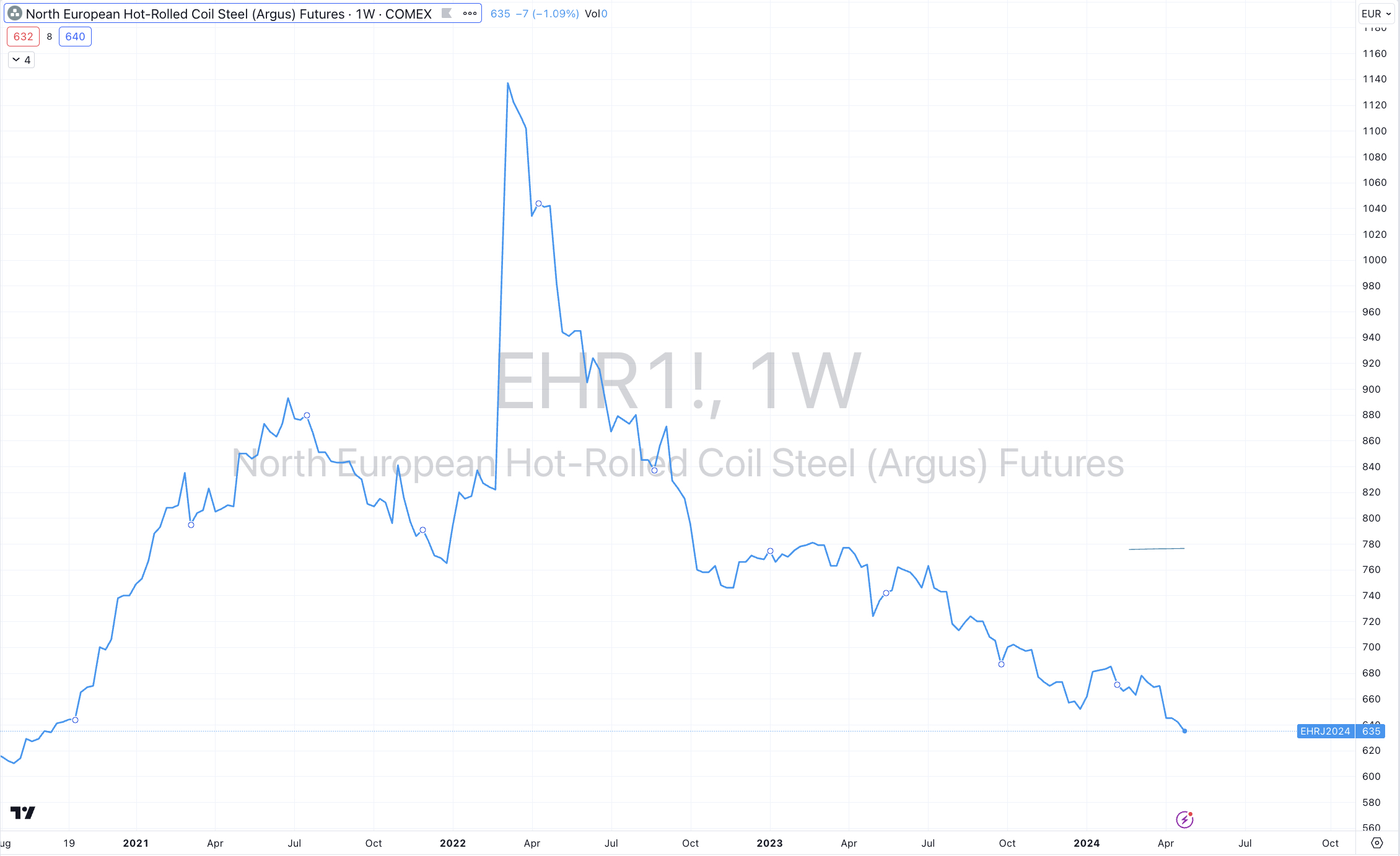
Hot Rolled Coil Steel isn’t overbought anymore nor is Platinum and Coffee.
The former broke its 11 week winning streak.
All 3 fell notably during the week.
Finally, Rice had a bullish outside reversal week which suggests a continuation of its upward trend.
Aluminium fell 5% after rising 14% over the previous 4 weeks.
Orange Juice rose breaking its 6 consecutive weeks of gains
And Sugar’s rose, ending its declining weekly at 8 weeks.
Amongst currencies, the USD rose strongly and it isn’t oversold this week.
No currencies are in any extreme territory this week and its easiest to reference last weeks edition to see which ones appeared as so.
The GBP was strong, the Euro was mixed and the Yen was weaker.
The AUD was weaker everywhere except against the Yen.
There were big moves in FX this past week, with many moving 1% or more.
For example, the SEK fell 1.7% versus the USD while the Yen fell 2.5% against the USD.
And the AUD/EUR had an outside weekly bearish reversal.
The larger advancers over the past week comprised of;
Australian Coking Coal 1.9%, Rotterdam Coal 7.8%, China Coking Coal 1.9%, WTI Crude 3.7%, Lean Hogs 2.3%, Heating Oil 2.5%, Cattle and Lumber rose 1.3%, Natural Gas 15.1%, Orange Juice 2.5%, Sugar 2.6%, S&P GSCI 1.1%, Dutch TTF Gas 6.8%, Brent Crude 2.3%, Gasoil 2%, KLSE 2.3%, MOEX 2%, Copenhagen 1.5% and Turkiye’s BIST 100 rose 2.1%.
The group of largest decliners from the week included;
Aluminium (4.9%), Copper (2.3%), HRC (4.6%), Coffee (2.9%), Lithium (7.2%), Tin (2%), Newcastle Coal (2.5%), Nickel on MCX (1.9%), Palladium (6.5%), Platinum (3.7%), Urea Middle East (1.6%), Silver in USD (2.5%), Corn (2.2%), Oats (8.5%), Soybeans (3.2%), Wheat (1.9%), Shanghai (1.5%), CSI 300 (3%), CAC (1.6%), China A50 (2.8%), DJ Transports (2.5%), HSCEI (2.8%), Hang Seng (3%), BOVESPA (1.6%), S&P SmallCap 600 (3.6%), Russell 2000 (3.7%), Nasdaq Composite (3.3%), KOSPI (2.9%), FTSE 250 (2.4%), S&P MidCap 400 (2.4%), Mexico (2.1%), Nasdaq 100 (3.1%), Stockholm (2.5%), SOX (5.8%), Chile (2.3%), S&P 500 (1.5%), STI (1.7%), TAIEX (2.3%), ASX 200 (1.3%), ASX Materials (3%) and the ASX Small Caps fell 2.8%