Pineapple Socialism

pineapple

Australian’s are an accepting lot. A very compliant, submissive and subservient group indeed.

Industry and government say anything they wish and we believe it.

We have reserves of gas and coal, yet our energy prices are rising.

We have a huge beef and lamb herd yet we pay astronomical prices.

We have taxes imposed on every product and service.

We have 22 million people living in a land mass the size of the United States, yet our property prices are more expensive than Hong Kong?

It costs no more today to build a house of comparative standards than it did 10 years even after accounting for the increase in labour.

The government needs to release land to the population and not to the land-banking developers. There is no land shortage in Australia.

The trend we have seen is food, energy and land inflation coupled by asset and product deflation. So, my assets are falling in value yet I am paying more for my staple requirements. No why wonder I feel poorer!

I see this trend continuing.

As many are having difficulty paying for their staples including accommodation, heaven forbid should we engage in some luxury such as a $4 cappuccino or try to buy a sandwich for under $9. Don’t get me started on the cost of city parking, fruit or vegetables.

Last week I bought a Nestle branded bottle of water in an Indonesian airport for 40 cents. Four hours later I landed in Perth, Australia and paid $4.50 for the same bottle of water which also happens to be three times the cost (on a per litre basis) than the price of petrol I used on my drive home. How is this so?

The rest of the world is securing supply of necessities while Australians pay more and more, for much of the product that we already produce here.

Why?

I hear reasons that include dwindling supply, higher global demand and rising farming production costs but there will be a limit to how much jargon the population can handle involving words such as transparency, “best practices” and accountability.

I don’t know the answers but if recent protests in Israel about the rising cost of living are any indication, social unrest will also be an emerging and relevant trend. Unfortunately such an event would drive these prices even higher.

My rant is about the high cost of necessities and not the cost of electrical goods and many other products which have actually become cheaper but I do think it’s time that retailers can stop crying poor as to why we won’t pay $75 for T-shirt.

I wonder how long we are going to be fooled by Australia’s facade of free market capitalism and democracy, when we should probably sooner accept the government evolution to socialist capitalism. The problem is, it feels like a sort of socialism without the social benefits and control. After all, thousands still sleep rough in Australia’s cities!

Whichever way this turns, the population could decide for themselves and not cop the rough end of the pineapple anymore?

Keep your snouts out of the piggy bank

A Piggy bank (penny bank/money box)

Image via Wikipedia

The news report link below mentions that the current Australian Labor government plans to withdraw money from the Future Fund to help its surplus budget ambitions and promising to return it later.

http://www.theaustralian.com.au/national-affairs/labor-plans-future-fund-withdrawal-as-it-takes-aim-at-budget-surplus/story-fn59niix-1226134325846


In the spirit of this blog’s mantra – “Try to hear what is not being said” – this could translate to being read as “Holy smokes, we are in trouble”.

This article has attracted rebuttals, revisions and corrections but just the sheer mention of this story is unbelievable.

Australia is a rich country which weathered the 2008/09 financial crisis better than most, yet it’s government is proposing more taxes and now wants to raid its sovereign pension fund to meet political promises.

If the Australian government needs to do “borrow” money from the Future Fund , there is a $1.1 trillion superannuation industry which they could also fiddle with. Maybe a new tax for contributions??

Beware Australian government, you need some new policy advisors!

News stories such as this, together with rising petrol and food prices along with revivals of mortgage stress, civil unrest wouldn’t too hard to rouse.

Watch Syria – Not Libya

Map of Syria

Image via Wikipedia

This is my read of geopolitical stirrings across the Middle East and how it may be a catalyst for weakness in the equity markets.

Tunisian, Egyptian and Libyan uprisings are a sideshow to the main event. Investors should watch the developments in Syria.

The violence in Syria seems to be on a grander scale, yet America is more vocal about Libya’s Ghaddafi. Why?

The answer and concerns lie with Iran.

Iranian influence through political arms such as Hezbollah in Lebanon, Hamas in Palestine and the Muslim Brotherhood in Egypt is putting the literal geographic squeeze on Israel which is overseen by the Iranian Revolutionary Guard.

Iran’s friendship with Syria sees them funding projects that range from military infrastructure and weaponry, gas pipelines and establishing banks. This possibly makes Tehran the most politically stable and powerful government in the Middle East, today.

Turkey’s political instability of late isn’t helping either.

The catalyst for real global geopolitical turmoil depends on what happens in Syria.

If the Syrian situation escalates, the U.S. will be placed amongst difficult circumstances involving Iran, Israel, nuclear & chemical weapons, Oil and Gas.

A rise in the oil price (Iran is the world’s fourth largest oil producer, OPEC’s second largest producer behind Saudi Arabia and has four times the reserves of Libya) could be the catalyst that sends equity markets into a funk that lasts more than a meagre 10% correction.

The timing of such an event could also see various Western political figures lose re-election as military spending continues higher due to new deployments and energy and food inflation rises.

If you haven’t watched Middle East developments over the years, the near term could, unfortunately, be the most explosive, condensed episode.

Gold – setting up for a crash?

Crystaline Gold

Image via Wikipedia

Why not? In fact, anything remains possible in financial markets.

Whether gold is resembling a mania or bubble is subjective. Heck, gold could probably double and double again! In the tech stock mania of 1999, We witnessed certain stocks rise 10 fold in under 2 years while gold has only tripled in 5 years. Finance historians have said that one requisite of a mania is to have the asset made easily available to the masses. Well, I haven’t researched whether this is the case today, but I have read about gold dispensing ATM’s have appeared in Europe, North America and the Middle East.

I find it quite comical that when gold rises, zealots dismiss any criticism of their beloved gold by wheeling out their citation of it being a store of value. Who decided that gold is the store of value?

What about silver, tin, sugar or coconut oil as a”store of value”? They too have also tripled in price in the past 5 years?

Between 1981 and 2005, we saw a period of massive asset price inflation and gold traded between $220 and $520 an ounce. It was a very poor store of value for that 24 year period.

I think it’s important to question if gold has become a financial asset that is now a speculative instrument.

I’d also like to challenge the growing movement that gold is an alternative currency. I would like readers to shave a sliver of gold from their hoarded ingots and pay for a coffee, restaurant bill or their car insurance premium! Seriously – when you next sell your family home, don’t put a dollar figure on it – just request that the selling price is 450 ounces of gold. Let’s see how your property conveyancer settles that against the bank’s mortgage?

However, I do marvel at predictions of various targets set by pundits. I ask myself how do they come to such a figure?

As gold doesn’t produce cash flow or have an operating profit, I wonder how these “analyst’s” can value it’s worth? Gold bugs often rebut this statement by talking about Indian jewellery demand, waning mine development and slowing supply.

I’m just not convinced.

If gold is not coming close to a crash, a notable correction would be a healthy. I have posed the question to various folk that gold could halve and they’re answer is overwhelmingly – “It’s not possible”.

Amongst the stories that I now hear and read include Inexperienced investors exhibiting interest in buying gold, Bar room stories of  how “they” bought gold years ago, Affirmations that gold will be the only thing that will keep its value when the world ends and the front page of the business section of a national newspaper features a story claiming it was easy for the featured executive to have made money by investing in gold.

http://www.theaustralian.com.au/business/companies/defensive-strategy-turns-to-gold-for-gattung/story-fn91v9q3-1226118429451

To boot, new gold ETF’s are being created almost weekly, the commodity futures regulators are increasing margins to kerb speculation and gold is within $30 of (the more precious) the price of platinum. The spread between these two metals has averaged ~ $400 for the past 30 years.

Recent moves in the U.S. bond market are telling me that “hard asset” deflation should be investors bigger concern, rather than inflation. Albeit, I believe we will see continued food and energy price inflation. More on this topic is a forthcoming post.

Finally, I believe that there is no such thing as a forced buyer, yet with gold, I think many are acting either in a manner that they feel “forced” or worse still; that they are about to miss-out.

Money is made of cotton

Once Valledupar's main economic produce; Cotton

Image via Wikipedia

Did you know that U.S. paper currency paper is composed of 75% cotton (and 25% linen)?

Each note (depending on its denomination) has a life expectancy of between 2 and 6 years.

The U.S. Mint prints approx. 38 million paper notes per day. Annually, the weight of this money would equal 28 million pounds (or 12.7 million kilograms or the weight of seventy-four Boeing 747 airplanes).

Proportionately, cotton should account for 21 million pounds of this weight which is less than 0.5% of the annual U.S. cotton production alone.

More practically, approx. 55 trillion pounds of cotton is produced around the world globally. India and China are the two largest producers accounting for nearly 60% of this crop.

Some of the supply and demand story includes: cotton’s demand increases when developing countries grow richer (and most of these nations are in tropical climates), India and Pakistan are 2 of the world’s top 4 producers (where political tensions are on the rise) and it’s water intensive.

The price of cotton spent most of the past 30 years trading between 50 cents & $1 per pound, however commencing mid-2009 up to April 2011, the price rose from 60 cents to above $2 per pound.

In the past 3 months, the price of cotton has halved to US$1.03 per pound.

Australia’s inverted yield curve makes America a fertile investing habitat

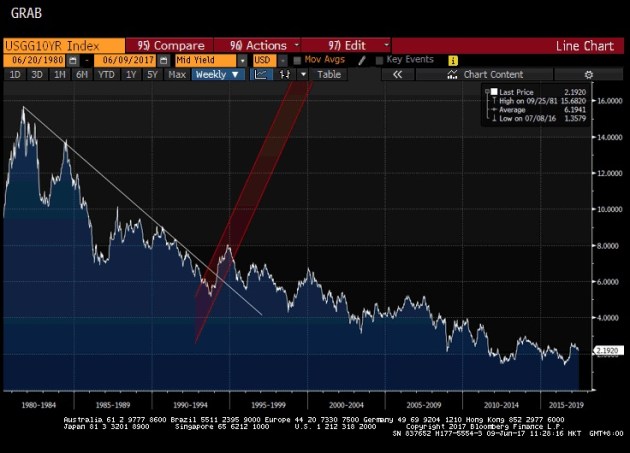
Today, Australia’s 10 year government bond yield fell below the Reserve Bank’s overnight cash rate for the 1st time since early 2009.

Historically, an inverted yield curve is correlated with moderating inflation, weakening economic activity and possibly suggesting signs of an economic downturn.

Could this precede the official call of a recession? I think the implications are still not fully accepted, meaning Australia remains in denial, for China will apparently save us.

Although I’m bullish on China and commodities, there are phenomenons called “cycles”. Prices do revert to their mean and the Australian Dollar can fall.

Global investors could do well to sell (high) their strong AUD, CHF, JPY or EUR and buy (low) the weaker, cheaper USD.

To enter the world of folly, this could be a turning point for the U.S. Dollar and its rise would have various implications on assets ranging from the Swiss Franc to commodity prices.

Forget the U.S. government’s woes. I prefer to treat the U.S. government and its bonds, if you will; similar to the equity or debt of any other U.S. company. I consider the equity and debt of McDonald’s Corporation is more creditworthy than that of the U.S. government.

Furthermore, investors with USD are searching for returns (as cash currently earns zero) and with a S&P 500 PE of 12 thus giving it an earnings yield of 8%, this is a nice “pick-up” of 5% over the U.S. government 10 year bond….

Finding opportunities amongst the Greek debt noise

I have found that watching debt markets can help you assess opportunities & risks in equities.
For example, let’s look at the yield of Greek debt.
Forget the 14& yield on the 10 yr debt, Greek 2yr debt is yielding 25%.
Irish and Portuguese 2 year debt is 13%.
Spanish and Italian 2 yr debt is barely giving investors 4%, which incidentally are the debt markets to watch.
25% is a big difference between 13% – it easily tells you Greece is not in the clear even though there is a proposed 2nd EU rescue package. In fact, if govn’t debt is yielding 25% – it should default. The wording in the recent ‘draft proposal’ can be paraphrased as a “technical debt”.
Europe’s back-stop will remain in place as long as it can, but I can’t (at this stage, whilst still analysing the particulars) easily accept the EU “put” in the same manner as the “Bernanke put” that started a rally in U.S. equity markets in August 2010.
If the “EU put” is so steadfast, then “back-up the truck” and buy the heck out of Greek debt? Geez – 25% return in 2 years…
Keep in mind that the Euro Zone still has 17 member states with 17 different national governments. This is the simple reason why they’ll have a tougher task than the United States legislators in coming to conclusions.
Equity opportunities may be found in companies that suffer from broader EU “down-drafts” but reside and are domiciled outside the Euro Zone in countries such as Switzerland, Denmark, England, Norway and Sweden.

Stop complaining Australia!

In answer to the "Is the glass half empty...

Image via Wikipedia

I can’t help observe the pessimism that is permeating into the conversations and attitudes of Australians, more so than I have noticed over the the past 20 years. It’s easy to blame economies around the world, bank and politicians. Perhaps using the choices available and also taking responsibility for one’s actions is the obvious answer to effecting the change that a person needs?

Maybe we can re-think this unconscious or expectant idea of deservedness. Why do people have the notion that the world, your local community, the capital markets or government for that matter, are required to present them with a continual ‘fair & equitable’ existence.

Is the glass half-empty or half-full?

It seems as if we are losing the ability to “get on with it”. Obviously negativity and defeatism is an easier condition to accept. This may be understandable when we are bombarded with news stories that range from continual personal and corporate failures, increased family stress, xenophobic immigration, terrorism threats and rising nationalism.

I’ve probably got you shaking in your boots? Ready to sell your retirement portfolio and buy a hut by a river, buy a gun, learn to fish and bake bread? It’s a free country!

We happen to live in a wonderful country blessed with many benefits and indeed privileges, yet Australians are complaining.

Recent news stories that I have read include towns complaining about the influx of “fly in-fly out” miners who don’t spend money in the area whilst working there, calls for more indigenous, minority and women workers to feature prevalently in medium to high-end jobs OR complaints how a solar panel industry operator will suffer due to the government’s subsidy ceases to ‘back-stop’ their business.

Do you want democracy, free-markets and capitalism OR socialism?

If you prefer the former, then what about being competitive? How about offering an excellent, friendly service or developing a competency and tenacity that puts you in a position to compete for a terrific job (and rely on discrimination law if it’s applicable).

I have spoken to numerous friends in the United States over the past month. They too, are aware that the ‘world’ is telling them that the ‘sky is falling’, yet they are all trying like heck to be positive, get back to doing business, working hard and trying to spend their way out of out of recession.

Restaurants in San Francisco, plastic surgeons in Dallas and cruise ship operators in Miami are doing quite well.

Australia – let’s get on with it!

I’ll leave you with an adaptation of an old story about a hot dog vendor and psychology.

A Man lived by the side of the road…and sold hot dogs.

He was hard of hearing, so he had no radio. He had trouble with his eyes, so he had no newspaper. But he sold good hot dogs.

He put up a sign on the highway, telling how good they were. He stood by the side of the road and cried, “Buy a hot dog, mister!” And People bought.

He increased his meat and bun order, and he bought a bigger stove to take care of his trade. He got his son home from college to help him. But then something happened. His son said, “Father, haven’t you been listening to the radio? There’s a big Depression on. The international situation is terrible, and the domestic situation is even worse.”

Whereupon the father thought, “Well, my son has gone to college. He listens to the radio and reads the newspaper, so he ought to know.” So, the father cut down on the bun order, took down his advertising sign, and no longer bothered to stand on the highway to sell hot dogs.

His hot dog sales fell almost overnight. “You were right, son”, the father said to the boy. “We are certainly in the middle of a Great Depression.”

Is News Corp this year’s BP?

The politicians are after them, the public despises them and any reference about News Corp’s activities comes with the preface, “Rupert Murdoch’s News Corp………..”.

When an oil rig exploded and sunk last year in the Gulf of Mexico, BP and Transocean’s stock prices fell 50%.

I thought News Corp stock was already cheap and we like buying bargains.

So far, News Corp’s stock price has fallen 20% and may keep falling for another week or three but there should be a moment when the stock price’s decline has discounted the fiscal damage that this scandal along with the possibility of News not buying 100% of BSkyB, may equate to.

Just like BP, analysing this opportunity doesn’t have to be difficult.

If you believe that the world of business and politics is about being “fair and equitable”, then don’t read any further.

News Corp employs 50,000 people, is a huge political donor and Prince Alwaleed owns 7% of the company.

The Murdoch family owns nearly 12% of it and control over 38% of the voting stock. That’s a big stake, to not exert influence or favours.

Heard around the traps…

1) When assets are being priced on macro concerns, it’s time to look at the micro (i.e. individual stocks)

2) When the majority are looking from the “top down”, start looking from the ‘bottom up”.

3) “The world seldom ends when everyone is telling me so. When many start becoming short sellers, it may actually be a buy signal”.