Where to put your money

Today I was asked which asset class would I put money in?

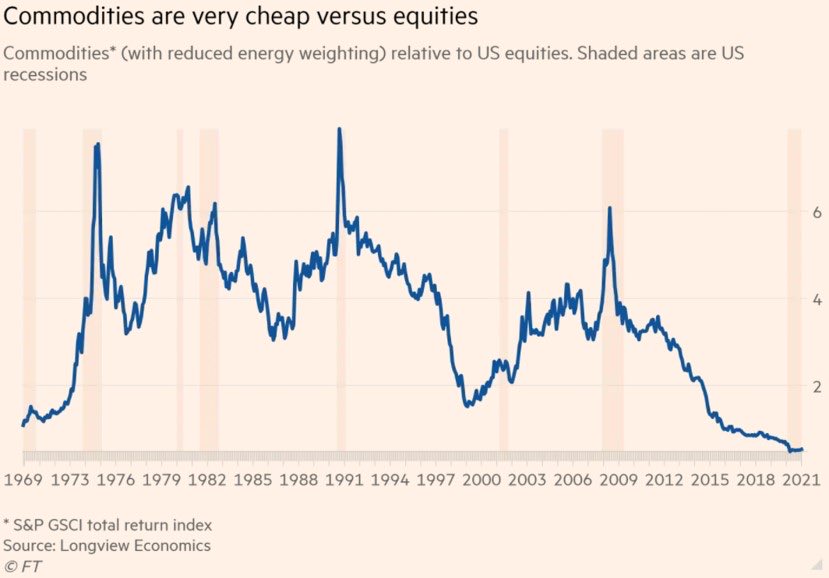
My answer was equities and commodities. I forgot to also mention the U.S. Dollar.

This broad answer is predicated on valuation and selected commodities and currencies which are Oversold.

In other words, insist on a bargain or buy ‘straw hats in winter’.

Many other assets are either expensive or clearly in the speculative realm, thus relying on a greater fool to pay a higher price than they did….

for example, buying a house in Australia will likely mean paying a P/E of 46….

and be careful with some commodities, especially those who have doubled or tripled in price over the past 10 months.may pose a short term trap.

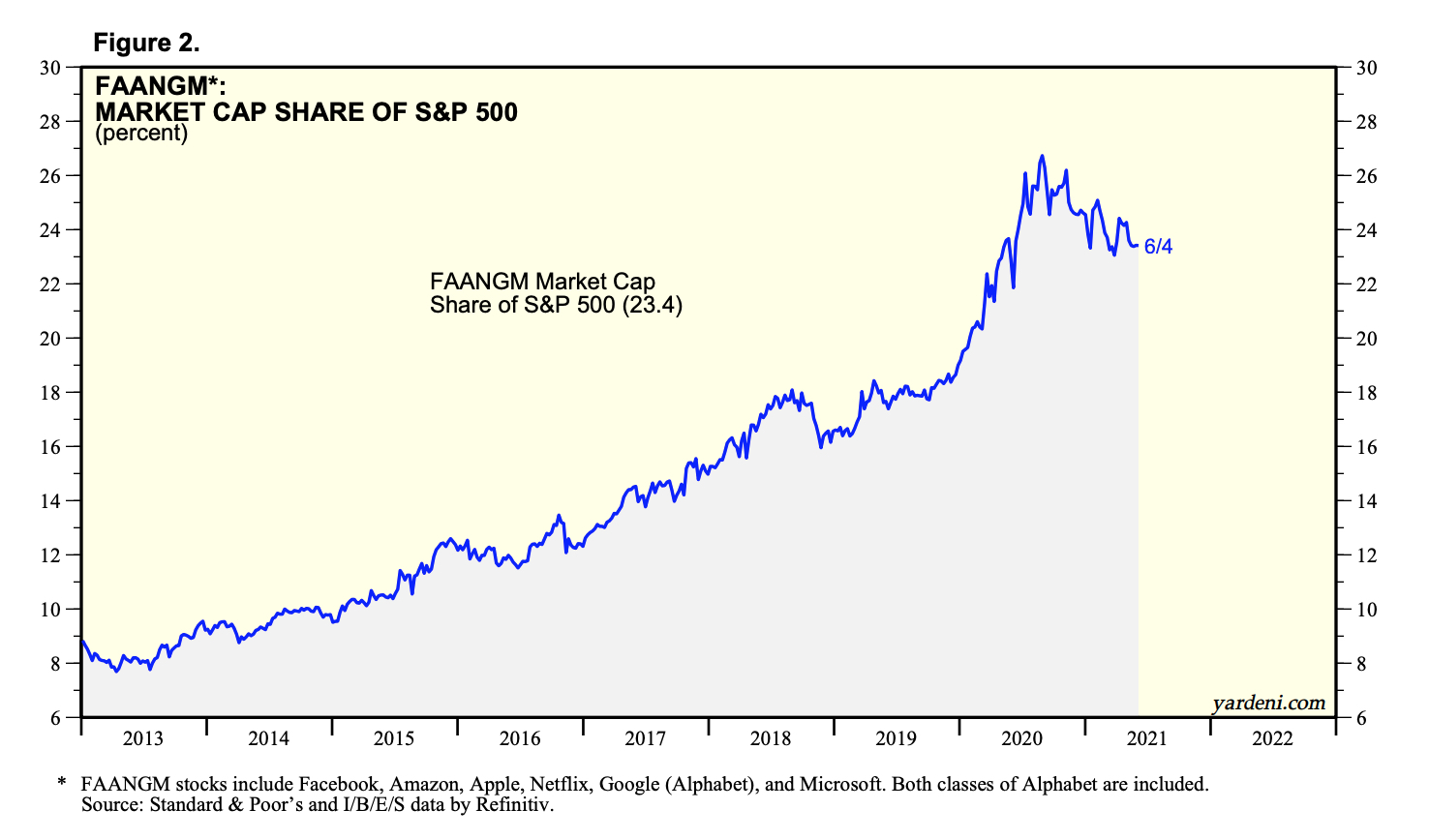
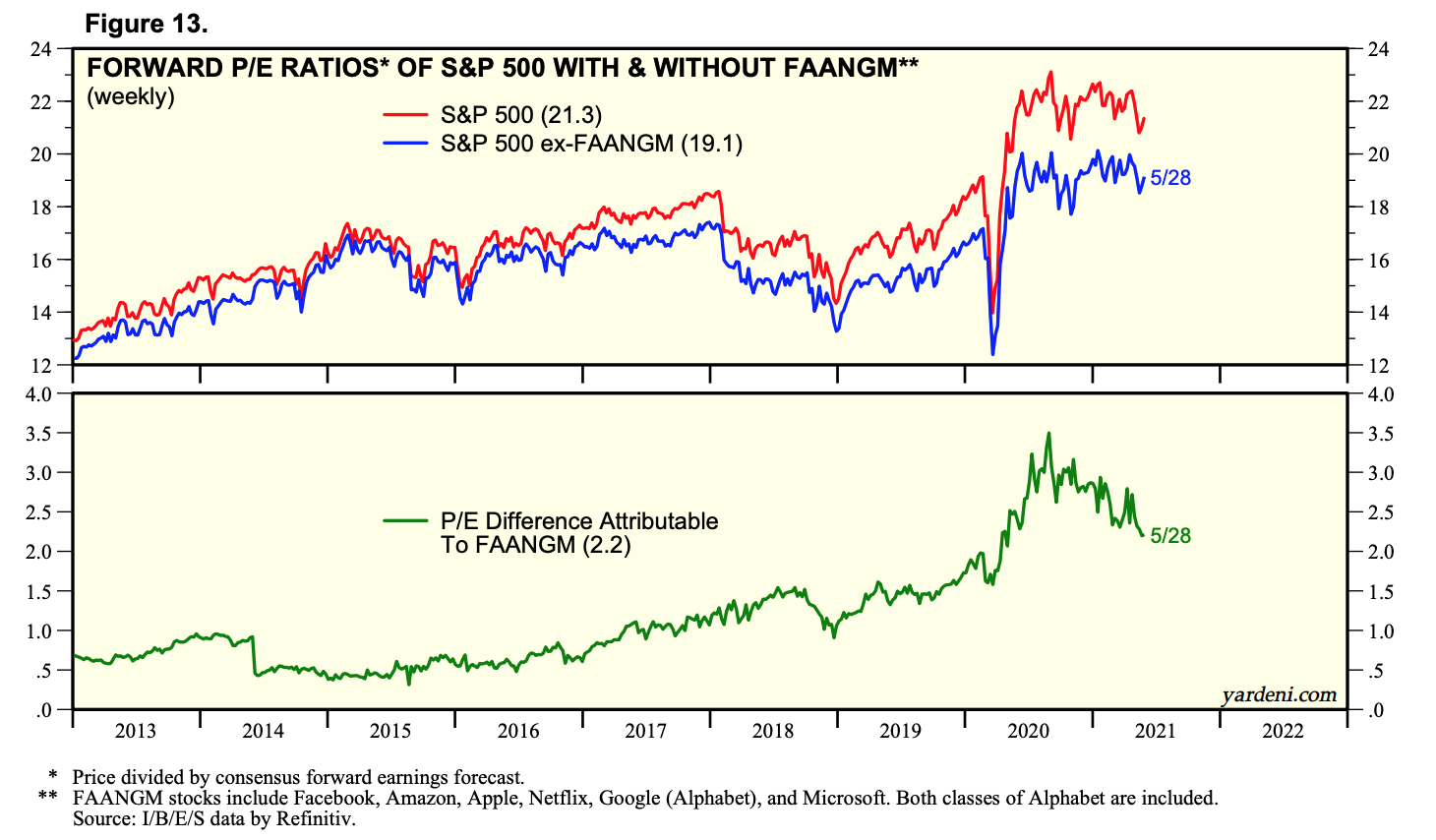
Regarding equities, the S&P 500 seems fairly valued and not offensively priced with a P/E of 19 (when you exclude the 6 FAANGM stocks) as displayed in the image below.

This puts it on an earnings yield of 5.3%, which 3.3 times more than the 1.58% yield on the U.S. 10 Year Government Bond.

It’s P/E Ratio is lower than pre-March 2020 and surprising to many, the S&P 500’s earnings are now 11% higher since pre-pandemic times.

Companies have been booking some handsome profits.

But my view is that index hugging is less attractive that stock-picking.

After all, many stocks have P/E’s of 11.

Alcoa is one of them.

June 7, 2021

by Rob Zdravevski

rob@karriasset.com.au

Macro Extremes (week ending June 4, 2021)


The following assets (on a weekly timeframe) registered an Overbought reading or traded more than 2.5 standard deviations above its rolling mean.

Extremes “above” the Mean (at least 2.5 standard deviations)

Coffee

Live Cattle

Orange Juice

Brazil’s Bovespa equity index

Overbought (RSI > 70)

French & Korean Government 10 year bond yields (5th consecutive week)

The Commodities Indices (the CRB and Bloomberg’s)

Tin (for the 6th week)

Iron Ore (for 6 consecutive weeks)

Gasoil

Heating Oil

Gasoline

WTI Crude Oil

Brent Crude Oil

Lean Hogs (for the 15th consecutive week and its highest price since July 2014)

Soybeans (a return to the list)

Canadian Dollar / USD (where the CAD is exhibiting strength against the U.S. Dollar)

the Dow Jones Industrial Index

U.S. KBW Banking Index (14th consecutive week)

France’s CAC-40 Equity Index (for the 8th consecutive week)

Germany’s DAX equity index

Italy’s MIB equity index

the Oslo, Helsinki and Stockholm equity indices (for the 2nd consecutive week)

and Australia’s ASX 200 (now at its most weekly overbought since late July 2019)


The Overbought Quinella – Both Overbought and Traded at > 2.5 standard deviations above the weekly mean)

Nil

Assets (securities) within my immediate universe which touched the other side of the extreme, being Oversold (where the RSI is < 30) or were at least 2.5 standard deviations below its mean are;

Extremes “below” the Mean (at least 2.5 standard deviations)

Chinese Government 10 Year Bond Yields (3rd consecutive week, of falling yields, indicating persistant buying of Chinese bonds)

AUD / GBP (signifying a strong British Pound)

Oversold (RSI < 30)

Nil

The Oversold Quinella – Both Oversold and Traded at < 2.5 standard deviations above the weekly mean)

Nil

Notes & Ideas:

The most notable observation are various commodities amongst the energy complex have reached Overbought levels.

It remains quite in Foreign Exchange land.

In last week’s note I suggested watching a host of global equity indices which were nearing extreme Overbought readings.

Indeed, we now see more indices join this week’s list.

The British Pound is strong against many currencies and within a whisker of being Overbought across a range of them.

The U.S. 10 year bond yield it yet to break above 1.75%. Yields eased further this past week from last weeks 1.58% to close at 1.55%.

After recent visits to Overbought territory, the past weeks trading has produced several outside bearish reversal’s.


This is where a security trade to higher high (than the previous week) and then makes a lower low (than the previous week) and closes below last weeks close.


Some of assets who made that list and where I look for lower prices include;


EUR/AUD, which means I now look for the Euro to weaken. Meaning, sell your Euro and Buy AUD,

Dow Jones Transport Index (after 12 consecutive weeks being overbought),
Copper (following a 22 week overbought streak),
GBP/USD, suggesting selling British Pounds and

buying US Dollars andGold (in USD).


On the risk monitoring front, I keenly watch the HSCEI index and the Japanese Yen as traded against the AUD and USD.

A month ago, I wrote a seperate note about the rise of the Baltic Dry Index when it touched Overbought extremes. Its price has  declined 25% since then.


Reiterating comments from last week’s note;


Gold as priced in USD and AUD (not in CAD) traded to 2 standard deviations (SD’s) above its weekly mean, although it’s not an ‘extreme’ as per this notes criteria of 2.5 SD’s

and we await break either way in the Russell 2000.

Even though crypto currency, Ethereum is nearly half the price it was 4 weeks, no cryptocurrencies are Oversold yet.

And lastly, Bitcoin is 181% above its 200 Week Moving Average, which is higher from last week’s 175% reading and certainly lower when compared to its 466% peak in mid-April 2021

June 6, 2021

by Rob Zdravevski

rob@karriasset.com.au

Rob Zdravevski
The effect of Biden’s Chinese investing bans

There are so many 2nd and 3rd derivative effects from this news.

https://www.bloomberg.com/news/articles/2021-06-03/biden-to-blacklist-59-chinese-companies-in-amended-trump-order?sref=qLOW1ygh

The headline screams nationalism, protectionism and death to globalisation.

Then there is worthy speculation about trade wars, military tension, broader protest by Chinese manufacturers to curtail supply to American companies and currency manipulation to occupy my time.

n.b. the Chinese Yuan is at a 3 year high versus the USD.

Albeit I understand the security concerns behind this decision but the card has been badly played.

Biden’s strategy is to win votes and maintain control of both houses at the November 2022 mid-term elections, when all 435 seats in the United States House of Representatives and 34 of the 100 seats (14 Democrats and 20 Republicans) in the United States Senate will be contested

He will do that by spending big (enriching or impressing the populous) and being tough on China. Both things Obama never did.

Biden won’t forget that in the middle of Obama’s first term, the Republicans ended unified Democratic control of Congress by winning a majority in the House of Representatives.

My mind tells me that opportunity will lie in declining Chinese stocks (it’s always interesting when there is forced selling), a rising U.S. Dollar (this will impact commodity prices) and rising U.S. interest rates.

China can weaken their currency and sell a bucket load of U.S. Treasuries. They are the largest foreign owner of U.S. debt. This will send yields higher which increases U.S. government borrowing (it’s interest bill) costs and triggers other inflationary risks (? short Manhattan property again ? )

Interestingly, the Australian Financial Review said, “Australia has not developed a similar list of Chinese companies that Australians are not permitted to invest in personally or through a company.”

Can you imagine that ? ….a government telling me if I am allowed to own shares in a company which is traded on a public market where I’ve previously been permitted to trade shares.

June 4, 2021

by Rob Zdravevski

rob@karriasset.com.au

AUD/USD price action

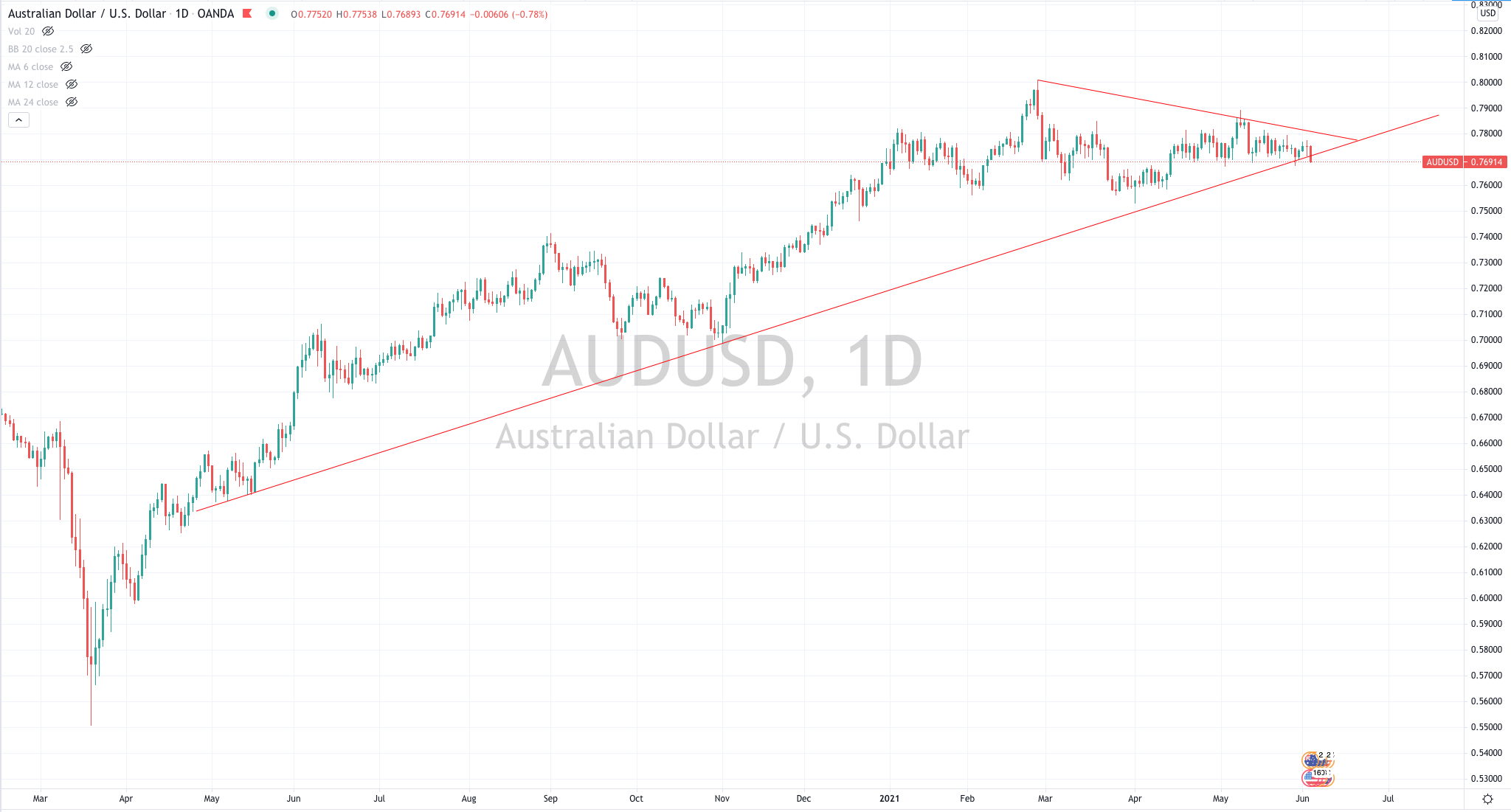
Yesterday’s outside reversal day in the AUD/USD precedes today’s break and move lower. It’s also having a negative effect on Gold and Silver.

The AUD/USD is in a new downtrend but yet to be confirmed as strong, however my other indicators (including moving averages) are adding to the probability that 0.7540 is the next stop.

Then we’ll see if 0.7330 and 0.7000 are plausible.

I’ll also watch the AUD/JPY for further confirmation.

June 3, 2021

by Rob Zdravevski

rob@karriasset.com.au

Mum’s always calling

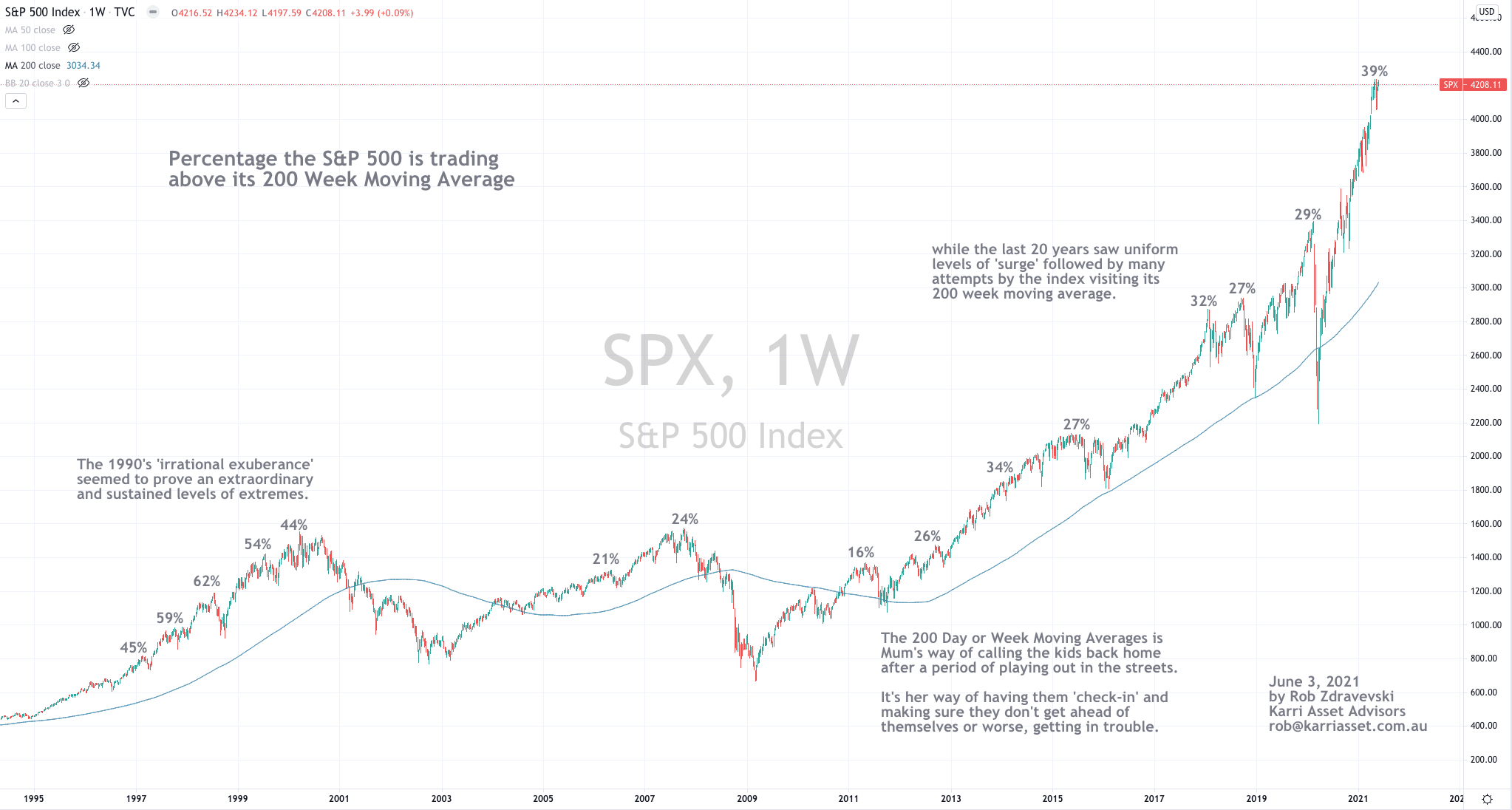
The 200 Day or Week Moving Averages is Mum’s way of calling the kids back home after a period of playing out in the streets.

It’s her way of having them ‘check-in’ and making sure they don’t get ahead of themselves or in some sort of trouble.

June 3, 2021

by Rob Zdravevski

rob@karriasset.com.au

Stagflation, not just simple inflation

I think that the criteria placed and expected by the ESG ‘movement’ will accelerate the current rise in inflation.

In fact, I believe that ‘ESG’ requirements pose a risk towards economies experiencing a period of stagflation.

The supply chain disruptions coupled with a return to normal demand (if not slightly higher due to increased savings pools) and rising food prices are part of the normal inflationary effects.

But when you combine ESG pressures and expectations along with legislation, we are beginning to see a decrease in industrial capacity.

Collectively, this will occur through a combination of facilities closing, a dearth in capital expenditure and difficulty gaining new approvals for replacement construction.

Stagflation occurs when we see inflation coupled with stagnating or falling GDP and usually declining productivity.

It’s a most fascinating topic occupying my time how I position investment portfolios.

June 1, 2021

by Rob Zdravevski

rob@karriasset.com.au

Newsletter – Building for Inflation or Stagflation

My latest newsletter mentions how I’m building portfolios for a rising inflationary environment.

https://mailchi.mp/karriasset/position-for-inflation

The Woodside anomaly

The ‘de-correlation’ and anomaly of the Woodside Energy (WPL.AX) share price.

May 31, 2021
by Rob Zdravevski
rob@karriasset.com.au

Trusting China (Part 1)

At a recent investment forum, the topic of the prospect of a U.S. Dollar losing its reserve currency status was raised.

Consensus pointed at the Chinese Yuan (Renminbi) taking over that mantle over varying range of timeframes.

But when I asked the gathering would they buy the Chinese currency once it becomes the world’s reserve currency, the majority of answers featured the response ’No’ and “I don’t trust the Chinese’.

But I thought,

we have been happy purchase products manufactured in China, for low competitive prices.

In fact, we probably aren’t aware how many Chinese made items we actually consume or utilise, ironically mostly commissioned/ordered by Western corporations.

And we are equally happy for ’the Chinese’ to buy the goods or assets which ’the West’ wants to sell to them.

After all, China flirts with Japan as being the largest owner of U.S. Government Bonds.

So, I pondered the hypocrisy of ‘westerners’.

The thing is…..we will need to, at some point ’trust the Chinese’

Interestingly, JP Morgan Chase CEO, Mr Jamie Dimon (in the recent Senate Banking Committee Hearings) said that Chinese banks will be the prominent competition for the American banking industry in the next 30 years.

<end of Part 1>

May 31, 2021
by Rob Zdravevski
rob@karriasset.com.au

Macro Extremes (week ending May 28, 2021)

The following assets (on a weekly timeframe) registered an Overbought reading or traded more than 2.5 standard deviations above its rolling mean.

Extremes “above” the Mean (at least 2.5 standard deviations)

Chinese Government 10 Year Bond Yields

Overbought (RSI > 70)

French & Korean Government 10 year bond yields (4th consecutive week)

The Commodities Indices (the CRB and Bloomberg’s)

Aluminium (following a 12 week streak and rest last week, it returns to the list, )

Tin (for the 5th week)

Copper (returning after last week’s break from a 22 week overbought streak)

Gasoil

Heating Oil

Lean Hogs (for the 14th consecutive week and its highest price since July 2014)

U.S. KBW Banking Index (13th consecutive week)

Dow Jones Transport Index (12th consecutive week)

France’s CAC-40 Equity Index (for the 7th consecutive week) and

Spain’s IBEX (3rd week)

the Helsinki 25 and Stockholm 30 equity indices


The Overbought Quinella – Both Overbought and Traded at > 2.5 standard deviations above the weekly mean)

Canadian Dollar / USD (4th consecutive week of the quinella, where the CAD is exhibiting strength against the U.S. Dollar)

Assets (securities) within my immediate universe which touched the other side of the extreme, being Oversold (where the RSI is < 30) or were at least 2.5 standard deviations below its mean are;

Extremes “below” the Mean (at least 2.5 standard deviations)

Nil

Oversold (RSI < 30)

AUD / GBP (signifying a strong British Pound)

USD / CNY (a weak USD is translating into a strong Chinese Renminbi)

The Oversold Quinella – Both Oversold and Traded at < 2.5 standard deviations above the weekly mean)

Nil

Notes & Ideas:

The most notable observation is that many assets which were Overbought over the past few weeks have either mean reverted or are on their way to doing so.

Something to watch are a host of global equity indices are nearing extreme Overbought readings.

The British Pound is strong against many currencies and within a whisker of being Overbought across a range of them.

A deletion from the list is Iron Ore, which was in its 7th week in overbought territory. It’s price fell 8% for the week to close at $189. Incidentally, it fell 15% during the week the it touched a low of $176. This is all considerably lower from its $225 high, only a few weeks ago,

The U.S. 10 year bond yield it yet to break above 1.75%. Yields eased further this past week to close at 1.58%.

Last week, I wrote that the the Russell 2000 seems to be in the early stage of a new downtrend. This is yet to be confirmed as it rose 2.5% in the past week. Interestingly, the index has been trading sideways since early February and odds are increasing of a break either way.

Gold as priced in USD and AUD (not in CAD) traded to 2 standard deviations (SD’s) above its weekly mean, although it’s not an ‘extreme’ as per this notes criteria of 2.5 SD’s.

And lastly, Bitcoin is 175% above its 200 Week Moving Average, which is down from last week’s 196% reading and certainly lower when compared to its 466% peak in mid-April 2021

No cryptocurrencies are Oversold yet.

May 29, 2021

by Rob Zdravevski

rob@karriasset.com.au