Macro Extremes (week ending July 9, 2021)

The following assets (on a weekly timeframe) registered an Overbought reading or traded more than 2.5 standard deviations above its rolling mean.

Extremes “above” the Mean (at least 2.5 standard deviations)

USD/KRW (does a stronger USD and weaker Korean Won mean cheaper Samsung phones and Hyundai cars?)

Overbought (RSI > 70)

Brent Crude Oil

WTI Crude Oil

Gasoil

Heating Oil

RBOB Gasoline

Tin (for the 11th week)

Iron Ore

Hot Rolled Coil Steel

France’s CAC-40 equity index (for the 13th consecutive week)

Switzerland’s SMI equity index (for the 4th week)

the Nasdaq 100

the S&P 500

and the Copenhagen, Stockholm and Helsinki equity indices.

The Overbought Quinella – Both Overbought and Traded at > 2.5 standard deviations above the weekly mean)

Natural Gas

Assets (securities) within my immediate universe which touched the other side of the extreme, being Oversold (where the RSI is < 30) or were at least 2.5 standard deviations below its mean are;

Extremes “below” the Mean (at least 2.5 standard deviations)

AUD/USD (for the 4th consecutive week)

AUD/JPY (a weaker AUD and a stronger Yen suggests ‘risk-off’ is tiring)

Nikkei 225 equity index

Hang Seng China Enterprise Index (HSCEI) <see note>

Hang Seng (HSI) equity index 

U.S. Government 10 year bond yields (10’s),

the Australian (10’s),

Canadian, Chinese, U.K., Japanese and Swedish 10’s

the U.S. 10 year minus 2 year yield spread 

Oversold (RSI < 30)

Nil

The Oversold Quinella – Both Oversold and Traded at < 2.5 standard deviations above the weekly mean)

Nil

Notes & Ideas:

This past week significantly produced a new wave of moves of 2.5 standard deviations below the Weekly mean, but not a single Oversold RSI Stochastic reading.

This tells me the downside moves are a fake-out and represent a trading Buy or at least, a bounce.

It’s time to prepare for when the new occurrences of extremes arise.

The week’s dominant price movers mainly featured losers in the soft agricultural’s, weakness in Asian equity markets https://robzdravevski.com/2021/07/08/chinese-stocks-are-not-popular/ and a lower AUD versus the U.S. Dollar and the Japanese Yen, some which are listed below.

Corn (10%), Wheat (6%), Sugar (5%), Soybeans (4%), Aluminium (3%), Cattle (2%), HSCEI (5%), Hang Seng (3%), Nikkei 225 (3%), Korean KOSPI (2%), Bitcoin (4%), Ethereal (8%) and Lumber (4%) which is nearing a $700 target.

And other commodity commentary saw Precious Metals have a benign week and while Brent Crude has a 7% weekly range (from top to bottom), it only declined 0.7% for the week from its previous close. Importantly, Brent remains in Overbought territory, as does a host of the energy complex.

In other big news, the Nasdaq 100 and the S&P 500 are making (yet, again) new All-Time Highs and still hanging around in Overbought territory.

Although my recent post suggests that it’s plausible and perverse that we see a higher leg in these indices depending on what the bond market does, as mentioned in this post.

Other equity indices closed near flat for the week, although ominously many had wide and whipsawing ranges which saw them either Bearish Outside Reversal Weeks (Singapore Straits Times) or where many made ‘lower highs and lower lows’, including the SOX Semiconductor Index, the Russell 2000, the S&P MidCap 400, the U.S. KBW Banking Index and the Dow Jones Transports.

The U.S. 10 year bond yield it yet to break above 1.75%. The yield fell to 1.36% from last week’s 1.43%, although bouncing from a 1.25% low. The 10’s remain bound in a larger range but we watch it broader capital markets could become explosive is the 10’s break either below 1.25% or above 1.65%.

And lastly, Bitcoin is trading 146% above its 200 Week Moving Average, which is slightly higher than last week’s 154% reading and certainly lower when compared to its 466% peak in mid-April 2021.

July 11, 2021

by Rob Zdravevski

rob@karriasset.com.au

The 10 Year bond yield should reverse higher

In the chart below, you can see that last night the U.S. Government 10 Year Bond Yield (‘the 10’s’) touched the lower end of a daily 2.5 standard deviation point and kissed the supporting trend line.

They are a ‘hair’ away from being Oversold. It’s now plausible that the yield in the 10’s move back to the 1.58%

This translates into a Long entry point for U.S. financial and cyclical equities……..and also for some selected commodities such as Brent Crude, Soybeans, Sugar, maybe Corn, perhaps Platinum and certainly Copper.

For the past 2 weeks, the media has been heralding the end of the ‘reflation trade’. It should prove to be momentary.

If one is interested and ‘ballsy’, rising yields in the 10’s should provide a short trade for your high price to revenue stocks. Think Peloton, Snap, Pinterest etc.

* not personal advice…do your own work or seek professional advice

July 9, 2021

by Rob Zdravevski

rob@karriasset.com.au

Watch the yield spread between the 10 & 2 year bonds

It’s an interesting market day developing for the U.S. session.

The chart below is an observation of when the spread between the 

U.S. 10 year yield minus the U.S. 2 year yield reaches an oversold “daily” reading and how it portends higher S&P 500 prices.

In the vain hope of being a trader, there is an opportunity to pick up some stocks which have been weaker over the past few days.

There is much noise in today’s European session (preceding the July 8 U.S. business day) with broad bond buying resulting in declining government yields, falling U.S. equity futures prices and weakness in European and Asian equities.

Hasn’t the stock market preferred lower bond yields, thus making equities more attractive?

……then why the media hubbub today about the weakness in the equity markets due to lower bond yields?

Lower bond yields are good for equities.

In the meantime, readers can refer to my recent posts about the range of the U.S. 10 year bond yield (and the spread) is in and the effect it should have on the stock market if it breaches either side.

https://robzdravevski.com/2021/06/22/interest-rate-watch/

https://robzdravevski.com/2021/06/22/what-the-10s-2s-spread-may-tell-us/

https://robzdravevski.com/2021/05/09/watching-the-u-s-10-year-bond-yield/

July 8, 2021

by Rob Zdravevski

rob@karriasset.com.au
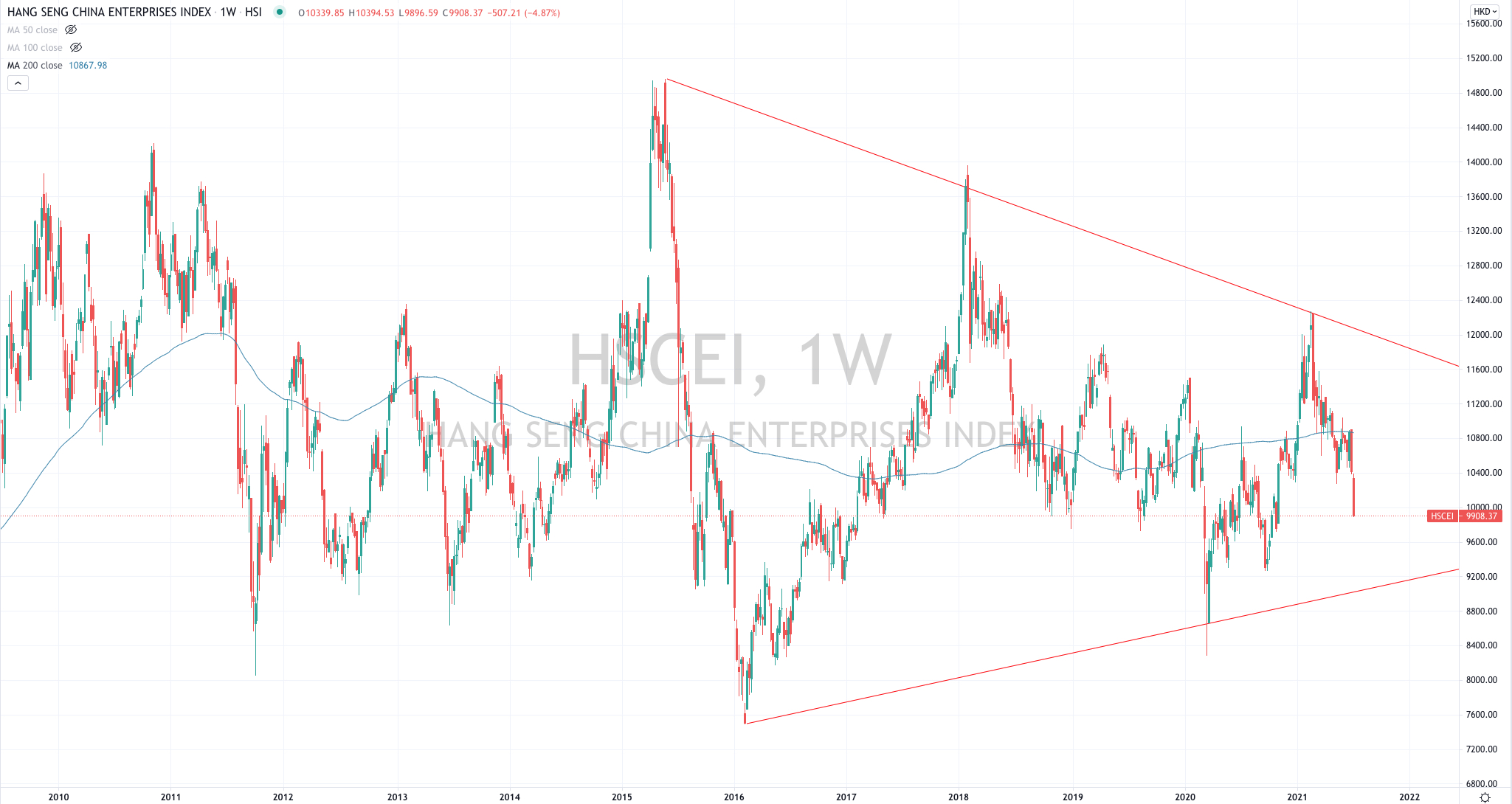
Chinese stocks are not popular

A most interesting contrarian, oversold investment opportunity on my radar is the Hang Seng China Enterprises <equity> Index (“HSCEI”).

The HSCEI serves as a benchmark that reflects the overall performance of Mainland Chinese securities listed in Hong Kong.

Index constituents include Bank of China, Sinopec, Alibaba, Conch Cement, Geely Auto, CNOOC, China Mobile, ICBC, CITIC and Tencent.

With all the hoopla surrounding restrictions of where Chinese companies are permitted to list their publicly quoted securities, temporary mis-pricing is often what occurs at such a moment.

The HSCEI has declined 20% from its February 2021 peak.

Why would Chinese authorities ruin their ascension onto the global capital markets scene by restricting foreign capital interest and retarding their own companies seeking liquidity?

It doesn’t make sense and I think there is some type of smokescreen (tactic) behind the latest announcements which may include inflicting a little pain on U.S. investors or flexing a little (soft-power, economic) muscle.

Don’t lose sight of the larger part of a story. China wants to have a financial services and capital market industry similar to the Western World.

They are hiring ‘western’ skills and offering full banking licenses to ‘western’ firms, just so they can be ‘like us’.

It is in China’s interest to bid for foreign capital.

For example, China is the world’s 2nd largest bond market. Today, the foreign share of the mainland Chinese bond market is 3.5%, which has risen from 1.2% at the end of 2017.

Interest in Chinese capital markets (bonds or stocks) will continue to grow with news such as $300 billion to enter the bond market as a result of FTSE Russell officially adding China to its World Government Bond Index in October 2021.

In order to sniff out an investment opportunity, it’s important to filter or dissect the current ‘noise’.

July 8, 2021
by Rob Zdravevski
rob@karriasset.com.au
* not investment advice, just commentary

Trading bounce in Crypto is done

For the crypto traders, this morning’s technicals are giving me trading sell signals for BTC ($33,389) and ETH ($2,289).

The respective 13% and 29% bounce from my June 24-26 buying calls (see previous posts) is surely adequate. Although I’m not sure if that’s adequate for the crypto crowd?

….now I’m looking for a test of those recent lows.

What we just saw was a trading bounce in the midst of medium term downtrend.

For example, if Bitcoin breaks back below $29,500, then the $24,000 area is next with a visit to $19,600 representing a good shake-out.

July 8, 2021

by Rob Zdravevski

rob@karriasset.com.au

OPEC crimping supply is curtains for the oil price

The sub-headlines in the overnight OPEC oil news read;

“Dispute between core members blocks deal to boost output”
“Coming days will determine whether the conflict will escalate”

https://www.bloomberg.com/news/articles/2021-07-05/opec-in-crisis-as-specter-of-destructive-infighting-looms-again?sref=qLOW1ygh

I think OPEC’s disarray is NOT a positive for the oil price.

OPEC+’s abstinence of adding supply will see slack (supply) found elsewhere due to the lure of current oil prices and adds weight to my trading call of a temporary peak occurring soon as I wrote in last week’s post.

https://robzdravevski.com/2021/06/28/looking-for-interim-peak-in-crude-oil/

The price of Brent is likely to see a $1 or $2 spike in tonight’s (today’s) session, as the U.S. wakes up from its 4th July holiday break)….

which all coincides with marginal and futile Oil Price upgrades by broking firms to a measly $80.

and if you are establishing a new “long’ position here, you must wonder what last few percent are you trying to squeeze out?

July 6, 2021
by Rob Zdravevski
rob@karriasset.com.au

A 14% rise and no one blinks

Isn’t this just extraordinary ?

And I do mean extraordinary, yet it seems to be accepted as normal or expected.

The S&P CoreLogic Case-Shiller U.S. National Home Price NSA Index, covering all nine U.S. census divisions, reported a 14.6% annual gain in April, up from 13.3% in the previous month.

https://www.spglobal.com/spdji/en/corporate-news/article/sp-corelogic-case-shiller-index-shows-annual-home-price-gains-surged-to-146-in-april/

My take on the S&P 500

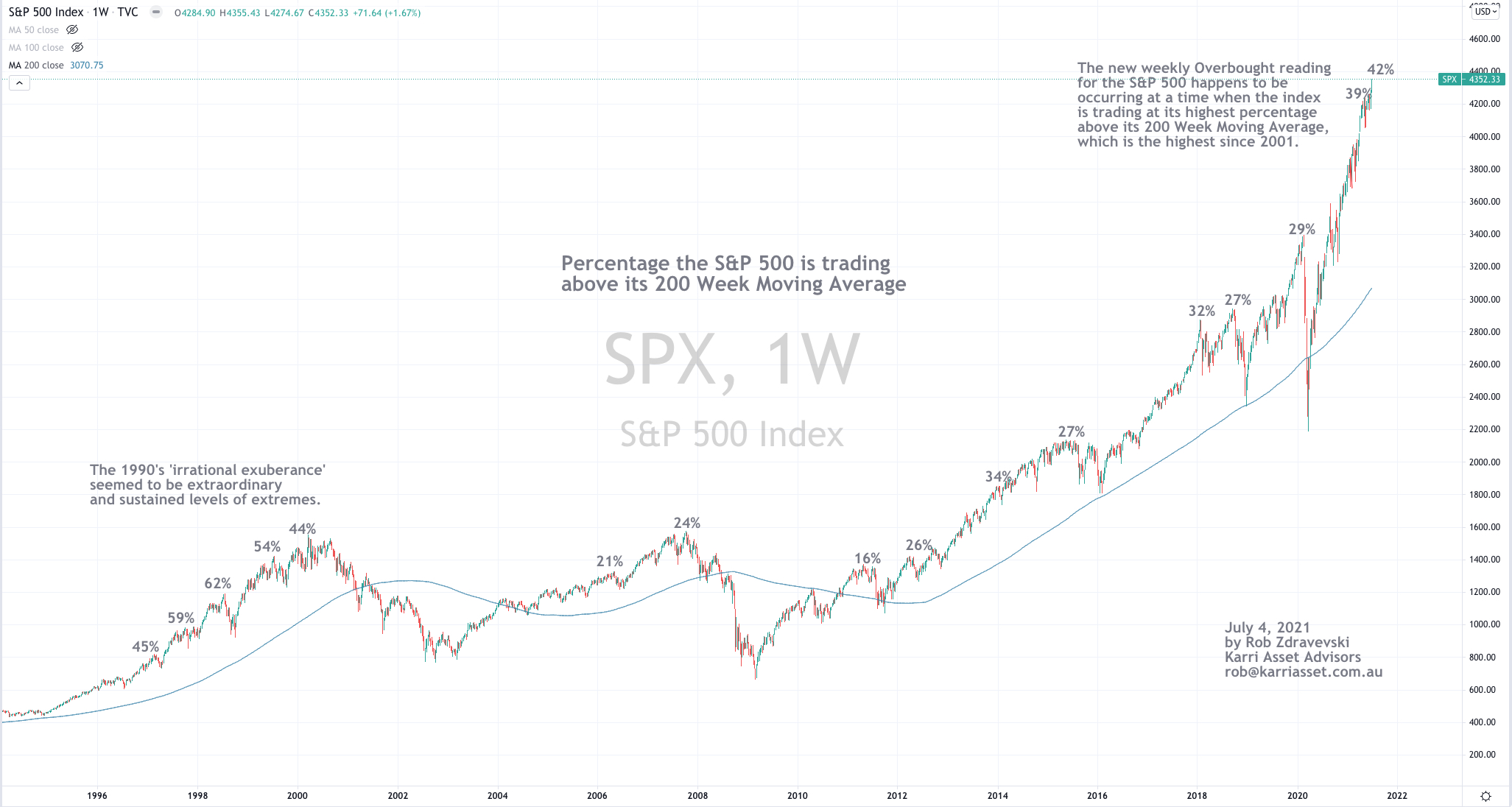
The S&P 500 is trudging higher and has registered a new Weekly Overbought reading.

This Overbought moment is also occurring with some coincidence of it also trading at its highest percentage above the 200 Week Moving Average (WMA).

This is long-term stuff.

These levels were last seen in 2007 and 2001.

It seems logical for the S&P 500 to mean revert over the coming 2 years but keep in mind the mean will continue to roll higher, perhaps to 3,500 in mid-2022.

So, if the S&P 500 ‘rolls over’ and meanders from current levels back to the 200 WMA, it’ll result in a 20% decline and only mean we are back to the same levels seen in November 2020 (for context, that’s 8 months ago)

This is why I think index based/ETF type (overly diversified) investing will provide poor results over the coming 2 years and the ‘age of the stock picker’ is already upon us.

Although (and perhaps confusingly), if you reference this link, the broader market also has every reason to carry on higher, much like the late 1990’s and perhaps more so when coupled with today’s liquidity and with a risk-free rate (the 10 year bond yield) which is now averaging ~ 1.8% as opposed to the 5.5% in the late 1990’s…..all, until the 10 year minus 2 year yield spread moves above 2%.

July 5, 2021

by Rob Zdravevski

rob@karriasset.com.au

Macro Extremes (week ending July 2, 2021)

The following assets (on a weekly timeframe) registered an Overbought reading or traded more than 2.5 standard deviations above its rolling mean.

Extremes “above” the Mean (at least 2.5 standard deviations)

Nil

Overbought (RSI > 70)

Tin (for the 10th week)

Gasoil

Heating Oil

RBOB Gasoline

WTI Crude Oil

Brent Crude Oil

Iron Ore

Hot Rolled Coil Steel

Orange Juice 

the CRB (commodities) index

France’s CAC-40 equity index (for the 12th consecutive week)

Korea’s KOSPI equity index

Switzerland’s SMI equity index (for the 3rd week)

the Nasdaq 100

the S&P 500

and the Copenhagen, Stockholm and Helsinki equity indices.


The Overbought Quinella – Both Overbought and Traded at > 2.5 standard deviations above the weekly mean)

Natural Gas

Assets (securities) within my immediate universe which touched the other side of the extreme, being Oversold (where the RSI is < 30) or were at least 2.5 standard deviations below its mean are;

Extremes “below” the Mean (at least 2.5 standard deviations)

AUD/USD (for the 3rd consecutive week)

Oversold (RSI < 30)

Nil

The Oversold Quinella – Both Oversold and Traded at < 2.5 standard deviations above the weekly mean)

Nil

Notes & Ideas:

The list of extreme readings remains light as new trend are developing and mean reversions take place.

It’s time to prepare for when the new occurrences of extremes arise.

In the past week, most price volatility occurred in the commodity and equity markets, while currencies and bonds remained subdued. 

Movers for the week include…

Aluminium +3%

Hot Rolled Coil Steel +7%

Natural Gas +6% (see my break-out trading call)

Leans Hogs rose 6% (after falling 17% in the past 2 weeks) 

Corn rose 7%, recouping last week’s 8% decline

Soybeans +10%

The biggest news is the Nasdaq and S&P 500 rose (2.7% and 1.7% for the week respectively) to make new All-Time Highs and reach Overbought territory.

All while the Banking and Transports indices are not. 

Furthermore, the Russell 2000’s high is back on March 15, 2021 and the MidCap 400 high was April 26, 2021.

Other notable moves included a 3.5% decline in the Hang Seng Index and a 4.2% fall in the Hang Seng China Enterprises Index (HSCEI) 

Korea’s KOSPI and Australia’s ASX 200 were flat on the week and that was enough have their RSI reading ease below the Overbought 70 mark.

The U.S. 10 year bond yield it yet to break above 1.75%. The yield fell to 1.43% from last week’s 1.53%. The 10’s remain range bound. Markets could become explosive is they break either below 1.25% or above 1.65%.

A mostly benign week for Cryptocurrencies except for Ethereum’s 12% rise. 

Here is my Trading Buy call.

And lastly, Bitcoin is trading 154% above its 200 Week Moving Average, which is slightly higher than last week’s 149% reading and certainly lower when compared to its 466% peak in mid-April 2021.

July 4, 2021

by Rob Zdravevski

rob@karriasset.com.au

Westpac’s hitting resistance and holding support

Another price chart I am watching is that of Westpac Bank (WBC.AX).

I often post technical charting comments on Linkedin but my equity investing work always starts with identifying themes or trends and then moves onto fundamental mathematical analysis (balance sheets, income statements etc)…….

I use technical analysis to help with my price entry and exit as numbers and price charts make wonderful patterns which also assists with probability.

I am fundamentally bullish on banking stocks, however I have lightened some bank holdings as they recently reached historically overbought prices and fully valued valuations.

In Westpac’s case, it was a prudent thing to do. After all, the stock rose 57% from $16.50 (my buy price) to $26 within 10 months.

The high was $27.12.

It’s currently $25.60.

The share price capitalised what I thought was more than 2 years worth of earnings. So at that price (in June 2021) I asked myself do I want to pay this price (buy the stock) which is already factoring in 2024’s earnings?

From here, I think Westpac’s price trades below $24.50 (breaking that lower trend line) and makes a visit to $22.30.

Buying it 13% cheaper would be nice.

p.s. that line floating through chart is the 100 week moving average.

I’ll review this picture in late July/early August.

* this is not advice, just personal commentary.

July 2, 2021

by Rob Zdravevski

rob@karriasset.com.au