‘Higher Highs’ not yet forthcoming

What I am seeing in many markets and securities is akin to the attached chart of the S&P MidCap 400 Index.

Trend lines have been held or broken, some recent lows were higher than the previous lows…..

but I’m watching whether ‘higher highs’ are made and breach their recent peaks and not so much their all-time highs.

For the S&P MidCap 400, that ‘recent’ high that needs to be broken lies at 2,646.

Until any such break, it remains a range bound trading market where trends are unconvincing and weak.

Incidentally, today’s ‘daily’ price action (unlike the weekly chart shown below) saw many indices and stocks perform a bearish outside reversal day.

It is worth noting albeit one day doesn’t make a trend.

January 19, 2023

by Rob Zdravevski

rob@karriasset.com.au
Mmmm, Coffee

Nearly a year ago, I called a 50% decline in the price of Coffee (Arabica Beans)

While that view was formed and based on a few factors, in that note, I shared a chart denoting the ‘extreme’ percentages that Coffee was trading above its 200 week moving average.

Back then, early February 2022, Coffee was trading at $2.60. 

To be particular, my call was for the price of Coffee to trade back down to it 200 week moving average.

Today, it is trading at $1.52 which is right on its 200 week moving average.

Then 2 months ago, I provided an update about this trade

That original note was designed to suggest that the price of Coffee had no business being up in that stratosphere, while it also hinted and translates into some other points;

a) buyers/importers of coffee should consider taking a chance and not locking in future delivery at those high prices, 

b) it was a terrific time for coffee farmers to sell their wares,

c) companies such as Nestle and Starbucks would have experienced some margin compression,

d) speculators should be selling and,

e) other speculators may consider ‘shorting’ Coffee.

Today, these messages can start to be reversed.

And now….

So mean reversion is complete, however my work suggests reasonable enough probability of lower prices ahead, putting my more heavier accumulation somewhere between $1.10 – $1.23.

Incidentally, the recent intra-day low seen was $1.42.

Albeit my strategy is to nibble at the position (with a lower percentage allocation) at current prices, I will wait for my signals and lower prices, before increasing the size of the allocation.

January 17, 2023

by Rob Zdravevski

rob@karriasset.com.au

Oversold AUD/JPY portends notable low in Oil

The study below shows that WTI Crude Oil makes a notable low approximately 6 weeks after the AUD/JPY first enters weekly oversold territory. 

I’d say that 3 occurrences of a weekly Oversold AUD/JPY in 22 years is considered ‘notable’.

This could be my ultimate illustration definition of ‘waiting for your pitch’.

Should this study hold true, at this stage, the AUD/JPY is yet to enter Oversold territory and so the Oil price is not at a ‘monumental’ low.

January 16, 2023

by Rob Zdravevski

rob@karriasset.com.au
Commodities are not cheap……

not in their own right nor when compared to equities.

In the chart below, the notations (and accompanying ellipses) denote the moment and percentage amount that the CRB Index is trading below its 200 week moving average

Commodities are cheap (more so versus equities) when the CRB Index trades below its 200 week moving average and registers a weekly Oversold reading.

It also signalled a reasonable time to strategically increase your allocation to equities.

There have been only 7 notable blocks when this has happened over the past 30 years.

Today, commodities aren’t cheap compared to equities and I’m not getting any convincing signal to pile into equities.

In both asset classes, I am just trading between the cycle, while maintaining a higher than normal cash allocation.

January 15, 2023

by Rob Zdravevski

rob@karriasset.com.au
Macro Extremes (week ending January 13, 2023)

A weekly Macro, Cross Asset review of prices trading at extremes which may generate future investment ideas and opportunities.

The following assets (on a weekly timeframe) registered an Overbought or Oversold reading and/or have traded more than 2.5 standard deviations above or below its rolling mean.

Extremes “above” the Mean (at least 2.5 standard deviations)

Copper

CNH/USD

Overbought (RSI > 70)

German 2 year government bond yields

Gold (in Canadian Dollars)

Cattle

Istanbul’s BIST Index

SGD/USD

The Overbought Quinella – Both Overbought and Traded at > 2.5 standard deviations above the weekly mean)

Japanese 10 year bond yield

Extremes “below” the Mean (at least 2.5 standard deviations)

Turkish 10 year government bond yields

Oversold (RSI < 30)

U.S. 5 year yield minus U.S. 3 month bill yield spread

Chile 10 year bond yield

Urea (U.S. Gulf) 

The Oversold Quinella – Both Overbought and Traded at > 2.5 standard deviations above the weekly mean)

None

Notes & Ideas:

This week’s biggest news was the continuing rally in equities in Europe.

Over the past 2 weeks, the AEX and the DAX are both up 8.3%.

Other parts of the world rallied, breaking multi-week losing streaks.

And the 1.9% weekly advance in the U.K.’s FTSE 100 saw it close at an all-time high. 

Who would’ve thought!

while Australia’s ASX Small Caps index has risen 6% in the past 2 weeks.

Bond yields fell once again. 

We are seeing the simultaneous buying of bonds and equities.

For example, since October 17th, 2022, (when many bonds were hitting ‘weekly’ Oversold Extremes and equities were not) the IEI bond ETF has risen from a price of $112.30 to $117.13, which is an advance of 4.3%. 

The IEF bond ETF has risen 7% over the same time frame…..the S&P 500 has climbed 6.6% since that same date.

Inversely, Canadian 10’s are now 2.90% and no longer 3.75%. U.S. 10’s are 3.51% and not 4.33%.

A host of commodity prices rose this week with the recently depressed Aluminium and Lumber posting the largest gains.

Copper made a new visit to an Overbought criteria. 

While most of the energy complex rallied, I’m not convinced in a change of trend as Crude, Gasoil and Heating Oil had ‘inside week’s’.

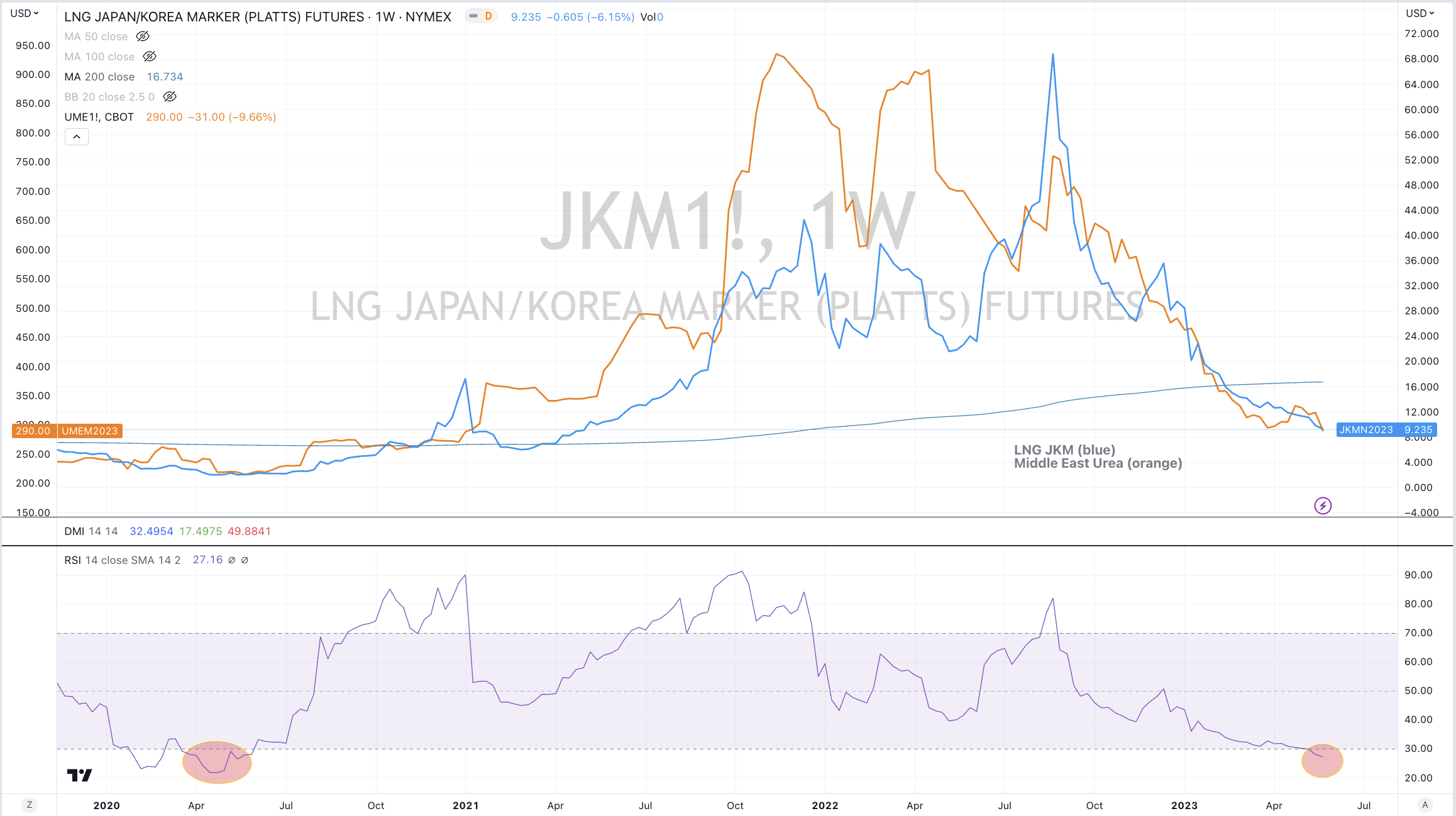
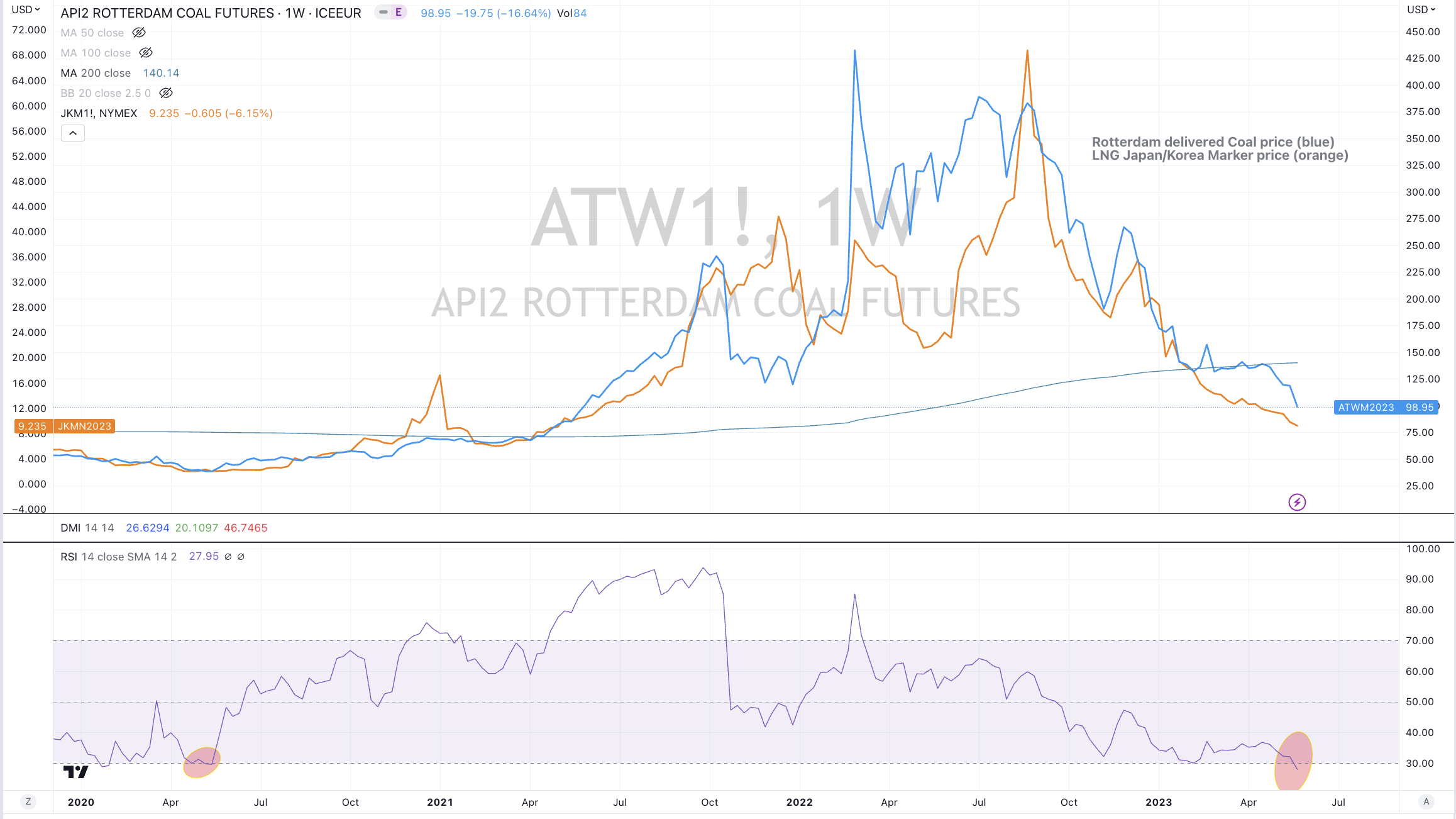
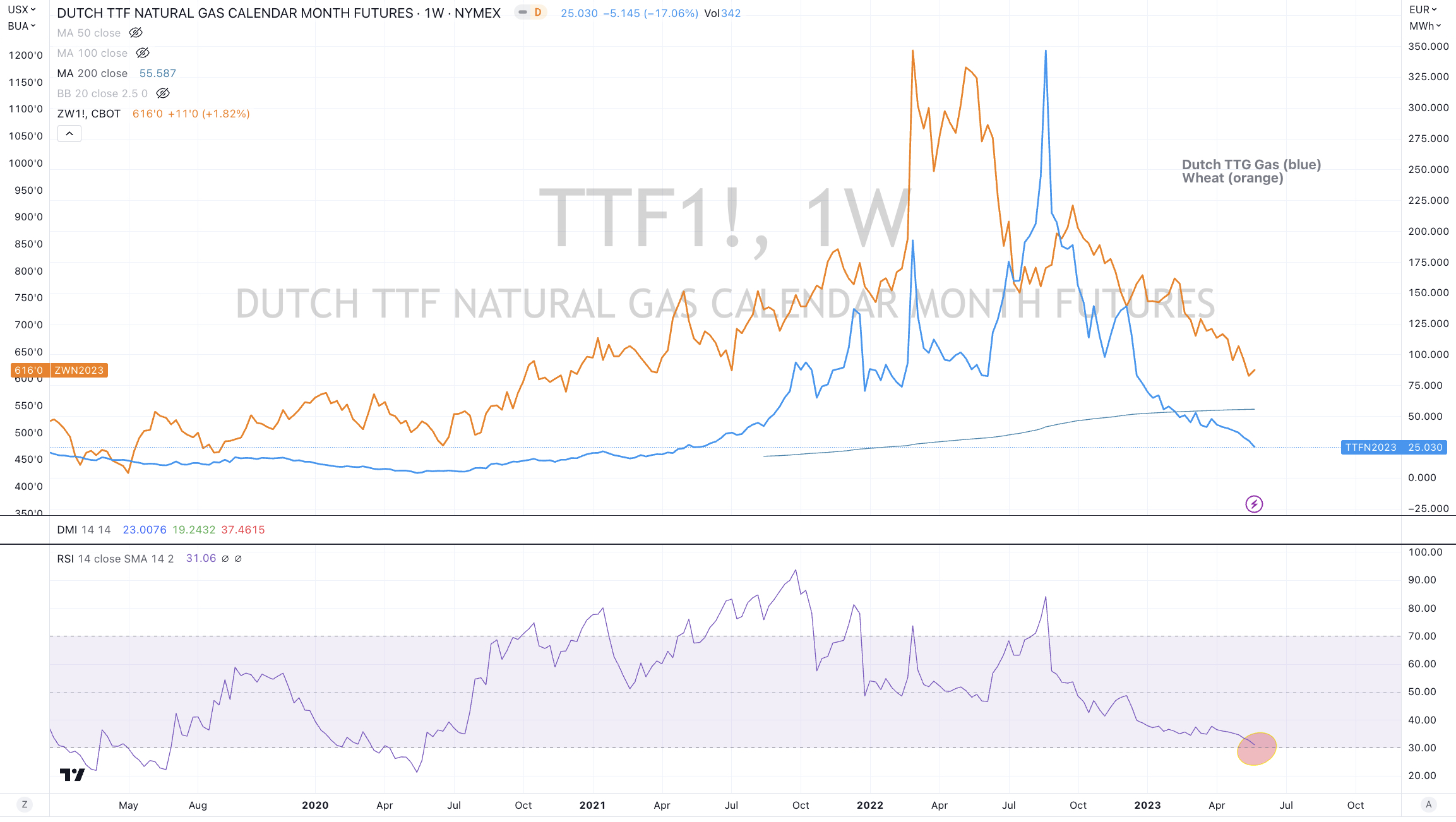
In the negative category were the various Gas contracts with the Japan Korea LNG Marker (JKM) and Dutch TTF Gas prices closing at their lowest levels in 15 months.

JKM is now $20 as opposed to its $68 only 5 months ago

And Dutch TTF Gas is $65 and no longer the $320 we saw in August 2022.

Furthermore, Henry Hub Natural Gas has tanked 64% in the past 5 weeks, Rotterdam delivered Coal has slumped 42% in 6 weeks, Coffee has declined 11% in only 3 weeks and Nickel has fallen 11% in the past 2 weeks.

On a jolly note, Orange Juice and Cattle are flirting with all-time highs.

I’m talking about prices higher than the pre-Billy Ray Valentine years.

The larger advancers over the past week comprised of;

Aluminium 13.9%, Bloomberg Commodity Index 3.2%, Cocoa 1.8%, China Coal 5.1%, WTI Crude Copper 7.8%, Heating Oil 8.4%, Lumber 17.2%, Tin 6.5%, Gasoline 12.8%, Sugar 4.1%, CRB Index 4.2%, Brent Crude 8.8%, Uranium 2.1%, Silver 1.8%, Gold 2.9%, Gold in CAD 2.5%, Corn 3.2%, Oats 5.7%, Rice 2.2%, Soybeans 2.4%, S&P GSCI 5.7%, CSI 300 2.4%, AEX 3.3% KBW Banking Index 2.2%, CAXC 2.4%, DAX 3.3%, DJ Industrials 2%, DJ Transports 3.5%, MIB 2.4%, Nasdaq 100 4.5%, Stockholm 3.7%, Russell 2000 5.4%, S&P SmallCall 600 4.4%, SOX 6.2%, S&P 500 2.7%, TAEIX 3.1%, TSX 2.8%, FTSE 100 1.9%, Australia’s ASX 200 rose 3.1% while the Small Cap Index rallied 2.8%.

The group of decliners included;

Aluminium (5.2%), Rotterdam Coal (1.9%), Baltic Dry Index (16.3%), Lean Hogs (2%), JKM LNG (29.1%), Coffee (4.2%), Natural Gas (7.8%), Nickel (8.3%), Platinum (2.9%), Cotton (4%), Dutch TTF Gas (6.8%), Urea U.S. Gulf (2.9%) and Turkey’s Istanbul BIST Index fell 8.6%.

While I try to include commentary about cumulative and consecutive weekly performances such as the Baltic Dry Index falling 42% over the past 2 weeks or the AUD/GBP continued rally from its bullish outside reversal week (a few weeks back), I recommend that readers reference the preceding weekly editions to help track the continuity of previously mentioned prompts.

January 15, 2023

by Rob Zdravevski

rob@karriasset.com.au 

Beware of bull traps…..until they are not!

I don’t think that the S&P 500 is in a strong bullish trend (on a daily basis) yet.

It remains a ‘market’ in which I am renting, rather than owning.

It still needs to break about 4,119 to make a ‘higher high’.

For now it’s within a range. In fact, it has been in an approximate 13% range since May 2022.

Whilst recent price action is constructive, it remains a question of whether it can make a higher high.

If it does, I’m not going to confuse momentum with bargain hunting.

After all, the S&P 500 still remains above its 200 week moving average and there are gaps to fill back to 3,300 and some more at lower levels.

Fundamentally, I am bemused that the S&P 500 is ‘only’ 20% below its all-time high amongst the headwinds that I perceive.

The chart below also contains some of my trend line doodling’s.

January 12, 2023

by Rob Zdravevski

rob@karriasset.com.au
Is WTH going to cost you your job?

Working From Home is the real risk for institutionalised employees

I wonder if the majority of people losing their jobs at Blackrock, Goldman Sachs or Morgan Stanley were the ones who chose more work/life balance than the rest by insisting to work from home?

Once upon a time, sackings were often based on last in, first out.

Perhaps now it based on one’s proximity to the office and collegiately?

In sport, if you sit far away from the bench (and possibly goofing around) the coach won’t see you readily.

But if you stand close to the coach throughout the game, there is a much better chance of being put in the game…….or even being promoted.

Especially, if you are seen to be interested and even periodically ask to be ‘put in the game’.

There is nothing like a bunch of hubris and a good recession to fix the labour market.

Perhaps the forecasted revenue to employee ratio will be impacted.

January 12, 2023

by Rob Zdravevski

rob@karriasset.com.au
Remember, all of that palaver about…..

the EUR/USD breaking parity.

The circles in the chart below remind me when it was at various Oversold extremes.

That was the moment to Sell USD and Buy EUR.

Today, the financial media are talking about Europe being an interesting buy opportunity.

Today, doing so, is marginal.

January 11, 2023
by Rob Zdravevski
rob@karriasset.com.au
The AUD Gold price is seemingly full

Listed Australian gold equities have had a stellar run, especially in the past month or so.

However, I have been a seller and not initiating any new buys.

Albeit the Australian Dollar (AUD) Gold price has been acting well as it has been making higher lows and higher highs, some context is required.

Since December 1, 2022, the AUD Gold price has only risen 2.4%, (as the shorter time frame chart illustrates below) while some gold related equities have risen 15%-20% over the same time. The excitement doesn’t quite correlate.

For more context, the AUD Gold price has traded within a 9% band for the past 12 months.

Now, if I zoom out and place the recent ‘spike’ in perspective, the AUD Gold price is beginning to trade near 2.5 standard deviations above its weekly mean and trading at 13% above its 200 week moving average. In the second chart below, I’ve denoted other historically ‘stretched’ moments.

Incidentally, Gold priced in Canadian Dollars is exhibiting ‘greater’ Overbought tendencies.

This is a story about knowing where the pendulum is and not necessarily lamenting about missing out on the last 20% or selling too early, as I have indeed done. Regarding the latter, I do tend to enter too early and sell early. Its part of my philosophy of enjoying the ‘fat part of the trade’.

I think anyone acquiring gold assets priced in AUD at current levels (whether bullion, listed equity or exploration tenements) isn’t getting a bargain but instead falling victim to a smaller scale of FOMO.

In the coming weeks, I’ll be watching for any news relating to ‘insiders’ selling shares and whether specific stocks make higher highs

The larger warning is that there are ‘gaps’ below in many trading charts which typically get ‘filled’ at some time.

There will be other chances to buy.

January 9, 2023

by Rob Zdravevski

rob@karriasset.com.au
Macro Extremes (week ending January 6, 2023)

A weekly Macro, Cross Asset review of prices trading at extremes which may generate future investment ideas and opportunities  

The following assets (on a weekly timeframe) registered an Overbought or Oversold reading and/or have traded more than 2.5 standard deviations above or below its rolling mean.

Extremes “above” the Mean (at least 2.5 standard deviations)

None

Overbought (RSI > 70)

German 2 year government bond yields

Gold (in Canadian Dollars)

Cattle

Istanbul’s BIST Index

The Overbought Quinella – Both Overbought and Traded at > 2.5 standard deviations above the weekly mean)

Japanese 10 year bond yield

Extremes “below” the Mean (at least 2.5 standard deviations)

U.S. 5 year yield minus U.S. 3 month bill yield spread

Oversold (RSI < 30)

Urea (U.S. Gulf) 

The Oversold Quinella – Both Overbought and Traded at > 2.5 standard deviations above the weekly mean)

Turkish 10 year government bond yields

Notes & Ideas:

This week’s biggest news was the stunning rally in equities, mainly seen in Europe.

So much so, the U.K’s FTSE 100 closed at its highest level since late July 2018.

Encouragingly, the U.S. small and mid caps outperformed the large cap indices.

Bond yields mainly fell, meaning bond prices rose as they caught a bid.

This means we bond prices rising while equities were doing the same.

Amongst the currencies, I’m seeing continued strength in the Korean Won, the Singapore Dollar and the Japanese Yen versus the USD, as they swing towards the other end of the pendulum. I recall their weakness 3 months ago.

The AUD/GBP continued its rise following a recent outside bullish weekly reversal.

In commodities, Lean Hogs mean reverted to their 200 week moving average.

Australian Coking Coal prices have risen 20% in the past 2 weeks.

Energy prices resumed/continued their decline. Natural Gas prices have fallen 30% in the past 2 weeks.

Grains saw weakness as they near Oversold levels

And the Baltic Dry Index slumped 25% as it attempts to re-test the August 2022 lows. (see the chart below)

I’ve got some correlations to study relating to these commodities.

The larger advancers over the past week comprised of;

Australia Coking Coal 8.2%, Copper 2.6%, Platinum 2%, Cotton 2.8%, Uranium 2.6%, Gold 2.3%, Shanghai 2.2%, CSI 300 2.8%, AEX 5.1%, KBW Banking Index 4.4%, CAC 6%, DAX 4.9%, DJ Transports 3.6%, MIB 6.2%, HSCEI 6.5%, HSI 6.%, IBEX 5.7%, KOSPI 2.4%, S&P MidCap 400 2.6%, Nasdaq Biotech 1.8%, Helsinki 3%, Stockholm 4.6%, Russell 2000 1.8%, S&P SmallCap 600 2.4%, SMI 3.9%, SOX 4.1%, TAEIX 1.7%, TSX 2.2%, FTSE 100 3.3% and Australia’s Small Cap Index rallied 3.2%.

Incidentally, the Dow Jones Industrials and the S&P 500 rose 1.5%, while the Nasdaq and the ASX 200 both advanced 1%.

The group of decliners included;

Aluminium (5.2%), Rotterdam Coal (9.6%), Bloomberg Commodity Index (4.2%), Baltic Dry Index (25.4%), China Coal (2.2%), WTI Crude (8.1%), Gasoil (4.4%), Lean Hogs (8.5%), Heating Oil (8.8%), HRC (1.9%), JKM LNG (3.6%), Coffee (5.4%), Natural Gas (17.1%), Nickel (3.8%), Gasoline (9.4%), Sugar (5.4%), CRB Index (4.7%), Dutch TTF Gas (8.9%), Urea U.S. Gulf (7.1%), Brent Crude (8.7%), Urea Middel East (4.2%), Corn (3.6%), Oats (6.3%), Rice (3.4%), Soybean (2.1%), Wheat (6.1%), S&P GSCI (6%) while Brazil’s BOVESPA declined 0.7% and India’s SENSEX fell 1.6%.

January 8, 2023

by Rob Zdravevski

rob@karriasset.com.au