Copper/Gold Ratio leads them all

There is a skew in probability that the Copper/Gold ratio breaks and leads the next directional move for bond yields.

So while credit may lead equity…….the copper/gold ratio (HG/GC) leads credit.

While I watch the HG/GC closely, a move lower in this ratio bodes well for my call that interest rates move lower and in turn, a further decline in the HG/GC adds to my thesis that inflation also abates.

I reiterate my view that I think the Fed raises rates 3 (or 4) times and then cuts once, at a later date, perhaps by mid-2023.

Market forces and a slowing economy could mean G7 central banks don’t raise rates as aggressively as 7 or 8 hikes that the broking houses have been forecasting.

In the chart below, the U.S. 2 year note yield is in ‘dark blue’ while the HG/GC ratio appears in ‘light blue’.

I also encourage readers to search for older posts that I’ve written referencing the HG/GC.

May 19, 2022

by Rob Zdravevski

rob@karriasset.com.au
Recessions help with the making adjustments

Perversely, a recession may fix many things such as the labour shortages but the balancing act that remains is that higher prices leads to lower demand which leads to frugality and lower GDP.

Declining demand will lead to rising inventory which translates into falling prices.

If interest rates climb in order to stifle inflation, it will also increase the cost of servicing debt which will also affect consumer activity.

If a recession occurs and corporations are experiencing declining margins and lower sales, they in turn will cut their workforce.

There will be more labour available but the amount of job openings that we see now, may not be there.

This falls into the category of ‘being careful what you wish for’.

Keep in mind that servicing ones consumption, property speculation and indebtedness sometimes doesn’t matter, until one has lost their job or had difficulty finding one.

Opening paragraph from this story link is, “Employers posted a record 11.5 million job openings in March, meaning the United States now has an unprecedented two job openings for every person who is unemployed.”

May 19, 2022
by Rob Zdravevski
rob@karriasset.com.au
Macro Extremes (week ending May 13, 2022)

The following assets (on a weekly timeframe) registered an Overbought or Oversold reading and/or have traded more than 2.5 standard deviations above or below its rolling mean.

Extremes “above” the Mean (at least 2.5 standard deviations)

EUR/GBP

Overbought (RSI > 70)

Australian 2, 3, 5 & 10 year government bond yields

Canadian, Spanish, French, Greek, Italian, Swedish, Portuguese and New Zealand 10 year government bond yields

U.S. 2, 5 & 10 year yields

TBX & TBT

U.S. Dollar (DXY) Index

The Overbought Quinella – Both Overbought and Traded at > 2.5 standard deviations above the weekly mean)

None

Extremes “below” the Mean (at least 2.5 standard deviations)

Gold/Copper Ratio

Copper 

Tin

Coffee

Silver

CAD/USD

DKK/USD

SGD/USD

IDR/USD

NZD/USD

AUD/USD

Dow Jones Industrial Average

S&P 400 Mid Cap index

The Nasdaq 100

Sensex

Copenhagen

TAIEX 

and Canada’s TSX.


Oversold (RSI < 30)

TLT & IEF

Russia’s MOEX Index

South Korea’s KOSPI

JPY/USD

EUR/USD

HKD/USD

GBP/USD

FXE

And Bitcoin, Ethereum and Cardano

The Oversold Quinella – Both Overbought and Traded at > 2.5 standard deviations above the weekly mean)

NZD/AUD

KRW/USD

SEK/USD

CNH/USD

Russell 2000 index


Notes & Ideas:

The big news is the return of equity indices peppering 2.5 standard deviations below their weekly mean, along with some commodities such as Silver.

The S&P 500, Nasdaq 100 and the Russell 2000 was amongst those indices hitting lowly extremes, of which I wrote this note earlier last week about the latter.

Incidentally, they have risen 4% – 5% from their intra-day lows seen only days ago.

While Chinese indices rose, for they spent the past weeks in Oversold territory.

Persistent USD strength means many currency crosses are hitting their lower end ‘extremes’ such as the NZD, while the Aussie did so with an intra-week low of 0.6829.

While the downward trend is intact, it is not conclusive that it strengthens from current prices. So, with the consideration of probability there is merit in selling some USD and Buying AUD below 0.6950.

While bond yields continue to play out their peaking process as are selected commodities, many (but not all) of the assets which recently registered an Overbought status, this week made ‘lower lows’ however presumption can be dangerous, as I don’t have enough signals to suggest their recent trends have waned or ended.

In fact, the yield in the following government bonds produced an outside bearish reversal week; Swiss, German, French, U.K., Italian, Kiwi, Swedish and the U.S. trifecta of 2;s, 5’s and 10’s….

And the German, Korean, U.S. 10 year yields and the U.K. Gilts are not Overbought this week.

Corresponding with extended weeks of ‘extremes’ in bond yields (as reported in this weekly publication), I think yields retrace in sympathy with inflation abating.

hint: this is bullish for a bounce in technology stocks.

Other notes include;

Gold broke below a weekly support

Hot Rolled Coil Steel has traded down to and is resting on a support line.

Tin has fallen 27% since its early March high.

The Dow Jones and S&P 500 has seen 6 consecutive weekly declines. Weekly streaks of 6, 7 and 8 are not seen too often. This means be wary of jumping onto the current streak, where probability suggests it close that this streak is coming to an end.

Equally, a streak that is broken doesn’t mean a reversal of a similar length is what follows next.

I’m reminding people that the Australian yield curve hasn’t inverted unlike the U.S., albeit the latter was only so for about 6 days.

And in a coming post, I’ll write about the US 10 year / Australian 10 year spread

The larger advancers over the past week comprised of; 

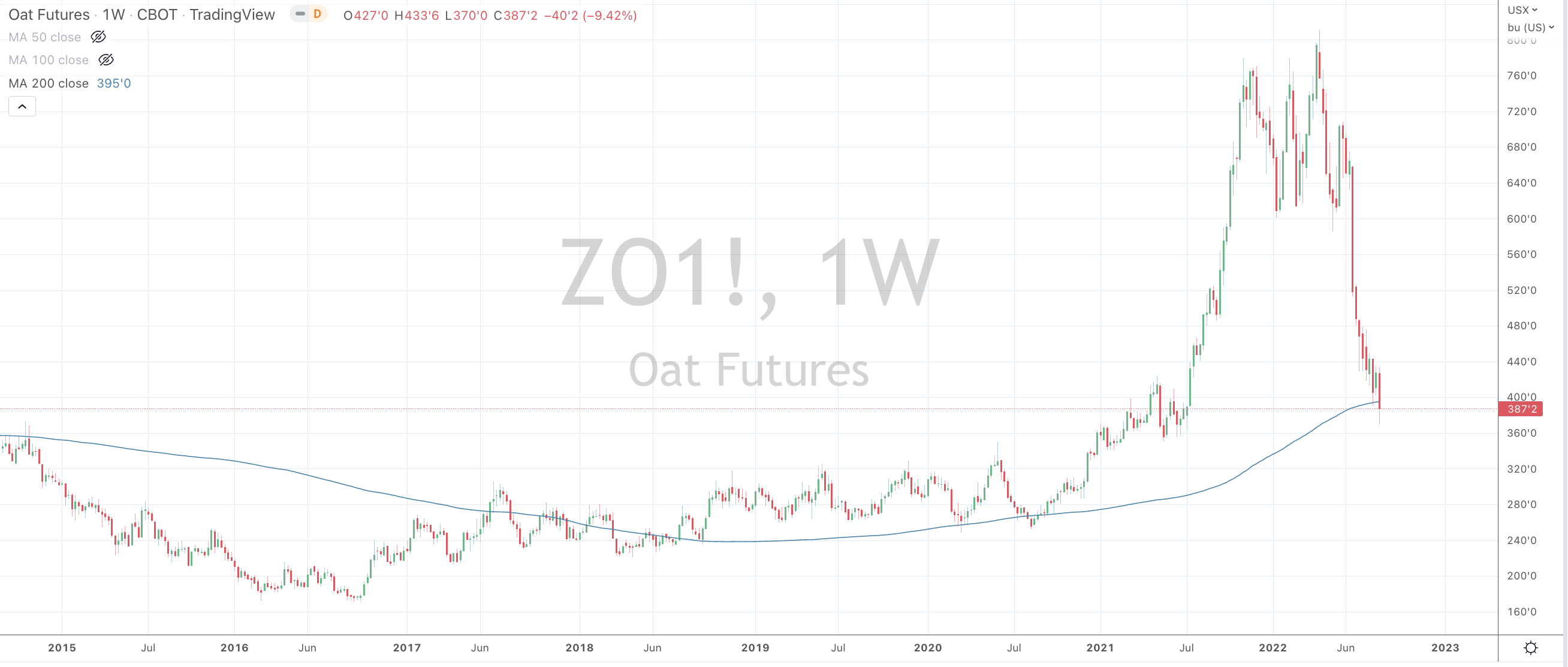
Baltic Dry Index 14.2% (up 39% in 4 weeks), Gasoline 5.3%, Oats 2.2%, Wheat 6.2%, Shanghai Composite 2.8%, AEX 1.8%, CSI 300 2%, DAX 2.6%, MIB 2.4% & Stockholm 2.5%.

The group of decliners included;

Australian Coal (1.8%), Aluminium (2%), Gasoil (2.8%), Copper (2.2%), HRC (3.6%), JKM (10.2%), Lumber (6.9%), Natural Gas (4.7%), Tin (12.8%), Nickel (6.9%), Orange Juice (5.2%), Palladium (5.2%), Platinum (2.7%), Silver (6.1%), Urea (2.1%), Uranium (9%), Gold in AUD (1.9%), KBW Banking Index (4.6%), Gold (3.8%), Dow Jones Industrials (2.1%), DJ Transports (3%), MOEX (3.6%), Midcap 400 (1.9%), Nasdaq (2.4%), Nikkei (2.1%), Sensex (3.7%), Copenhagen (4.7%), S&P 500 (2.4%),  STI (3.1%), TAIEX (3.5%), TSX (2.6%) and Australia’s ASX 200 fell 1.8%.

May 15, 2022

by Rob Zdravevski

rob@karriasset.com.au  

Bitcoin and S&P 500 hit the target

On March 11, 2022, I wrote this note below, which suggested that Bitcoin and the S&P 500 may simultaneously fall to $29,700 and the S&P 500 declines 20% from its high.

Last night, they did both, on the same day.

Technically, the S&P 500 is 19.8% below its January 2022 high.

My January 6, 2022 quip pointed at Bitcoin visiting the $26,000 – $23,000 level.

That remains entirely possible, for last nights low of $25,400 (depending on the exchange you are watching) entered that zone.

I’ll look for a quick slump to $22,000 before assessing the next move.

However, this post is more about Bitcoin being a better sentiment indicator rather than a currency.

May 13, 2022

by Rob Zdravevski

rob@karriasset.com.au

Mean Reversion is a happening thing

The Russell 2000 is the first U.S. index that I watch to hit a ‘buying range’ which attracts my interest.

Today, it closed at 1,718 points.

It also falls into the category of being the first one down and the first to ‘bottom’.

The weekly chart below shows the RTY marrying its trading below its 200 week moving average (i.e. long term mean reversion has been satisfied) together with registering a weekly oversold reading….

It’s the 10th occurrence in 32 years, but this market and economy doesn’t feel like the 2001 tech crash, the fallout of the 2008/2009 GFC nor the unknown of a 2020 pandemic outbreak.

……..then for the stockpickers out there, there is a host of oversold carnage (bargains) to pick from.

The next indices closing in on the same milestones include the KBW Banking Index, the MidCap 400 and the Nasdaq Transports.

May 12, 2022

by Rob Zdravevski

rob@karriasset.com.au

TSMC is now Oversold

Taiwan Semiconductor’s (TSMC) stock price is Overbought (on a weekly basis) for only the 4th time in the past 25 years.

Remember all that tension and scarcity about semiconductor shortages?

Surely, it hasn’t gone away?

TSMC’s stock price has fallen 40% from its January 2022 high.

Its market capitalisation has been trimmed by $245 billion.

The decline is based on a combination of valuation, market forces, economic ebbs and more so, on the stretched price action of the stock price.

As Russia invaded Ukraine, I wrote this note on Feb 23rd, 2022.

Those puts options are now priced at $18.50.

As far as the stock is concerned, $82 and $76 are buying areas I have circled.

May 10, 2022

by Rob Zdravevski

rob@karriasset.com.au

Alcoa wipes 50% quickly

Only 20 days ago, I wrote this note reiterating my mean reversion theme and I chose the Alcoa stock price as only one example.

I didn’t expect the $55 price target to be seen so soon.

Alcoa has now retraced 50% of the (somewhat parabolic) advance since October 2020.

Investing (in general) involves probability and mathematics.

In conjunction with my other indicators, today I’ll assign a certain probability that Alcoa’s stock price visits the next stop of $44.

In the meantime, the current risk, valuation, sentiment and pricing prompts me to accumulate some Alcoa around this $54-$55 mark.

May 10, 2022

by Rob Zdravevski

rob@karriasset.com.au

Macro Extremes (week ending May 6, 2022)

The following assets (on a weekly timeframe) registered an Overbought or Oversold reading and/or have traded more than 2.5 standard deviations above or below its rolling mean.

Extremes “above” the Mean (at least 2.5 standard deviations)

Cotton

EUR/GBP

Overbought (RSI > 70)

Australian 2, 3, 5 & 10 year government bond yields

Canadian, Spanish, French, Greek, British, Italian, Korean, Swedish, Portuguese and New Zealand 10 year government bond yields

German 2, 5 and 10 year yields

U.S. 2, 5 & 10 year yields

TBX

CRB (Commodities) Index and Bloomberg Commodities Index

U.S. Dollar (DXY) Index

Gasoline

The Overbought Quinella – Both Overbought and Traded at > 2.5 standard deviations above the weekly mean)

TBT

Natural Gas

Extremes “below” the Mean (at least 2.5 standard deviations)

Gold/Copper Ratio

U.S. 10 year yield minus Australian 10 year yield

Taiwan’s TAEIX index


Oversold (RSI < 30)

TLT

IEF

China’s CSI 300

Shanghai Composite

Russia’s MOEX Index

JPY/USD

EUR/USD

SGD/USD

DKK/USD

CNH/USD

HKD/USD

FXE

The Oversold Quinella – Both Overbought and Traded at > 2.5 standard deviations above the weekly mean)

GBP/USD

KRW/USD


Notes & Ideas:

This past week’s big news was bond yields new highs. Which means bond prices hit new, recent lows…..but not in Japan.

The Aussie yield curve is nearly oversold, but not inverted. More on this in a future note.

The U.S. spread is back at 0.40%, a target I’ve mentioned some weeks ago (see bull steepeners).

U.S. Bond ETF’s (TLT & IEF) have never been oversold (on a monthly basis) before…..

The Gold/Copper ratio has made a new appearance in the ‘extreme list’. It’s encroaching of an important support line was mentioned in last week’s edition. Old notes of mine have discussed this ratio’s correlation to the economy’s health and interest rates.

Other observations include;

Bitcoin has fallen 10% since breaking last week’s mentioned support line.

Aluminium has declined 27% in the past 9 weeks.

The S&P 500 has posted 5 consecutive weekly declines, not seen for quite a while.

Although, it only fell 0.2% this past week, as did the Dow Jones Industrials.

There is an ‘image misnomer’ in the past week’s action. While there was continued carnage in selected stocks, U.S. indices posted a surprisingly mild week. 

In fact, North American bourses rode out the week quite well. Most of the declines were seen in Europe with the Nordic’s taking the larger brunt, continued weakness in Asia and Australia posted its largest weekly decline since the February 24th, 2022 Ukrainian invasion.

More so, many indices are yet to make ‘lower lows’ than those seen in March 2022.

The Dow Jones Transports rose 0.2% for the week, the MidCap 400 only fell 0.8%, the Nasdaq 100 surprisingly only declined 1.3% as did the Russell 2000.

The latter is nearing its 200 week moving average and an oversold reading. ETF buyers prepare !

The weakness in the Yen versus the AUD in no longer at 7 years lows but the JPY/USD saw more weakness, its lowest price in 20 years (April 2002).

This obviously makes Japanese products and services more competitive.

There was a divergence amongst the energy complex. Heating Oil., Distillate (Gasoil) & Coal slid while Crude Oil, Gasoline and Natural gas rose decently.

Interestingly, Natural Gas rose 11% on the week, even though it fell 8% during Friday’s trade alone.

One thing to watch is that the CRB Index didn’t make a new high, while the U.S. Dollar Index (DXY) did.

Stockholm, Helsinki, Kospi, Bovespa, MIB, DAX and KBW Bank Index are nearing their 200 week moving average.

The IBEX, CSI 300, HSCEI and Hang Seng are below their 200 WMA.

and once again, Precious Metals fell while major equities indices did the same.

The larger advancers over the past week comprised of; 

Baltic Dry Index 13.1% (up 25% in 3 weeks), Rotterdam Coal 22.9% (recovering last week’s fall), WTI Crude 4.9%, Natural Gas 11%, Platinum 1.8%, Gasoline 9.2%, Dutch TTF GAs 2.3%, Brent Crude 6.1%, Uranium 3.3%, Wheat 5%, KBW Bank Index 2.2%, SOX 2.1%.

The group of decliners included;

Australian Coal (2.2%), Aluminium (7.2%), Cocoa (3%), China Coal (4.2%), Gasoil (7.2%), Copper (3.2%), Heating Oil (17.3%), JKM (2%), Coffee (5.3%), Lumber (9.6%), LNG (4.1%), Nickel (6%), Orange Juice (2.4%), Palladium (12.3%), Silver (3.1%), Urea (2%), Corn (3.5%), Oats (3.5%), Rice (2.8%), Soybeans (3.7%), Bitcoin (10.3%), Ethereum (10.3%), Cardano (6.6%), AEX (4.1%), CAC (4.2%), CSI 300 (2.7%), DAX (3%), MIB (3.2%), HSCEI (6.7%), Hang Seng (5.2%), IBEX (3.1%), Bovespa (2.5%), Kospi (1.9%), Nasdaq 100 (1.3%), Sensex (1.9%), Oslo (2.1%), Copenhagen (5.8%), Helsinki (3.6%), Stockholm (4.7%), Swiss SMI (3.3%), Singapore’s STI (1.9%), FTSE 100 (2.1%) and the Australia’s ASX 200 fell 3.1%.

May 8, 2022

by Rob Zdravevski

rob@karriasset.com.au  
When bonds and stocks both fall

When bonds and equities both fall, it’s a sign of indiscriminate selling.

Big Tech has been an obvious victim and the watchlist below shows that it doesn’t matter what you own.

In fact, during yesterday’s trading, there weren’t many places to hide.

There have been some reports citing that this past day mimics those seen on October 9, 2008 and March 18, 2020.

All this tells us is that some parties are in some type of forced liquidation. There is no use in speculating who and why.

However, such an occurrence isn’t reliable in calling a bottom in the S&P 500 as other indicators such as long-term RSI’s, Standard Deviations and VIX (to name a few) do not marry up with the plunges seen in 2008 and 2020.

May 6, 2022

by Rob Zdravevski

rob@karriasset.com.au

Trying to hear what is not being said – May 5, 2022

I recall Goldman Sachs calling for $200 oil when it was trading at $130. It soon dropped to $90.

It’s a little bit funny that I’m not hearing that prediction being repeated anytime over the past 6 weeks.

In the meantime, Goldman Sachs did $100 million in trading revenue on 32 separate business days in the 1st quarter. Their trading division accounted for 61% of its quarterly revenue. 

As far as profits are concerned, I wonder how much the proprietary trading division made during the quarter?

Do people ever think it is possible that while an investment house is promoting its market calls to ‘buy’ something, that the same investment house may be the seller of their own stock or inventory?

May 5, 2022

by Rob Zdravevski

rob@karriasset.com.au