I’m conditioning myself to see U.S. #unemployment rate between 5.5% – 6% within 30 months.
Opining that it should hold the current 3.7% levels is fighting against (my work on) probability and more so when you consider the quantum change seen in interest rates.
I’ll give you a floor of 3.3%.
What if the #unemploymentrate nearly doubles?
What do various capital markets look like with a 6% U.S. unemployment rate?
In business, wage pressure would certainly ease.
It’s not a very sharp outlook for residential real estate, especially if you lose your job.
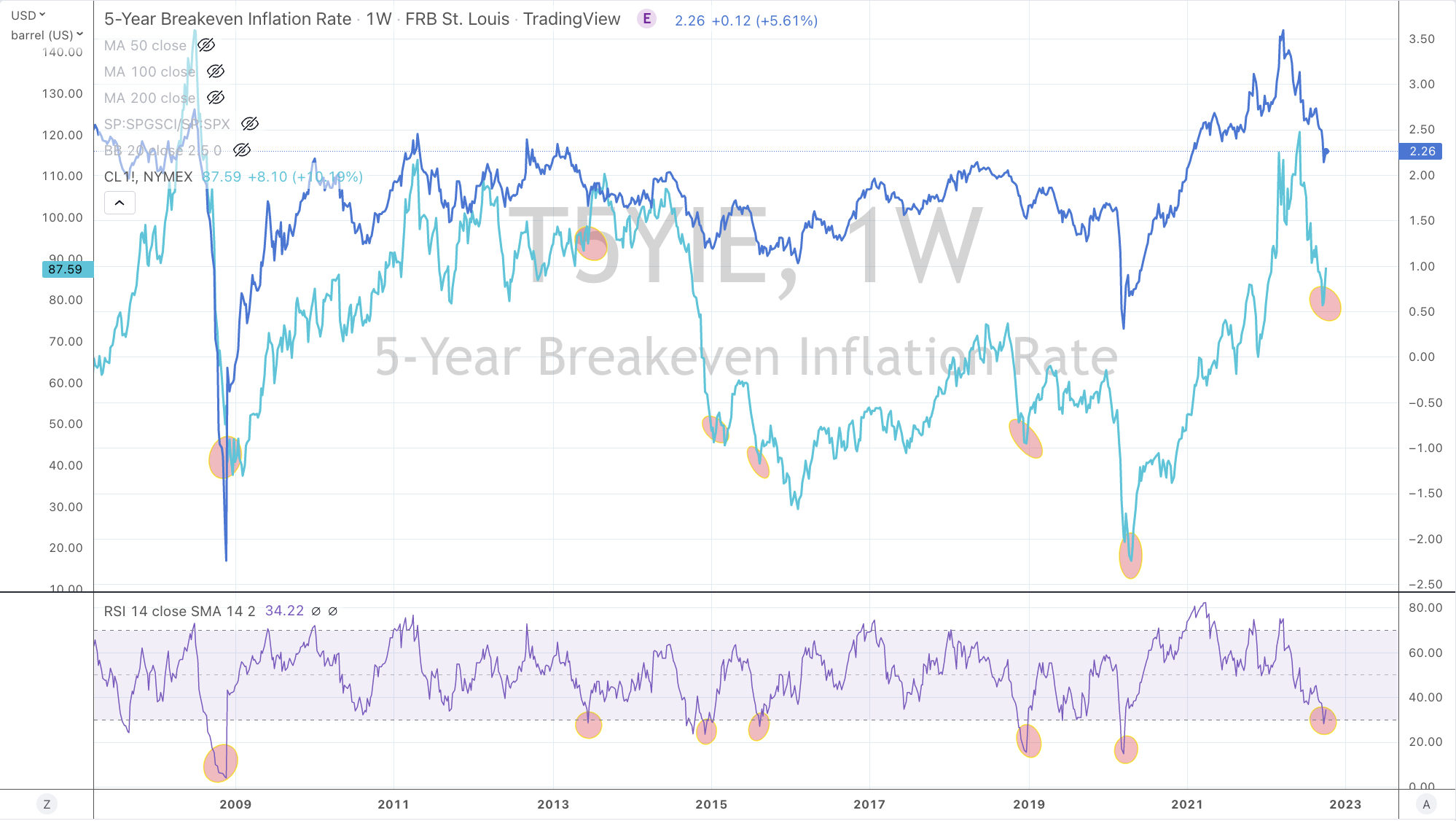
Here is a lovely chart showing the price of WTI Crude compared to U.S. 5 year break-even inflation rate.
To which the St. Louis Fed says about the latter, ‘the value implies what market participants expect inflation to be in the next 5 years, on average.’
Each value dance wonderfully together.
The better part of the chart is the lower bit where the RSI (Overbought/Oversold) indicator appears.
Whenever the 5 year breakeven inflation rate is Oversold (as this weekly chart shows), the WTI Crude Oil price finds a floor from which to advance.
We saw an Oversold 5 year b/e rate last week.
This week’s OPEC production cut announcement wasn’t a surprise because this Oversold moment in the U.S. 5 year break-even inflation rate tends to coincide with OPEC announcing production cuts.
Of course, Biden isn’t happy that OPEC have cut production.
Furthermore, Biden has virtually released all of the nation’s Special Petroleum Reserves. While he probably thinks it was his strategy sending Gasoline prices lower, when it was in fact a combination of other falling commodity prices (which is deflationary), mean reversion in the oil price and rising credit forces at work.
No to mention the importance of Biden needing lower domestic petroleum prices to aide his mid-term election hopes.
OPEC’s production cut may seem to be mathematically synchronised to the United State’s own inflation break-even rates but I think it is equally loaded with a little political payback.
Funnily, the U.S. isn’t pleased with this announcement and have passed on their views but it’s difficult to have a say into a club of which you’re not a member of.
Keep in mind, this study doesn’t assist the decision of when to sell your Oil.
What is the big deal with the Chinese government’s recent directives stymying technology or education firms?
During the 2010’s, the U.S. Department of Education either forced the closure or change of ownership, sued or ended accreditation or recognition of ‘education providers’ such as DeVry Education Group (now Adtalem Global Education), ITT Educational Services, Corinthian Colleges and Apollo Education (which was taken private at $10 per share, compared to its high of $89/share in 2009).
For example, then Californian attorney-general, Kamala Harris led the charge in suing Corinthian (leading to their demise in 2016 when she won her judgement) for predatory practices of mounting and leaving students in crippling debt……much like China’s concerns today.
In addition, didn’t the U.S. government force the break-up of AT&T and Microsoft?
And I wonder……aren’t Google, Facebook, Microsoft, Apple etc, some type of pseudo-government agencies ?
or at least, at their behest or influence?
Between all the congressional hearings and testimonies and the ‘cloud’ of anti-trust undertakings, a little perspective is required to the current Chinese news.
After all, it is not a far-fetched idea that Amazon is forced to ‘spin-off’ its AWS division.
The hypocrisy of western governments doesn’t seemed to be recognised by their own selves. They apply a host of restrictions, rules and bans too.
Perhaps China is entering its own Progressive Era and the U.S. may have its own 2.0 version?
What is this Crude Oil Reserves graphic saying to me?
It tells me that Australia is a minnow and it’s more of a LNG nation.
It tells me why integrated European and American oil companies enter joint ventures in foreign lands, ’cause that’s where the oil is.
And the U.S. is playing an interesting game of being the worlds largest oil producer against reserves that don’t suggest that status being sustainable.
Prior to the March 2020 collapse in oil prices, the U.S. was pumping a world leading 15 million barrels per day.
If the U.S. reduces daily production to let’s say 12 million barrels (not because Trump thinks he can force privatised companies to do so but more so relating to the global supply glut), then when dividend into their reserves of 37 Giga barrels, the United States will have 3,083 days or 8.4 years of reserves left.
That’s acute enough to create tension across politics and the oil price.
Incidentally, Saudi’s daily production is 12 million barrels.



 rob zdravevski's blog