The peril of market cap weighted ETF’s

The top 10 Australian stocks (as per market capitalisation) account for 47% of the weighting in the ASX 200 equity index.

The other 190 stocks make up the remaining 53%.

Loosely put another way, 11 cents of every $1 invested in an ASX 200 index strategy (think monthly superannuation contributions) goes towards buying BHP stock. Then a further 8 cents of each $1 buys CBA shares, another 6 cents is spent on buying CSL and 4 more cents acquires shares in National Australia Bank.

There you have the top 4 stocks making up 29% of the ASX 200.

Much has been mentioned about the top 10 U.S. stocks adding up to 30% of the S&P 500 market weighting.

There is much peril in market capitalisation weighted indices (and their #etfs).

In the absence of seeking a bargain let alone considering prevailing valuations nor conducting any analysis, many investors are showing fiscal complacency by hiding in large caps stocks and convincing themselves about the safety of ‘blue chips’.

There are other places to allocate equity monies.

January 4, 2023

by Rob Zdravevski

rob@karriasset.com.au
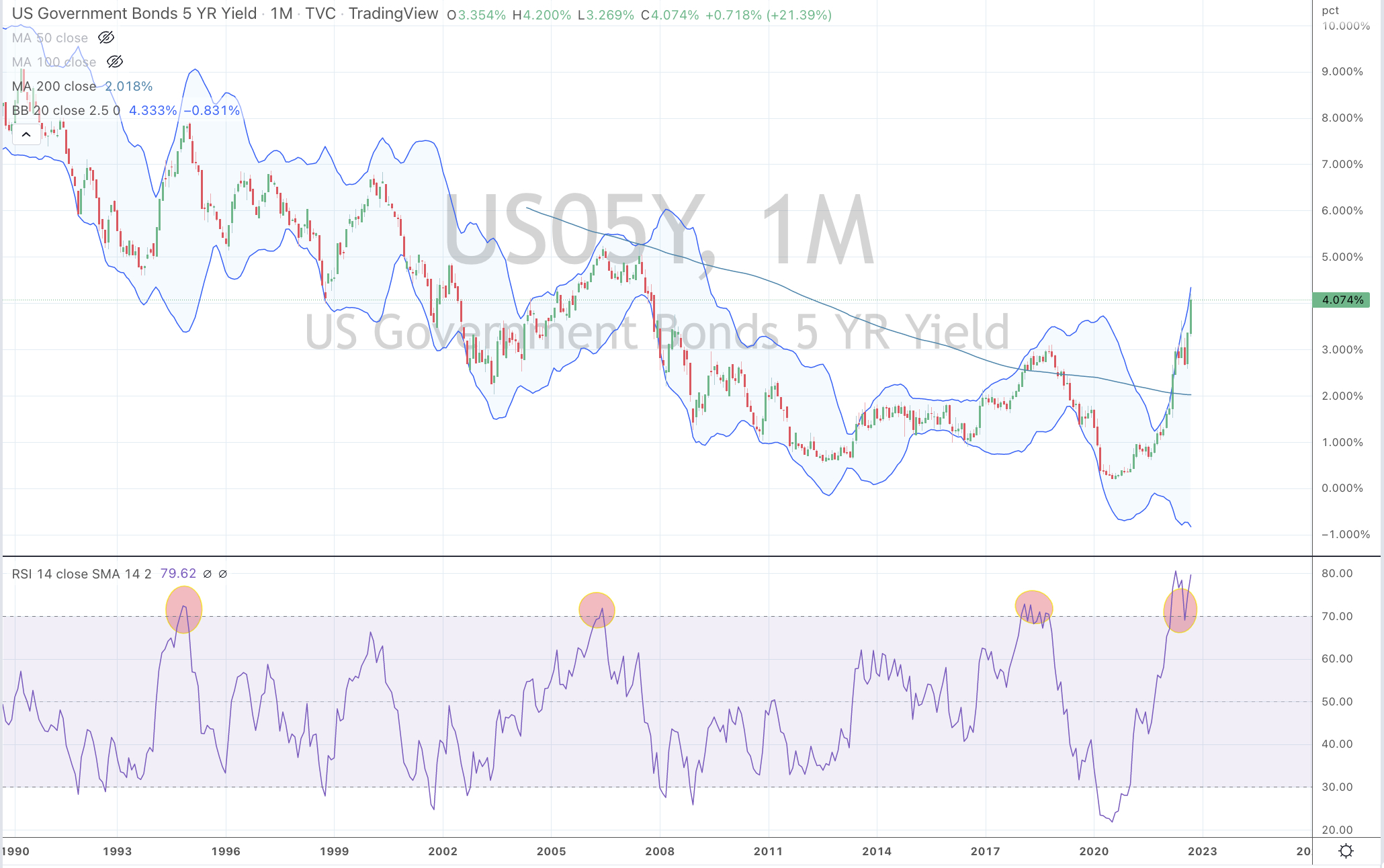
Bonds are a Buy !

It’s important to keep things simple.

With all this palaver about interest rates, people want to hear what the action is.

How is one expressing their investing view about the topic?

Bond yields are so stretched, that on a monthly basis, they are ‘this’ Overbought for only the 4th time in 35 years (as expressed in the U.S. 5 year bond yield chart with those circles on it)

If you like fixed interest, then you may consider buying a Bond ETF which owns a spread of such bonds…..

because, inversely those bond prices are at extremely Oversold levels, as the Monthly chart below shows.

I have posted a chart of one of those U.S. traded bond ETF’s

This is the case across the 5, 10, 20 and 30 year maturities.

Disclaimer: not personal advice, do you own research or speak to a licensed professional.

September 27, 2022

by Rob Zdravevski

rob@karriasset.com.au

Tesla, ETF’s and Distortion

I can’t help think the return of the stock picker is nigh.

Here are some samples of concern with being invested in passively managed market capitalisation based Exchange Traded Funds (ETF’s)

Tesla’s entry into the S&P 500 Index will force index funds to buy about $73 billion worth of its shares, S&P Dow Jones Indices said.

‘Your’ S&P 500 ETF will be “forced” to acquire Tesla shares and I think many ‘active’ managers may do the same, simply to prevent underperforming against the index.

This means that investors in a S&P 500 ETF will become owners of Tesla shares on December 21, 2020 when the company has a whopping market capitalisation of ~$554 billion.

Furthermore, the market cap of whichever company leaves the S&P 500 (to make room for Tesla) will hardly be comparable.

For example, lowly weighted HollyFrontier and Xerox have market caps of $4 billion.

Adding to the peril, is that the six FAANGM stocks (Facebook, Apple, Amazon, Netflix, Google & Microsoft) already account for 27% of the index’s composition;

while the top 10% weighted stocks in the S&P 500 provide 54% of the index’s concentration and risk;

and lastly, ‘indexing’ now accounts for or controls 45% of the whole market.

Distortion is everywhere.

https://www.reuters.com/article/usa-stocks-tesla/update-1-tesla-to-join-sp-500-in-single-tranche-idUSL4N2IG4SA

December 2, 2020

by Rob Zdravevski

rob@karriasset.com.au