pondering ‘what if’ lower oil prices

A call that I’m not hearing much about it for lower #oil prices.

My historical posts have called for WTI Crude to around an initial visit to $64, and failing that $46-$48.

I think the probability for the latter is gaining.

Today, WTI Crude is $69.40.

A $46 price in WTI #Crude correlate with lower Nat Gas prices and the share prices of related petro/hydro chemical companies.

As an example, that may translate to seeing the trading of stock prices in companies such as #Woodside (WDS.AX) at A$19, #BP at 333p and #Occidental (OXY.N) <US$38.

September 5, 2024

by Rob Zdravevski

rob@karriasset.com.au

Knowing when you’re pushing oil barrels uphill

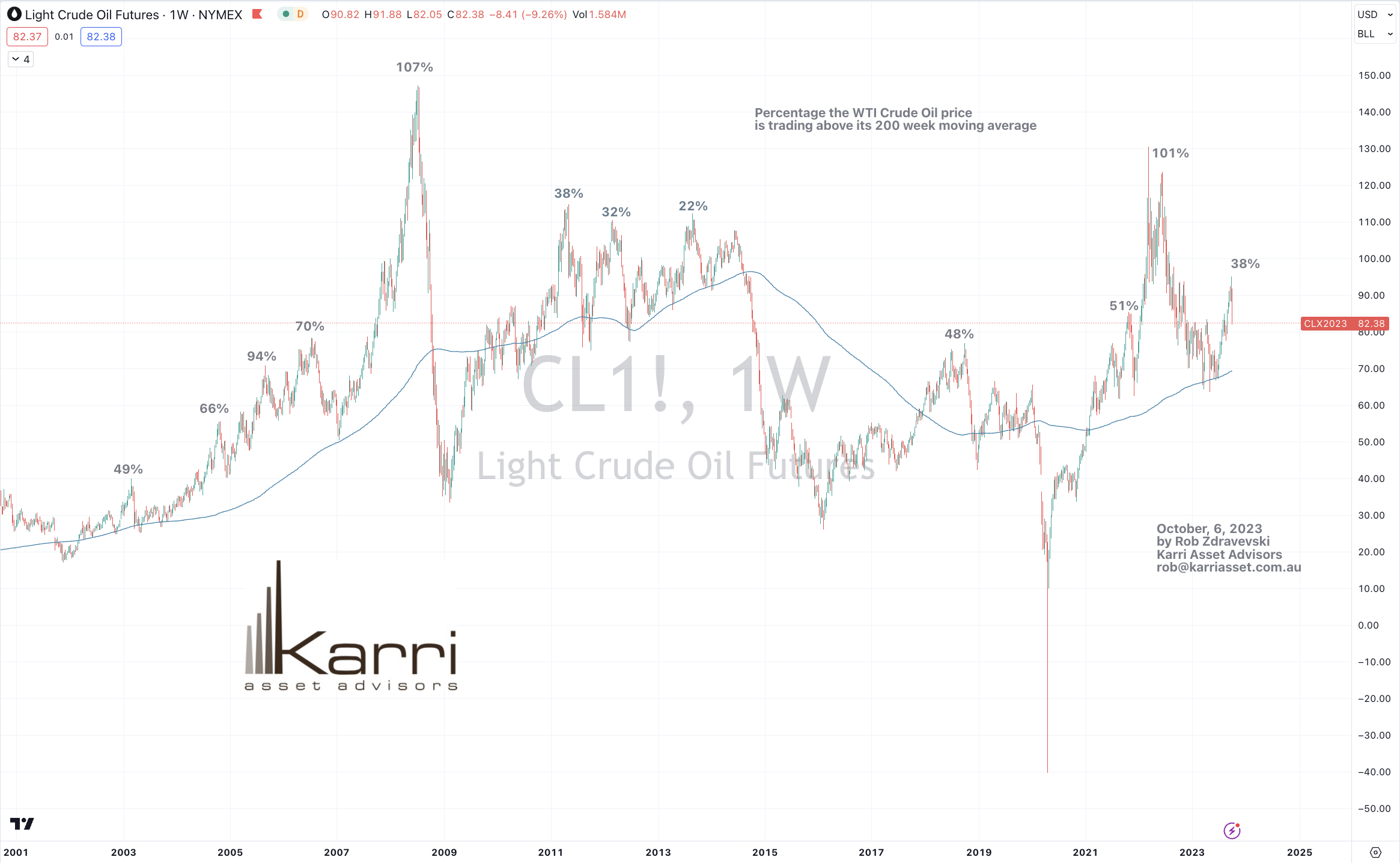
The study below shows the percentage that the WTI Crude Oil price was trading above its 200 week moving average.

When combined with my other studies and metrics, (albeit I couldn’t predict this week’s 10% decline) the probability of the oil price embarking on an extended advance was waning.

More so (subjectively observed), when the financial media noise increased surrounding the various analysts saying $100 was inevitable.

This coincides with my note written 2 weeks earlier.

The high was $95, it is now $82, may see you at $73.10.

Better yet, we may see much cheaper shares in energy companies.

October 6, 2023

by Rob Zdravevski

rob@karriasset.com.au

Re-visiting BP – Rosneft, buybacks and Overbought

BP’s stock price has risen 51% in the past year.

Days away from the anniversary of Russia’s invasion of Ukraine and 11 months since BP I wrote this note……

….when BP said they promise to sell their stake in Rosneft……it’s another investing lesson in separating reality and media noise from corporate spin and intent.

To my understanding, BP still owns its 19.75% stake in Rosneft and the BP recently received dividends as a result of this holding to the tune of GBP 580 million.

This is twice the amount that the UK Government has provided in humanitarian aid to the Ukraine (while its military aid has been +$2 billion).

Today, BP’s share price is “the most overbought” (on a Monthly basis) than anytime over the past 20 years.

I feel that it would be advisable if BP gets a wriggle on and keeps it promise to sell its Rosneft stake.

So far, from a capital market’s perspective, BP’s management has done a stellar job.

On a capital management front, why would you use fortuitous profits and gains to buy your own shares at these extreme highs and veil it as a ‘return to shareholders’.

Government confiscation of retained earnings (taxes) and other things come to mind for their reasoning.

But I find it a lazy decision to embark on share buybacks, such as the $2.5 billion announced in November 2022. I can see why they have decided so but there are other things they can do.

February 14, 2023
by Rob Zdravevski
rob@karriasset.com.au

Anatomy Of An Overreaction

JP Morgan announced that it lost $2 billion due to either a flawed hedging strategy or just bad trading.

Some reports cite that the loss is more like $1 billion when you account for the gains made on the other side of the hedge which the initial strategy was trying to protect or offset.

My question is to ponder whether JP Morgan’s stock price has overreacted.

The market capitalisation of JP Morgan prior to this news was approx. $161 billion.

It’s stock price has fallen near 14%, meaning it’s market cap has fallen $23 billion and now stands at $138 billion.

I’d like to compare it to BP’s 2010 Macondo oil rig disaster in the Gulf of Mexico.

Sadly, 17 men died as a result of this explosion and it crippled parts of the Gulf Coast economy, not to mention the environmental damage caused.

Prior to the rig explosion, BP stock was trading at $60 per share and its market cap was $190 billion.

2 months later, the stock had fallen to $27 and it market cap was $86 billion.

Today, BP’s stock price has risen 40% from that June 2010 low but more importantly, it’s stock price recovered the decline that it suffered following the sinking of the oil rig, within 4 months.

The financial settlement costs for this disaster is estimated to be near $8 billion.

Both companies; are making a net profit of approximately $25 billion per annum, have P/E estimates of between 6 & 7 for the next fiscal year and are trading just below their book value.

JP Morgan’s error doesn’t seem to be systemic, life-threatening nor open to punitive lawsuits.

Assuming that the JP Morgan loss will be $2 billion, the ratio of the financial loss compared to the fall in the company’s value matches the decline experienced by BP.

It looks like an overreaction.