Bullish trend in LNG is developing

I see a long trade in JKM LNG.

It has risen 4% today, currently trading at ¥1,775

The price action is constructive and first stop may be around ¥2,500.

It doesn’t matter if any rise is defined as a bounce, a rebound in demand, a short squeeze or mean reversion…..

JKM LNG (as priced in Yen) appeared in the Oversold list through the late May/early June editions of Macro Extremes when the price was around ¥1,550.

Since then, the margin of safety has faded so I’ll be sharp on this one.

This sentiment is a reversal of my warnings of peaking LNG prices over the past couple years. Those notes can be searched and found within my blog.

Furthermore, there is a reasonable correlation between LNG prices and the U.S. inflation rate……

August 8, 2023

by Rob Zdravevski

rob@karriasset.com.au

* these are my own notes, not personal advice to the reader.

Cheap Australia and commodities

I think the UDUSD should hold around the 0.6460 region, thus USD buyers of Australian assets would be well advised to strike their transaction terms soon.

In turn, this renders AUD priced assets as being the cheapest since November 2022

This drop of a further penny or so, should correspond with an Iron Ore price visiting between the $92 – $98 mark.

It’s currently trading at $103.

and perhaps a price in BHP around A$43.35 although I prefer A$39.60.

August 8, 2023

by Rob Zdravevski

rob@karriasset.com.au

Chocolate prices in flux

There was a wicked daily bearish reversal in Cocoa trading today.

This should translate into a bearish weekly reversal.

Two months ago I highlighted the ‘rare air’ that Cocoa was trading at.

Corresponding within that June 2023 note, today’s closing price of Cocoa is 35% above its 200 week moving average.

While today’s intra-day high was 42% above the same mean.

While the Cocoa production is in deficit, stockpiles have grown and rising prices are curbing demand.

August 7, 2023

by Rob Zdravevski

rob@karriasset.com.au

U.S. 30 year bonds yields are stretched

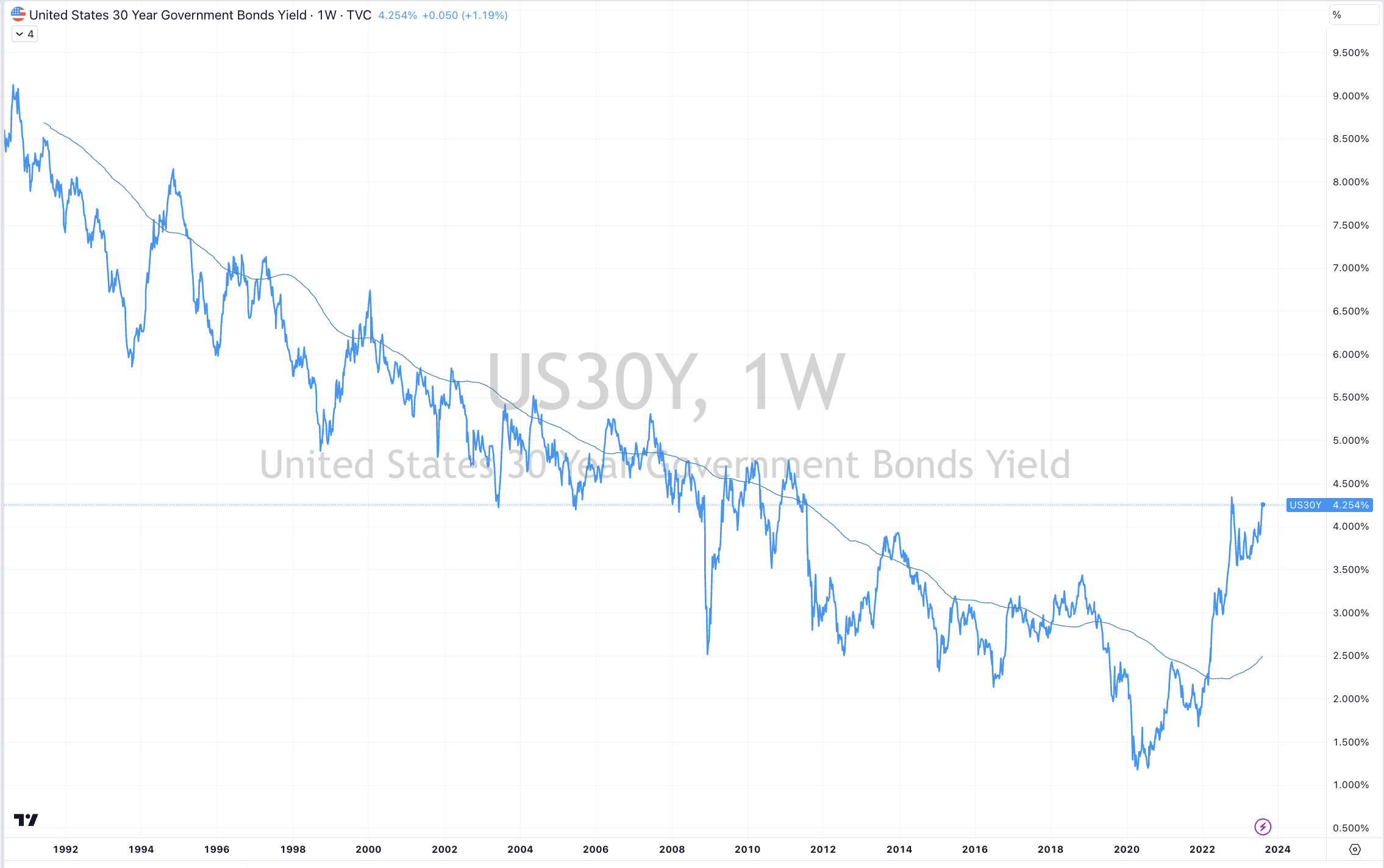
I think U.S. 30 year government bond yields ease back to somewhere between 3.16% to 3.36%.

What time frame?

Perhaps around July – December 2025…

but that matters less.

U.S. 30’s made an appearance in the overbought section of this week’s Macro Extremes.

They (the 30’s) don’t really have much business trading much more higher than where they are now. While the 200 week moving average should roll higher to honour the parabolic price move seen over the past 2 years.

…the study below tells me to buy bonds whilst waiting a little before locking in your borrowing rates.

August 7, 2023

by Rob Zdravevski

Karri Asset Advisors

rob@karriasset.com.au

Macro Extremes (week ending August 4, 2023)

A weekly Macro, Cross Asset review of prices trading at extremes which may generate future investment ideas and opportunities.

The following assets (on a weekly timeframe) either registered an Overbought or Oversold reading and/or have traded more than 2.5 standard deviations above or below its rolling mean.

Extremes “above” the Mean (at least 2.5 standard deviations)

U.S. 10 year breakeven inflation rate

Japanese Government 10 year bond yield

TBT

U.S. Government 10, 20 & 30 year bond yields

U.S. 10 year yield minus German 10 year bond yield spread

Gasoil

Heating Oil

Straits Times Index

AEX

MIB

Overbought (RSI > 70)

Russian 10 year government bond yields

U.S. 3 month bill yields

Cocoa 

Urea Middle East price

Turkiye’s BIST 100

And Chile’s IPSA and IGPA equity indices

The Overbought Quinella – Both Overbought and Traded at > 2.5 standard deviations above the weekly mean)

CHF/AUD

Russia’s MOEX equity index

Extremes “below” the Mean (at least 2.5 standard deviations)

TLT

Rubber

AUD/CAD

CLP/USD

Oversold (RSI < 30)

Newcastle Coal

The Oversold Quinella – Both Oversold and Traded at < 2.5 standard deviations below the weekly mean)

None 

Notes & Ideas:

Equities had a poor showing this past week and amidst a sea of probability, it shouldn’t be a surprise considering the consecutive weeks that some bourses spent either extending winning weekly streaks or being overbought.

American indices aren’t in such territory anymore whether its the Nasdaq, Transports, Small Caps or Banks.

In fact, the DJ Industrials, DAX, CAC, MIB, Nasdaq Composite, Nasdaq 100, Nikkei 225, Russell 2000, SOX, TAEIX, FTSE 100, Mexico and Toronto’s TSX.,……all posted outside bearish reversal weeks

Furthermore, many stock market indices also broke weekly winning streaks such as Chile, U.S. KRE Regional Banks and DJ Transports along with the Nasdaq 100 ending its 10 week residence in the overbought arena. 

Amsterdam’s AEX gave exactly last week’s gains.

Russia’s MOEX and Turkiye’s BIST 100 extended their amazing bull runs to recently include consecutive winning streaks of 6 & 7 respectively. Avid readers of this periodical can recite that these numbers are where streaks are closer to being exhausted and ending.

On a jolly note, the Nasdaq SmallCap 700 had a pleasant week.

Commodities were active again.

With the decline across the agricultural, Wheat isn’t overbought anymore.

Cattle had a bullish outside reversal week while Silver (priced in AUD) performed the opposite feat, being a bearish outside reversal week.

Rubber entered the oversold arena as it posted its 5th consecutive losing week.

Orange Juice reversed all of last week’s gains.

On the other side of the ledger, the S&P GSCI, Gasoil (diesel) and Brent Crude Oil respectively are into their 5th, 6th and 6th week of rising prices.

and Cocoa is now in its 9th week of being overbought.

In currencies, the AUD was weaker across many pairs and approaching the oversold region.

The AUD/EUR has stretched its weekly losing streak to 7 weeks.

Last week’s bearish outside reversal week in the AUD/JPY portended this week’s weakness in ‘risk; as seen in equity markets.

The Euro was mostly firmer as was the USD against most.

While the GBP/AUD is new overbought levels.

The South African Rand fell 4% giving up recent gains.

The Colombian Peso (COP) posted a bearish outside week….

And the CHF/AUD extends its weekly rising streak to 7 as it makes a visit to the Overbought quinella this week.

Bond yields mainly declined, which is keeping with my broader view of abating and mean reverting yields….although for the week, the Germans, Spanish and French yields did rise.

The Japanese 10’s soared into overbought land.

The larger advancers over the past week comprised of;

Australian Coking Coal 6.5%, Brent Crude 1.8%, Baltic Dry Index 2.3%, China Coking Coal 13.2%, WTI Crude 2.4%, Iron Ore 2.3%, Gasoil 3.4%, Heating Oil 3.4%, Coffee 2.2%, Cattle 1.6%, Dutch TTF Gas 7.3%, Rice 1.9%, MOEX 2.8% and BIST 100 rose 4.7%.

The group of decliners included;

Lean Hogs (2.1%), Copper (2.2%), Hot Rolled Coil Steel (2%), Lumber (4.2%), Tin (5.1%), Newcastle Coal (2.2%), Natural Gas (2.4%), Orange Juice (4.9%), Gasoline (3.5%), Silver (3.1%), Urea U.S. Gulf & Middle East (5.9%), Silver in AUD (1.8%), Corn (7.1%), Soybeans (3.7%), Wheat (9.8%), AEX (2.7%), CAC (2.2%), DAX (3.1%), DJ Transports (2.3%), MIB (3.1%), Hang Seng (1.9%), IBEX (3.3%), Nasdaq Composite (2.9%), Nasdaq 100 (3%), Nikkei 225 (1.7%), Copenhagen (2.1%), Helsinki (2.1%), Stockholm (2%), Swiss SMI (1.9%), SOX (4%), S&P 500 (2.3%), Singapore’s Strait Times (2.3%), TAEIX (2.6%) and the Nasdaq Transports fell 3.4%. 

August 6, 2023

by Rob Zdravevski

rob@karriasset.com.au

40 years of peaks in Australian bond yields

At what stage, during 7 distinct moments over the past 40 years should one have bet that the Australian 2 year bond yield should venture too much further beyond the extremes circled below?

Today, this yield is trading at 3.90%. Most recently, it spent 6 weeks between 4.10% and 4.30%.

See you at the mean reversion?

August 2, 2023

by Rob Zdravevski

rob@karriasset.com.au
Expanding breadth can be exhausting

Amidst waning volume, the Russell 2000 yet to make higher highs than January 2023, let alone last August of 2022, whilst presently trading at 2.5 standard deviations above its weekly mean.

#exhaustion

August 1, 2023

by Rob Zdravevski

rob@karriasset.com.au

Heating Oil is too hot to touch

The picture below shows Heating Oil’s story of mean reversion and its recent bounce, now trading at some stretched percentages above a specific mean.

Observe the pendulum. Going long here doesn’t provide a margin of safety.

My Macro Extremes’ publication from this past weekend listed Heating Oil, Gasoline and Distillates returning to Overbought territory.

August 1, 2023

by Rob Zdravevski

rob@karriasset.com.au

Chile cuts interest rates with soft hands

To achieve a soft landing, you need ‘soft hands’.

Ask any baseball infielder the importance of having ‘soft hands’.

In an example of managing monetary policy the way it should be done, without political fear or favour…….Chile cuts interest rates by 1%.

They are going to the where the ‘puck’ is going to be, not where it has been.

2 years ago, I started writing how Chile was addressing inflation ahead of other countries.

While referencing their income and GDP per capita, where I cited that “inflation is a tax that the poor can’t afford to pay”, the commodity sensitive (emerging) nations hiked rates much earlier than the G-12 nations.

Chile, Mexico, Brazil have all been ahead of the curve, while the central banks of the countries with the most indebted citizens have needed to tread carefully, in order not to ‘break’ things including the residential housing market.

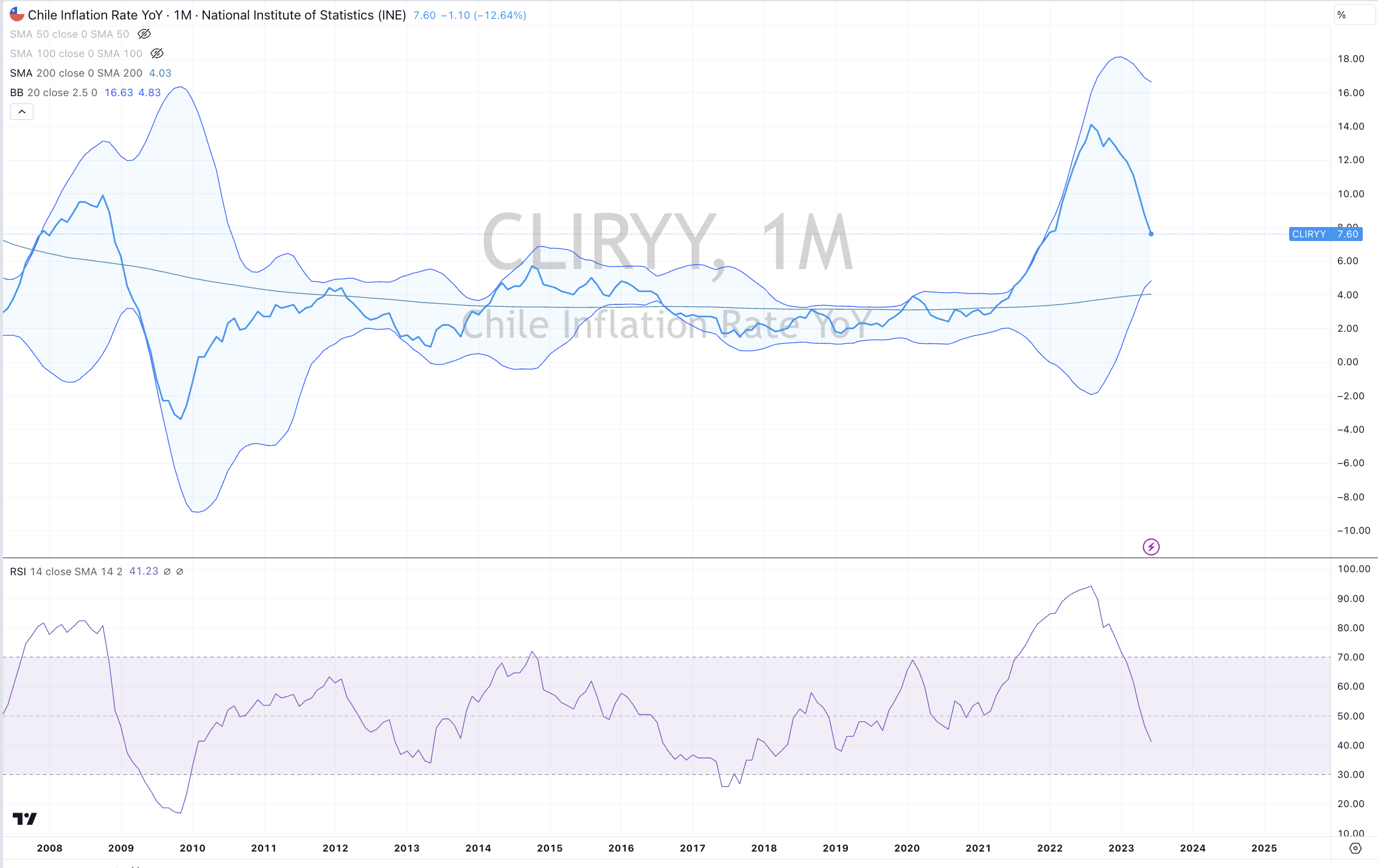
To give you an example of their pre-emptive action, the chart below shows the Chilean inflation rate.

While inflation has already turned lower, I’ll assume that they expect the lagging reaction to their aggressive hikes to take on a greater effect.

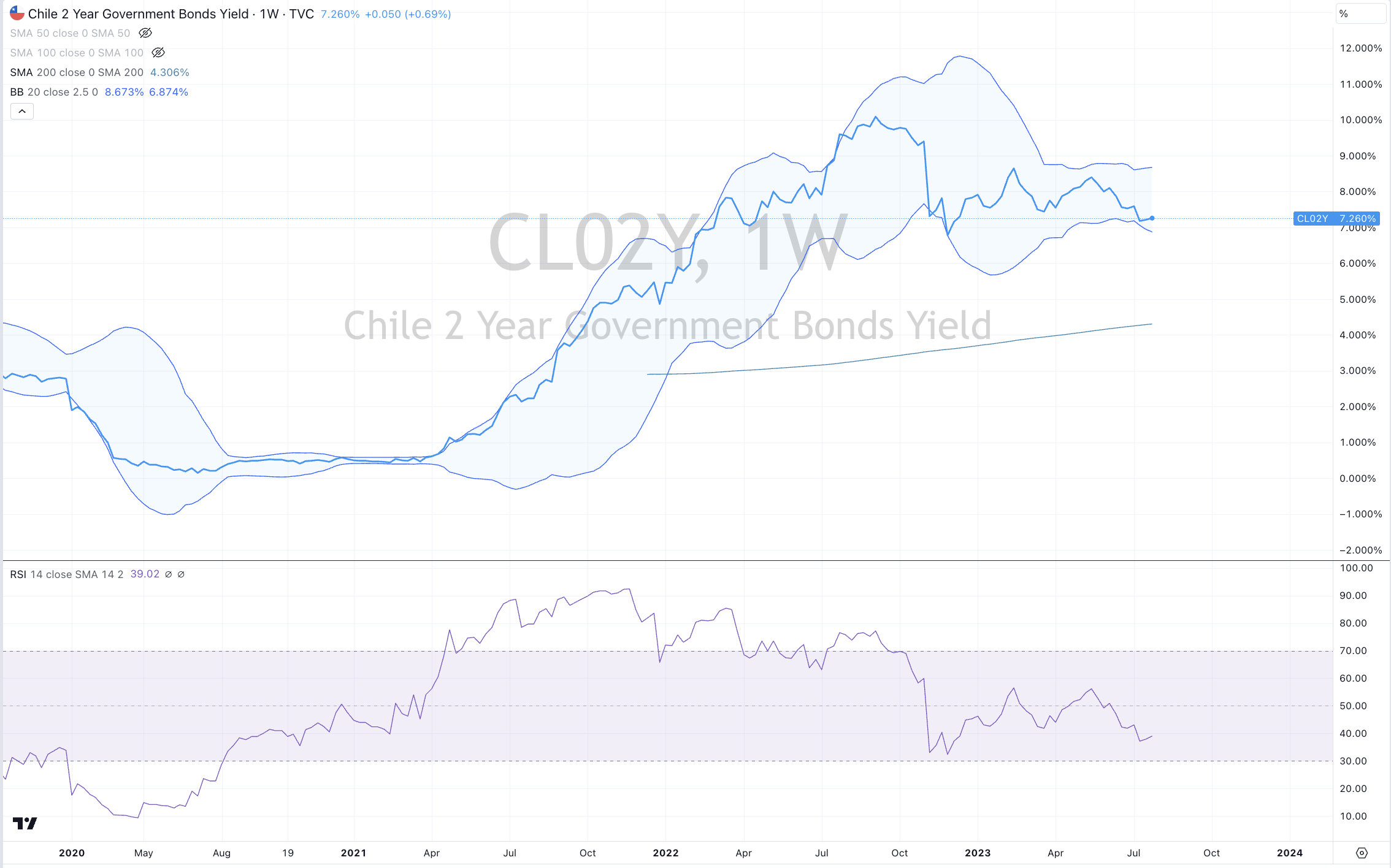
And you can see the Chile government 2 year bond yield also moving lower

This rate cut will also assist Chilean companies with their feasibility and financing of various mining projects.

Also, last month, I found this interview with the Chilean Finance Minister, Mario Marcel very interesting.

Incidentally, he previously served as the Governor of Chile’s Central Bank.

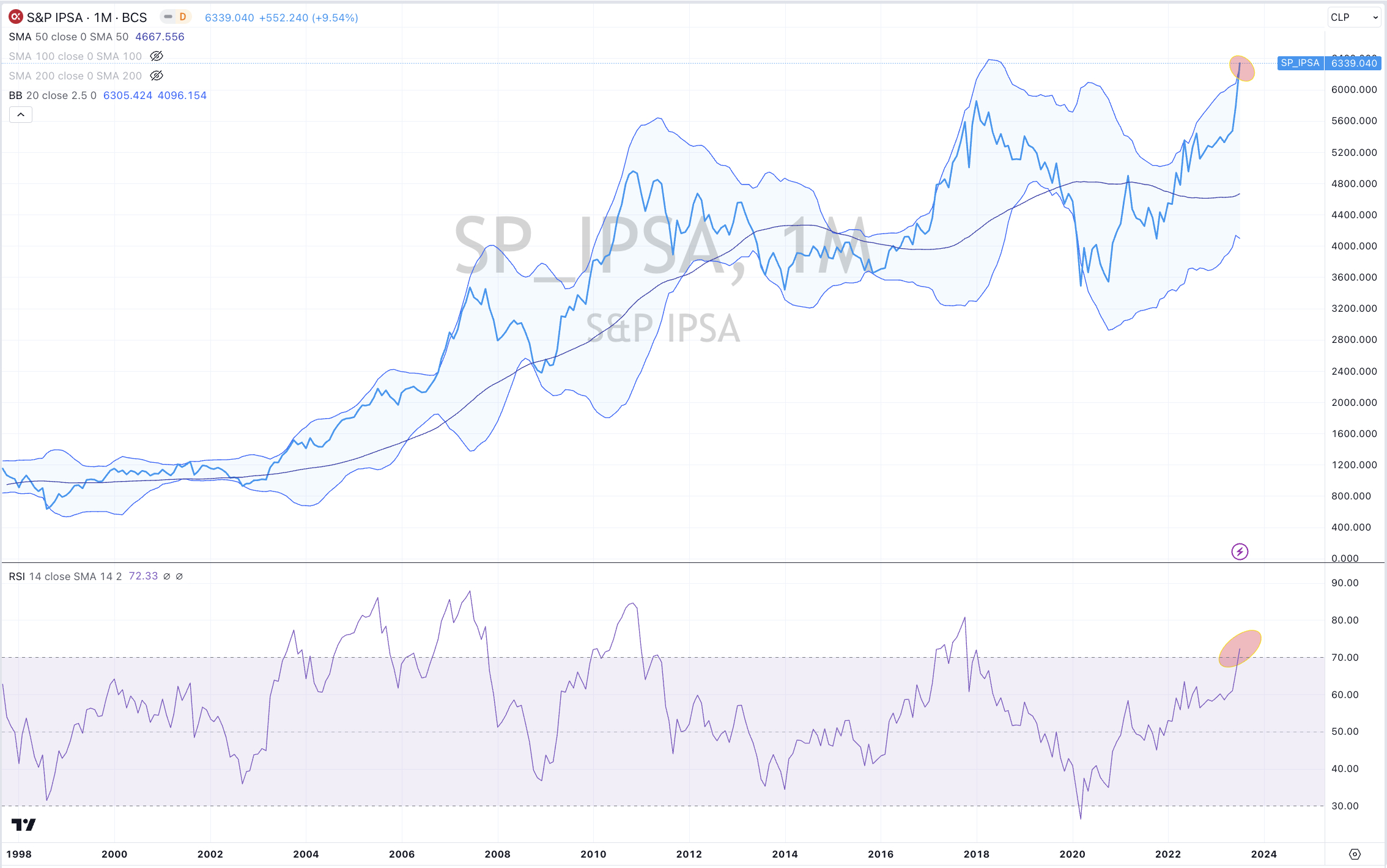
Perhaps perversely, this rate cut occurs while Chile’s stock market is touching some overbought historically overbought levels. It has risen 52% since it’s first rate hike in July 2021 and is now at an all-time high.

This is another example of markets looking much forward than many expect.

The S&P 500 and Nasdaq 100 have risen 2.5% and 11% respectively since the U.S. Federal Reserve Bank’s first rate hike in March 2022.

Since Australia’s Reserve Bank delivered its first rate hike (May 2022), the ASX 200 Index has responded with a rise of 3.7%.

This news in Chile translates into taking profit and re-weighting Chilean equity exposure lower.

My expected retracement in Chile’s IPSA Index should also stifle the latest run in the copper price and give me an opportunity to enter selected commodities on any forthcoming dip.

July 31, 2023

by Rob Zdravevski

rob@karriasset.com.au

Macro Extremes (week ending July 28, 2023)

A weekly Macro, Cross Asset review of prices trading at extremes which may generate future investment ideas and opportunities.

The following assets (on a weekly timeframe) either registered an Overbought or Oversold reading and/or have traded more than 2.5 standard deviations above or below its rolling mean.

Extremes “above” the Mean (at least 2.5 standard deviations)

U.S. 10 year breakeven inflation rate

Japanese Government 10 year bond yield

Cotton

Gasoil

Heating Oil

Gasoline 

Orange Juice

Urea (both U.S. Gulf and Middle East prices)

Wheat

S&P SmallCap 600

KBW Bank Index

KRE Regional Bank Index

Indonesia 30 Index

Overbought (RSI > 70)

Russian 10 year government bond yields

U.S. 3 month bill yields

Cocoa 

MXN/USD

COP/USD

S&P 500

Nasdaq Composite Index

India’s Nifty 50 and Sensex

Turkiye’s BIST 100

Chile’s IPSA and IGPA equity indices

And Russia’s MOEX equity index

The Overbought Quinella – Both Overbought and Traded at > 2.5 standard deviations above the weekly mean)

Dow Jones Transports

Extremes “below” the Mean (at least 2.5 standard deviations)

Chilean 2 year government and yield 

Oversold (RSI < 30)

Newcastle Coal

The Oversold Quinella – Both Oversold and Traded at < 2.5 standard deviations below the weekly mean)

None 

Notes & Ideas:

Most of the currencies at extremes in last weeks edition are no longer so.

The AUD and EUR were weaker and the JPY was stronger.

Overall, the USD was stronger (it bounced off its oversold levels) except against most Asian currencies and the South African Rand.

The Rand continues to strengthen and the AUD/ZAR continuous to plummet.

The AUD/JPY pair had a bearish outside reversal week.

And the CHF/AUD is in a 6 week rising streak.

The big story in equities is that the S&P 500 is now overbought.

In fact, many equities are now appearing in that category.

The Dow Jones Transports registered a quinella overbought reading this week while rising for its 5th consecutive week and producing a 20% return over the past 8 weeks.

The KRE Regional Banking Index has posted an impressive 22% return in its 5 week winning streak. 

The U.S. Mid Cap indices took a breather from being overbought, while the Russell 2000 was only a hair away from back-t0-back overbought weeks.

Shanghai, the CSI 300, HSCEO, Hang Seng and Mexico bourses all produced an outside bullish reversal week. 

And the Nasdaq 100 in now in its 10th week of being overbought.

In commodities, most energy was stronger while precious metals, gases and steel related commodities were weaker.

It has been over a year since Gasoline, Heating Oil and Distillates traded at overbought extremes.

Cattle eased lower from overbought territory.

Lumber and Hot Rolled Coil Steel have fallen 11% and 8% respectively over the past 2 weeks.

Cocoa is now in its 8th week of being overbought, 

while WTI Crude Oil and Diesel (Gasoil) are in a 5 week winning streak.

Yields were generally lower this past week, except for Japan.

The Japanese 10’s attracted the most attention during the week.

And the Aussie 10-2 yield spread has risen to its weekly mid-point.

The larger advancers over the past week comprised of;

Aluminium 1.7%, Brent Crude 4.8%, Baltic Dry Index 13.5%, Cocoa 3.2%, Coking Coal 2.7%, WTI Crude 5%, Gasoil 9.9%, Gold 1.8%, Copper 3%, Heating Oil 8.2%, Tin 2.6%, Newcastle Coal 6.1%, Orange Juice 5.7%, Gasoline 3.2%, S&P GSCI 2.8%, Urea U.S. Gulf 13.8%, Urea Middle East 10.3%, Shanghai 3.4%, CSI 300 4.5%, AEX 2.7%, DAX 1.8%, DJ Transports 2.9%, MIB 2.2%, HSCEI 6.1%, Hang Seng 4.4%, MOEX 2.9%, Nasdaq Composite 2%, Nasdaq 100 2.1%, SOX 4.1%, Strait Times 2.8%, BIST 5.7%, KLSE 2.6%, Mexico 2.3% and KRE 5.1%.

The group of decliners included;

Rotterdam Coal (3.6%), Iron Ore 4.3%, Hot Rolled Coil Steel (4.3%), Coffee (2.4%), Lumber (5.4%), JKM LNG (5%), Natural Gas (3%), Palladium 3.7%, Platinum (2.8%), Sugar (4.4%), Dutch TTF Gas (4.6%), Oats (2%) and the Copenhagen bourse fell 2.6%

July 30, 2023

by Rob Zdravevski

rob@karriasset.com.au