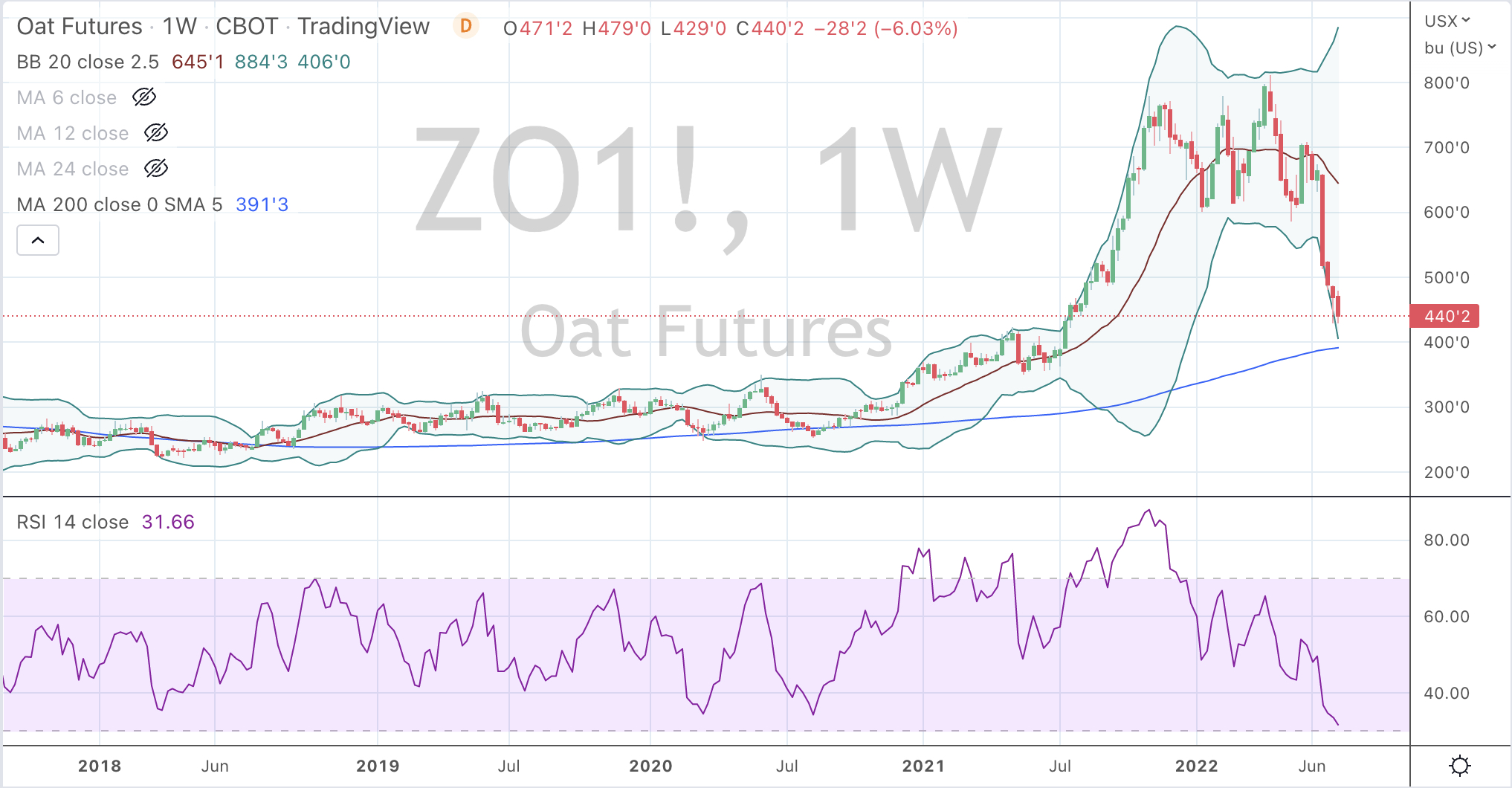
This weekly price chart of Oats tells me its set up is looking good for a low around the $3.94 mark in the coming 2-3 weeks.
A further decline of 10% is sympathetic to the trajectory of other ‘softs’ such as Rice, Wheat, Corn and Soybeans.
I think Cotton and Coffee have substantially more to downside than others. More on that in a future note.
The price of Oats nearly trebled through 2020- 2021 and then stayed elevated for 6 months.
However, this is a story about;
not chasing prices which are at extreme percentages above whatever mean you choose to obey;
observing euphoria and not running with the herd;
if you did, take the ‘fat part of the trade’ and;
allow for the probability of mean reversion.
Furthermore, farmers would have been well advised that an extreme run in price is often short-lived before considering crop rotation,
as would have buyers of agricultural land.
It was a sellers market.
When we combine an increase in inventories and higher fertiliser prices amidst a mid-cycle slowdown, prices are now declining towards the other end of the pendulum.
Canada is the world’s largest exporter of Oats, Russia is the largest grower whilst the U.S. and Germany account for 50% of the global Oats import market. Oats yield 50% more per acre than Wheat.
Lower Oats prices will benefit the likes of Kelloggs, Hain Celestial & Nestle.
Those ‘middle-men’ who have built up inventories will soon (next 6 months) be seen selling at a discount or loss.
What if the price of Gasoil (diesel, distillate) halves?
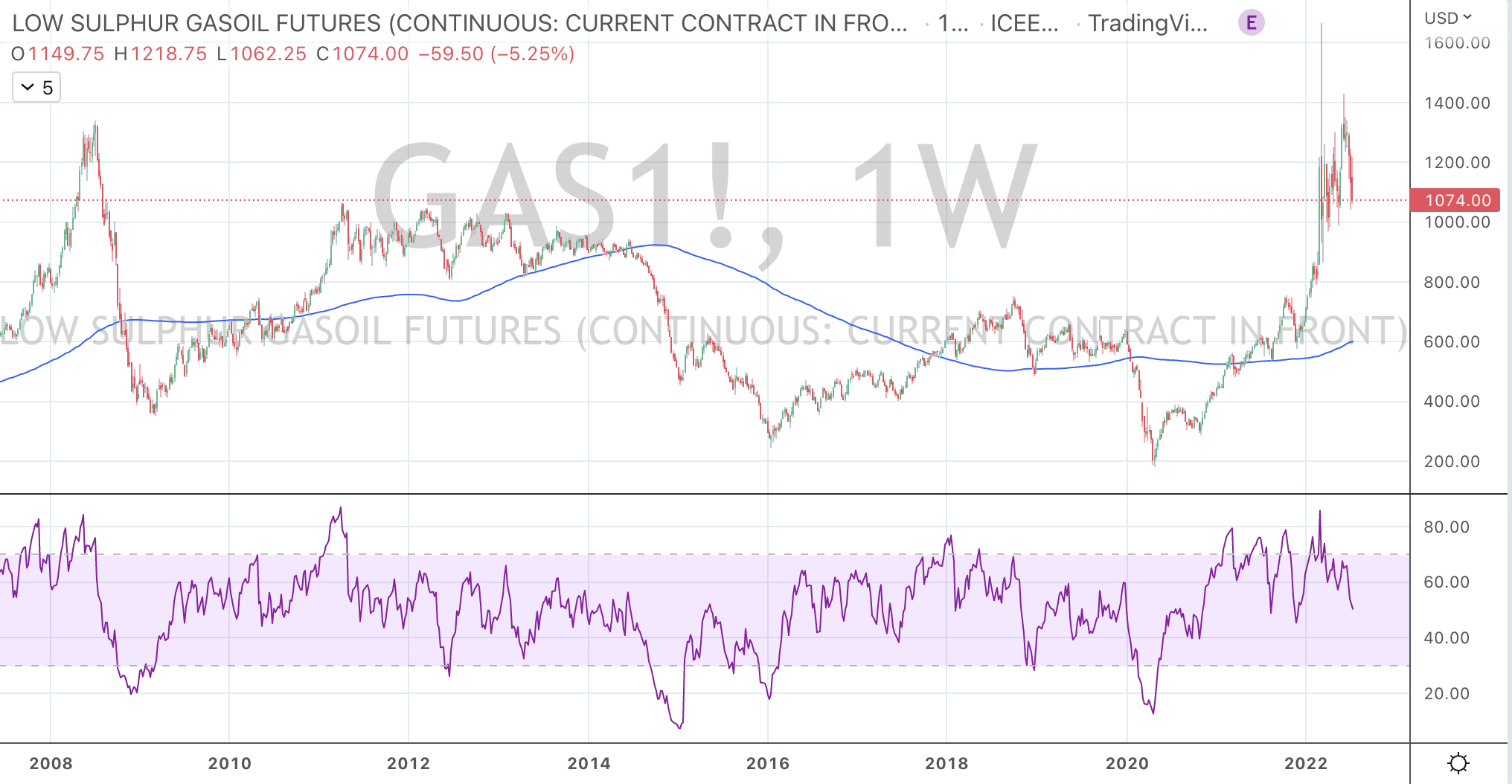
Since March 2020, the price of Gasoil rose 7-fold.
But the real entry point for the ‘long’ trade was when it was meandering around $300 some 2 years ago.
Recently and today was not a time to be a buyer either.
The chart below shows that the Gasoil has already declined 40% from the recent highs which has been driven by various energy scarcity tensions.
For more than a year, I’ve been wittering about mean reversion and the 200 week moving average and how it (more so) beckons prices following parabolic price moves.
I’d say a 700% rise within 2 years could qualify for ‘parabolic’.
While Gasoil fell 9% last night to close at $1,074, what if it makes its way towards $600 and greets that 200 week moving average?
That’s a further decline of 44%.
Firstly, it would be deflationary.
Secondly, it will be beneficial to trucking companies.
Transportation indices and respective trucking stocks have been hammered.
Any decline in Gasoil prices will aide margins of trucking companies.
If I’m wrong and if the Gasoil price consolidates or rises, those stock prices have already factored in a drop in profits.
When supply chains shorten, trucking companies will have an added boost.
Keep in mind, that average will turn (relatively) higher soon, so let’s watch for a $650 target in the coming few months.
In this series of posts in April 2022, (when the stock was $84) I wrote that I expected Newmont Mining to decline tot he $64-$68 region and made mention of its 200 week moving average.
Inflation continues to be a politically induced phenomenon.
The U.S. currently has an approximate 25% tariff on $300 billion worth of goods from China.
and Australia doesn’t seem to know how to treat its customers.
Yet, the politicians either blame the central banks or appoint them the ogre to fix it.
Perhaps the western governments should stop practising protectionism, nationalism and xenophobia in order to scare the voting constituency into re-electing them.
Globalisation provided many economies with lower prices.
Be careful what you wish for.
p.s. global diplomacy and trade rhetoric is currently at kindergarten level.
July 12, 2022 by Rob Zdravevski rob@karriasset.com.au
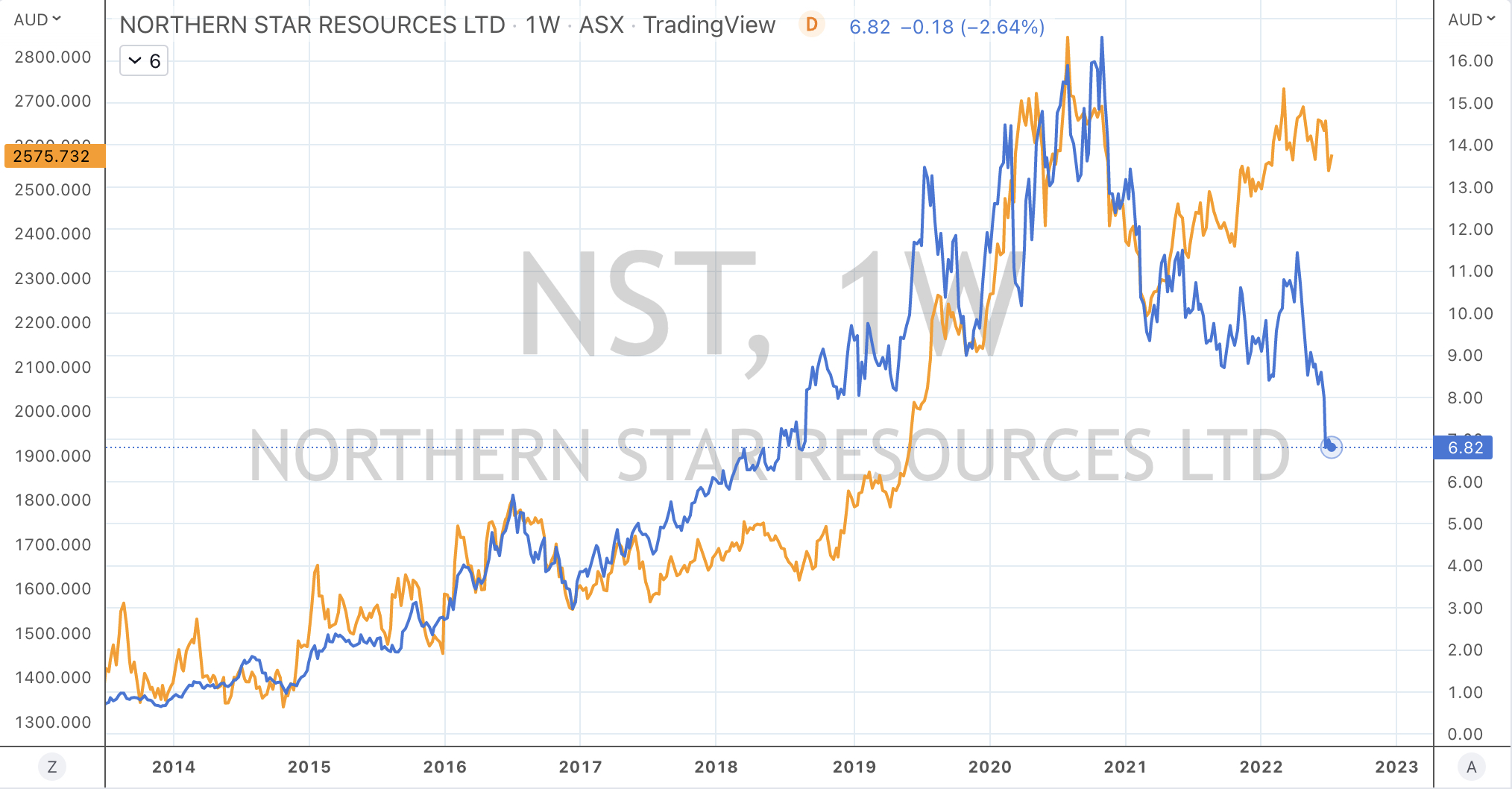
Over the past year, the stock prices of Australian gold mining producers have diverged from gold as priced in AUD.
The chart below shows ASX listed Northern Star (NST) laid over the AUD gold price.
(NST appears in blue)
Whilst a company’s gold reserves and resource along with their ‘all-in sustaining costs’ (AISC) are a couple metrics to include in your analysis, keep in mind that Gold isn’t perishable, nor does it replenish such as wheat.
Furthermore, a gold miner can also choose to ‘leave the gold in the ground’, rather than incur rising costs of extraction.
And, on a U.S. Dollar basis, these companies are even cheaper, the further the Australian Dollar declines.
The world’s largest duty-free shopping group, Dufry is buying Autogrill (one of the world’s largest owner and provider of airport concession and motorway catering services)
And the deal is akin to buying straw hats in winter…..considering that travel numbers are yet to recover, higher fuel prices are set to crimp motoring holidays and airport malaise continue.
These two companies know about the business of retail while you are in transit.
Once upon a time, Autogrill created a business called World Duty Free. After they de-merged it and floated it on Borsa Italia in 2013, Dufry acquired it a couple years later.
The Benneton family own 50.3% of Autogrill and they are happy sellers in exchange of Dufry shares and board representation. If you are not involved in a high-flying sector such as technology, this is a very good way for a 50.3% shareholder to find a happy home for their holding.
Sadly, the price offered to every other Autogrill shareholder is 8% below the prior day’s close of EUR 6.85.
Overall, Dufry has done well to to announce a take-under, rather than a takeover.
Although it seems challenging for a $3 billion market cap Dufry to swallow $2.6 billion Autogrill, it is a part stock and cash deal.
I’ll wait a few months for the deal to close and the merger to digest and check back if Dufry shares are cheaper than their current CHF 33.00 price.