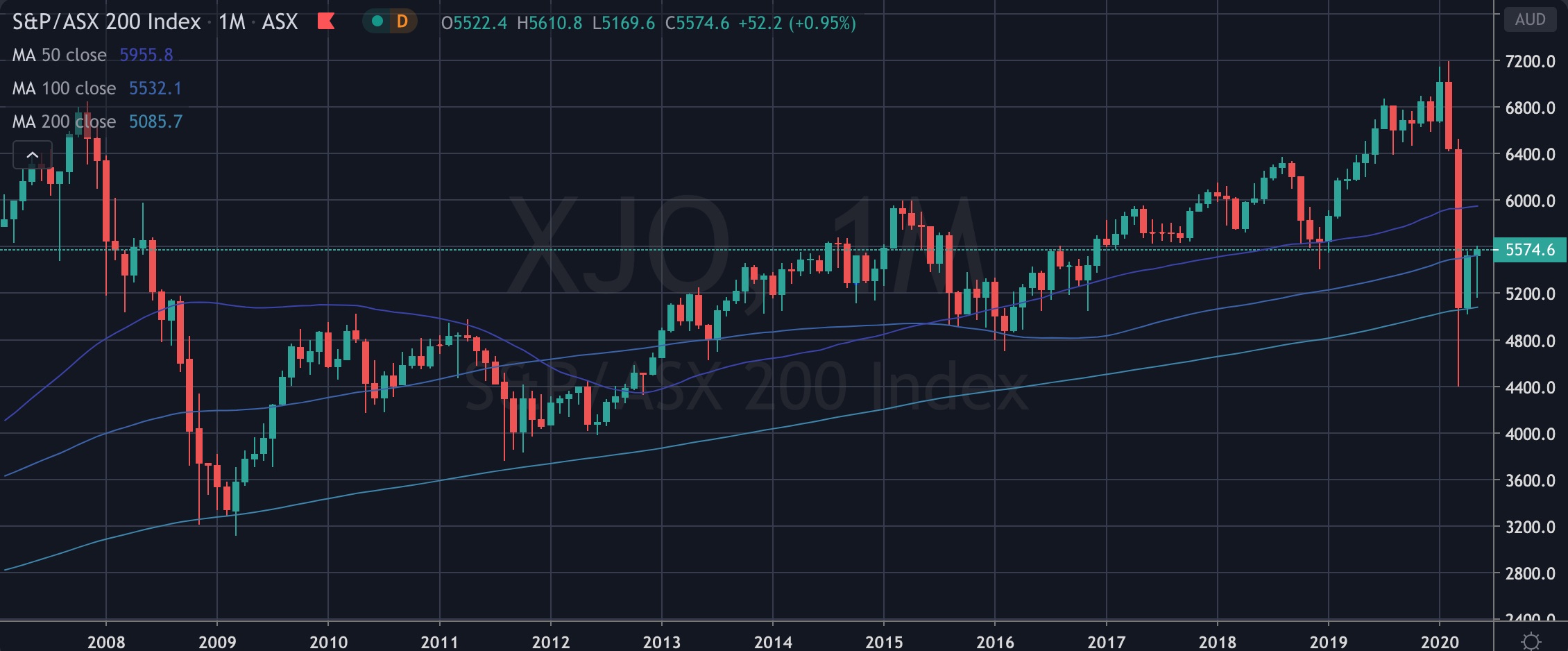
A Top in the ASX 200

Today, we saw the “top”.

An old Wall Street proverb goes “nobody one rings the bell at the top”.

I am happy to go on the record to say today’s action in the ASX 200 registered the high of this rally which commenced March 23, 2020.

My work and signals suggest todays high of 5,780 shouldn’t be breached +/- 20 points within this immediate timeframe.

With humility, I was equally pleased in calling the 4,400 low on the ASX 200, which incidentally occurred on March 23, 2020.

– May 26, 2020, by Rob Zdravevski

Overall – Bullish on Oil

by Rob Zdravevski

May 25, 2020


Basic thesis is…

Petro-nations need petro-dollars,

they can’t live with a $30, nor $20 oil price,

my view is the March 6th Saudi and Russia stoush was a concerted effort to disarm U.S. shale supply,

main aim was to knock the U.S. off the perch of their temporary and “artificial” status of #1 oil producer,

that status was achieved on shale production,

it was a tactic (not only geo-political) but OPEC centric to dethrone a non-OPEC nation from being a net exporter

worldwide Oil Rig count has fallen at least 33% (see link)

also there is little to no new capex 

in turn, reserves been depleted in past years,

replacement discoveries are lagging,

then add a premium for rising geo-political tensions

Regarding price action, following the rapid decline, the actual oil price needs to “work itself out”.

Currently,Brent is trading at $35.50 and Oil is still in rally within a bear market…..

following the snap back, Brent needs to close and break above $37.10 to test the $43 mark

Failing a breach above $37, the $29 mark is a plausible level to pullback to coupled with a few weeks would also marry a view of consolidating the recent volatility.

Bull Markets – you ain’t seen nothing yet

The great bull market is yet to come.

The large misnomer in Equity Index Investing has been that the past 10 years has produced the longest and greatest bull market ever.

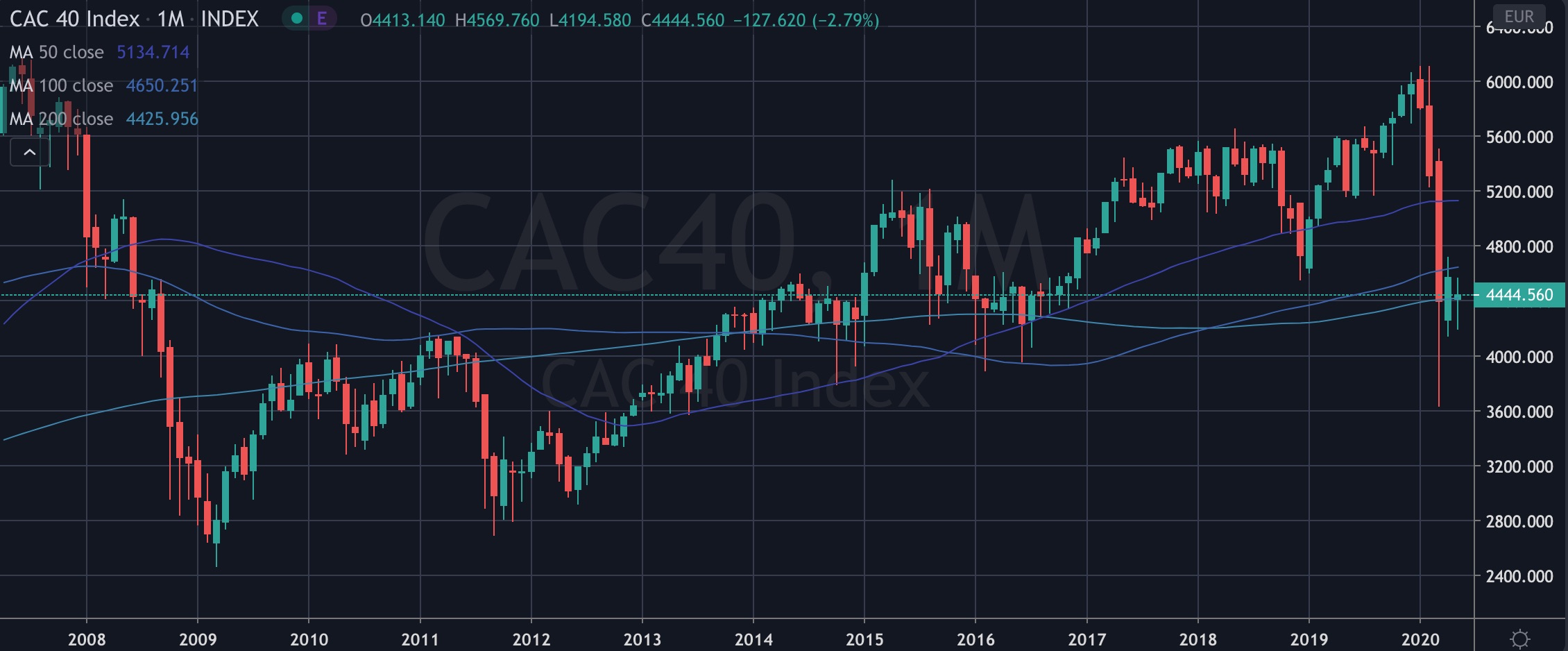
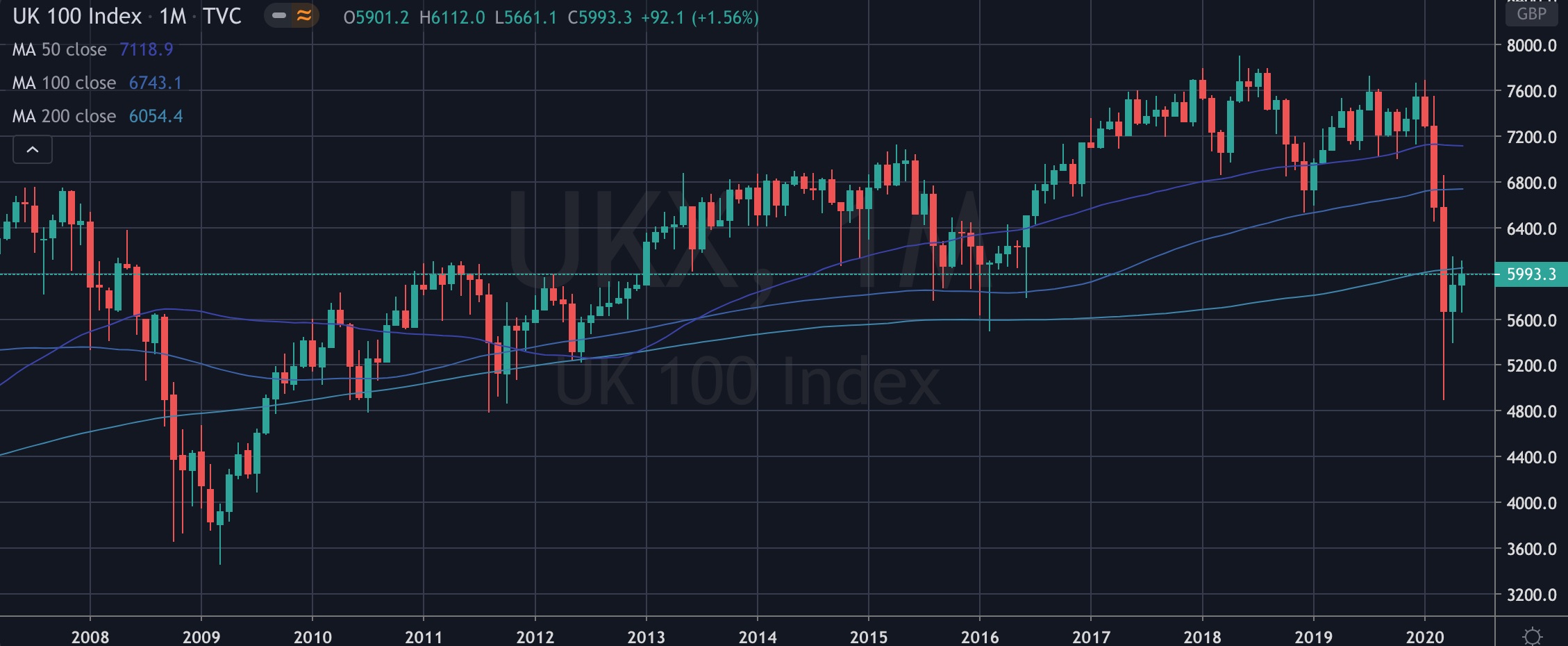
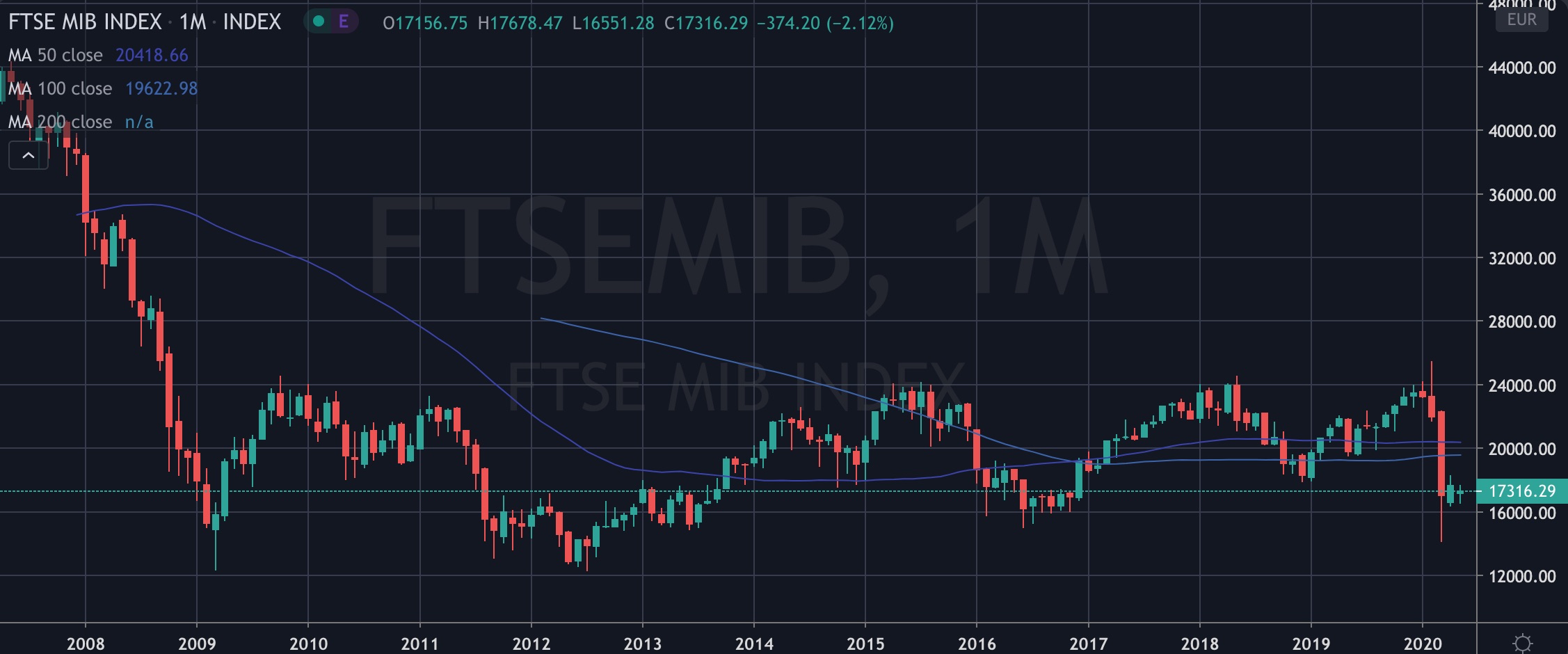
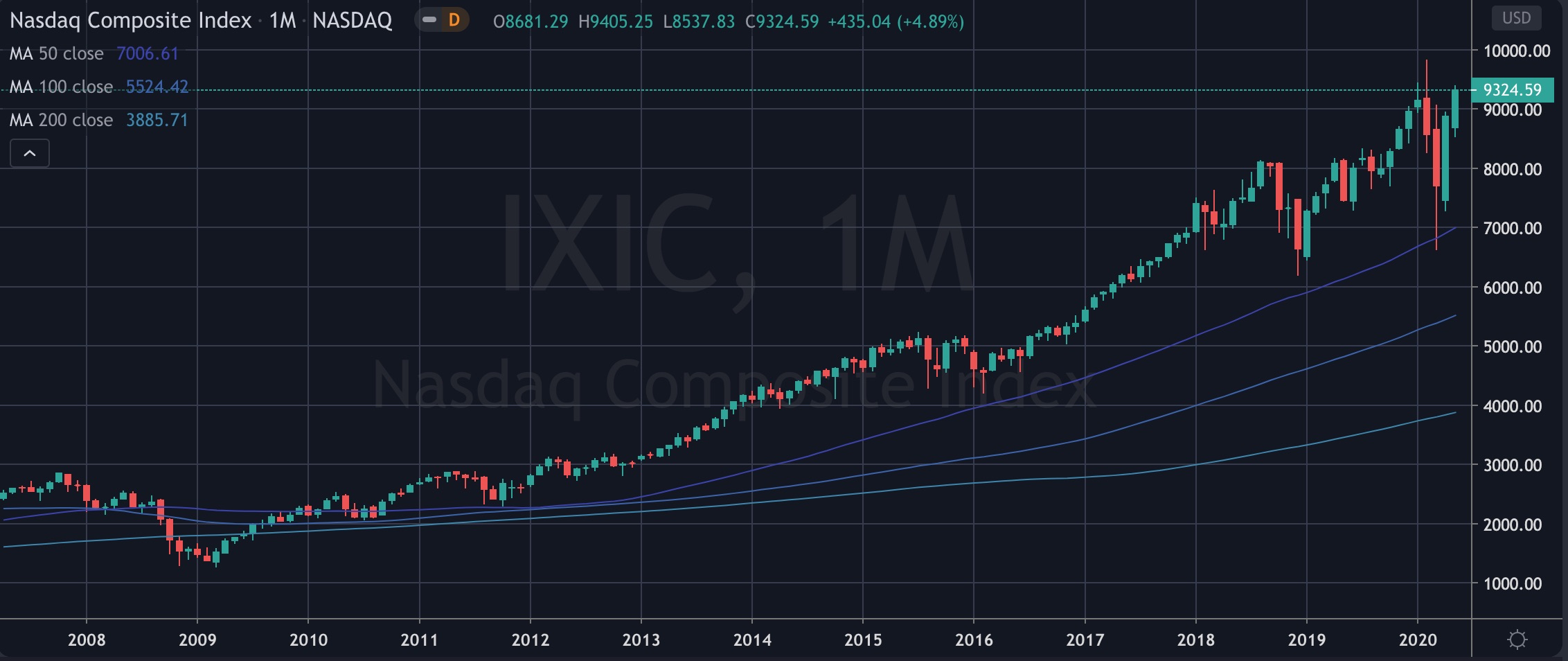
Other than the S&P 500 and Nasdaq, many of the world’s (Australia, France, Italy, UK, Spain & Germany) major indices have either treaded water or had marginal returns since 2010.

Japan’s Nikkei has doubled over the same time, however that is commensurate with it producing a compounded annual return of 7%.

It has been with good doses of conformity and complacency that investors should question whether the rise of passive index tracking ETF’s has provided what they were looking for.

I like picking specific stocks and investing directly in those companies.

May 20, 2020
by Rob Zdravevski
rob@karriasset.com.au

Short Gold

For various reasons from my analysis……
I am calling the price of Gold lower.

The chart below is one analysis snippet sample showing you how the current rally has occurred with little and waning volume, unlike previous advances.

So the trade is……Short Gold around its current level of $1,717,
Stop Loss, at a monthly close above $1,805. (5% risk)

If it closes above this level, reverse the trade, Go Long and we’re off to the races !

Initial downward targets are;
$1,551
$1,478
$1,380 (19% reward)
and ultimate target $1,300. (24% reward)

Could possibly overshoot to $1,251 – $1,268 region.

Let me put this way…..I don’t want to own Gold at this price and this stage, whether its for a hedge, armageddon or any fundamental reason.

There are other better investment opportunities elsewhere as I feel a “long” Gold trade is a marginal trade, at best.

Note: these are my personal notes and just a digital record…..not personal advice to you..…see my disclaimer so you don’t get hurt and you don’t sue me.
Stay safe !

Buy a cheap plane, picking through Virgin’s scraps

A new Boeing 737-800 costs approx. US$82 million but you may be able to pick one up for 15 cents in the dollar.

Perhaps interested buyers could call the Sydney office of Deloittes (the administrators for Virgin Australia) and throw them a $12 million bid or lower?

p.s. it’s abut $200,000 for a new paint job.

Interestingly, in the 2019 Virgin Australia annual report they failed to tell us the amount of planes they operate, let alone list how many are owned or leased.

Although in the financials of the annual report you’ll also find morsels of info such as how they carry non-cancellable leases and on a more sadder note, approx. $200 million in employee long service leave provisions.

Though, I feel there is a chance that Virgin Australia’s livery will still be part of our aviation industry. It will be easier for an acquirer to run with the existing brand, slots, maintenance and broader infrastructure than to have a new carrier start from scratch.

https://lnkd.in/g2dFj98

https://lnkd.in/gFie8H8

#virgin #airlines #VAH #aircraft #leases

Weak results don’t matter

French Bank, Societe Generale (SocGen) reported its quarterly results,

Gross Operating Income fell from EUR 1.4bn to EUR 492 million,

EUR 820m is set aside for “cost of risk”,

The allowance or cost for these bad loan provisions have tripled from 21bps to 65 bps


Thus, it loses EUR 326m vs a profit EUR 640m in the same period last year,

Revenue falls 15% from the same period

Return on Equity is now – 0.50%

And interestingly price to book ratio is below 0.20


https://www.societegenerale.com/sites/default/files/press_release_q1-2020.pdf

https://www.spglobal.com/marketintelligence/en/news-insights/trending/ivf8udjj9cpzct1isejraa2

This market has nothing to do with economic reality and nothing to do with valuation reality. 

It’s a macro market, its a liquidity market and a money flow market.


This is the type of market and economic environment where companies are either or will;


go under;

need a bailout;

need to raise capital;

amble along or;

were strong going in and become stronger coming out

I know which “bucket” of companies I want to own and I’d be willing to pay a premium to own them.
This is a market which separates the well financed from the over-leveraged.

You want to own companies with a ‘fortress’ balance sheet and who is a ‘Gorilla’ in its market or industry.


https://mises.org/library/trouble-prosperity-interview-james-grant

https://themarket.ch/english/covid-19-unmasked-an-essential-weakness-in-finance-ld.1804

April 30, 2020

by Rob Zdravevski

rob@karriasset.com.au

The art of being earnings accretive

November 28, 2019

by Rob Zdravevski


I just love the deal made by Bernard Arnault and LVMH in buying Tiffany.

The sales pitch LVMH gave Tiffany was;

  • a 32% premium to its previous close (the price was revised upwards, twice)
  • An all cash deal from the world’s largest luxury brand house with a market cap of $200 billion run and controlled by the world’s 2nd or 3rd richest individual.
  • and we are “offering Tiffany time and money”, to get away from the burden of quarterly reporting spare Tiffany from the demands of quarterly reporting and invest over the long term.

LVMH’s chief financial officer Jean-Jacques Guiony went further on to say, “We expect to bring Tiffany time and capital, which are two things that aren’t easy to get when you’re quarterly reporting to the stock market”.

In essence, the deal is basically a “private equity” style acquisition conducted by a publicly listed company.

“The deal underlines the growing firepower of LVMH, which generated €46.8bn in sales and €5.5bn in free cash flow last year. After its shares rose 60 per cent this year, it now has a market value of more than €200bn”, the Financial Times commented.

LVMH will not issue or use its own stock to pay for the acquisition.

Instead, they will issue their own LVMH debt to pay for Tiffany’s. With their A+ credit rating, LVMH will be able to more or less be its own price maker of the coupon rather than market dictating so.

Companies often offer their stock to pay for acquisitions when they believe they can use their inflated and expensive shares as currency.

In LVMH’s case, it’s the opposite. This tells me so many things about management’s opinion of the company’s prospects.

They’re not using their stock as its too valuable to give away to Tiffany shareholders. Why give away something of value when debt (cash) is cheap? Why dilute the equity holders?

It’s a very clever and logical decision.

Interestingly, LVMH had already prepared and submitted a “Base Prospectus” in July 2019 for issuance of debt notes for an amount up to EUR 20 billion.

Tiffany’s US$16.6bn purchase price will equal EUR 18.3 billon and if they add advisor fees of let’s say EUR 400 million and they’ll close it for under EUR 19 billion.

They should likely offer 5 year paper with a coupon of 0.50%, which is a generous 90 basis points above the EUR 5 year Euro Government bonds (which are currently trading at negative 0.40%) and LVMH could possibly even rank the debt as unsubordinated.

Of Tiffany’s $4.2 billion revenue, they tend to produce (a normalised “undisturbed”) free cash flow amounting $300 million annually.

So, EUR 19 billion debt will cost LVMH EUR 95 million in interest per annum which easily covered by Tiffany’s free cash flow, let alone that LVMH have said that they expect the TIffany’s acquisition to become earnings accretive to the tune of EUR 500 – 600 million by 2020. That’s operating profit, not cash flow and we are talking about a year away.

Bien joué Monsieur Arnault
Ignore the noise & be patient

As an investor, do you find yourself “jumping at shadows” with the smallest hint of (real or perceived) bad news?

Are you truly as much of a longer term investor, which you say you are? I implore my clients to really think about this question. If not, it’s best that you cut yourself some slack & confusion , by admitting that you are a speculator.

Major equity markets have staged a wonderful rally with most of them re-visiting their levels of last August or October. If you focused on hunting for bargains and overreactions, you would have used the months of November and December to add to your portfolio.

Some “shadow jumpers”, “Trump deflectors” and “trade war worriers” may have riddled themselves with worry or worse yet, panic, which may have resulted in a poorly thought out decision to sell your securities during this time. It takes time for investments to mature.

Once the analysis and thesis is developed, formed and capital deployed, it doesn’t mean that the “payoff” occurs within the time it takes to run a horse race.

And through the period of the thesis being proved and confirmed, there will be volatility and pricing hijinks. Interestingly, the price action of the indices below are suggesting new long term trends are being confirmed.


No alt text provided for this image


No alt text provided for this image


No alt text provided for this image


No alt text provided for this image

Understanding Volatility

Courtesy of: Visual Capitalist

“>http://<div style=”clear:both”><a href=”https://www.visualcapitalist.com/5-lessons-about-volatility-to-learn-from-the-history-of-markets/”><img src=”https://2oqz471sa19h3vbwa53m33yj-wpengine.netdna-ssl.com/wp-content/uploads/2019/02/volatility-history-infographic.jpg&#8221; border=”0″ />

Courtesy of: Visual Capitalist

You are missing out if you only invest in Australian equities

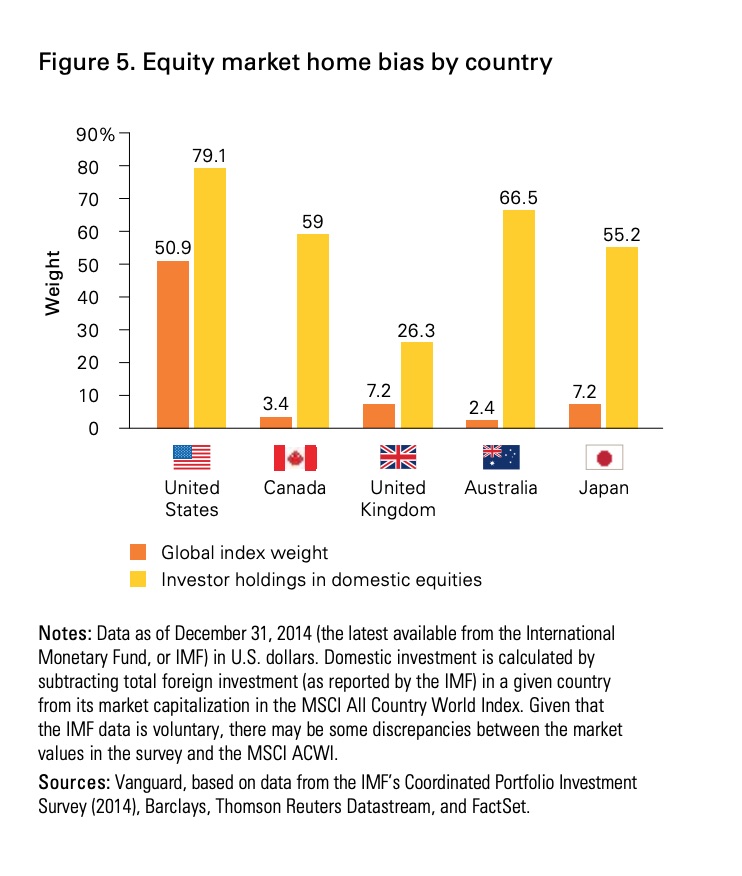
The overwhelming bia and perhaps “comfort” which Australian investors exhibit and seek by either solely or heavily investing in their domestic equity market has proved to be a substandard strategy over the past 20 years.

Larger, developed markets have outperformed the ASX 200 over this greater period of time.

My anecdotal experience whilst being an Australian domiciled stockbroker who focused and specialised in “overseas” equities, from investors who shunned international securities included them telling me that “at last they can drive by and ‘touch’ the company” which they are invested in, or some may have justified their strategy by convincing themselves they could conduct their research more easily by knowing the Australian company better.

I find these type of justifications quite weak and poorly founded.

It’s highly unlikely that an investor in BHP has researched or visited all or most of their sites, offices and operations located in Australia and the same would be the case if one analysed a power, supermarket or healthcare business.

Interestingly, Australians probably use more products and services from overseas corporations than they care to admit.

Whether its Google, Ford, Facebook, Dropbox, Sony, Bayer, Siemens, Netflix etcetera, etcetera……

I fear, that the government “sponsored” or “promoted” programs of negative gearing, franking dividend credits and perpetual money flow into superannuation will continue to allow “local” only biased Australian investors to continue doing themselves an investing disservice for decades to come.