Cheaper fuel is good for trucking companies

15 months ago, I wrote a note titled “Positioning in trucking companies”.

Within it, I mused “what if the price of of Diesel (Gasoil) halves?”

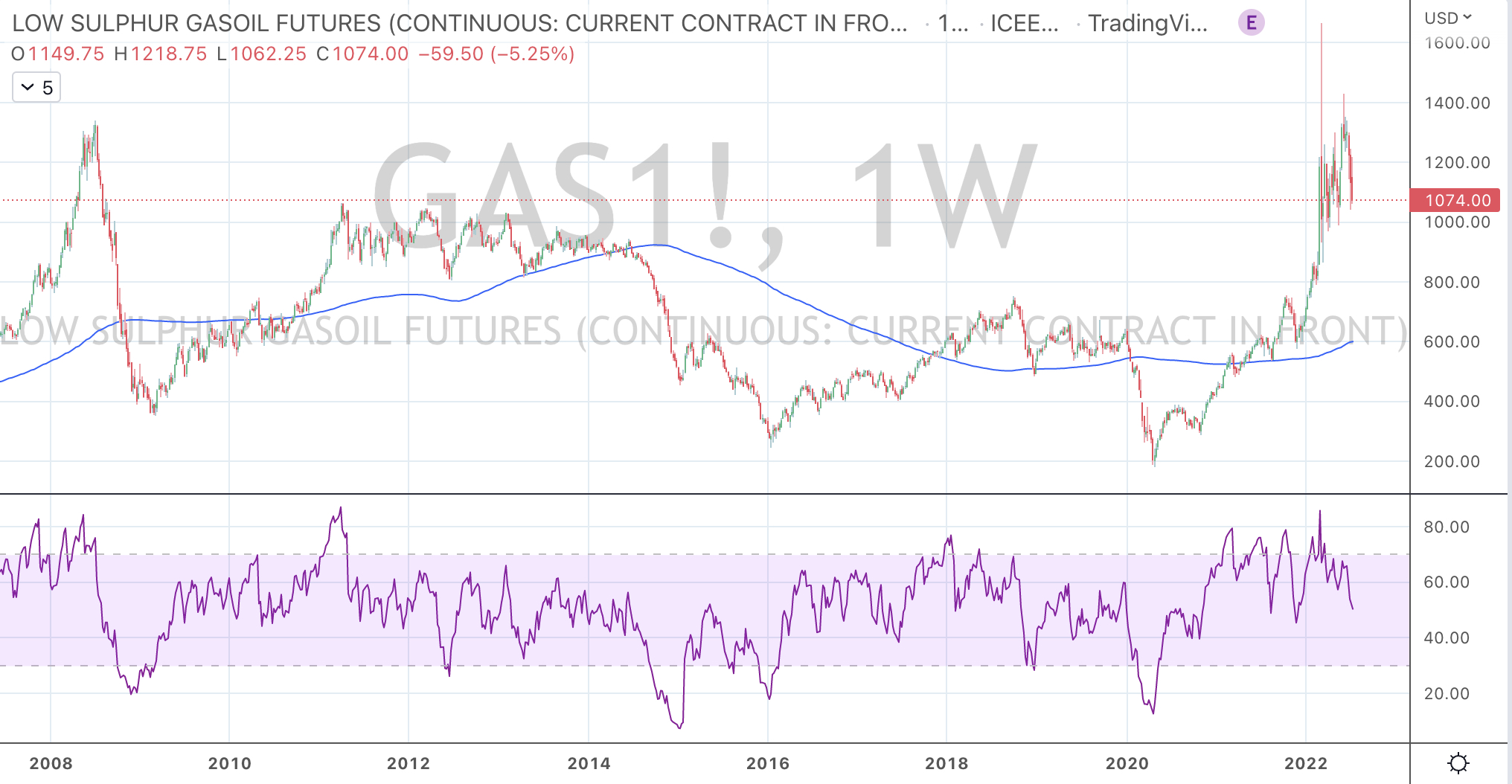
I went on to say, “what if it makes its way towards $600 and greets that 200 week moving average?”

If diesel prices would fall by 50%, then I figured that would be good for trucking (transportation) companies.

Back then, the shares in trucking companies were cheap, unloved and trading in their doldrums.

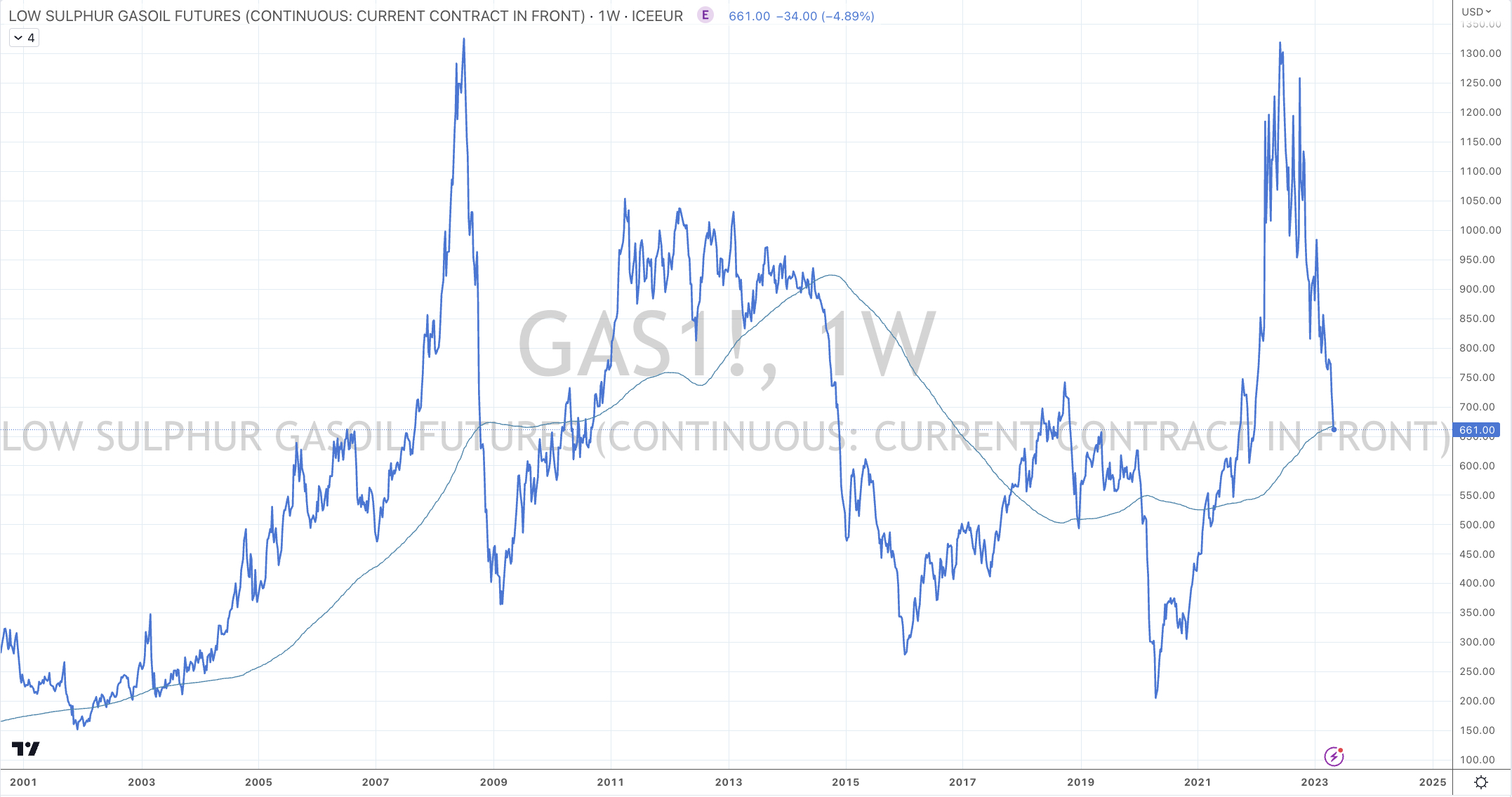
The Gasoil price did halve and it did trade and touched its 200 week moving average.

The stock prices of GXO Logistics and XPO between the week of July 13, 2022 and the week of July 24, 2023 rose 58% and 121% respectively.

Incidentally, my ‘Macro Extremes’ edition for the week ending July 24, 2023 listed the Gasoil price in the overbought section.

Those stocks were sold then…….

I’ll look to re-acquire them again, perhaps, when I see the Gasoil (Diesel) price re-visit its 200 week moving average.

October 5, 2023

by Rob Zdravevski

rob@karriasset.com.au

A story about Diesel prices

Today, Gasoil (diesel) and Heating Oil completed their mean reversion back to their 200 week moving average. This was prompted in this weekends edition of Macro Extremes.

They join Crude Oil and Natural Gas who achieved this milestone a couple months earlier.

However, ‘achieving’ mean reversion doesn’t translate to a ‘Buy’ signal.

This observation is a reminder to not have chased prices higher, especially at the stratospheric levels seen at the onset of the Russian-Ukraine war.

You would think lower fuel costs should be good for truckers and courier services, however there is a perverse trend that diesel prices lead the stock prices of ‘transporters’ lower.

This is a result of their fuel forward purchases, hedges and a lag in working off inventories.

This is terrific for today’s spot buyers.

Gasoil has halved since that high.

Although, falling Gasoil prices translates into predicting weakness in the Dow Jones Transports Index,

and a lower transports index usually mimics a decline in the S&P 500,

which coincides with weakness in the U.S. Dollar and broadly lower commodity prices,

which portends lower interest rates (perhaps the 2 year) yields,

which might be a positive for technology stocks.

But amongst this story telling, Gasoil, Heating Oil and Crude Oil will find a floor before it becomes mainstream news.

May 3, 2023

by Rob Zdravevski

rob@karriasset.com.au

Positioning in Trucking Companies

What if the price of Gasoil (diesel, distillate) halves?

Since March 2020, the price of Gasoil rose 7-fold.

But the real entry point for the ‘long’ trade was when it was meandering around $300 some 2 years ago.

Recently and today was not a time to be a buyer either.

The chart below shows that the Gasoil has already declined 40% from the recent highs which has been driven by various energy scarcity tensions.

For more than a year, I’ve been wittering about mean reversion and the 200 week moving average and how it (more so) beckons prices following parabolic price moves.

I’d say a 700% rise within 2 years could qualify for ‘parabolic’.

While Gasoil fell 9% last night to close at $1,074, what if it makes its way towards $600 and greets that 200 week moving average?

That’s a further decline of 44%.

Firstly, it would be deflationary.

Secondly, it will be beneficial to trucking companies.

Transportation indices and respective trucking stocks have been hammered.

Any decline in Gasoil prices will aide margins of trucking companies.

If I’m wrong and if the Gasoil price consolidates or rises, those stock prices have already factored in a drop in profits.

When supply chains shorten, trucking companies will have an added boost.

Keep in mind, that average will turn (relatively) higher soon, so let’s watch for a $650 target in the coming few months.

July 13, 2022

by Rob Zdravevski

rob@karriasset.com.au

#trucking #transportation #supplychains

Why Are Investors Surprised ?

If you are transportation

Truck convoy-08

company….

  • working on a net margin of 3%,
  • trading on a P/E ratio of 14 (vs. the underlying index P/E of 11),
  • when Goodwill equals a figure that is half of your Market Cap,
  • dealing in a fragmented marketplace with rising fuel and wages costs and
  • that has negligible free cash flow;

why are investors surprised when the stock falls 15% on bad news?

In capital markets, it is difficult to pick an investment winner but it should be easy to figure out what to avoid.