Very Good Pay for Low Productivity

A topic I’ve been thinking about involves wages, labour and productivity.

Particularly in Australia.

Bureau of Statistics data suggests that wage inflation is benign.

https://www.abs.gov.au/statistics/economy/price-indexes-and-inflation/wage-price-index-australia/latest-release

I am seeing the contrary. A range of people from hospitality workers, truckers to tradies being paid above award rates for their labour.

Sorry folks, but house cleaners are making $55 per hour. That’s the same as a registered nurse.

On the subject of labour, it is anecdotally evident that we have a shortage of labour. Whether that is spliced and framed between those willing and not willing to work (either subsidised or otherwise), available labour is scarce.

I’d like to be corrected with this next statement but productivity (any type that you wish to look at) is significantly lower than it was 20 or 30 years ago.

Certainly software has helped increase one type of productivity but generally in Australia, I think the drop in productivity commenced from the moment Bill Kelty became the Secretary of the ACTU in 1983.

The costs associated with hiring and keeping employees coupled with the difficulty in firing staff has manifested it into a growing gravy train of complacency and lack of productivity.

Now, it has spread into a common work vernacular.

Why does it take 18 months to build 5km of highway ??

Australia is a one-speed economy.

Slow !

September 1, 2021

by Rob Zdravevski

rob@karriasset.com.au

Lithium all feels too electric

Lithium is such a hot topic to the point that I’m being asked for my opinion by people while I’m having a morning coffee.

I quickly reply by saying something like, “if you’re suddenly interested in lithium stocks, it probably means everyone should get out”.

Now that I’ve upset my coffee drinking mates (mainly because they’re thin skinned)…….

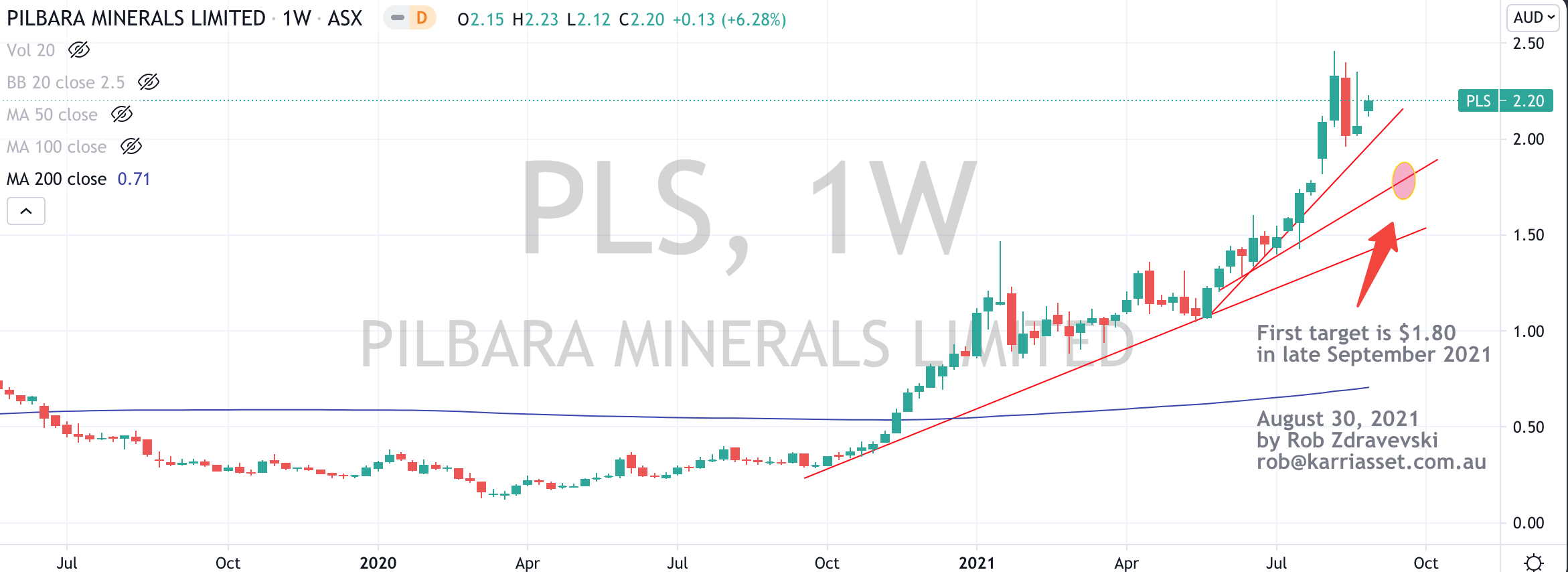
my quick take on stock price of Pilbara Minerals (PLS:ASX) is a call for it to visit $1.80 around the September 22nd area.

(see the attached weekly chart below)

Where it moves after that will depend on the strength of the decline and other indicators or nuances in the price action.

Note the continual line at the bottom of the chart, 

this is its 200 week moving average which is currently floating around 71 cents.

Beyond its valuation fundamentals, a $51m loss at its latest fiscal year report wasn’t surprising to see. While a $175 million revenue in the past year makes it a little difficult to swallow buying shares at $6 billion market cap. A 35 times multiple on revenue is often seen in a technology stock.

Furthermore, buying PLS at $2.20 when its trading at 210% above its 200 week moving average is equally perilous.

This percentage is in the same stratosphere are many high flying assets and securities seen lately around the world, including Bitcoin.

Keep in mind that, that moving average should accelerate higher in the coming 6 months perhaps to the $1.20 mark.

While PLS falling to $1.20 would represent a ~ $3 billion destruction of market capitalisation, it would mathematically represent a digestible mean reversion which would also (ironically) equate to a 62% retracement of the rally which started a year ago.

This last scenario is entirely plausible.

August 30, 2021

by Rob Zdravevski

rob@karriasset.com.au

Exit by billions in dividends

The recent opportunity in the dividend stripping trade on being long Fortescue (FMG:ASX) was one of the more obvious in the Aussie market in quite a while.

As I wrote (cryptically) a couple weeks ago, that the stock has long-term downside risk and

once it trades ex-dividend the stock will likely see more weakness.

Records profits are terrific as are record dividend payments, but from the page of ‘knowing how the world operates’, I believe that for reasons of confidence, Dr Forrest can never be seen selling any of his FMG shares and so I think his strategy is to either pledge or gift them to other entities and drag as much of his net worth out via dividend distributions.

Over the past 3 years, ~ $7.5 billion has moved his general way courtesy of dividend payments. That may account for a third of his net worth.

If I could get another $7 billion out in the next 3 years, I’d be quite happy with that parachute move.

Don’t get me wrong, it’s brilliant.

August 30, 2021

by Rob Zdravevski

rob@karriasset.com.au

Macro Extremes (week ending August 27, 2021)

The following assets (on a weekly timeframe) registered an Overbought reading or traded more than 2.5 standard deviations above its rolling mean.

Extremes “above” the Mean (at least 2.5 standard deviations)

Cocoa

EUR/AUD

Overbought (RSI > 70)

Hot Rolled Coil Steel (for the 48th consecutive week)

Switzerland’s SMI equity index (for the 12th week)

the Nasdaq 100 & S&P 500 index

Amsterdam’s AEX, Copenhagen’s 25 and Helsinki equity indices

and India’s NIFTY 50 equity index

The Overbought Quinella – Both Overbought and Traded at > 2.5 standard deviations above the weekly mean)

cryptocurrency, Cardano

Cattle

Orange Juice

Assets (securities) within my immediate universe which touched the other side of the extreme, being Oversold (where the RSI is < 30) or were at least 2.5 standard deviations below its mean are;

Extremes “below” the Mean (at least 2.5 standard deviations)

Korea’s KOSPI equity index

Oversold (RSI < 30)

None

The Oversold Quinella – Both Oversold and Traded at < 2.5 standard deviations above the weekly mean)

None

Notable deletions from last week’s list include;

Italy’s overbought MIB,

the oversold Russell 2000 small cap index which bounced 5% this week,

a range of oversold commodity based currencies

and oversold Chinese equities (those indices rose 2.5% in the past week)

Notes & Ideas:

This past week was a story of rising government bond yields, soaring commodity prices (which is some relief for the many is clear downtrends) while most equity indices advanced.

Although, as the list above shows, not many entrants in the ‘extreme’ category. Many prices are meandering around and (marginal) trade opportunities are to be found in those developing new trends

The DXY and various currencies are worth keeping an eye on too.

The JGB’s are still suggesting ‘risk-on’ for equities are they rise slightly having closed at 0.02%, which is above a resistance line I’m watching. 

Last week, I also wrote about another risk appetite predictor in the U.S. 10 year minus Australian 10 year bond yield spread which is now firmly above an important resistance line.

Equities have every possibility of ‘melting up’ and not down.

There weren’t many decliners in the past week.

It’s a complete turnaround from last week’s sea of red.

The Advancers included Brent Crude 11.7%, WTI Crude 10.6%, Gasoil 9.6%, Heating Oil 10.6%, Natural Gas 14%, Gasoline 4.7%, Aluminium 4%, Gold 2% (its best week since mid-May), Hogs 2.4%, Copper 4.4%, Coffee 5.9%, Cattle 11%, Silver 4%, Corn 3.5% and Soybeans 2.5%…all goes towards explaining the 6% rise in the CRB Index.

Amongst equity indices, the TAIEX 5.3%, Russell 2000 and SOX both rose 5%, the Nasdaq Transports 4.1%, the DJ Transports 2.4%, Nikkei 2.3%, HSCEI 2.4%, Shanghai 2.7%, and the Midcap 400 rose 3.4%.

The most notable mover in crypto land was Cardano rose 7%, compounding last weeks +14% and 52% from the previous week. 

And lastly, Bitcoin is trading 222% above its 200 Week Moving Average, which is lower than last week’s 230% reading and notably higher than the reading of 140% seen 8 weeks ago, while certainly lower when compared to its 466% peak in mid-April 2021.

August 29, 2021

by Rob Zdravevski

rob@karriasset.com.au
Korea raises rates

The Bank of Korea has increased its interest rate by 0.25% to 0.75%.

https://www.reuters.com/business/finance/skorea-seen-delivering-its-first-pandemic-era-rate-hike-2021-08-25/

It’s the first major developed market to increase rates since a few years ago.

Albeit Korea increased its inflation rate expectations, it is the first to cite concern over growing consumer debt posing a risk to the economy.

In my recent posts about Russia, Brazil and Mexico increasing interest rates, their concerns were about the rising cost of living and also pertinent as they are commodity sensitive economies.

These countries don’t have large consumer debt levels, unlike Korea or others appearing in the list below.

So is Australia behind the curve in raising interest rates?

August 26, 2021
by Rob Zdravevski
rob@karriasset.com.au
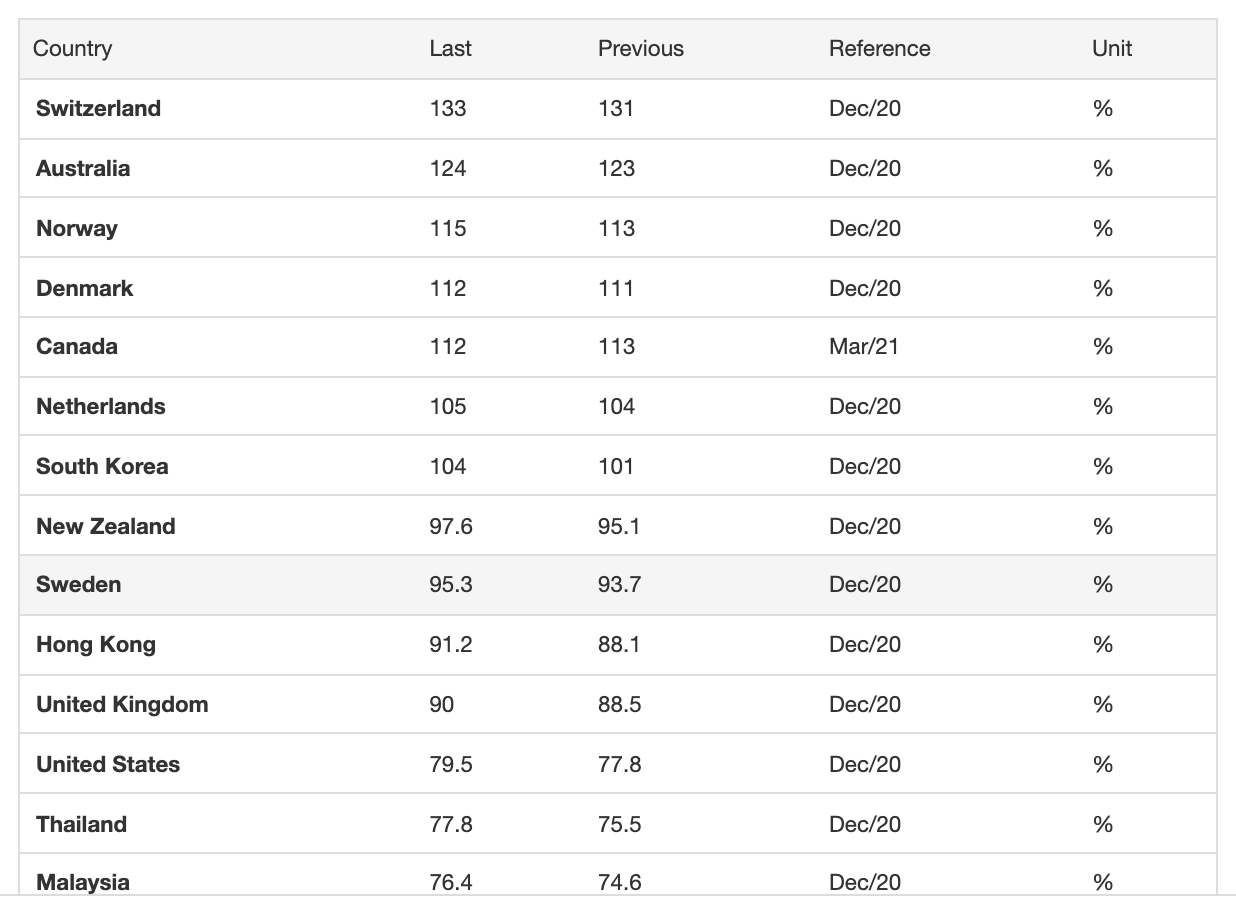
Consumer Debt to GDP (per country)

Don’t you love the herd?

Buy straw hats in winter

Buy umbrellas in summer.

They are cheaper, plentiful and it’s not very trendy.

Here is a story about chasing something ‘hot’ and attractive accentuated with scarcity and marketing. This comes with an accompanying price.

https://www.bloomberg.com/news/features/2021-08-24/fifthdelta-brevan-howard-demand-shows-hedge-funds-are-hot-again?sref=qLOW1ygh

It just stinks !

Another story heard on the road today…..

an accountant tells me that his client was quite impressed with the 21% return his managed fund portfolio achieved, that he gave his financial planner a further $1 million to allocate to the same strategy.

There are a few cognitive bias here to identify.

By the way, this return is not stellar because ‘everyone did’ 19%-29% in the last financial year.

Incidentally, the ASX 200 posted a 24% capital return and 26% if you include dividends.

The financial planner declared he will charge $11,000 for the service of selling (sic: recommending) the appropriate products.

I’m not sure this is value for money? I mean directing money to funds appearing on a product list, meeting the client once a year and ‘rebalancing’ a portfolio in the first week of each July is hardly skillful.

Notwithstanding, the funds themselves have their own costs. Let’s say an average of 0.5%, which the investor doesn’t normally see, as the funds reports its performance as ‘net of fees’.

More amazingly, is that the financial planner deployed 100% of the money in the same week which the investing client remitted the funds.

Isn’t it just superbly fortuitous that on the day that a $1 million became available, that the ‘stars and universe’ signalled an appropriate, prudent and cheap moment to pile in last week.

No sour grapes here. This is how a large part of the financial services industry operates.

My suggestion to the investing retail public is a combination ‘eyes wide open’, ask questions and challenge the advisors thinking.

August 25, 2021

by Rob Zdravevski

rob@karriasset.com.au

How to play inflation

My latest newsletter is here.

https://mailchi.mp/karriasset/how-to-play-inflation

You may choose to subscribe to receive new editions.

It’s a seller’s market

In the context of the Australian residential real estate market and specifically, the Perth market I was asked by an esteemed national accounting firm today for my buy, sell or hold opinion.

Following the discussion, I followed up with this email,

“In today’s meeting I gave you that current valuation case for residential property being expensive or at least fully valued, in citing a net earnings yield of 2% equating to a Price/Earnings Ratio of 50.

My other negative points included fixed or perhaps growing expenses (including rising interest rates).

Poignantly, should interest rates double, your client may still be able to service the debt, but others around him (especially those buyers of property in the past 2 years) may feel debt payment strain. This leads to a rise in listings and lower prices due to increase stock. Water does find its natural level.

On the other side of the financial statement, residential properties don’t have same ability to increase revenue in the manner or potentially the velocity in which a corporation can.

Invariably, higher residential prices have heralded new dwelling development which also increases stock.

But most subjectively, when you find clamouring buyers driven by scarcity and fuelled with low interest rates, it is identifiably a “Seller’s market” and not the other way around.

It may not be a time to ‘dump’ all holdings as it depends of your cost basis, the utility the property provides or the associated debt and holding costs but there are times to trim and sell assets when they are fully priced.

When it comes to residential real estate, a seller should greet moments when liquidity and buying interest is abound and forgo perfect timing, as the real estate market doesn’t afford you ’natural’ price discovery and quick settlement periods, unlike the stock market.

Catching the ‘fat’ part of the trade is perfect.
Preserving capital is paramount.”

August 24, 2021
by Rob Zdravevski
rob@karriasset.com.au

#property#realestate#Perth#Australia

‘Petro-Nations’ need ‘Petro-Dollars’

Keep this in mind when you ponder the price of oil and the supply/demand equation.

https://www.bloomberg.com/news/articles/2021-08-22/libyan-central-banker-pins-revival-hopes-on-higher-oil-output?sref=qLOW1ygh

And then when you add OPEC+ efforts to machinate a higher price by curtailing output, a nation reliant on oil receipts means oil supply will find its way to the market.

There remains a reasonable case for Brent Crude to visit $64 and failing to hold that, a trip to $57 and $54 are entirely plausible.

More so, watch when a petro-nation panics after having missed out on a selling at $76 per barrel because OPEC botched a manipulation effort trying to send it to $90.

August 24, 2021

by Rob Zdravevski

rob@karriasset.com.au