One year on, it’s less fertile
May 9, 2021 Leave a comment
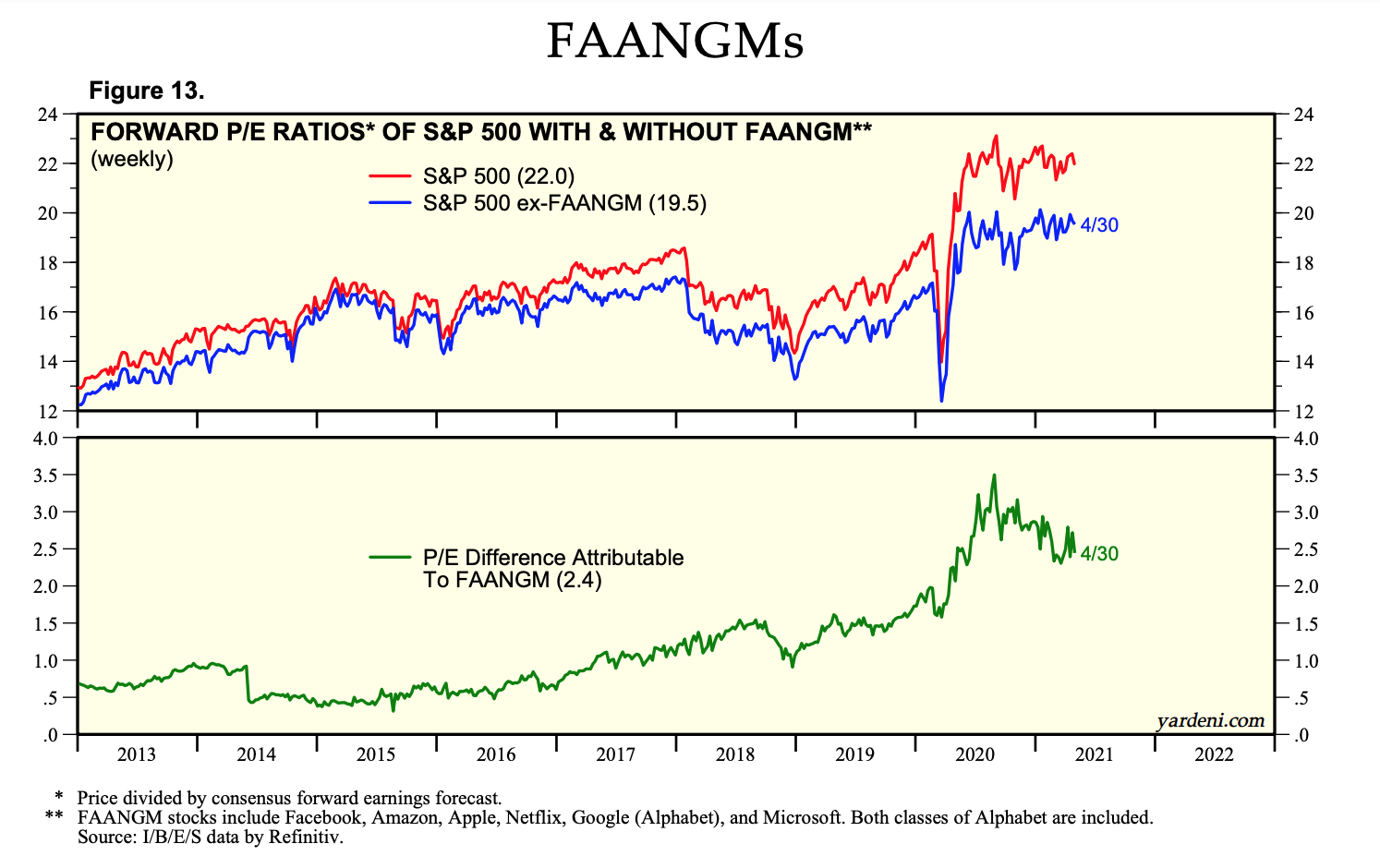
In March 2020, the S&P 500’s forward P/E estimate momentarily dived (the red line in the chart below) to 14.
It was difficult to guess what future earnings would be, so I added an arbitrary 25% to the estimate, placing my forward P/E ratio estimate at 17.5.
This means the index had an earnings yield of 5.7%.
At that time, the 10 year government bond was yielding 0.8% which meant the earnings yield was 7 times more than the ‘risk-free’ rate.
That was its highest multiple since World War 2.
It led me to determine that equities were indeed a fertile habitat, as I wrote in a July 2020 newsletter.
https://mailchi.mp/karriasset/equities-the-fertile-habitat
Today, the S&P 500’s forward P/E is 22.
So comparing its earning yield of 4.5% to a 10 year bond yield of 1.59% placed this ‘spread’ on a comparatively measly 2.9 times.
If we remove the dominance of the FAANGM stocks (these 6 stocks account for 24% of the S&P 500’s market capitalisation), then the SPX forward estimate P/E drops to 19.5.
The earnings yield becomes 5.1%. The difference over the risk free rate remains an uninspiring 3.2 times.
This means it’s a less interesting environment for beta orientated index hugging investors and more alluring for the stock-picker.
May 9, 2021
by Rob Zdravevski
rob@karriasset.com.au
 About Rob Zdravevski
 rob zdravevski's blog